What you'll learn
- How the behaviourist perspective explains behaviour as learned from the environment.
- The key learning processes: classical conditioning, operant conditioning and, as an extension, observational learning.
- Research that illustrates behaviourism, including Watson and Rayner (1920), Skinner (1938) and Bandura et al. (1961).
- How to evaluate behaviourism and compare it with the psychodynamic perspective.
The basic idea: behaviour is learned
A perspective is a broad way of explaining behaviour. The behaviourist perspective argues that psychology should focus on observable behaviour: what people or animals actually do, rather than hidden thoughts or unconscious conflicts.
Behaviourist perspective
The behaviourist perspective explains behaviour as the result of learning from the environment, mainly through associations, rewards, punishments and imitation.
Behaviourists are strongly linked to the nurture side of the nature/nurture debate. They argue that behaviour is shaped by experience. A baby is often described, in behaviourist thinking, as a blank slate: behaviour develops through learning.
The behaviourist headline
Behaviourists look outside the person for explanations: what stimuli, consequences and models in the environment have shaped this behaviour?
Key behaviourist assumptions
Observable behaviour
Behaviourists prefer to study behaviour that can be directly measured, such as pressing a lever, salivating, crying, hitting a doll, or avoiding a feared object.
This links to psychology as a science, because observable behaviour can be recorded, counted and compared between participants or conditions.
Environmental determinism
Environmental determinism
Environmental determinism is the idea that behaviour is caused by external forces in the environment, such as rewards, punishments and learned associations, rather than by free choice.
This makes behaviourism quite deterministic. It suggests that if you know a person’s learning history, you can partly predict their behaviour.
Stimulus and response
Stimulus and response
A stimulus is something in the environment that triggers behaviour. A response is the behaviour or reaction that follows.
For example, a loud noise is a stimulus; flinching or crying may be the response.
Classical conditioning: learning by association
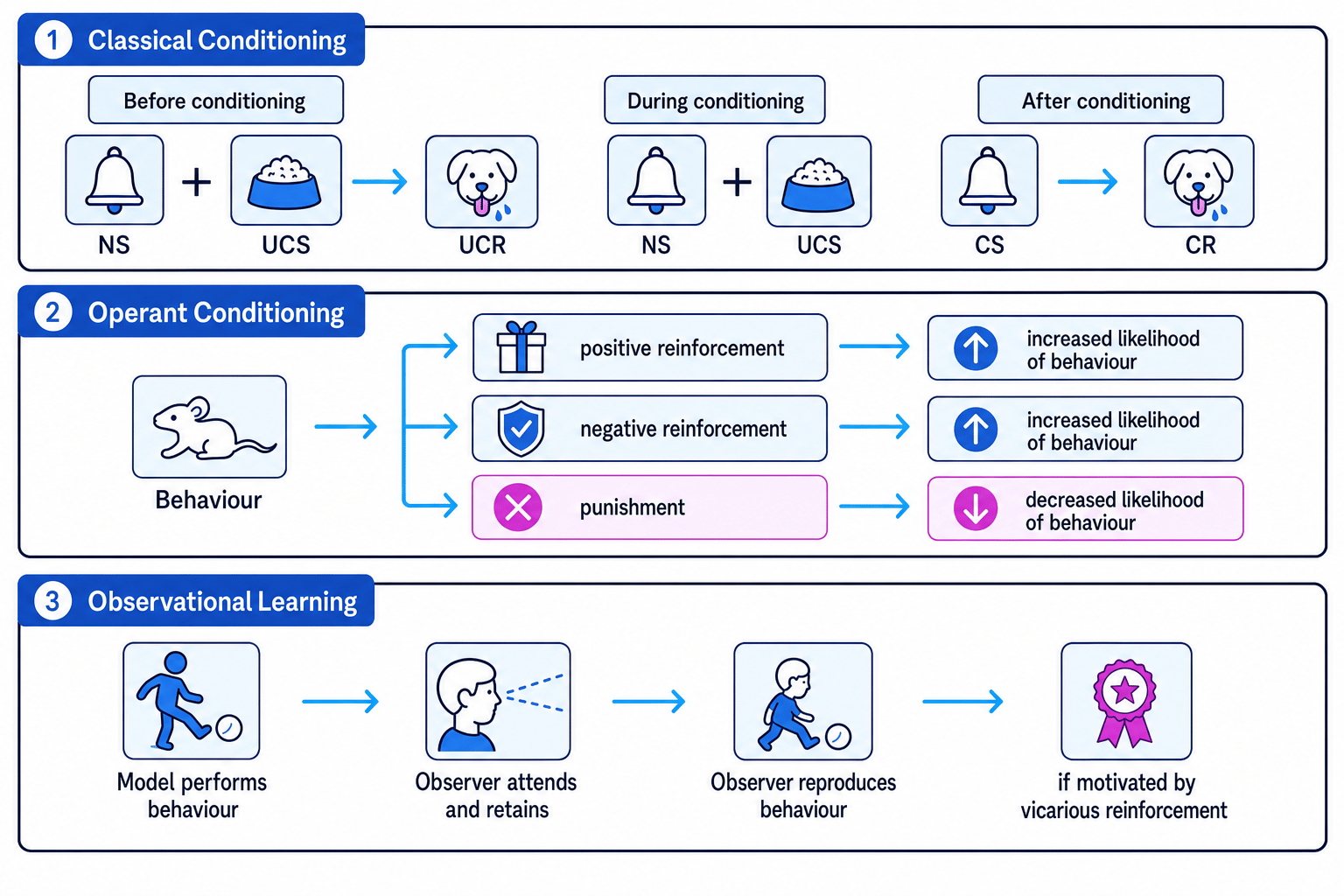
Classical conditioning is learning through association. It happens when a person or animal learns that two things go together.
The classic example is Pavlov’s dogs. Pavlov found that dogs could learn to salivate to a bell if the bell was repeatedly paired with food.
Classical conditioning
Classical conditioning is learning by association, where a neutral stimulus becomes linked with an automatic response after being paired with a stimulus that naturally produces that response.
Key terms:
- The unconditioned stimulus, or UCS, naturally produces a response.
- The unconditioned response, or UCR, is the natural response to the UCS.
- The neutral stimulus, or NS, does not originally produce the response.
- The conditioned stimulus, or CS, is the formerly neutral stimulus after learning.
- The conditioned response, or CR, is the learned response to the CS.
Watson and Rayner (1920): Little Albert
Watson and Rayner used classical conditioning to condition fear in an infant known as Little Albert. Albert was initially not afraid of a white rat. The rat was paired with a loud noise, which naturally caused fear. After pairings, Albert showed fear when presented with the rat alone.
This illustrates behaviourism because it suggests an emotional response, such as fear, can be learned from the environment.
Explaining a learned fear
A child is frightened by a loud bang while reaching for a balloon. Later, they cry whenever they see balloons.
- The loud bang is the UCS because it naturally produces a fear or startle response without learning.
- The child’s fear at the bang is the UCR, while the balloon starts as the NS because it did not originally cause fear.
- After the balloon and bang are paired, the balloon becomes the CS because it now triggers fear on its own.
- Crying at the balloon alone is the CR because it is the learned fear response.
- If the child also fears round party decorations, this shows stimulus generalisation, because similar stimuli trigger the learned response.
Mixing up the conditioning terms
Do not say the UCS “becomes” the CS. The neutral stimulus becomes the conditioned stimulus after association. The UCS still naturally produces the response.
Operant conditioning: learning by consequences
Operant conditioning is learning through the consequences of behaviour. If a behaviour is followed by a pleasant consequence, it is more likely to be repeated. If it is followed by an unpleasant consequence, it is less likely to be repeated.
Operant conditioning
Operant conditioning is learning where behaviour is strengthened or weakened by its consequences, such as reinforcement or punishment.
This is strongly associated with Skinner (1938), who used the Skinner box to study animals such as rats and pigeons. For example, a rat might learn to press a lever if lever pressing is followed by food.
Reinforcement and punishment
Reinforcement
Reinforcement is any consequence that increases the likelihood of a behaviour being repeated.
There are two main types:
- Positive reinforcement: something pleasant is added after a behaviour, so the behaviour increases.
- Negative reinforcement: something unpleasant is removed after a behaviour, so the behaviour increases.
Punishment
Punishment is any consequence that decreases the likelihood of a behaviour being repeated.
Classifying consequences
A student completes homework more often after different classroom consequences.
- If the teacher gives praise after homework is completed, this is positive reinforcement because a pleasant consequence is added and homework behaviour increases.
- If completing homework means the student avoids a lunchtime catch-up session, this is negative reinforcement because an unpleasant consequence is removed and homework behaviour increases.
- If the student loses phone privileges after not completing homework, this is punishment because the consequence is intended to reduce non-completion.
- The key decision is whether the behaviour increases or decreases: reinforcement increases behaviour, while punishment decreases behaviour.
Negative reinforcement is not punishment
“Negative” means something is removed, not that the consequence is bad. Negative reinforcement strengthens behaviour because it removes something unpleasant.
Observational learning: learning by watching others
Behaviourism traditionally focused on direct learning: your own associations and consequences. However, social learning theory extends this by arguing that people can also learn by watching others.
Observational learning
Observational learning is learning by watching a model’s behaviour and the consequences of that behaviour.
A model is someone whose behaviour is observed and potentially copied. Vicarious reinforcement occurs when you see someone else being rewarded, making you more likely to copy them.
Bandura argued that observational learning involves mental processes:
- Attention: noticing the model’s behaviour.
- Retention: remembering the behaviour.
- Reproduction: being able to copy the behaviour.
- Motivation: having a reason to copy it, such as reward.
Bandura, Ross and Ross (1961): Bobo doll study
Bandura et al. exposed children to adult models who behaved aggressively or non-aggressively towards a Bobo doll. Children who saw an aggressive model later showed more aggressive behaviour, including imitation of the model’s specific actions.
This supports behaviourist ideas because behaviour was learned from the environment. However, it is not “pure” behaviourism, because Bandura also emphasised internal mental processes such as attention and motivation.
Applying observational learning
A teenager starts copying dangerous pranks after watching an online influencer receive lots of likes and praise.
- The influencer acts as a model because their behaviour is visible and potentially imitated.
- The teenager is more likely to learn the behaviour if they attend to the video and retain the steps of the prank.
- The likes and praise act as vicarious reinforcement, because the model appears rewarded.
- Copying is more likely if the teenager can reproduce the behaviour and is motivated by social approval.
AO2 application shortcut
In a scenario, ask: is the behaviour caused by an association, a consequence, or a model? That usually tells you whether to apply classical conditioning, operant conditioning or observational learning.
Applications of the behaviourist perspective
Behaviourism is useful because it has led to practical ways of changing behaviour.
Treating phobias
A phobia can be explained as a learned fear through classical conditioning. Behaviourist treatments aim to create new learning.
For example, systematic desensitisation gradually pairs the feared object with relaxation, so the person learns a calmer response. This is based on counterconditioning, where a new response replaces the old conditioned fear response.
Token economies
A token economy uses operant conditioning. Desired behaviours are rewarded with tokens, which can later be exchanged for privileges or rewards. This has been used in schools, prisons and psychiatric settings.
Education and parenting
Teachers and parents often use behaviourist principles, such as praise, rewards, shaping and clear consequences.
Shaping means reinforcing small steps towards a desired behaviour. For example, a teacher may praise a student first for attempting an answer, then later for giving a more detailed answer.
Strengths of the behaviourist perspective
It is scientific
Behaviourism uses observable, measurable behaviour. Many behaviourist studies use controlled laboratory methods, which can increase reliability because procedures can be repeated.
It has useful applications
Behaviourist principles have real-world uses in therapy, education, parenting, animal training and behaviour management. This gives the perspective high usefulness.
It is supported by research
Studies such as Watson and Rayner (1920), Skinner (1938) and Bandura et al. (1961) show that behaviour can be shaped by learning.
Weaknesses of the behaviourist perspective
It can be reductionist
Reductionism
Reductionism means explaining complex behaviour using a narrow or simplified explanation.
Behaviourism can reduce human behaviour to stimulus-response learning, ignoring thoughts, emotions, biology and individual meaning.
It may underestimate free will
Behaviourism is deterministic because it suggests behaviour is controlled by environmental forces. Critics argue that humans can reflect, choose and resist environmental influences.
Animal research may not generalise
Much behaviourist research used animals. This allows control, but humans have language, self-awareness and complex social reasoning, so findings may not always apply directly.
Ethical concerns
Watson and Rayner’s Little Albert study would be highly unethical by modern British Psychological Society standards. Albert was caused distress, could not give informed consent, and was not properly deconditioned.
Bandura et al. (1961) also raises ethical questions because children were exposed to aggressive models and may have been encouraged to behave aggressively. Modern researchers must consider protection from harm, informed consent, right to withdraw and debriefing.
Generic evaluation
Avoid writing “it is unethical” without saying why. Link ethics to specific issues such as distress, consent, right to withdraw, deception, debriefing or possible long-term effects.
Comparison with the psychodynamic perspective
OCR expects you to know how the behaviourist perspective is similar to and different from the psychodynamic perspective.
Psychodynamic perspective
The psychodynamic perspective explains behaviour through unconscious conflicts, childhood experiences, instincts and defence mechanisms.
Similarities
Both perspectives can be seen as deterministic. Behaviourism says behaviour is determined by learning history; psychodynamic psychology says behaviour is shaped by unconscious forces and early childhood experiences.
Both also have applications to therapy. Behaviourism led to treatments such as systematic desensitisation, while the psychodynamic perspective led to therapies aiming to uncover unconscious conflicts.
Differences
The behaviourist perspective focuses on observable behaviour and often uses controlled experiments. The psychodynamic perspective focuses on unconscious mental processes, which are harder to measure scientifically.
Behaviourism is mainly linked to nurture, because it emphasises learning from the environment. The psychodynamic perspective includes early experience too, but also emphasises internal drives and unconscious conflict.
Behaviourist therapies often aim to change symptoms directly. Psychodynamic therapies aim to understand the underlying unconscious causes of symptoms.
Comparison sentence for essays
Behaviourism explains behaviour through external learning, whereas the psychodynamic perspective explains behaviour through internal unconscious conflict.
How to structure an essay answer
For OCR essay-style answers, keep AO1, AO2 and AO3 separate in your mind:
- AO1: accurately describe principles and concepts, such as conditioning, reinforcement and observable behaviour.
- AO2: apply the correct behaviourist concept to a new scenario.
- AO3: evaluate using evidence, ethics, usefulness, reductionism, determinism, validity, reliability and comparison with psychodynamic psychology.
In the exam
- Start with a clear definition of the behaviourist perspective: learned behaviour, environment and observable responses.
- Use named research accurately, especially Watson and Rayner (1920), Skinner (1938) and Bandura et al. (1961), but explain how each supports behaviourist ideas.
- For evaluation, avoid generic points: link strengths and weaknesses to science, usefulness, ethics, determinism, reductionism and comparison with the psychodynamic perspective.
Check yourself
- Can you explain the difference between classical conditioning and operant conditioning?
- Why is negative reinforcement not the same as punishment?
- In what ways is Bandura et al. (1961) behaviourist, and in what ways does it go beyond strict behaviourism?

