What you'll learn
- What psychologists mean by nature, nurture, and interactionist explanations.
- How to use OCR core studies such as Bandura et al. 1961, Sperry 1968, and Maguire et al. 2000 in debate essays.
- How to evaluate nature/nurture explanations using AO3 ideas like reductionism, determinism, ethics, validity, and social sensitivity.
- How this debate overlaps with — but is not the same as — other debates in psychology.
The big question
The nature/nurture debate asks: how far is behaviour caused by biological factors, and how far is it caused by experience?
This is one of the most important debates in A-Level Psychology because almost every topic can be viewed through it: aggression, memory, obedience, development, mental health, intelligence, brain function, and more.
The nature/nurture debate
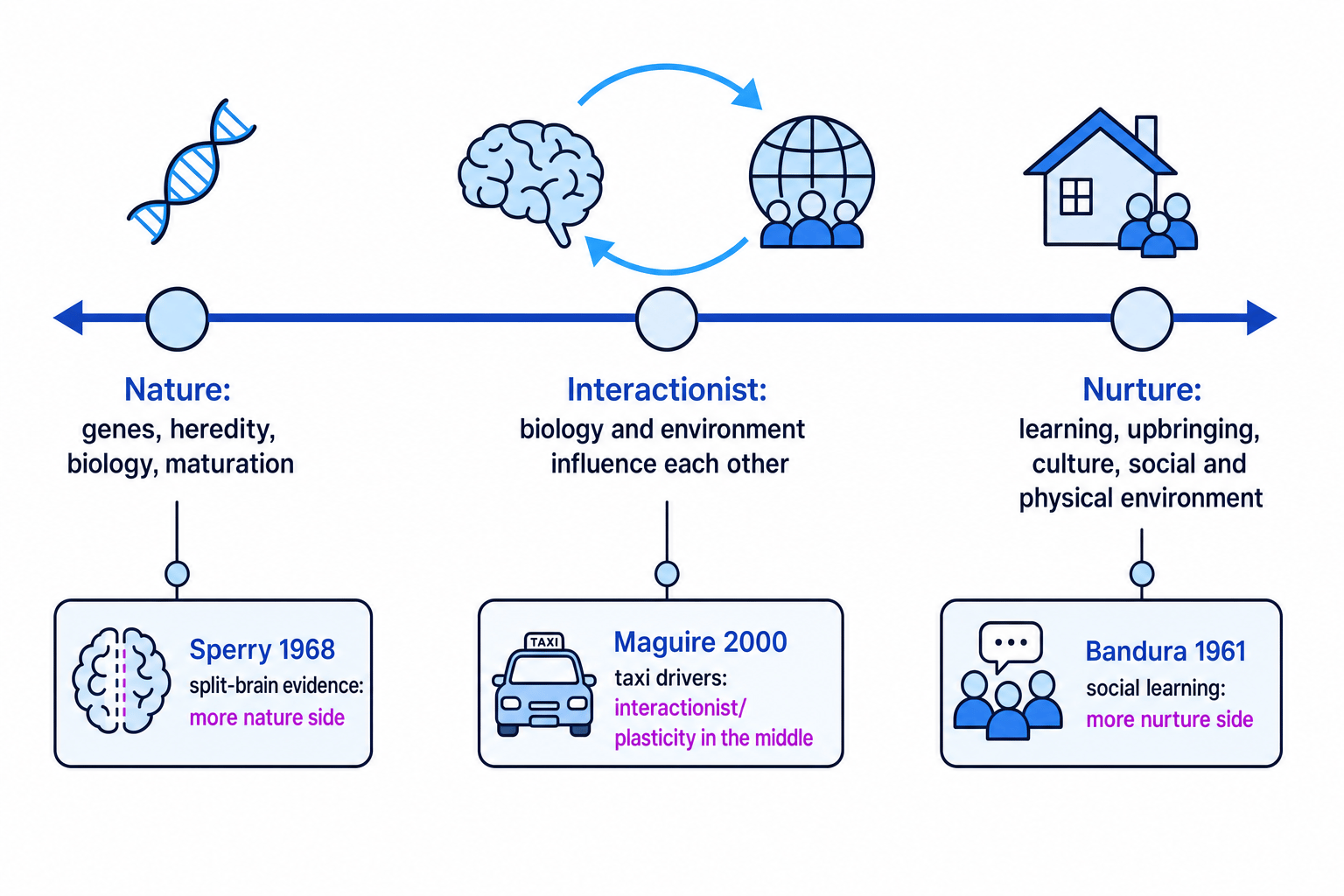
The nature/nurture debate concerns the relative influence of nature — biological and inherited factors — and nurture — environmental and experiential factors — on behaviour, cognition, and emotion.
Nature: biological explanations
Nature explanations argue that behaviour is influenced by biological factors. These may include:
- Genes: units of hereditary information passed from parents to offspring.
- Heredity: the transmission of characteristics from one generation to the next.
- Brain structures: areas of the brain linked to particular functions.
- Neurochemistry: chemicals in the nervous system, such as neurotransmitters and hormones.
- Maturation: biologically programmed development over time, such as puberty or brain development.
Nature explanations do not always mean a behaviour is “present at birth”. A biological factor may unfold later through maturation.
Genotype and phenotype
A genotype is a person’s genetic makeup. A phenotype is the observable characteristic or behaviour that results from the interaction between genetic makeup and the environment.
Research example: Sperry 1968
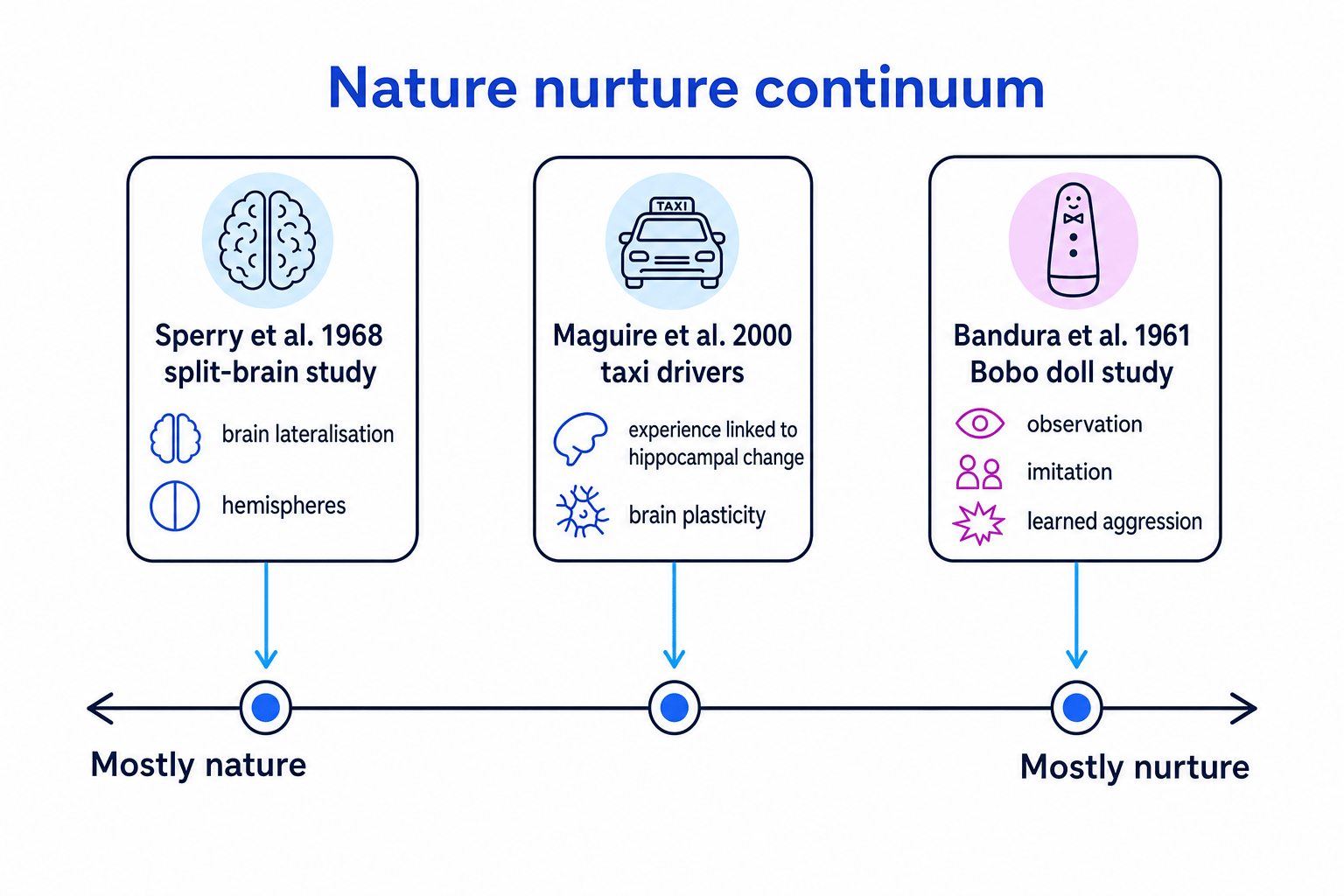
Sperry 1968 studied patients who had undergone split-brain surgery, where the corpus callosum — the bundle of nerve fibres connecting the two hemispheres — had been severed to reduce severe epilepsy.
Sperry presented information to one visual field at a time. Because each visual field is processed by the opposite hemisphere, this allowed him to investigate what each hemisphere could do separately. For example, when an image was shown to the left visual field, it was processed by the right hemisphere, and patients could often select the object with the left hand but not name it verbally.
This supports a nature-based explanation because it shows that brain organisation affects cognition and behaviour. Language ability was mainly linked to the left hemisphere, while some spatial and visual tasks were better processed by the right hemisphere.
However, it is not a pure “gene” study. The patients had epilepsy and surgery, so their behaviour was also shaped by medical history and experience.
Nature does not always mean genetics
Nature includes genes, but it also includes wider biological factors such as brain structures, hormones, neurochemistry, and maturation.
Nurture: environmental explanations
Nurture explanations argue that behaviour is shaped by experience. This can include:
- Family upbringing.
- Peer influence.
- Education.
- Culture.
- Reinforcement and punishment.
- Observation and imitation.
- Trauma, stress, or life events.
In psychology, nurture is often linked to learning theory: the idea that behaviour changes because of experience.
Research example: Bandura et al. 1961
Bandura, Ross and Ross 1961 investigated whether children would imitate aggressive behaviour shown by an adult model. Children saw either an aggressive model, a non-aggressive model, or no model. They were then placed in a room with toys, including a Bobo doll.
Children who saw the aggressive model were more likely to imitate physical and verbal aggression. This supports a nurture explanation because aggression was learned through observation and imitation, rather than being treated as purely innate.
This study is useful for the debate because it suggests children can acquire behaviour from social models, especially when the model is similar or powerful.
Ethically, there are concerns because children were exposed to aggressive behaviour and may have experienced distress or learned aggression. Under the BPS Code of Human Research Ethics, psychologists should consider responsibility, protection from harm, valid consent, and debriefing.
Saying Bandura proves aggression is learned
Bandura et al. 1961 supports a nurture explanation, but it does not prove all aggression is learned. Biological factors such as temperament, hormones, or brain development may also influence aggression.
Interactionism: nature and nurture together
Most modern psychologists reject a simple “either nature or nurture” answer. Instead, they take an interactionist position.
Interactionist approach
An interactionist approach argues that behaviour develops through an interaction between biological factors and environmental experiences.
This means biology may create a predisposition, but the environment can affect whether and how that predisposition is expressed.
For example, a person may have a genetic vulnerability to anxiety, but whether they develop an anxiety disorder may depend on experiences such as stress, parenting, peer relationships, or trauma.
Epigenetics
Epigenetics refers to changes in gene expression caused by environmental influences. The genes themselves do not change, but the environment can affect whether certain genes are switched on or off.
This is important because it breaks down the simple division between nature and nurture. The environment can influence biology.
Research example: Maguire et al. 2000
Maguire et al. 2000 studied London taxi drivers using MRI scans. They found that taxi drivers had larger posterior hippocampi than a control group, and that time spent as a taxi driver was positively associated with hippocampal volume.
The hippocampus is a brain structure involved in spatial memory and navigation. This study suggests that experience — learning and navigating London’s complex road system — may be associated with brain plasticity.
So Maguire is especially useful for an interactionist essay: the study is biological because it measures the brain, but it also supports nurture because experience appears linked to brain change.
Placing evidence on the nature/nurture continuum
-
Identify what is being explained. In Maguire et al. 2000, the behaviour is spatial navigation and the biological outcome is hippocampal structure.
-
Decide whether the evidence emphasises biology, experience, or both. The MRI scans show a biological difference, but taxi-driving experience is linked to that difference.
-
Reach a balanced judgement. Maguire is best placed near the middle of the continuum because it suggests experience can shape the brain, rather than showing behaviour is caused only by genes or only by learning.
Evidence from twin and adoption studies
Although not always core studies, twin and adoption studies are often used to explain this debate.
Monozygotic twins are identical twins who share 100% of their genes. Dizygotic twins are non-identical twins who share about 50% of their genes, like ordinary siblings.
A concordance rate is the extent to which two people share a characteristic. If identical twins have a much higher concordance rate than non-identical twins for a behaviour, this suggests a genetic influence.
Interpreting concordance rates
-
Compare the genetic similarity. Monozygotic twins share more genes than dizygotic twins, so a higher concordance rate in monozygotic twins would suggest a nature influence.
-
Compare the rates. If monozygotic twins show 65% concordance and dizygotic twins show 30%, then 65%>30%65\% > 30\%65%>30%, which supports some genetic contribution.
-
Check whether the rate is 100%. If monozygotic concordance is not 100%, then genes cannot be the whole explanation. Environmental factors must also play a role.
Best essay phrase
A strong conclusion is often: “This suggests a genetic influence, but not genetic determinism.”
Different positions within the debate
1. Strong nature position
A strong nature position argues that behaviour is mainly caused by biological factors. For example, brain lateralisation in Sperry 1968 suggests cognition depends on the organisation of the nervous system.
Strength: It can be scientific and objective, using brain scans, genetic analysis, or controlled laboratory methods.
Weakness: It can be reductionist because it may simplify complex behaviour into genes or brain structures.
2. Strong nurture position
A strong nurture position argues that behaviour is mainly caused by environmental experience. Bandura et al. 1961 supports this by showing imitation of aggressive models.
Strength: It is useful because it suggests behaviour can be changed through education, parenting, therapy, or social policy.
Weakness: It can underestimate biological influences and may still be deterministic if it implies people are controlled by their environment.
3. Interactionist position
An interactionist position argues that biology and environment influence each other. Maguire et al. 2000 is a strong example because it links navigational experience with brain structure.
Strength: It is more realistic and holistic.
Weakness: It can be harder to test because interactions between genes, brain, family, culture, and experience are complex.
Applications of the debate
Nature/nurture is not just theoretical. It affects real decisions.
Education
If learning and environment matter, then schools can use modelling, reinforcement, feedback, and supportive relationships to shape behaviour. Bandura’s social learning theory can be applied to anti-bullying programmes by encouraging positive role models.
Mental health
A nature explanation may support biological treatments such as medication or neurological assessment. A nurture explanation may support psychological therapies, family support, or changes to stressful environments.
An interactionist approach is often strongest. For example, a person may have a biological vulnerability to depression, but social support and coping strategies may reduce risk.
Social policy
If behaviour is shaped by poverty, education, culture, or discrimination, then social interventions may be justified. However, if research is interpreted carelessly, nature explanations can become socially sensitive by encouraging labelling or discrimination.
Social sensitivity
Nature/nurture research can affect how groups are treated. Claims about intelligence, aggression, mental illness, or criminality must be handled carefully because they may influence stigma, policy, and individual rights.
Similarities with other debates
Nature/nurture and freewill/determinism
The debates overlap because both nature and nurture explanations can be deterministic.
A nature explanation might argue that behaviour is determined by genes or brain structure. A nurture explanation might argue that behaviour is determined by upbringing or reinforcement.
However, they are not the same debate. Nature/nurture asks where behaviour comes from. Freewill/determinism asks whether people have choice.
Nature/nurture and reductionism/holism
Nature explanations are often reductionist because they may reduce behaviour to genes, hormones, or brain areas. Nurture explanations can also be reductionist if they reduce behaviour to reinforcement or imitation.
Interactionist explanations are usually more holistic because they consider multiple levels of explanation together.
Nature/nurture and individual/situational explanations
Nature explanations often focus on individual biological differences. Nurture explanations often focus on situational influences such as family, culture, or social models.
But they are not identical. A situational factor may be biological, such as the effect of sleep deprivation on behaviour, and an individual factor may be learned, such as a personal fear.
Evaluating nature/nurture in essays
For AO3, avoid saying “nature is better” or “nurture is better” in a vague way. Instead, evaluate the quality and implications of the explanation.
Good AO3 points include:
- Validity: Does the evidence really measure the behaviour it claims to explain?
- Reliability: Could the findings be replicated consistently?
- Ethics: Were participants protected from harm, deception, and loss of dignity?
- Reductionism: Does the explanation oversimplify complex behaviour?
- Determinism: Does it ignore choice and personal agency?
- Usefulness: Can it lead to helpful interventions or treatments?
- Social sensitivity: Could the findings be misused to stereotype or discriminate?
- Ethnocentrism: Are findings based on one culture but applied too widely?
Writing a one-sided debate essay
A top answer usually does not argue that behaviour is purely nature or purely nurture. It weighs evidence and often reaches an interactionist conclusion.
In the exam
-
Define the debate clearly first. State that nature refers to biological and inherited influences, while nurture refers to environmental and experiential influences.
-
Use named studies precisely. For example, Bandura et al. 1961 supports nurture, Sperry 1968 supports biological influence, and Maguire et al. 2000 supports interactionism.
-
Evaluate the implications. Link your AO3 to issues such as reductionism, determinism, ethics, usefulness, social sensitivity, validity, and how far the evidence really separates nature from nurture.
Check yourself
- Why is Maguire et al. 2000 often better described as interactionist than purely biological?
- How could Bandura et al. 1961 be used to support a nurture explanation of aggression?
- What is the difference between the nature/nurture debate and the freewill/determinism debate?