What you'll learn
- How the adolescent brain develops, especially the balance between reward and control systems.
- Why brain development can help explain risk-taking behaviour in young people.
- The key ideas, method, findings and evaluation of Barkley-Levenson and Galván (2014).
- How knowledge of brain development can be applied to reduce risky behaviour.
The big idea: why adolescence matters
In Child Psychology, pre-adult brain development looks at how the brain changes before adulthood and how those changes affect behaviour. The key behaviour here is risk taking: choices where a person may gain something rewarding, but could also experience harm or loss.
Adolescence is not just “being immature”. It is a developmental period where different brain systems change at different speeds. This matters because the systems involved in reward, emotion and self-control do not all mature together.
Risk taking
Risk taking means choosing an action where the outcome is uncertain and there is a possibility of negative consequences, such as injury, punishment, embarrassment or loss.
Examples include dangerous driving, unsafe sex, experimenting with drugs, binge drinking, antisocial behaviour or taking dares in front of peers.
Brain areas you need to know
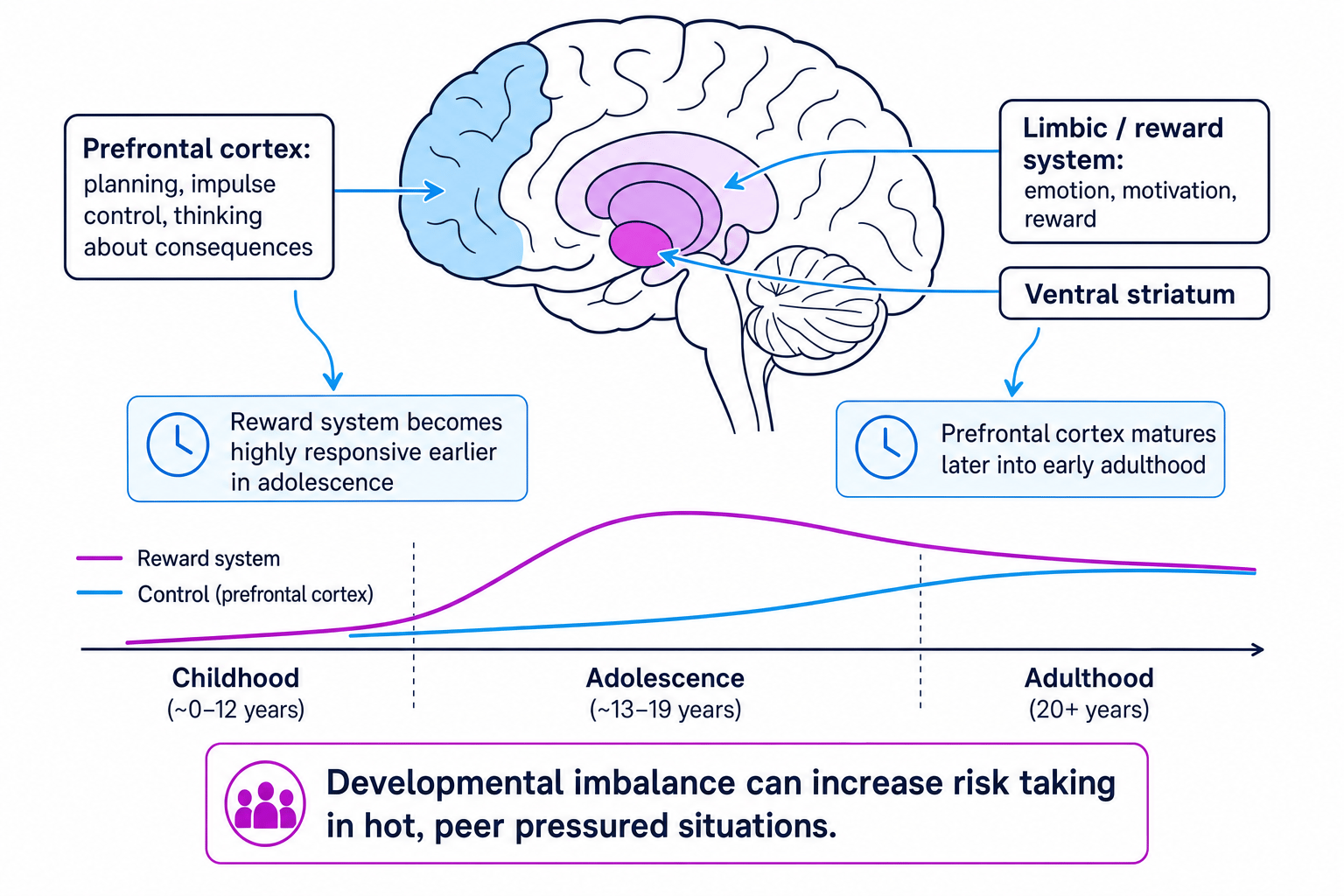
The prefrontal cortex
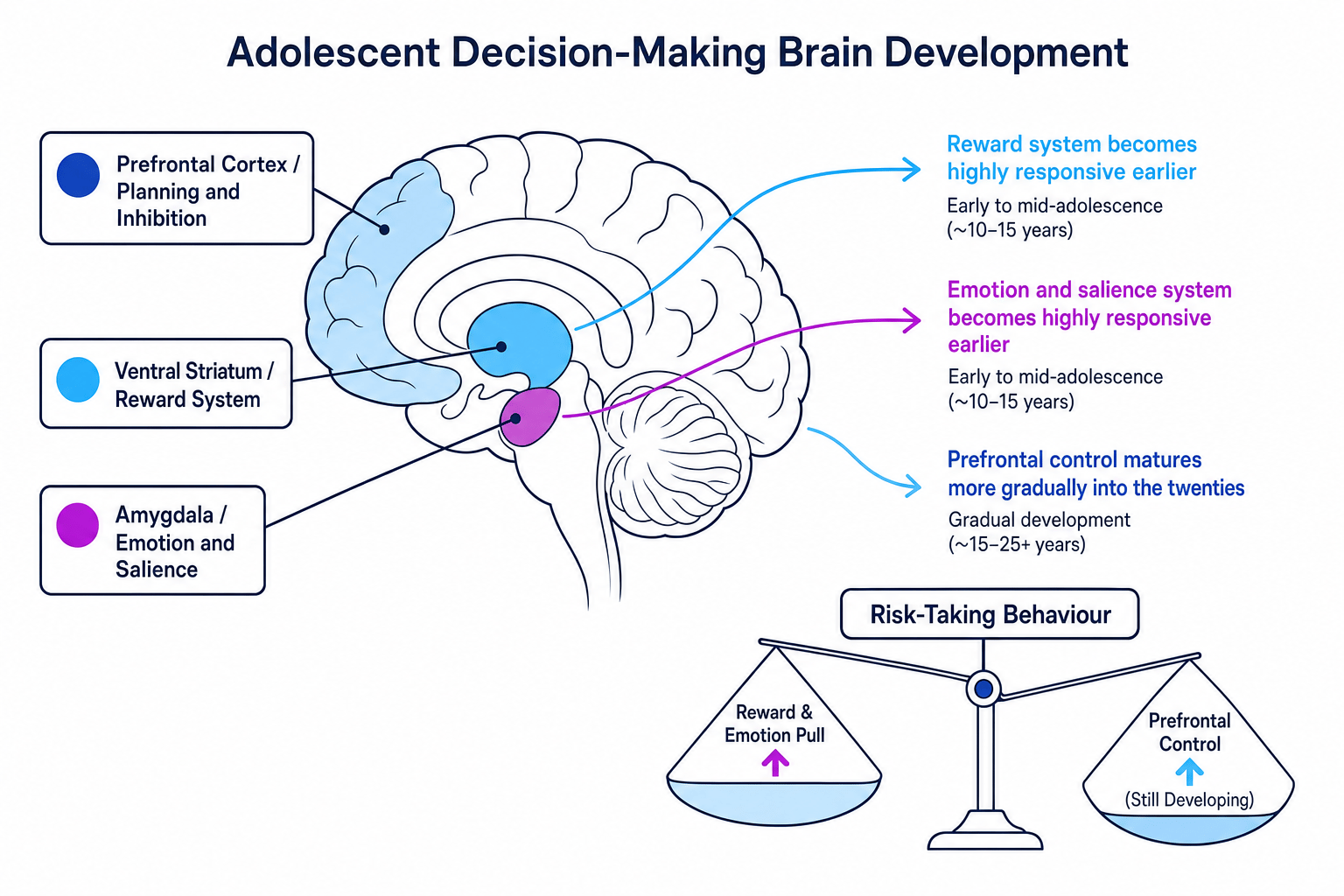
The prefrontal cortex is the front part of the brain involved in planning, decision-making, impulse control and thinking about consequences. It develops gradually and continues maturing into early adulthood.
The limbic system
The limbic system is a group of brain areas involved in emotion, motivation and reward. Two important parts are:
- The ventral striatum, which is strongly involved in reward anticipation and motivation.
- The amygdala, which is involved in emotion, threat detection and emotional salience.
The developmental imbalance
During adolescence, reward and emotion systems can become highly responsive before the prefrontal cortex has fully matured. This can make exciting or rewarding options feel especially powerful, while long-term consequences are less effectively controlled.
This is often called a dual systems explanation: one system pushes towards reward, while another system supports control and inhibition.
Applying the developmental imbalance
A 16-year-old is with friends who encourage them to cycle through a red light for a laugh.
- The possible reward is immediate: social approval, excitement and avoiding embarrassment in front of peers.
- The limbic/reward system may respond strongly because the situation is emotionally and socially charged.
- The prefrontal cortex may not yet be mature enough to consistently inhibit the impulse, especially under peer pressure.
- A biological explanation would predict greater risk taking in this “hot” social situation than in a calm situation where the teenager has time to think.
Expected value: making risk measurable
Barkley-Levenson and Galván’s study focuses on expected value. This is a way of estimating whether a risky choice is “worth it” by combining the size of the possible reward with the probability of getting it.
Expected value
Expected value is the average value of an option if it were repeated many times. In simple reward tasks, it can be calculated as:
EV=p×vEV = p \times vEV=p×vwhere ppp is the probability of winning and vvv is the value of the reward.
A gamble with a high reward is not automatically a good choice. If the chance of winning is very low, its expected value may still be poor.
Calculating expected value
A participant can choose between a guaranteed 4 points or a gamble with a 25% chance of winning 20 points.
- Convert the probability into a decimal: 25% becomes p=0.25p = 0.25p=0.25.
- Substitute into the formula: EV=0.25×20EV = 0.25 \times 20EV=0.25×20.
- Calculate the expected value: EV=5EV = 5EV=5 points.
- Compare the options: the gamble has an expected value of 5 points, which is higher than the guaranteed 4 points, so it is the better option mathematically.
Reward size is not the same as expected value
Do not say “the biggest reward is always the best choice”. Expected value depends on both reward size and probability.
Background: brain development and risk taking
The biological background to this topic is that adolescent risk taking may be linked to uneven brain development.
The prefrontal cortex supports controlled decision-making, such as delaying gratification, resisting peer pressure and considering future consequences. However, this region develops relatively slowly.
By contrast, reward-related areas such as the ventral striatum become very responsive during adolescence. This can make rewards feel especially attractive, particularly immediate rewards such as fun, social approval or excitement.
This helps explain why teenagers may understand the risks in theory but still take risks in real life. The issue is not necessarily ignorance. It may be that emotional and reward-based pressures are especially strong in the moment.
AO1 phrasing
A strong description says: adolescent risk taking may result from a mismatch between early-developing reward systems and later-developing cognitive control systems.
Key research: Barkley-Levenson and Galván (2014)
Aim
Barkley-Levenson and Galván (2014) investigated how adolescents represent the expected value of risky choices in the brain. They wanted to understand whether adolescent risk taking is linked to differences in neural activity during decision-making.
Method
This was a laboratory study using functional magnetic resonance imaging, usually shortened to fMRI.
fMRI
fMRI is a brain scanning technique that measures changes in blood oxygenation. It is used as an indirect measure of brain activity because active brain areas need more oxygenated blood.
Participants completed a decision-making task while inside the scanner. They made choices involving possible rewards, where the probability and value of the reward varied. This allowed the researchers to examine how participants responded to choices with different expected values.
The researchers compared adolescents with older participants, looking at both:
- Behavioural responses, such as whether participants accepted or rejected risky options.
- Neural responses, such as activity in reward-related and control-related brain regions.
Results
The study found that adolescents were sensitive to expected value, meaning they were not simply choosing randomly or failing to understand the task.
However, adolescents showed differences in how expected value was represented in the brain. Reward-related regions, especially areas such as the ventral striatum, were important in adolescent decision-making.
The findings support the idea that adolescent risk taking is linked to heightened reward processing and developing control systems. Adolescents may be especially drawn to rewarding options, particularly when rewards are immediate or emotionally engaging.
Conclusions
Barkley-Levenson and Galván concluded that adolescent risky decision-making has a biological basis. Differences in brain development affect how young people evaluate rewards and risks.
This does not mean adolescents are incapable of rational decision-making. Instead, it suggests that their brains may process reward and value differently from adults, especially in situations involving immediate incentives.
What the study adds
Barkley-Levenson and Galván show that adolescent risk taking can be studied scientifically by linking choices in a reward task to neural activity in the developing brain.
AO3 evaluation of Barkley-Levenson and Galván
Strength: scientific and objective
A major strength is the use of fMRI. Brain activity provides biological evidence rather than relying only on self-report. This supports psychology as a science because the study used controlled procedures and measurable data.
However, fMRI does not directly measure thoughts. It measures blood oxygenation, so researchers must infer what brain activity means.
Strength: useful applications
The research is useful because it helps explain why risk-taking interventions should not just give teenagers information. If adolescent risk taking is partly driven by reward sensitivity, then strategies should reduce immediate temptations or increase support for self-control.
For example, road safety campaigns may be more effective if they reduce peer pressure and immediate rewards, rather than only warning teenagers that dangerous driving is risky.
Weakness: ecological validity
The task took place in an fMRI scanner, which is very different from real-world risk taking. Real adolescent risks often involve friends, emotion, alcohol, status, embarrassment or time pressure.
This means the study may have limited ecological validity, which is the extent to which findings reflect real-life behaviour.
Ecological validity
Ecological validity is the extent to which a study’s setting, task and findings apply to everyday life.
Weakness: reductionism
The explanation is biologically reductionist because it focuses on brain regions and neural activity. This is useful for identifying mechanisms, but it may underplay social and cognitive factors.
For example, peer pressure, parenting style, school environment, culture and individual personality can all influence risk taking.
Ethics
Because brain research can involve young participants, ethical safeguards are very important. Researchers should follow the BPS Code of Human Research Ethics, including informed consent, protection from harm, right to withdraw, confidentiality and additional care when working with under-16s.
In this kind of study, participants would need to be screened for MRI safety and warned that scanning can be noisy or uncomfortable. For younger participants, parental consent and the young person’s own assent would be needed.
Application: reducing risk-taking behaviour
If adolescent risk taking is partly caused by a reward-control imbalance, then interventions should help the developing prefrontal cortex “win” against immediate reward pressure.
Strategy 1: reduce hot decision-making
A hot decision is made in an emotional, exciting or socially pressured situation. A cool decision is made calmly, with time to think.
One strategy is to design environments so adolescents make important choices in cool states rather than hot states.
Examples include:
- Graduated driving licences that limit night driving or peer passengers for new young drivers.
- Pre-commitment plans, such as agreeing transport home before going to a party.
- Phone apps or banking controls that delay impulsive spending or risky online behaviour.
- School-based role play that practises refusal skills before the real situation occurs.
Choosing an intervention for risky driving
A local council wants to reduce dangerous driving among 17-year-old new drivers.
- Identify the risky trigger: young drivers may take more risks when friends are passengers because peer approval is immediately rewarding.
- Link this to brain development: the reward system may be highly responsive, while prefrontal control is still developing.
- Choose a strategy: restrict peer passengers for the first few months after passing the test, or encourage parent-teen driving agreements.
- Explain why it should work: reducing peer audience effects lowers immediate social reward, making careful driving easier.
Strategy 2: increase cognitive control
Another strategy is to strengthen decision-making skills. This might involve teaching adolescents to pause, compare outcomes and plan responses before risky situations occur.
This fits the biological explanation because it supports prefrontal cortex functions such as planning, inhibition and future thinking.
Application formula
For AO2 application, use this chain: scenario trigger → brain system involved → likely behaviour → intervention.
Linking to wider debates
Nature and nurture
The topic clearly supports nature because it focuses on brain maturation. However, it also allows for nurture, because social settings can increase or reduce risky behaviour. For example, peers may intensify reward, while supportive rules may reduce risk.
Free will and determinism
The explanation is partly biologically deterministic because brain development influences behaviour. But it is not fully deterministic: adolescents can still make choices, and interventions can change the environment.
Usefulness
This is a highly useful topic because it can inform education, parenting, public health and law. It suggests that effective policies should account for adolescent brain development rather than simply blaming young people for being reckless.
Do not overclaim
Avoid writing “teenagers cannot control themselves”. A better answer is: adolescents may be more vulnerable to immediate rewards, especially in emotional or peer-pressure situations, because control systems are still developing.
In the exam
- For AO1, describe the imbalance between reward systems and prefrontal control, then link it directly to risk taking.
- For Barkley-Levenson and Galván, include the aim, fMRI method, expected value task, key findings and conclusion.
- For AO3, evaluate both the biological strength and the limitations: scientific control, usefulness, ecological validity, reductionism and ethics.
Check yourself
- What is expected value, and why is it better than just looking at reward size?
- How does the dual systems explanation account for adolescent risk taking?
- How could knowledge of brain development be used to reduce one real-world risky behaviour?