What you'll learn
- What perceptual development means and why it matters in child psychology.
- How psychologists study perception in babies and animals when they cannot give verbal answers.
- The story of Gibson and Walk’s (1960) visual cliff study.
- How to apply the research to play strategies that support young children’s perception.
Background: what is perceptual development?
Before children can understand the world, they need to make sense of what they see, hear, touch, taste and smell. In the cognitive area of psychology, perception is treated as a mental process: the brain does not just “record” sensory information; it organises and interprets it.
Perception
Perception is the mental process of organising and interpreting sensory information so that we can understand the world around us.
A baby’s eyes may receive light from a toy, but perception is what allows the baby to experience it as a nearby object, a moving object, or a safe object to reach for.
Perceptual development
Perceptual development is the way children’s ability to interpret sensory information changes and improves with age, maturation and experience.
A central debate here is nature versus nurture. If a perceptual ability is present very early, it may be partly innate, meaning biologically built in. If it develops after experience, it may be more strongly influenced by learning.
Depth perception
One especially important perceptual ability is depth perception.
Depth perception
Depth perception is the ability to judge distance and see the world in three dimensions, including whether a surface is near, far, shallow or dangerously deep.
Depth perception matters because it helps children avoid hazards, crawl towards caregivers, reach accurately for toys and move safely around their environment.
Babies develop rapidly, but this is hard to study because they cannot explain what they see. Psychologists therefore infer perception from behaviour, such as where the baby looks, whether they crawl forward, or whether they show fear or avoidance.
Studying babies
Because babies cannot give reliable verbal reports, psychologists must use observable behaviour as evidence of what the baby may be perceiving.
How perception can be studied in babies and animals
Preferential looking
Preferential looking is a method where two stimuli are shown at the same time, and researchers measure which one the baby looks at for longer. If the baby consistently looks longer at one stimulus, this suggests they can discriminate between them.
For example, if a baby looks longer at a patterned image than a plain image, researchers may infer that the baby can perceive the pattern.
Habituation and dishabituation
Habituation happens when a baby’s response decreases after repeated exposure to the same stimulus. Dishabituation happens when the response increases again after a new stimulus is shown.
If a baby stops looking at one shape, then looks longer when a different shape appears, this suggests the baby noticed the difference.
Animal studies
Animals can also be useful in perceptual-development research. Some animals, such as chicks, goats and lambs, are mobile very soon after birth or hatching. If they avoid danger almost immediately, this may suggest that some perceptual abilities are innate.
Interpreting nature and nurture evidence
A researcher finds that newly hatched chicks avoid an apparent drop, while 8-month-old human infants also avoid it.
- First, compare the amount of prior experience. Newly hatched chicks have had very little opportunity to learn from moving around, so their avoidance gives stronger evidence for an innate ability.
- Next, consider the human infants. By 8 months, many babies have had visual experience and may have started crawling, so their avoidance could reflect learning as well as maturation.
- The best conclusion is therefore balanced: the animal evidence supports an innate element, but the human infant evidence does not fully rule out experience.
Key research: Gibson and Walk (1960) — The visual cliff
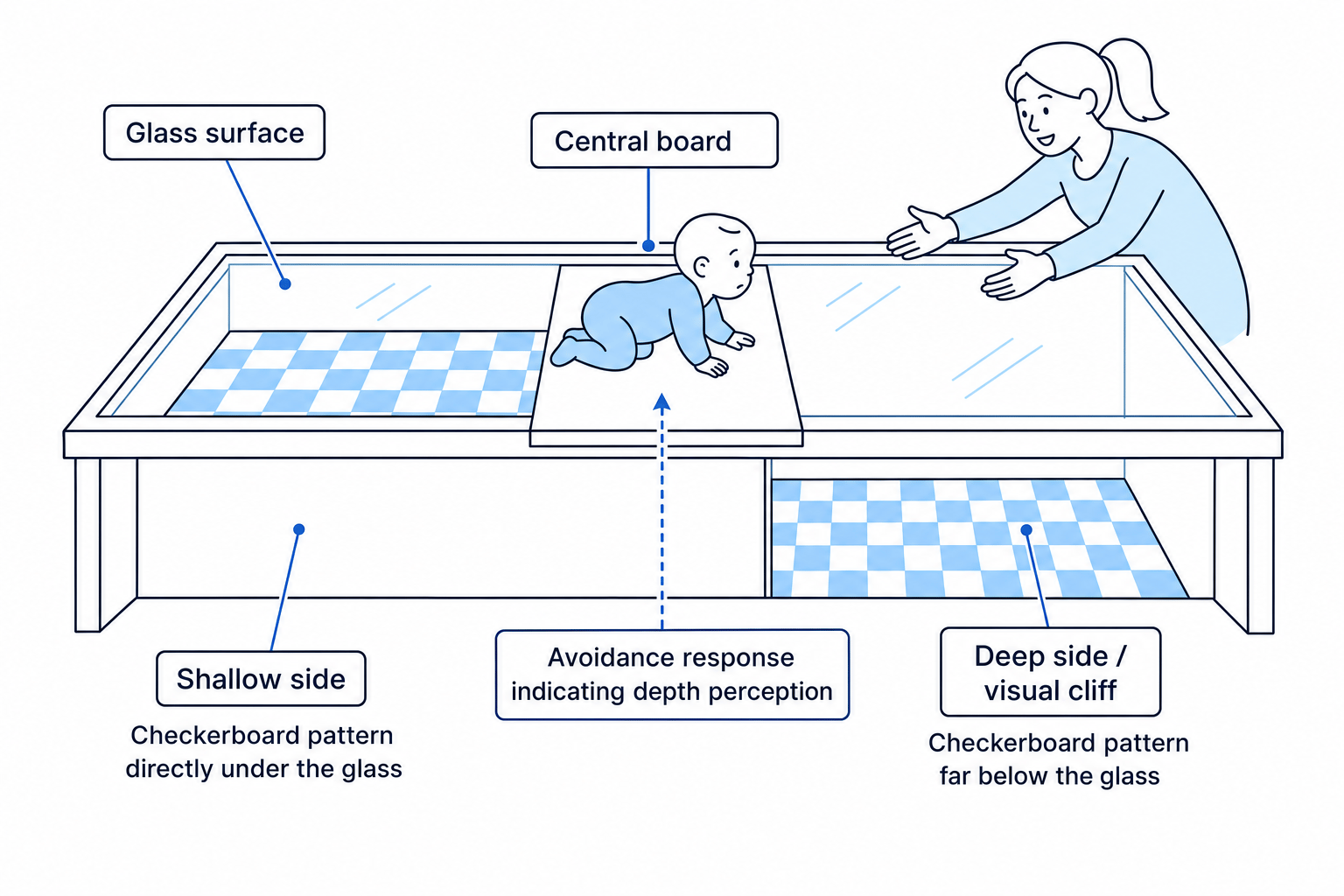
Gibson and Walk (1960) designed a famous study to investigate whether young children and animals can perceive depth. Their apparatus was called the visual cliff.
The visual cliff created the appearance of a drop without putting the infant in real danger. A sheet of glass covered the whole surface, so it was physically safe, but one side looked shallow and the other looked deep.
Aim
The aim was to investigate depth perception in infants and animals, and to explore whether depth perception may be innate or learned through experience.
Sample
The human sample included 36 infants aged between 6 and 14 months. Gibson and Walk also tested several animal species, including animals that are mobile very soon after birth or hatching.
Overclaiming the infant evidence
Do not write that Gibson and Walk proved human babies are born with depth perception. The infants were already several months old, so they had visual and possibly crawling experience.
Apparatus
The visual cliff had:
- a central board, where the infant was placed;
- a shallow side, where a chequered pattern was directly under the glass;
- a deep side, where the chequered pattern was much lower down, creating the appearance of a drop;
- a glass surface across both sides, so there was no actual danger of falling.
Procedure
Each infant was placed on the central board. Their mother encouraged them to crawl across the apparatus. The researchers observed whether the infant crossed onto the shallow side or the deep side.
The key behavioural measure was whether the infant avoided the apparent drop.
Results
Most infants were willing to crawl onto the shallow side. Far fewer were willing to crawl onto the deep side, even when encouraged by their mother. This suggests that many infants perceived the depth cue and avoided the apparent danger.
Animal findings also supported early depth perception in some species. Animals that need to move around soon after birth, such as chicks, lambs and goats, tended to avoid the deep side very early.
Conclusions
Gibson and Walk concluded that depth perception is present by the time human infants can crawl. The animal evidence suggests that depth perception may be partly innate, especially in species that need early mobility for survival.
Main conclusion
The visual cliff suggests that depth perception develops early, but in human infants it is difficult to separate innate perception from learning through movement and experience.
Evaluation of Gibson and Walk
Strength: controlled and scientific
The visual cliff was a controlled apparatus. The shallow and deep sides were similar except for the apparent depth cue. This improves internal validity, which means the study is more likely to be measuring the effect of the intended variable.
The study also produced observable behaviour, such as crawling or avoidance. This makes it more objective than simply asking adults to guess what a baby sees.
Strength: useful application
The findings are useful because they help adults understand that babies may be sensitive to depth cues. This can support safer home design, better supervision and age-appropriate play activities.
Weakness: sample and generalisability
The infant sample was small and limited. The babies were also aged 6 to 14 months, so the study cannot tell us exactly what newborn humans perceive.
Generalisability means how far findings from one sample can be applied to other people, settings or groups. In this case, we should be cautious about generalising to all babies or to newborns.
Weakness: crawling experience confound
A confounding variable is an uncontrolled factor that may affect the results. In this study, crawling experience is a possible confound. Babies who had already crawled around in the real world may have learned to avoid drops.
This matters because the study aimed to explore whether depth perception was innate, but prior experience may also explain the behaviour.
Ethical considerations
The infants were not actually at risk of falling because the glass surface supported them. However, the apparent drop could still cause distress. Under BPS ethical principles, researchers should protect participants from harm, gain parental consent and stop if the child becomes too distressed.
Animal research also raises welfare concerns. Researchers need to justify why animals are used, minimise distress and ensure that the potential scientific value is worth the cost to animal welfare.
AO3 sentence frame
A strong evaluation point often follows this pattern: “This is a strength/weakness because… This affects the study by… Therefore…”
Application: play strategies to develop perception
Perceptual development can be supported through safe, active play. The key is to give children opportunities to connect what they see with movement, touch and feedback from the environment.
Strategy 1: safe crawling obstacle play
For babies or toddlers, adults can create a safe obstacle course using cushions, mats, tunnels and low foam blocks. The child can crawl over, around and through objects while a caregiver stays close.
This supports:
- depth perception;
- distance judgement;
- hand-eye coordination;
- awareness of height and space;
- confidence in movement.
The activity should be safe, supervised and adjusted to the child’s stage of development. There should be no real drops or hazards.
Strategy 2: reaching and placing games
A caregiver can place colourful toys at different distances and encourage the child to reach, grasp, post or stack them. Shape sorters, stacking cups and building blocks are useful because the child must judge size, shape, distance and position.
Strategy 3: ball play
Rolling a ball back and forth helps children judge movement, speed, direction and distance. For older toddlers, gently throwing beanbags into a box can develop visual tracking and spatial judgement.
Choosing a perception-building play activity
A nursery wants a safe activity to support depth perception in 12-month-old children.
- Identify the target skill: depth perception involves judging distance and height, so an active movement task is more suitable than a purely verbal task.
- Match the activity to the child’s stage: a low cushion-and-mat obstacle course allows crawling and reaching without creating real danger.
- Explain why it helps: repeated movement gives the child visual, tactile and body-position feedback, helping them connect what they see with how far and safely they can move.
Linking to essay skills: AO1, AO2 and AO3
For AO1, describe the background, the visual cliff apparatus, the procedure, the results and the conclusions.
For AO2, apply the idea to a new situation. For example, if a toddler avoids crawling over a transparent bridge in a playroom, you could link this to depth perception and the visual cliff.
For AO3, evaluate the research. Useful points include control, ethics, ecological validity, sampling bias, the nature-nurture debate and the problem of testing babies who cannot speak.
In the exam
- Structure your answer as background → Gibson and Walk method/results/conclusion → application to play.
- Be precise: say depth perception, not just “seeing” or “eyesight”.
- For evaluation, avoid one-sided claims: explain both what the study shows and what it cannot prove.
- Always mention ethics when infants or animals are involved.
Check yourself
- Why does Gibson and Walk’s infant evidence not prove that depth perception is present from birth?
- How does the visual cliff measure perception without asking babies verbal questions?
- What play activity could help a toddler develop depth or distance judgement, and why?
