What you'll learn
- What psychologists mean by intelligence and IQ.
- How biological factors, especially genes, may influence intelligence.
- How Van Leeuwen et al. (2008) used a twin-family design to study general IQ.
- How intelligence can be assessed, and how to evaluate IQ testing carefully.
1. What do psychologists mean by intelligence?
Intelligence is not directly visible. Psychologists infer it from how people perform on tasks such as reasoning, memory, problem-solving, verbal understanding and learning.
Intelligence
Intelligence is a person’s ability to learn from experience, solve problems, reason effectively and adapt to new situations.
In biological explanations, the focus is often on general intelligence, sometimes called g. This is the idea that people who perform well on one type of cognitive task often tend to perform well on others too.
General intelligence
General intelligence, or g, is a broad mental ability thought to underlie performance across many different cognitive tasks.
An intelligence test usually produces an IQ score.
IQ
IQ stands for intelligence quotient. In modern testing, it is usually a standardised score showing how someone’s performance compares with others of the same age.
Most modern IQ tests are designed so that the average score is 100. Scores are interpreted relative to a comparison group, not as a direct “amount” of intelligence inside a person.
Treating IQ as the whole person
An IQ score is a test result, not a complete description of someone’s potential, creativity, motivation, personality or future success.
2. Biological factors that could affect intelligence
A biological explanation looks at physical factors inside the body and brain that may contribute to behaviour or mental processes.
For intelligence, important biological factors include:
- Genes: inherited sections of DNA that influence development.
- Brain development: including neural connections, brain efficiency and areas involved in memory, attention and reasoning.
- Prenatal influences: biological conditions before birth, such as maternal nutrition, illness or exposure to harmful substances.
- Early health and development: illness, injury, nutrition and sleep can all affect cognitive development.
Biology is influential, not destiny
Biological factors may shape intelligence, but they work together with environment. Genes can influence potential, while education, family life, nutrition and opportunity affect how that potential develops.
Genes and intelligence
Genes do not usually affect intelligence through one single “intelligence gene”. Intelligence is polygenic, meaning many genes each make a small contribution.
Polygenic
A polygenic trait is influenced by many genes, rather than by one single gene.
This matters because biological explanations of intelligence are probabilistic. They suggest increased likelihoods, not fixed outcomes.
3. Nature, nurture and heritability
The biological topic of intelligence links strongly to the nature–nurture debate.
- Nature refers to inherited, genetic and biological influences.
- Nurture refers to environmental influences, such as family, school, culture and life experiences.
One key concept is heritability.
Heritability
Heritability is the proportion of variation in a trait within a particular population that is associated with genetic differences. It does not tell you how much of one individual’s intelligence is “caused by genes”.
For example, if intelligence has high heritability in a sample, this means genetic differences help explain why people in that sample differ from each other. It does not mean intelligence cannot change, and it does not mean environment is unimportant.
Heritability does not mean fixed
A high heritability estimate does not mean intelligence cannot be improved. Heritability is about variation within a population, not a limit on an individual child.
4. Twin-family studies: the basic logic
A twin study compares similarities between different types of twins.
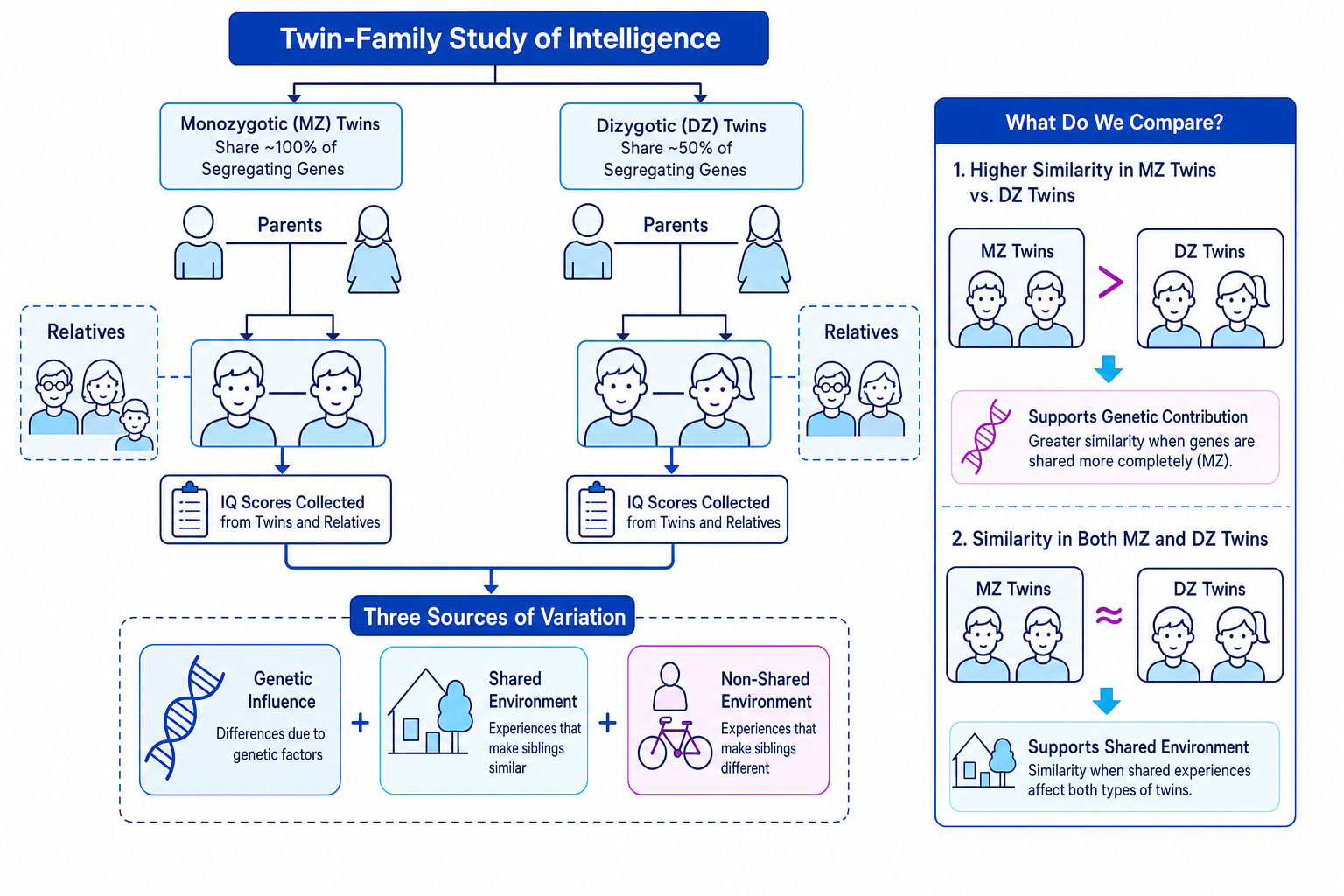
- Monozygotic twins, or MZ twins, develop from one fertilised egg and share about 100 percent of their genes.
- Dizygotic twins, or DZ twins, develop from two fertilised eggs and share about 50 percent of their segregating genes, like ordinary siblings.
Twin-family design
A twin-family design studies twins and other relatives, such as parents and siblings, to separate genetic influence from environmental influence more carefully.
If MZ twins are more similar in IQ than DZ twins, this supports a genetic contribution, because MZ twins share more genes. If both types of twins are very similar, this may suggest a strong shared environment, such as the same home or school.
Interpreting twin correlations
Suppose a simplified twin study finds that MZ twins have an IQ correlation of 0.82 and DZ twins have an IQ correlation of 0.50.
- Compare the twin correlations: because rMZ>rDZr_\text{MZ} > r_\text{DZ}rMZ>rDZ, MZ twins are more similar in IQ than DZ twins, which supports a genetic contribution.
- Estimate heritability using a simplified formula: h2≈2(rMZ−rDZ)=2(0.82−0.50)=0.64h^2 \approx 2(r_\text{MZ} - r_\text{DZ}) = 2(0.82 - 0.50) = 0.64h2≈2(rMZ−rDZ)=2(0.82−0.50)=0.64.
- Interpret the result carefully: this suggests about 64 percent of the variation in IQ in this sample may be associated with genetic differences, but it does not prove that any one child’s IQ is 64 percent genetic.
5. Key research: Van Leeuwen et al. (2008)
Aim
Van Leeuwen et al. (2008) aimed to investigate the extent to which genetic and environmental factors contribute to individual differences in general IQ.
This fits the biological approach because the study focused on inherited influences on cognitive ability.
Method
Van Leeuwen et al. used a twin-family study. This means they gathered IQ data from twins and their family members, including parents and siblings.
The sample was a large Dutch twin-family sample. Including relatives beyond the twins helped the researchers estimate different sources of similarity:
- Genetic influence: similarities due to inherited genes.
- Shared environment: experiences that make family members similar, such as household, neighbourhood and schooling.
- Non-shared environment: experiences that make family members different, such as different peer groups, illnesses, teacher relationships or individual experiences.
Shared and non-shared environment
A shared environment makes family members more alike. A non-shared environment makes family members different, even when they grow up in the same family.
Participants completed standardised intelligence measures. The researchers compared IQ similarities between MZ twins, DZ twins, siblings and parents. They then used statistical modelling to estimate how much variation in general IQ was linked to genes and environment.
Results
The main pattern was that MZ twins were more similar in general IQ than DZ twins and siblings. This supports the idea that genetic factors contribute to intelligence.
Van Leeuwen et al. reported a substantial genetic influence on general IQ, often summarised as around two-thirds of the variation in IQ being linked to genetic differences in this sample. Environmental factors still mattered, especially non-shared environmental factors and measurement error.
Conclusions
The study concluded that general IQ has a strong biological component, because closer genetic relatedness was associated with greater similarity in IQ.
However, the findings do not show that intelligence is completely genetic. Environmental factors still help explain differences between children, and the study is correlational rather than experimental.
Main conclusion of Van Leeuwen et al.
Van Leeuwen et al. (2008) supports the view that intelligence is substantially heritable, but it also shows why nature and nurture should be considered together.
6. Evaluation of Van Leeuwen et al. (2008)
Strengths
A major strength is the twin-family design. Studying MZ twins, DZ twins, siblings and parents gives a more detailed picture than studying twins alone. It helps researchers separate genetic influence from shared and non-shared environment.
Another strength is the use of standardised IQ tests. Standardisation improves reliability because participants are assessed in a consistent way.
The study also has useful real-world implications. It helps psychologists understand why children differ in cognitive ability and why support may need to be individualised.
Weaknesses
A key weakness is that twin studies rely on assumptions. One assumption is that MZ and DZ twins experience equally similar environments. If MZ twins are treated more similarly than DZ twins, then higher MZ similarity may partly reflect environment, not just genes.
Assuming twin studies prove causation
Twin studies show patterns of association. They support genetic influence, but they do not experimentally manipulate genes, so they cannot prove simple cause and effect.
Another issue is population validity. Van Leeuwen et al. used a Dutch sample, so findings may not generalise perfectly to children in other countries, cultures or education systems.
There is also a socially sensitive issue. Research on genetics and intelligence can be misused to justify inequality or stereotyping. Psychologists must communicate findings carefully: group differences, individual potential and social opportunities should not be reduced to biology alone.
Ethics
The study involved children and family data, so ethical care was important. Under the BPS Code of Human Research Ethics, researchers should protect:
- Informed consent from parents and appropriate assent from children.
- Confidentiality, especially because IQ data is personal and potentially sensitive.
- Protection from harm, including avoiding negative labelling.
- Right to withdraw, so families do not feel pressured to continue.
7. Application: assessing intelligence
One common method of assessing intelligence is a standardised IQ test, such as the Wechsler Intelligence Scale for Children, often shortened to WISC.
The WISC is used with children and measures a range of cognitive skills. Depending on the version, it can assess areas such as:
- verbal comprehension
- visual-spatial reasoning
- fluid reasoning
- working memory
- processing speed
Standardised test
A standardised test is administered and scored in the same way for everyone, using norms from a comparison group so that individual scores can be interpreted fairly.
A psychologist might use the WISC to understand a child’s learning profile. For example, a child may have strong verbal reasoning but weaker working memory. This can guide educational support.
Interpreting a deviation IQ score
A child receives a WISC full-scale IQ score of 115. The test has a mean of 100 and a standard deviation of 15.
- Calculate how far the score is above the mean: 115−100=15115 - 100 = 15115−100=15.
- Convert this into standard deviations: z=115−10015=1z = \frac{115 - 100}{15} = 1z=15115−100=1.
- Interpret the score: the child is one standard deviation above the average for their age group, suggesting above-average performance on this test, not guaranteed success in every real-life task.
Strengths of IQ testing
IQ tests can be useful because they are standardised, structured and often reliable. They can help identify children who may need additional support or extension work.
They can also be useful in research because they provide a measurable outcome, allowing psychologists to compare patterns across groups.
Weaknesses of IQ testing
IQ tests may be affected by culture, language, confidence, motivation and test anxiety. A child unfamiliar with the test style may underperform even if they have strong reasoning ability.
IQ tests also focus mainly on certain cognitive abilities. They may not capture creativity, emotional understanding, practical problem-solving or motivation.
AO2 application tip
If a scenario describes a child’s IQ score, apply it cautiously: say what the score suggests, then mention at least one factor that could affect validity, such as language, culture, anxiety or educational opportunity.
8. Debates and links
Nature versus nurture
Van Leeuwen et al. supports the nature side because MZ twins were more similar in IQ than DZ twins. However, nurture remains important because environment affects how genetic potential develops.
Reductionism versus holism
A purely biological explanation can be reductionist because it may reduce intelligence to genes and brain processes. A more holistic view includes education, family, culture, motivation and emotional wellbeing.
Usefulness
This research is useful because it helps explain individual differences and may support early intervention. However, it must not be used to label children as fixed or incapable of improvement.
In the exam
- For AO1, describe intelligence, IQ, heritability and the twin-family logic before naming Van Leeuwen et al. (2008).
- For AO2, apply the ideas to the source: ask whether the scenario is about genes, shared environment, non-shared environment or IQ assessment.
- For AO3, evaluate with twin-study assumptions, ethics, population validity, usefulness and the danger of genetic determinism.
Check yourself
- Why does greater MZ than DZ twin similarity support a genetic influence on intelligence?
- What is the difference between heritability and saying intelligence is “fixed”?
- Give one strength and one weakness of using a standardised IQ test with children.
