What you'll learn
- Why Piliavin et al. studied helping behaviour in a real subway emergency.
- The full “story” of the study: aim, method, sample, procedure, results and conclusions.
- How to evaluate the study for AO3 using validity, reliability, ethics and sampling.
- How to compare Piliavin et al. with the paired contemporary study, Levine et al. (2001).
The big question: why do people help?
Piliavin et al. (1969), often called the Subway Samaritan study, is a classic OCR core study in the Social area. The Social area looks at how behaviour is shaped by other people and the social situation.
This study sits in the key theme Responses to people in need, so the central question is: what makes a bystander help a stranger in an emergency?
Prosocial behaviour
Prosocial behaviour means voluntary behaviour intended to benefit another person, such as helping, comforting, sharing or rescuing.
Background: bystander apathy
Earlier research, especially after the murder of Kitty Genovese in New York, suggested that people may fail to help when others are present. This was known as bystander apathy.
Bystander effect and diffusion of responsibility
The bystander effect is the finding that people are less likely to help when other bystanders are present. Diffusion of responsibility means each person feels less personally responsible because responsibility seems shared across the group.
Piliavin et al. wanted to test this in a realistic setting. Unlike many laboratory studies, their “emergency” happened on a real subway train, where passengers could see the victim clearly and could not easily leave.
The arousal: cost-reward model
Piliavin et al. argued that emergencies create unpleasant emotional arousal. You might feel anxious, guilty, embarrassed or concerned. Helping is one way to reduce that arousal — but people also weigh up the costs and rewards of helping or not helping.
Arousal: cost-reward model
The arousal: cost-reward model explains helping as a decision process: an emergency causes emotional arousal, and the bystander chooses the response that reduces this arousal at the lowest perceived cost.
Costs of helping could include danger, effort, embarrassment or getting delayed. Costs of not helping could include guilt, public disapproval or seeing someone suffer.
Applying the arousal: cost-reward model
-
In a confined train carriage, a collapse is visible and hard to ignore, so passengers are likely to experience arousal such as anxiety or guilt.
-
A victim with a cane appears ill and deserving of help, so the cost of helping seems low and the cost of not helping seems high.
-
A victim who appears drunk may seem less deserving or more unpredictable, so the cost of direct help seems higher.
-
The model therefore predicts faster and more frequent help for the cane victim than the drunk victim.
Tell the story: AO1 description
AO1 means accurate description. For a core study, you need to be able to “tell the story” clearly.
Aim
Piliavin et al. aimed to investigate factors affecting helping behaviour in a real-life emergency. They looked at whether passengers would help a man who collapsed on a subway train, and whether helping was affected by the victim’s appearance, race, and the presence of a helping model.
Design
Field experiment
A field experiment is a study where researchers manipulate or compare variables in a real-world setting, rather than in a laboratory.
This was a field experiment using participant observation, meaning the observers were part of the setting and appeared to be ordinary passengers.
An independent variable is a factor the researchers manipulate or compare. A dependent variable is the measured outcome.
Key independent variables included:
- Victim condition: cane victim or drunk victim.
- Victim race: black or white victim.
- Model condition: whether a male confederate helped, and when/where he helped.
A confederate is someone working with the researchers while pretending to be an ordinary person in the situation.
Key dependent variables included:
- Latency to help: how long it took before someone helped.
- Number of helpers.
- Sex and race of helpers.
- Passenger comments.
Sample
The sample was an opportunity sample, meaning it consisted of people who happened to be available. In this case, the participants were around 4,450 passengers travelling on a New York subway line during the study period.
They did not know they were taking part, which is important for both validity and ethics.
Materials and setting
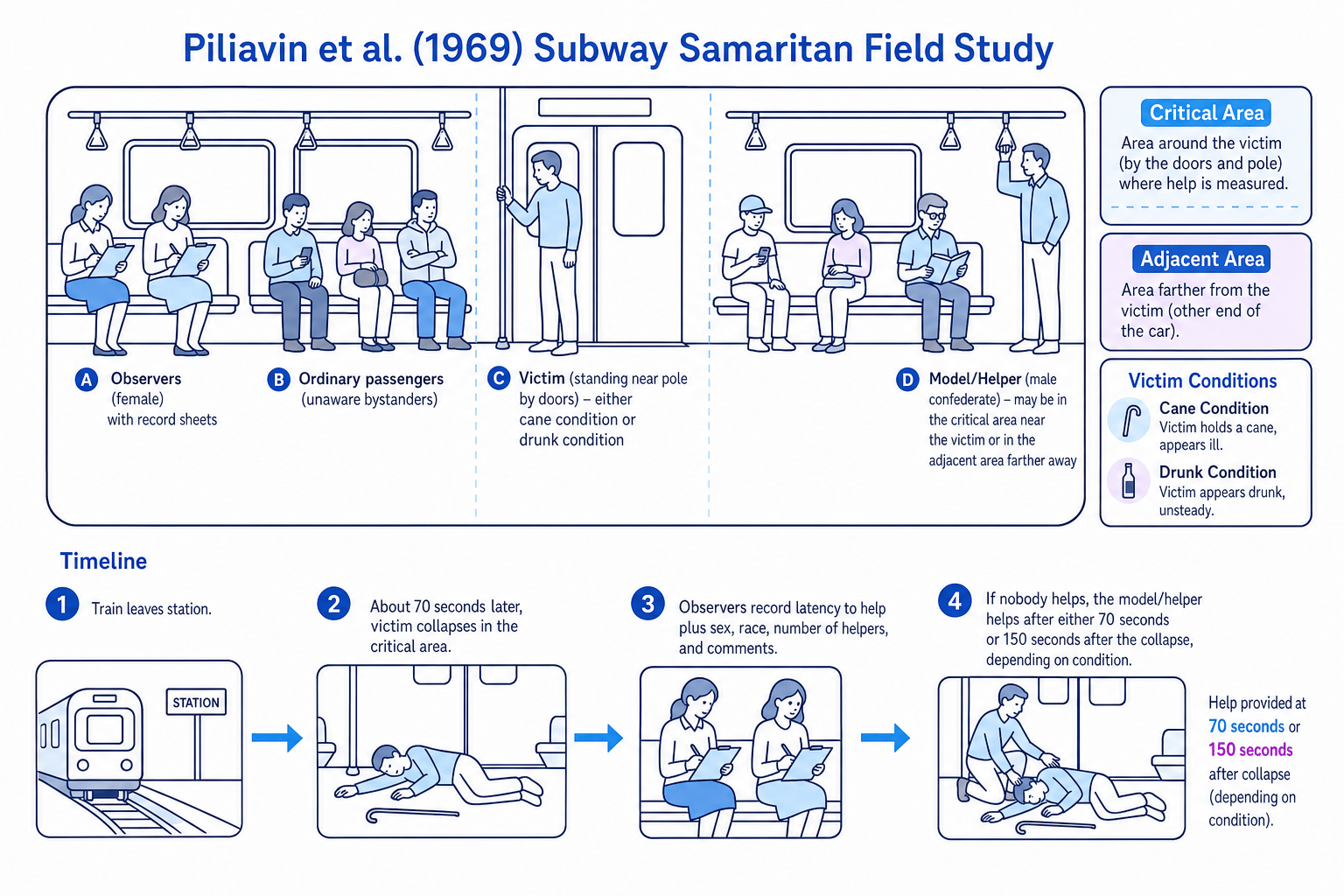
The study took place on a New York subway train. The “victim” was a male confederate aged in his twenties or thirties. In the cane condition, he carried a cane and appeared ill. In the drunk condition, he smelled of alcohol and carried a bottle in a paper bag.
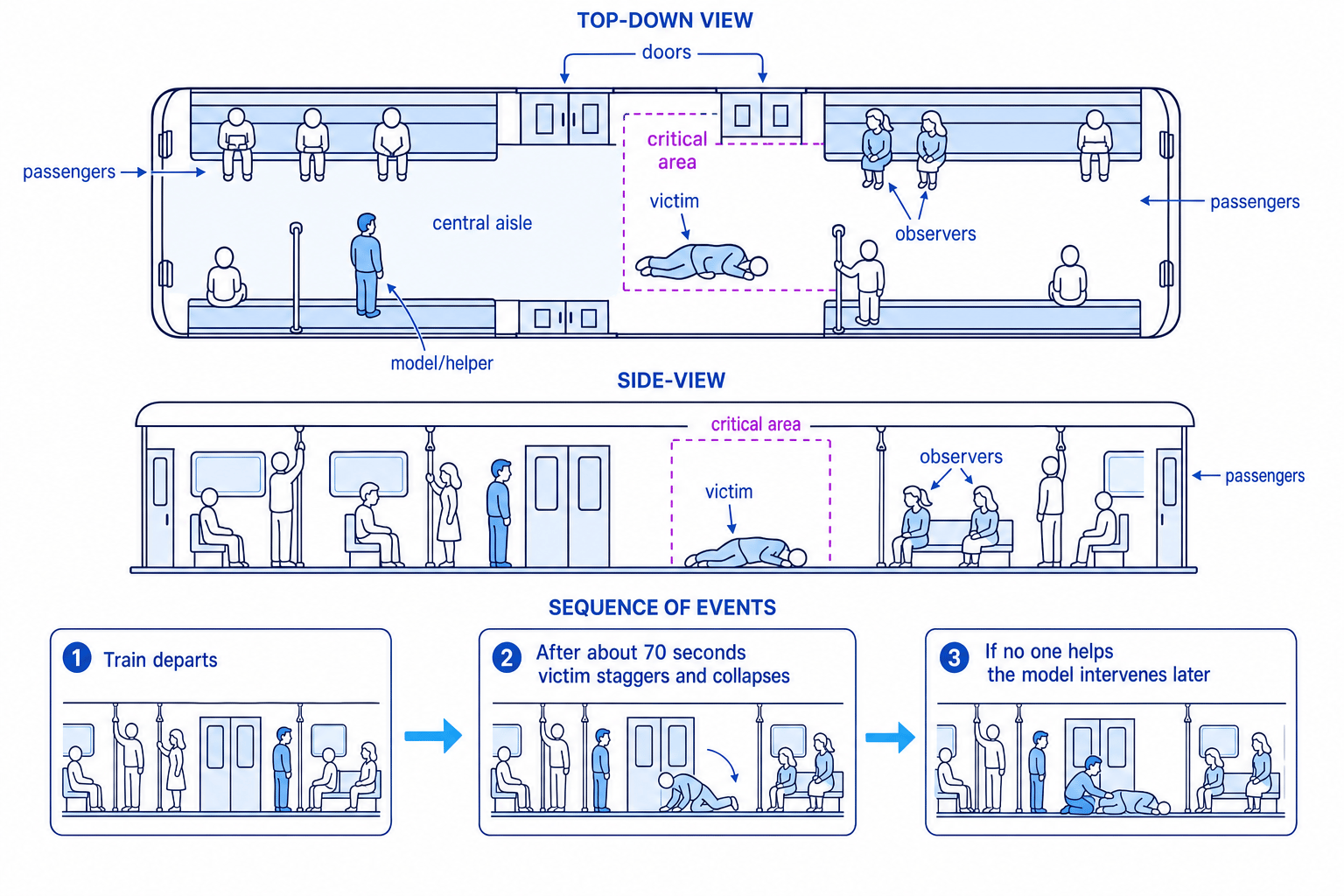
The basic set-up is easiest to picture as a real train carriage, with the victim collapsing near the doors, observers seated nearby, and ordinary passengers acting as unaware bystanders.
Procedure
Each trial followed a standard pattern:
-
A research team boarded the train. This included the victim, a male model/helper in some conditions, and two female observers.
-
About 70 seconds after the train left the station, the victim staggered forward and collapsed in the critical area, which was the area near the victim.
-
The victim remained on the floor until someone helped him.
-
If no passenger helped, the model/helper helped after a set delay, either 70 seconds or 150 seconds after the collapse, depending on the condition.
-
The observers recorded how quickly help was given, who helped, and any comments passengers made.
Do not call it a lab experiment
This was not a laboratory experiment. The key strength is that it took place in a real subway carriage with passengers who were unaware they were in a study.
Results
The most important result was that people often helped quickly, especially when the victim appeared ill rather than drunk.
- In the cane condition, help was given before the model intervened in 62 out of 65 trials.
- In the drunk condition, help was given before the model intervened in 19 out of 38 trials.
- First helpers were usually male.
- There was no simple evidence for diffusion of responsibility; having more bystanders did not automatically reduce helping.
- There was some tendency for same-race helping, especially when the victim appeared drunk, but victim condition was the stronger effect.
- Passenger comments were more common in the drunk condition, often justifying why people did not help.
Comparing helping rates
-
For the cane condition, calculate 62÷65×100≈95.4%62 \div 65 \times 100 \approx 95.4\%62÷65×100≈95.4%, so about 95% of cane trials led to spontaneous help.
-
For the drunk condition, calculate 19÷38×100=50%19 \div 38 \times 100 = 50\%19÷38×100=50%, so half of drunk trials led to spontaneous help.
-
Compare the two percentages: about 95% is nearly double 50%, showing that the victim’s apparent condition strongly affected helping.
Conclusions
Piliavin et al. concluded that bystander behaviour is not just about the number of people present. In this setting, passengers were often willing to help, especially when the victim seemed ill and deserving.
Main takeaway
Piliavin et al. challenged the simple idea of “bystander apathy”: in a face-to-face emergency where escape is difficult, people may help quickly, especially when the costs of helping seem low and the victim seems deserving.
The findings support the arousal: cost-reward model. The cane victim created high costs of not helping, such as guilt and public disapproval, while the drunk victim may have made helping seem more risky or less rewarding.
Evaluation: AO3
AO3 means evaluation: you judge the strengths and weaknesses of the study.
Strengths
A major strength is ecological validity, meaning the study reflects real-life behaviour. Passengers were on an actual subway train and did not know they were being studied, so their behaviour was likely to be natural.
The study also had good standardisation. The victim collapsed at roughly the same point in each journey, the observers recorded the same categories of behaviour, and there were 103 trials. This improves reliability, which means consistency of measurement.
Another strength is that the study collected both quantitative data, such as latency and number of helpers, and qualitative data, such as passenger comments. This gives a richer picture of helping behaviour.
Weaknesses
A key weakness is lack of control. Because the study took place in a real train, the researchers could not control who was present, their mood, whether they were in a hurry, or whether someone had medical training. This can reduce internal validity, meaning confidence that the IV caused the DV.
There is also sampling bias. The passengers were from one New York subway route, mostly during daytime weekday journeys in the late 1960s. This limits generalisability to other cultures, times, transport systems or types of emergency.
Ethics under the BPS Code
The study involved deception, no prior informed consent, limited right to withdraw and possible distress for passengers who witnessed a collapse. However, confidentiality was protected because names were not recorded, and the researchers could argue that natural helping behaviour could not be studied realistically if passengers were warned in advance.
A further issue is ethnocentrism. The study tells us a lot about helping in an urban American subway context, but it may not apply equally to rural communities or cultures with different norms about helping strangers.
Link to the key theme and Social area
This study is firmly in the Social area because it shows how behaviour is influenced by the social situation: the type of victim, the presence of other passengers, and whether a model helps.
It also links to the individual/situational debate. Some findings point to individual factors, such as the sex or race of helpers. However, the strongest explanation is situational: people responded differently depending on whether the victim appeared ill or drunk.
AO2 shortcut
When applying Piliavin to a new scenario, focus on four things: how visible the emergency is, whether escape is easy, whether the victim seems deserving, and whether the costs of helping seem high or low.
Comparison with Levine et al. (2001)
The paired contemporary study for this theme is Levine et al. (2001), which studied helping strangers across cities around the world using tasks such as helping someone with a dropped pen, helping someone with an injured leg, and helping a blind person cross the street.
| Comparison point | Piliavin et al. (1969) | Levine et al. (2001) |
|---|---|---|
| Theme | Responses to people in need | Responses to people in need |
| Area | Social area | Social area |
| Setting | New York subway | Cities around the world |
| Main focus | Situational factors in an emergency | Cultural and community differences in helping |
| Method | Field experiment with staged collapse | Field study using staged helping situations |
| Ethics | More deception and potential distress | Less distressing tasks, but still no prior consent |
| Generalisability | Limited to one subway context | Broader cross-cultural sample, but still mainly urban |
Both studies are useful because they measure real helping behaviour rather than asking people what they think they would do. However, Levine et al. is less ethnocentric because it compares different cultures, while Piliavin et al. gives more detailed control over one specific emergency situation.
In the exam
-
For AO1, tell the story in order: background, aim, method, sample, procedure, results, conclusions.
-
Use specific evidence, especially the cane versus drunk finding: 62/65 compared with 19/38.
-
For AO3, balance strengths and weaknesses: ecological validity and standardisation are strong, but ethics, sampling bias and lack of control are key issues.
-
In comparison questions, link Piliavin to Levine et al. by discussing field settings, real helping behaviour, culture, ethics and generalisability.
Check yourself
- Why did the cane victim receive more help than the drunk victim?
- How does Piliavin et al. challenge diffusion of responsibility?
- What is one ethical strength or weakness of studying helping behaviour in a real subway carriage?