What you'll learn
- What Levine et al. (2001) investigated about helping strangers across cultures.
- How the study was conducted using three naturalistic field situations.
- The main findings about culture, economic productivity, and “simpatia”.
- How to evaluate the study and compare it with Piliavin et al. (1969).
The big picture: responses to people in need
Levine et al. (2001) is the contemporary core study for the OCR H567 theme Responses to people in need, within the Social area of psychology.
This theme asks a deceptively simple question: why do people help some strangers but not others? Earlier research, such as Piliavin et al. (1969), focused on helping in an emergency. Levine et al. widened the question by asking whether people in different cultures vary in everyday helpfulness.
Altruism
Altruism means helping another person without expecting a direct personal reward. In psychology, researchers often study altruism through observable helping behaviour, because inner motives are difficult to measure directly.
Cross-cultural research
Cross-cultural research compares behaviour across different cultures, countries, or societies. Its aim is to see whether behaviour is universal or shaped by cultural norms, values and social conditions.
Core idea
Levine et al. found that helping strangers varied greatly across cities, suggesting that altruism is not just an individual trait — it is also influenced by cultural and social context.
Background to the study
Before Levine et al., many psychologists had studied bystander behaviour in Western settings, especially the USA. This created a problem: if most research uses one culture, we may wrongly assume the findings apply everywhere.
Levine et al. wanted to test whether helping strangers differs across cultures and whether these differences can be predicted by city-level factors.
The researchers considered several possible predictors:
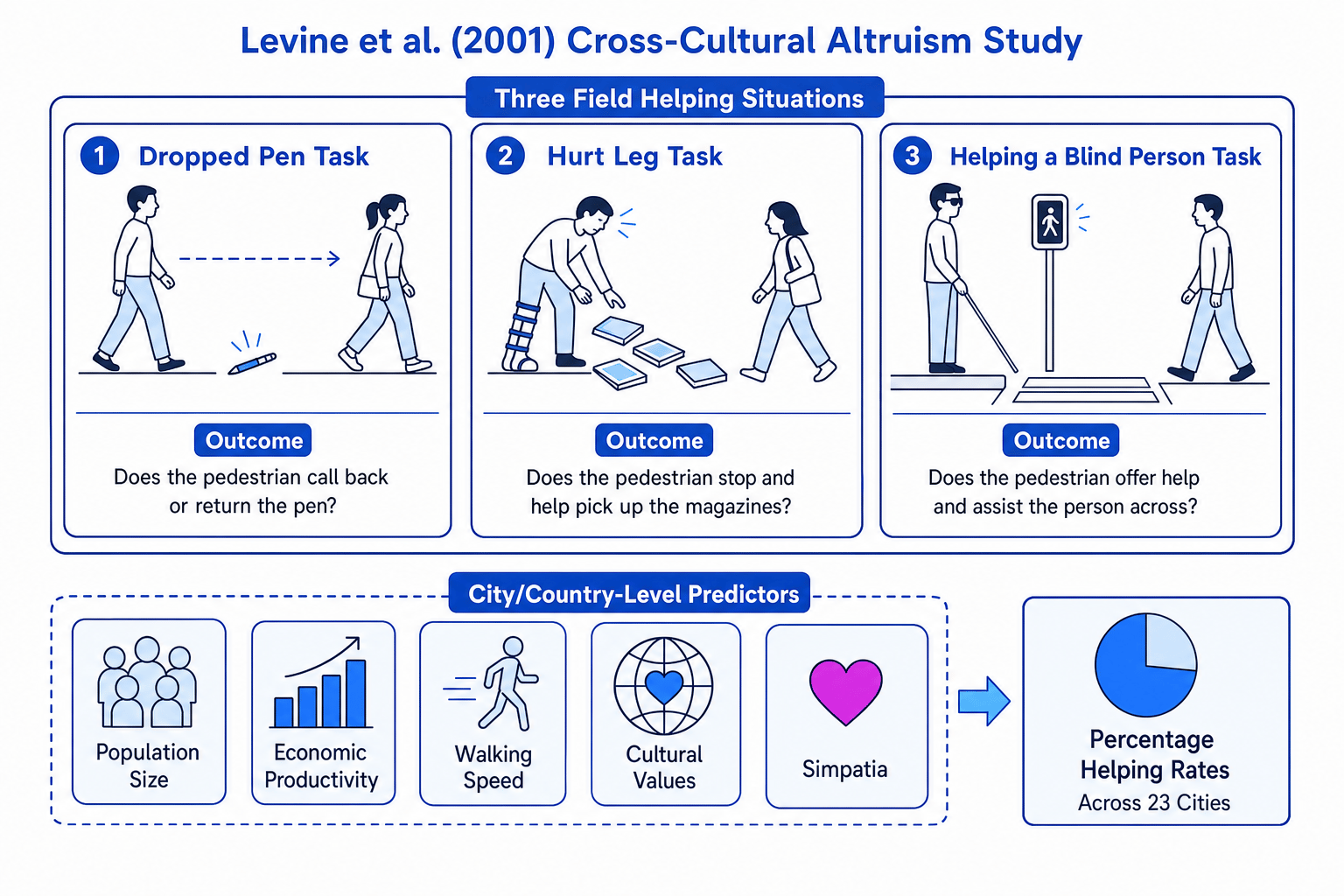
- Population size: whether people in larger cities are less helpful.
- Economic productivity: how wealthy or economically developed a country is.
- Pace of life: how quickly people move through everyday urban spaces.
- Cultural values: especially individualism versus collectivism.
- Simpatia: a cultural value emphasising warmth, friendliness and concern for others, often associated with some Latin American cultures.
Simpatia
Simpatia is a cultural script involving social warmth, friendliness, politeness and helpfulness in everyday interactions. Levine et al. investigated whether cultures high in simpatia would show more helping.
Aim of Levine et al. (2001)
The study aimed to investigate cross-cultural differences in helping strangers and to see whether those differences were related to features of the country or city.
More specifically, Levine et al. wanted to find out whether helping rates were linked to:
- city population size
- economic productivity
- walking speed as a measure of pace of life
- cultural values, especially simpatia
Method: how the study was designed
Levine et al. used a field experiment across 23 large cities around the world.
Field experiment
A field experiment is a study carried out in a natural real-world setting where researchers manipulate or standardise some conditions while observing behaviour. It usually has higher ecological validity than a laboratory experiment.
This was also a cross-cultural study, because the same helping situations were tested in different countries and cities.
The researchers used three helping tasks. These were designed to measure everyday, non-emergency helping towards strangers.
The three helping situations
1. Dropped pen task
An experimenter walked in front of a pedestrian and “accidentally” dropped a pen. The measure was whether the pedestrian helped by calling out, picking it up, or returning it.
2. Hurt leg task
An experimenter wore a visible leg brace and dropped magazines while appearing to struggle. The measure was whether the pedestrian helped pick up the magazines.
3. Helping a blind person task
An experimenter acted as a blind person, using dark glasses and a white cane, and waited near a crossing. The measure was whether a passer-by offered help crossing the street.
Operationalisation
Operationalisation means turning an abstract concept into something measurable. Levine et al. operationalised altruism as whether a passer-by helped in specific public situations.
Identifying the operationalisation of altruism
-
Start with the abstract concept: Levine et al. wanted to study altruism, which cannot be directly seen inside someone’s mind.
-
Match the concept to observable behaviour: in each task, a passer-by either helped or did not help.
-
State the operational measure: altruism was measured as the percentage of pedestrians who helped in tasks such as returning a pen, picking up magazines, or helping a blind person cross.
Sample
The participants were pedestrians in 23 cities across different countries. They did not volunteer; they were selected naturally as they passed through public spaces.
This means the study used an opportunity sample: the researchers used people who happened to be available in the right place at the right time.
Opportunity sample
An opportunity sample uses participants who are conveniently available. It is practical in field research, but it may not be fully representative of the wider population.
The participants were not aware they were in a psychological study. This helped produce natural behaviour, but it also raises ethical issues.
Procedure
The procedure was carefully standardised so that the helping situations were as similar as possible across cities.
Researchers carried out the tasks in public urban areas, usually during normal daytime activity. Pedestrians were tested individually so the researchers could judge whether that person helped.
The key dependent variable was the helping rate: the percentage of people in each city who helped.
Dependent variable
The dependent variable is the outcome measured by the researcher. In Levine et al., the main dependent variable was whether pedestrians helped, usually summarised as a percentage helping rate.
The study also compared helping rates with city or country-level variables, such as economic productivity and walking speed.
Correlation
A correlation is a relationship between two variables. It does not prove that one variable causes the other.
Correlation is not causation
Do not write that low economic productivity “caused” higher helping. Levine et al. found an association between variables, but other cultural or social factors may also explain the pattern.
Results
The study found clear differences in helping across cities.
The highest overall helping rates were found in some Latin American cities, especially those associated with simpatia. Rio de Janeiro in Brazil was reported as one of the most helpful cities.
The lowest helping rates were found in some other urban settings, with Kuala Lumpur in Malaysia often cited as among the least helpful in this study.
The most important pattern was that economic productivity was negatively related to helping. In simpler terms, people in less economically productive countries tended to show more helping towards strangers.
Population size and pace of life were less successful as predictors than the researchers expected. Individualism versus collectivism also did not explain the findings as clearly as simpatia.
Main finding
Helping varied widely across cultures, and the best-supported predictor was lower economic productivity, alongside cultural values such as simpatia.
Applying the findings to a new city
Imagine a new city is described as wealthy, highly economically productive, fast-moving, and low in everyday social warmth.
-
Compare the city to Levine et al.’s predictors: high economic productivity would point towards lower helping, based on the study’s negative relationship between wealth and helping.
-
Consider cultural norms: if the city is low in social warmth or simpatia-like values, this also supports a prediction of lower everyday helping.
-
Add a cautious conclusion: you could predict relatively low helping, but you should not claim certainty because Levine et al.’s findings are correlational and based on city-level patterns.
Conclusions
Levine et al. concluded that helping strangers is influenced by the wider social and cultural environment.
The study challenges the idea that altruism is simply a fixed personality trait. Instead, it suggests helping behaviour depends partly on cultural expectations, social norms, and perhaps the way people relate to strangers in public spaces.
The findings also suggest that Western psychological research cannot automatically be generalised to all cultures.
Evaluation: strengths
High ecological validity
The study took place in real streets and public spaces, not in a laboratory. Participants were unaware they were being observed, so their behaviour was likely to be natural.
Ecological validity
Ecological validity refers to how well a study reflects real-life behaviour and settings.
This is a major strength because helping strangers is something that naturally happens — or does not happen — in public environments.
Standardised procedures
The same three helping tasks were used across many cities. This improves reliability because the researchers attempted to measure helping in a consistent way.
Reliability
Reliability means consistency. A reliable study produces similar results when procedures are repeated in the same way.
Useful real-world insight
The study is useful because it shows that social behaviour varies across cultures. This can help psychologists, charities, urban planners and international organisations understand how local norms may affect public helping.
Evaluation: weaknesses
Sampling bias
The sample was limited to pedestrians in large cities. This means the results may not represent rural communities or smaller towns within the same country.
Sampling bias
Sampling bias occurs when the participants are not representative of the target population, limiting how far the findings can be generalised.
A “Brazilian” helping rate based on Rio de Janeiro, for example, cannot represent every person or region in Brazil.
Problems with cross-cultural equivalence
The same task may not have the same meaning in every culture. For example, approaching a stranger at a crossing may be seen as polite in one place but intrusive in another.
Ethnocentrism
Ethnocentrism means judging other cultures using the standards or assumptions of your own culture.
Levine et al. tried to avoid ethnocentrism by using simple everyday tasks, but cultural interpretation is still an issue.
Lack of control over extraneous variables
Because this was a field study, the researchers could not control everything. Weather, crowd density, local traffic rules, crime concerns, or attitudes to strangers might all affect helping.
This lowers internal validity because differences between cities may be due to uncontrolled factors rather than the predictors measured.
Internal validity
Internal validity refers to whether a study truly measures or tests what it claims to, without being distorted by uncontrolled variables.
Ethical issues
Participants did not give informed consent and were deceived because they did not know the situation was staged.
However, the tasks were brief, public, and low risk. The study also did not need to collect identifying personal information, which supports confidentiality and privacy.
Under the BPS Code of Human Research Ethics, the main issues are:
- Respect: lack of informed consent and limited right to withdraw.
- Responsibility: researchers needed to minimise distress or embarrassment.
- Integrity: deception should be justified by the study’s value.
- Competence: researchers needed training to carry out the tasks safely and consistently.
Ethics balance
For Levine et al., avoid saying “the study was unethical” as a blanket judgement. A stronger answer weighs the lack of consent against the low risk and high ecological validity.
Comparing Levine et al. (2001) with Piliavin et al. (1969)
Levine et al. is paired with Piliavin, Rodin and Piliavin (1969), the classic subway Samaritan study.
Both studies are part of the key theme Responses to people in need, and both studied real helping behaviour in public settings.
Similarities
Both studies:
- used field settings with high ecological validity
- observed spontaneous helping towards strangers
- involved some deception because participants did not know they were in a study
- measured actual behaviour rather than self-reported attitudes
Differences
Piliavin et al. studied helping in a single urban setting, the New York subway. Levine et al. studied helping across 23 cities, making culture the central focus.
Piliavin et al. involved a more urgent situation: a victim collapsing on a train. Levine et al. used lower-risk everyday helping tasks, such as picking up a pen or helping with magazines.
Piliavin et al. focused on factors such as the victim’s appearance, race, whether he appeared drunk or ill, and the effect of a model helper. Levine et al. focused on broader cultural and social predictors.
Comparison shortcut
Piliavin et al. is mainly about situational factors in emergency helping; Levine et al. is mainly about cultural differences in everyday helping.
Links to the Social area
The Social area studies how behaviour is influenced by other people and the social environment.
Levine et al. fits this area because helping is shaped by social norms, cultural expectations and public context. The study suggests that people’s behaviour towards strangers cannot be fully understood by looking only at individual personality.
Debates and wider issues
Nature versus nurture
Levine et al. supports the nurture side because helping behaviour appears to be influenced by cultural learning and social norms.
Individual versus situational explanations
The study supports situational and cultural explanations. A person’s likelihood of helping may depend on where they live and the norms of that environment.
Reductionism versus holism
The study could be seen as somewhat reductionist because it uses simple helping tasks to measure the complex idea of altruism. However, it is also relatively holistic because it considers broad social and cultural variables.
Psychology as a science
Levine et al. used systematic observation, standardised procedures and quantitative helping rates. This supports psychology as a science. However, uncontrolled field conditions make it harder to establish cause and effect.
In the exam
-
For AO1, tell the story clearly: aim, sample, three helping tasks, results, and conclusions.
-
For AO2, apply the study to the scenario by linking details to concepts such as operationalised helping, field experiments, culture, simpatia, or economic productivity.
-
For AO3, evaluate with balance: use ecological validity and usefulness as strengths, then sampling bias, ethics, ethnocentrism and lack of control as limitations.
Check yourself
-
What were the three helping tasks used by Levine et al.?
-
Why is Levine et al. considered a cross-cultural field experiment?
-
How does Levine et al. differ from Piliavin et al. in its explanation of helping?

