What you'll learn
- How Bocchiaro, Zimbardo and Van Lange studied obedience, disobedience and whistle-blowing in a laboratory setting.
- The key method, results and conclusions you need for AO1 “tell the story” answers.
- How to evaluate the study using validity, reliability, ethics, sampling and ethnocentrism.
- How Bocchiaro et al. compares with Milgram (1963) in the theme Responses to people in authority.
Big picture: where this study fits
Bocchiaro et al. (2012) is the contemporary core study in the Social area for the key theme Responses to people in authority. It is paired with Milgram (1963), the classic obedience study.
Milgram showed that many people obeyed an authority figure even when they believed they were harming another person. Bocchiaro et al. asked a slightly different question: when an authority asks us to do something unethical, do we obey, refuse, or report them?
Key social responses
- Obedience means following a direct order or instruction from someone seen as an authority figure.
- Disobedience means refusing to follow that authority figure’s instruction.
- Whistle-blowing means reporting unethical, harmful or illegal behaviour to someone who may be able to act on it, such as an ethics committee, manager or regulator.
Whistle-blowing is not just disobedience
A person can disobey privately by refusing to help, but whistle-blowing goes further: it involves reporting the wrongdoing to another authority or organisation.
Background and aims
Bocchiaro, Zimbardo and Van Lange were interested in the gap between what people predict they would do and what they actually do when under social pressure.
Most people like to believe they would “do the right thing” if asked to behave unethically. However, social psychology suggests that situational pressures — such as authority, politeness, fear of consequences and uncertainty — can make obedience more likely.
The study aimed to investigate:
- how many participants would obey an unethical request;
- how many would disobey;
- how many would whistle-blow;
- whether people’s predictions about their own behaviour matched real behaviour;
- whether personality variables could explain who obeyed, disobeyed or blew the whistle.
The central question
Bocchiaro et al. tested whether people show moral courage in a real situation, rather than simply saying they would in a hypothetical scenario.
Method: telling the story for AO1
Design
This was a controlled laboratory study, meaning it took place in a setting where the researchers could standardise the procedure.
It also involved an independent-measures comparison, because one group experienced the real situation, while a separate comparison group only predicted what they would do.
The main measured outcome was the participant’s behaviour: obedience, disobedience or whistle-blowing.
Sample
The main sample was 149 undergraduate students from VU University Amsterdam. There were 96 women and 53 men, with a mean age of about 20.8 years. They were recruited using flyers and were paid or given course credit.
A separate comparison group of 138 students was given a description of the situation and asked to predict what they themselves would do.
Materials and apparatus
The study used a cover story about a supposed sensory deprivation study. Sensory deprivation means reducing normal sensory input, such as light and sound.
Participants were told that previous sensory deprivation research had caused negative effects, such as panic and hallucinations. Despite this, they were asked to write a persuasive statement encouraging another student to take part.
Materials included:
- a computer for writing the statement;
- instructions from the experimenter;
- a list of positive words that could be used in the statement;
- an ethics committee form and mailbox, giving participants a chance to report concerns;
- personality questionnaires.
Procedure
Participants arrived at the university laboratory and met the experimenter. The experimenter described the fake sensory deprivation research and asked the participant to help recruit future participants by writing a positive statement.
Crucially, the participant was told not to mention the negative effects of sensory deprivation. This created the ethical conflict: obey the authority figure, refuse, or report the request.
The flow of the study is easiest to see as a sequence:
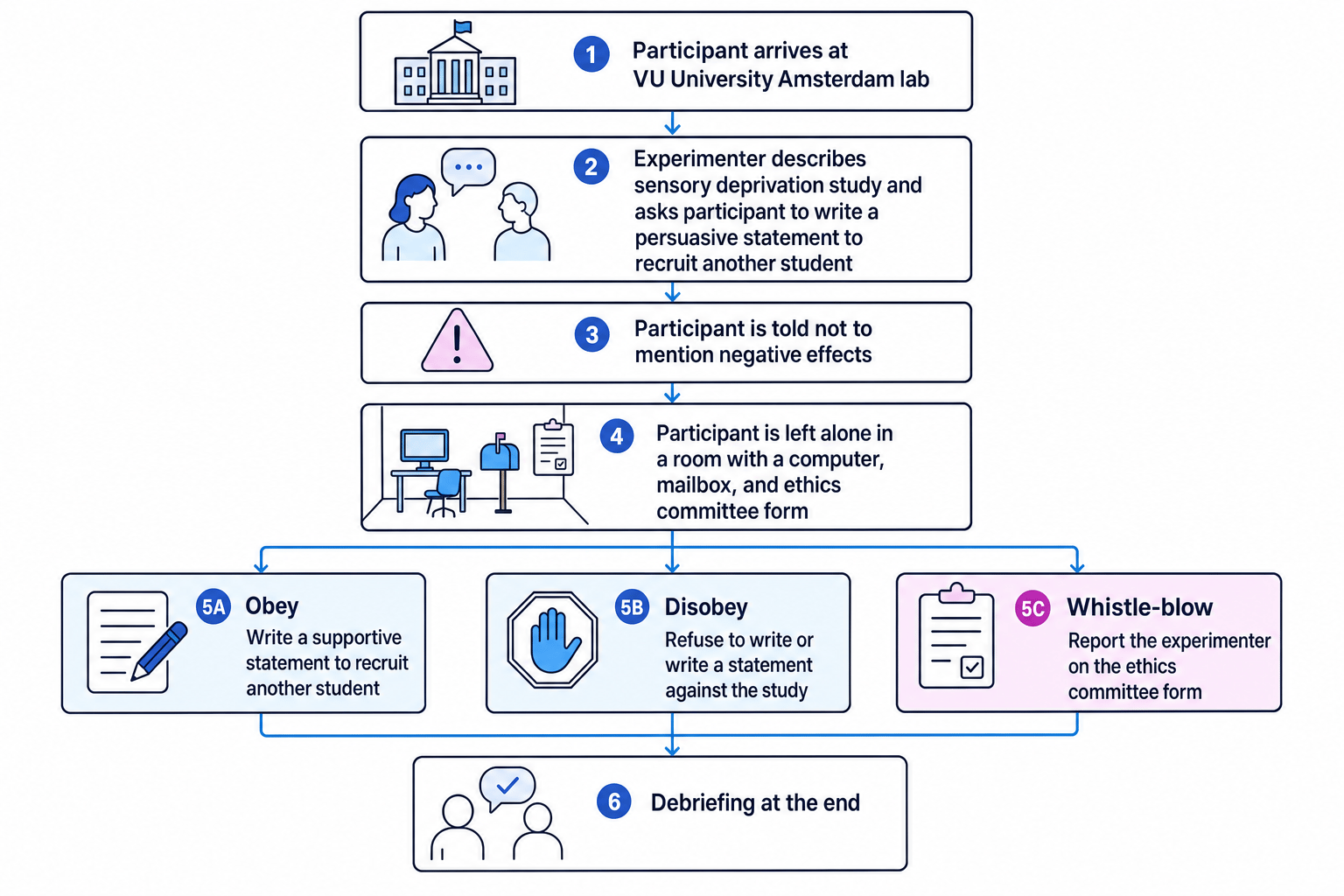
At the end, participants were fully debriefed and told that the sensory deprivation study was not real.
Classifying a participant’s response
-
If a participant writes the persuasive statement and does not report the experimenter, this is obedience, because they followed the authority figure’s instruction.
-
If a participant refuses to write the statement or writes a statement criticising the study, this is disobedience, because they resisted the instruction.
-
If a participant reports the unethical request using the ethics committee form, this is whistle-blowing, because they alerted another authority to the wrongdoing.
Results
The comparison group strongly overestimated how morally courageous they would be.
Predicted own behaviour:
- 3.6% said they would obey;
- 31.9% said they would disobey;
- 64.5% said they would whistle-blow.
Actual behaviour in the real situation was very different:
- 76.5% obeyed;
- 14.1% disobeyed;
- 9.4% whistle-blew.
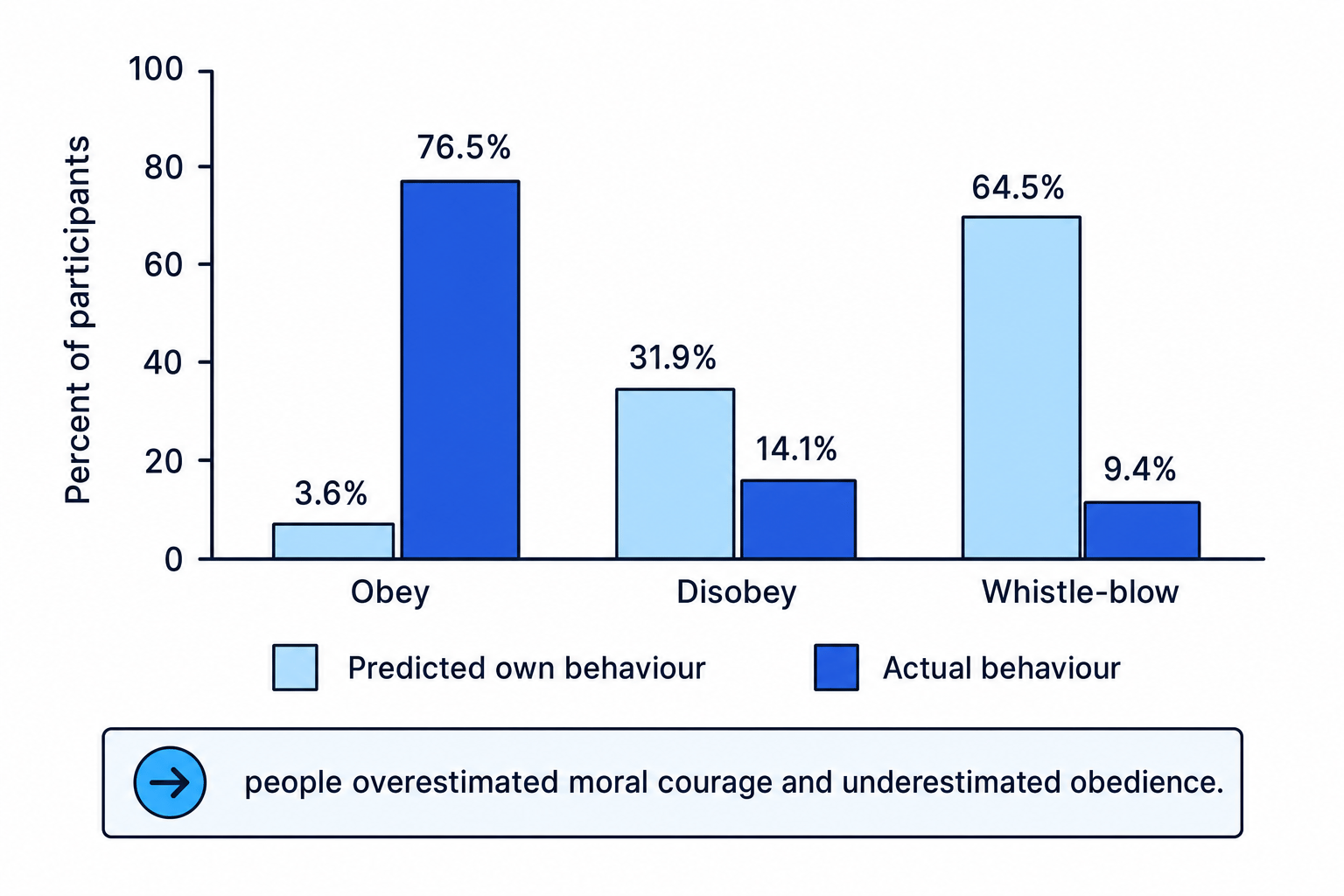
Personality measures did not clearly separate obedient participants from disobedient participants or whistle-blowers. This supports the idea that the situation was very powerful.
Headline result
Most people predicted they would blow the whistle, but most real participants obeyed the unethical request.
Conclusions
Bocchiaro et al. concluded that people are poor at predicting how they will behave when facing authority pressure.
The study suggests that:
- obedience can happen even when the authority request is unethical;
- whistle-blowing is much rarer than people expect;
- moral principles may be weaker in real situations than in imagined ones;
- situational pressure can be a stronger explanation than personality.
This fits the Social area because it shows how behaviour is shaped by the presence of other people, roles and authority relationships.
Applying Bocchiaro to a new situation
AO2 questions may give you a fresh scenario, such as a student, nurse or employee being told by a senior person to do something unethical.
Applying Bocchiaro to workplace pressure
-
Suppose a junior employee is told by a manager to delete negative customer complaints before an inspection. The manager is the authority figure, because they have higher status and power in the workplace.
-
If the employee deletes the complaints, their behaviour matches obedience in Bocchiaro et al., because they follow an unethical instruction.
-
If the employee refuses to delete them, that matches disobedience. If they also report the manager to HR or a regulator, that matches whistle-blowing.
-
Bocchiaro et al. would predict that many people may say they would report the manager, but fewer may actually do so when facing real authority pressure.
Evaluation for AO3
Validity
Validity means whether a study measures what it claims to measure.
A strength is that Bocchiaro et al. measured actual behaviour, not just questionnaire answers. This gives the study more validity than a purely hypothetical survey.
However, the laboratory situation was still artificial. Real whistle-blowing can involve serious consequences, such as losing a job, damaging relationships or facing legal threats. Reporting an experimenter on a form in a university lab may not fully capture real-life whistle-blowing.
Reliability
Reliability means consistency. Bocchiaro et al. used a standardised procedure, so each participant experienced a similar script, setting and opportunity to respond. This makes the study easier to replicate.
However, results may vary depending on the culture, type of authority figure and seriousness of the unethical request. A replication in a workplace, hospital or military setting might produce different levels of obedience and whistle-blowing.
Ethics
The study involved deception, because participants were misled about the sensory deprivation study. This also reduced fully informed consent, because participants did not know the true aim.
There was also potential psychological distress. Participants may have felt guilt, conflict or embarrassment when they realised they had obeyed an unethical request.
However, compared with Milgram (1963), the distress was less intense. Participants were debriefed, the harmful study was fake, and they were not led to believe they had directly injured another person.
BPS ethics link
For ethics evaluation, link to the BPS ideas of respect, responsibility and integrity: deception reduced informed consent, but debriefing helped protect participants afterwards.
Sampling bias and ethnocentrism
The sample was made up of university students from Amsterdam. This creates sampling bias, meaning the sample may not represent the wider population.
It may also be ethnocentric if we generalise the findings too widely. Dutch university students may respond differently to authority compared with older adults, people in other cultures, or people in more hierarchical organisations.
Usefulness
The study is useful because it shows that organisations should not simply rely on individual moral courage. If whistle-blowing is rare, workplaces need clear, safe and anonymous reporting systems.
It also helps explain why unethical behaviour can continue in institutions: many people may privately disagree but still obey or stay silent.
Comparison with Milgram (1963)
| Issue | Milgram (1963) | Bocchiaro et al. (2012) |
|---|---|---|
| Key focus | Obedience to destructive authority | Obedience, disobedience and whistle-blowing |
| Setting | Yale University laboratory | VU University Amsterdam laboratory |
| Task | Give electric shocks to a learner | Write a persuasive statement for an unethical study |
| Main result | 65% went to 450 volts | 76.5% obeyed the unethical request |
| Ethical concerns | Severe stress, deception, right to withdraw issues | Deception and possible guilt, but less intense distress |
| Sample | 40 male volunteers from the USA | Male and female Dutch university students |
| Contribution | Shows high obedience to authority | Shows whistle-blowing is much rarer than predicted |
Both studies support the idea that authority can strongly influence behaviour. However, Bocchiaro et al. is more contemporary and gives a broader picture because it includes disobedience and whistle-blowing, not just obedience.
Do not say Bocchiaro simply copied Milgram
Bocchiaro et al. was inspired by Milgram, but it tested a different issue: whether people would report an unethical authority figure, not whether they would physically harm someone.
Links to debates
This study supports the situational explanation of behaviour: people’s actions were shaped by the authority context more than by personality.
It also links to the free will versus determinism debate. Participants had choices, but the situation pushed many towards obedience.
For psychology as a science, the study has strong control and measurable behavioural categories, but ethical deception and artificiality limit what can be studied.
In the exam
-
For AO1, tell the story in order: background, aim, sample, procedure, results and conclusions.
-
For AO2, classify behaviour carefully: obeying is following the request, disobeying is refusing, and whistle-blowing is reporting the unethical authority.
-
For AO3, balance your evaluation: use at least one strength and one limitation, and compare directly with Milgram when the question asks about the key theme.
Check yourself
-
What was the unethical request made to participants in Bocchiaro et al.?
-
Why is whistle-blowing different from disobedience?
-
Give one similarity and one difference between Bocchiaro et al. (2012) and Milgram (1963).
