What you'll learn
- What psychologists mean by personality and why it matters in sport.
- How personality can be measured using questionnaires, interviews and observation.
- How Kroll and Crenshaw (1970) investigated personality profiles in athletic groups.
- How coaches might use personality knowledge ethically to improve performance.
Starting point: what is personality?
In sport psychology, personality is about the relatively stable patterns in how a person thinks, feels and behaves. It helps explain why two athletes can face the same competition but react very differently: one may see it as an exciting challenge, while another sees it as a threat.
Personality
Personality is a person’s characteristic pattern of thoughts, emotions and behaviours that tends to be fairly stable across time and situations.
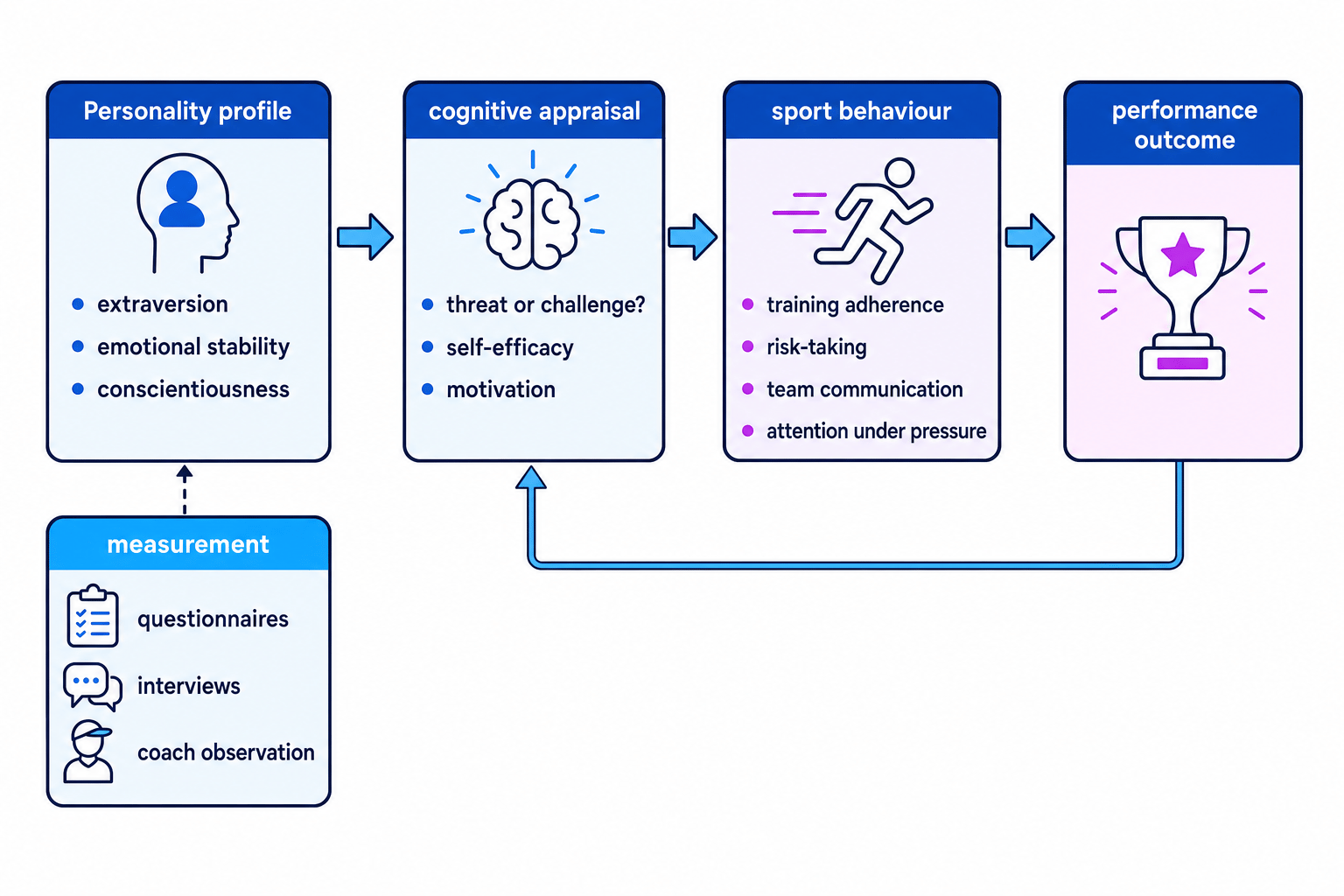
For this OCR Sport and Exercise Psychology topic, personality is treated as a cognitive topic because personality is linked to how athletes interpret situations, make decisions, manage pressure and think about themselves.
For example, an athlete who is high in confidence may appraise a final as “my chance to show what I can do”, whereas an athlete who is more anxious may appraise the same final as “something I might fail”.
Trait, situation and interaction
Trait approach
A trait is a relatively stable characteristic, such as extraversion, emotional stability or conscientiousness.
Trait
A trait is a consistent personal characteristic that may influence behaviour across different situations.
In sport, psychologists might ask whether certain traits are linked to certain sports. For example, team athletes may often need communication and assertiveness, while endurance athletes may benefit from persistence and emotional control.
However, the trait approach can be too simple if it assumes people behave the same way everywhere.
Situational approach
The situational approach argues that behaviour is shaped mainly by the environment. A calm athlete may become aggressive if the match is highly competitive, the crowd is hostile and the referee makes a controversial decision.
This matters because sport creates powerful situations: pressure, evaluation, competition, fatigue, team expectations and the possibility of winning or losing.
Interactionist approach
The interactionist approach combines both: behaviour is influenced by the person and the situation.
Person plus situation
The safest AO1 point is that personality may influence sport behaviour, but it does not act alone. Performance usually depends on an interaction between personality traits, cognitive appraisal and the sporting situation.
Applying the interactionist approach
A normally calm basketball player becomes irritable during a semi-final.
- Identify the personal factor: the player may usually be emotionally stable and controlled, so their usual trait profile does not predict aggression on its own.
- Identify the situational pressure: the semi-final is important, the score is close and the crowd may be hostile, increasing stress.
- Combine them: the athlete’s behaviour is best explained by the interaction between their personality and their appraisal of the situation as threatening.
- Apply to sport performance: a coach could use time-outs, breathing routines or self-talk to change the athlete’s appraisal before behaviour damages performance.
Measuring personality in sport
Psychologists need a way to turn personality into measurable data. This is usually done using psychometric tests, which are standardised tools designed to measure psychological characteristics.
Psychometric test
A psychometric test is a standardised measure of a psychological characteristic, such as personality, anxiety or motivation.
Common methods include:
- Questionnaires: athletes answer fixed questions or rating scales.
- Interviews: athletes discuss their thoughts, feelings and behaviour with a researcher or psychologist.
- Coach observation: coaches record patterns such as communication, persistence, risk-taking or response to failure.
- Personality inventories: established tests such as Cattell’s 16 Personality Factor Questionnaire, often shortened to 16PF.
Strengths of questionnaires
Questionnaires are useful because they can be standardised. This means every athlete receives the same instructions and questions, improving reliability.
Reliability
Reliability means consistency. A reliable personality measure should produce similar results when used again in similar conditions.
They also create quantitative data, which can be analysed statistically and compared across athletes or groups.
Weaknesses of questionnaires
Questionnaires rely on self-report, so athletes may give socially desirable answers. For example, an athlete may want to look confident, tough or coachable.
Validity
Validity means whether a test measures what it claims to measure.
A personality questionnaire may lack validity if an athlete misunderstands questions, exaggerates strengths or hides weaknesses.
Treating personality scores as destiny
Do not write as if a questionnaire score proves exactly how an athlete will perform. Personality measures suggest tendencies, not fixed outcomes.
Personality and sports performance
Personality may relate to sport in several ways.
Sport choice
People may be drawn to sports that suit their personalities. Someone who enjoys stimulation and social contact may prefer team sports. Someone who values independence may prefer individual sports.
But be careful: this is not a rule. Introverted athletes can excel in team sports, and extraverted athletes can excel in individual sports.
Performance under pressure
Personality may influence how an athlete appraises pressure. A highly confident athlete may interpret arousal as readiness. A less confident athlete may interpret the same arousal as panic.
This links to cognitive sport psychology because the key process is interpretation: what does the athlete think the situation means?
Training and persistence
Traits such as conscientiousness may be linked to training adherence, preparation and goal-setting. Athletes who are organised and persistent may be more likely to follow training programmes consistently.
Teamwork and communication
In team sports, personality may affect leadership, communication, conflict and cooperation. However, the most successful team is not simply the one with the “best” individual personalities. Team roles and relationships also matter.
AO3 balance
A strong evaluation point is that personality may correlate with sporting behaviour, but correlation does not prove causation. Sport might shape personality, personality might influence sport choice, or a third factor such as coaching culture could affect both.
Key research: Kroll and Crenshaw (1970)
Aim
Kroll and Crenshaw (1970) investigated whether different athletic groups had different personality profiles. Their study is important because it did not just look at one trait. It used a multivariate approach.
Multivariate analysis
Multivariate analysis examines several variables at the same time. In this study, it meant looking at a profile of personality traits rather than one isolated trait.
Method
Kroll and Crenshaw studied male athletes from four sporting groups, commonly reported as football, wrestling, gymnastics and karate. They used a personality questionnaire approach, including Cattell’s 16PF, to build personality profiles for each group.
The study compared groups statistically to see whether the pattern of personality scores differed between sports.
This was not an experiment in which personality was manipulated. It was more like a comparison between naturally occurring groups.
Results
The main finding was that the athletic groups showed different personality profiles. This suggests that athletes from different sports may differ in patterns of traits.
However, the study did not support a simple idea that there is one universal “athletic personality”. Instead, personality may vary depending on the type of sport, role demands and sporting culture.
Conclusions
Kroll and Crenshaw concluded that personality profiling may help us understand differences between athletes in different sports. Their findings are useful because they support the idea that sport psychology should consider the demands of the specific sport rather than treating all athletes as the same.
Kroll and Crenshaw in one sentence
Kroll and Crenshaw (1970) found that different athletic groups showed different personality profiles, but this does not prove that personality causes sporting success.
Using Kroll and Crenshaw in an AO2 scenario
A coach says: “All successful athletes must have the same personality.”
- Challenge the assumption: Kroll and Crenshaw compared different athletic groups and found differences between profiles, so a single universal athletic personality is too simplistic.
- Apply the sporting context: a gymnast, wrestler and football player face different demands, so different traits may be useful in different sports.
- Avoid overclaiming: the study compared existing athletes, so it cannot prove whether personality caused sport choice or whether sport experience shaped personality.
- Draw a practical conclusion: the coach should use personality information to support athletes, not to exclude anyone from sport.
Evaluating Kroll and Crenshaw (1970)
Methodological strengths
A strength is the use of a standardised personality measure. This improves reliability because participants answer the same items under similar conditions.
Another strength is the multivariate approach. Looking at a profile of traits gives a richer picture than studying only one trait such as extraversion.
Methodological weaknesses
A weakness is that the study was based on a specific sample of male athletes. This limits generalisability, because the findings may not apply to female athletes, younger athletes, recreational athletes or elite performers in other cultures.
Generalisability
Generalisability refers to whether findings from a study can be applied beyond the sample and setting used in the research.
The design also limits conclusions about cause and effect. If wrestlers score differently from gymnasts, we do not know whether personality led them to choose those sports, or whether training in those sports influenced their personality and self-presentation.
Validity issues
The study relied on personality questionnaires, which may be affected by social desirability. Athletes may answer in ways that fit the image of their sport.
For example, a football player may feel pressure to appear tough or dominant, while a gymnast may feel pressure to appear disciplined and controlled.
Ethics
The study is relatively low risk compared with many classic psychological studies, but ethical issues still matter under the BPS Code. Researchers should protect confidentiality, gain informed consent and avoid harmful labelling.
Ethical use of profiling
Personality profiling becomes ethically risky if coaches use it to stereotype, reject or shame athletes. It should be used to support development, not to label people as unsuitable.
Debates
This topic links clearly to the individual versus situational debate. Personality explanations focus on individual differences, while sport contexts remind us that pressure, team culture and coaching style also shape behaviour.
It also links to usefulness. Personality research can help coaches tailor support, but it must be applied carefully because evidence is often correlational.
Application: using personality to improve performance
A sensible strategy is to use personality profiling to personalise psychological skills training.
Strategy: personalised psychological skills training
A coach or sport psychologist could first assess an athlete’s personality using a questionnaire, interview and coach observation. They could then design support around the athlete’s likely cognitive responses.
For example:
- An athlete high in anxiety may benefit from relaxation, breathing control and positive self-talk.
- An athlete low in confidence may benefit from mastery goals and imagery of successful performance.
- An athlete who is highly extraverted may benefit from group-based motivation and leadership roles.
- An athlete who prefers independence may respond better to private feedback and individual goal-setting.
Self-talk
Self-talk is the use of internal or spoken statements to guide thoughts, emotions and behaviour.
Imagery
Imagery is mentally rehearsing a performance or situation using the senses, such as seeing, feeling and hearing the action in the mind.
Designing a personality-based intervention
A tennis player performs well in training but becomes tense and avoids risk during matches.
- Link the behaviour to cognition: the player may be appraising matches as threatening, which increases anxiety and cautious decision-making.
- Use personality information carefully: if profiling suggests low emotional stability or low confidence, this supports the idea that pressure is affecting performance.
- Choose a strategy: the sport psychologist could teach self-talk such as “commit to the shot” and imagery of coping successfully with break points.
- Match the delivery to the athlete: if the athlete dislikes public feedback, the coach could use private one-to-one reviews rather than team criticism.
- Review outcomes: improvement should be judged by match behaviour, confidence reports and consistency, not just by one personality score.
AO1, AO2 and AO3 essay thinking
For AO1, describe personality, measurement methods, the trait/situation/interactionist approaches, and Kroll and Crenshaw’s aim, method, findings and conclusions.
For AO2, apply personality ideas to a sporting scenario. If the question gives you an athlete, team or coach, use the details in the scenario: sport type, pressure level, behaviour, confidence, anxiety or communication.
For AO3, evaluate measurement issues, validity, reliability, sampling bias, ethics and whether the evidence proves causation.
In the exam
- Start by defining personality and linking it to cognition: appraisal, confidence, anxiety, motivation and attention.
- Use Kroll and Crenshaw (1970) as evidence that different sports may involve different personality profiles, but avoid claiming personality guarantees success.
- For evaluation, mention at least two of: questionnaire validity, social desirability, limited sample, correlation not causation, ethical risks of labelling athletes.
Check yourself
- Why is the interactionist approach usually stronger than a pure trait explanation in sport?
- What did Kroll and Crenshaw (1970) suggest about personality profiles in different athletic groups?
- How could a coach use personality profiling ethically to support an anxious athlete?

