What you'll learn
- How teams, cohesion, coaching and leadership shape sporting performance.
- How social factors can improve or reduce performance when athletes work with others.
- The key research: Smith et al. (1979) on coach effectiveness training.
- How to apply at least one strategy for improving team performance in a novel scenario.
Why “performing with others” matters
Sport rarely happens in isolation. Even “individual” athletes often train with coaches, practise in squads, and perform in front of audiences. In team sports, performance depends not only on skill and fitness, but also on communication, motivation, leadership and relationships.
Team
A team is a group of people who interact, share goals, have defined roles, and depend on one another to achieve performance outcomes.
A group can simply be people gathered together, but a team has interdependence: what one person does affects everyone else. For example, a goalkeeper’s communication affects the defenders, and defenders affect the goalkeeper’s workload.
Social performance
In sport psychology, “performing with others” means looking at how the social environment — teammates, coaches, leaders and audiences — changes behaviour, motivation and performance.
Teams and cohesion
What is cohesion?
Cohesion
Cohesion is the tendency of a team to stick together and remain united while pursuing goals or satisfying members’ social needs.
There are two important types:
- Task cohesion: how united the team is around performance goals, roles and strategies.
- Social cohesion: how much team members like, trust and enjoy being with each other.
A team can be high in one and low in the other. For example, an elite squad may not all be close friends, but they may have excellent task cohesion because everyone accepts their role.
Why cohesion affects performance
High task cohesion can improve communication, effort and role clarity. Social cohesion can improve enjoyment and commitment, which may reduce dropout. However, social cohesion alone is not enough. A team that gets on well but avoids difficult feedback may still underperform.
Thinking cohesion always means friendship
In sport essays, do not reduce cohesion to “everyone likes each other”. The strongest link to performance is usually task cohesion: shared goals, clear roles and coordinated effort.
Diagnosing a cohesion problem
A hockey team has good friendships but keeps losing because players chase the ball and leave gaps.
- The friendships suggest social cohesion is fairly strong, because players enjoy being together.
- The tactical disorganisation suggests weak task cohesion, because players are not united around roles and strategy.
- The best intervention would focus on role clarity, shared tactical goals and communication, rather than simply more social bonding.
Social effects during performance
Social facilitation and inhibition
Social facilitation
Social facilitation is when the presence of others improves performance, usually because arousal increases and the performer produces a well-learned or dominant response.
The dominant response is the behaviour most likely to happen in that situation. For an expert, it is often the correct skill. For a beginner, it may be an error.
Social inhibition is the opposite: performance gets worse in front of others, especially when the skill is new, complex or not yet automatic.
Predicting social facilitation
Two tennis players serve in front of a large crowd: one is an experienced county player, the other is a beginner.
- The experienced player’s serve is well learned, so their dominant response is likely to be technically correct.
- The crowd increases arousal, which should strengthen the dominant response.
- The experienced player is more likely to show social facilitation, while the beginner is more likely to show social inhibition because arousal strengthens mistakes.
Process losses and social loafing
Even talented teams can perform below their potential.
Process loss
A process loss is a reduction in team performance caused by poor coordination, reduced motivation, unclear roles or ineffective communication.
A useful idea is:
Actual productivity=Potential productivity−Process losses\text{Actual productivity} = \text{Potential productivity} - \text{Process losses}Actual productivity=Potential productivity−Process lossesOne type of process loss is social loafing, where individuals reduce effort because their contribution is less identifiable in a group.
A strong AO2 link
If a scenario mentions “some players hiding”, “unclear roles”, “poor communication” or “the team is less than the sum of its parts”, link it to process losses.
Coaching and leadership
Coaching
Coaching
Coaching is the process of helping athletes learn, develop and perform through instruction, feedback, motivation and relationship-building.
A coach does more than teach technique. They create the motivational climate of the team. For young athletes especially, the coach can influence confidence, enjoyment, anxiety and whether they continue in sport.
Effective coaching often involves:
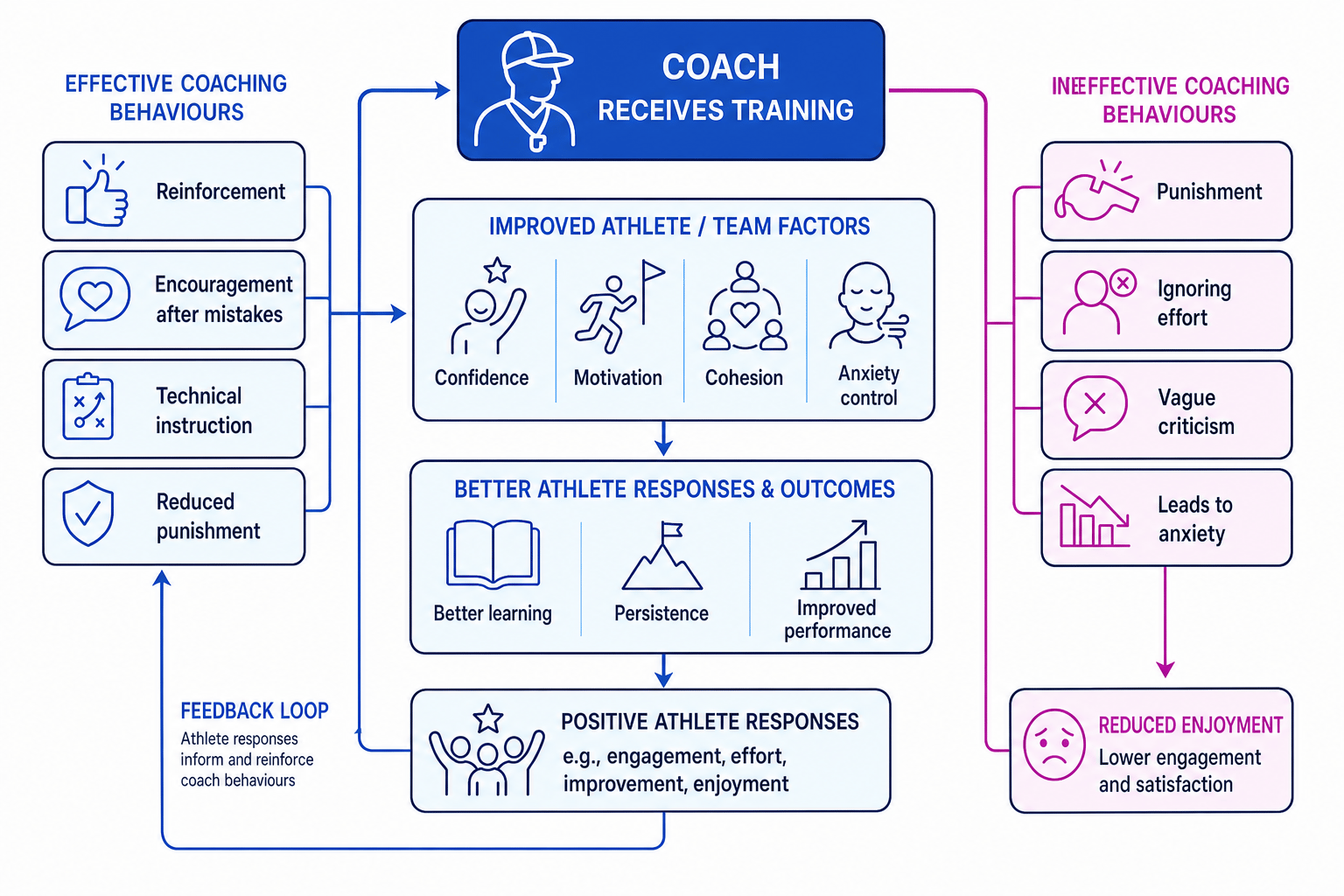
- Reinforcement: rewarding effort or desirable behaviour.
- Encouragement after mistakes: responding to errors as learning opportunities.
- Technical instruction: specific guidance on how to improve.
- Reduced punishment: avoiding humiliation, sarcasm or fear-based coaching.
Leadership
Leadership
Leadership is the process of influencing individuals or a group towards achieving goals.
Common leadership styles include:
- Autocratic leadership: the leader makes decisions and gives direct instructions.
- Democratic leadership: the leader involves athletes in decisions.
- Laissez-faire leadership: the leader gives little direction.
No style is always best. In a dangerous or time-pressured situation, autocratic leadership may be useful. For motivation, ownership and long-term development, democratic leadership is often helpful.
Calling one leadership style universally best
Avoid saying “democratic is always better” or “autocratic is always bad”. Strong evaluation explains that leadership effectiveness depends on the task, the athletes, the level of experience and the situation.
Choosing a leadership style
A new under-15 football team is anxious, inexperienced and unsure of roles before its first match.
- The players need structure, so the coach should provide clear tactical instructions and role guidance.
- Because anxiety is high, the coach should avoid harsh punishment and use supportive feedback.
- A mixed style would work best: more directive during tactical organisation, but democratic when setting team goals to increase ownership.
Key research: Smith et al. (1979)
The named study is Smith et al. (1979), “Coach effectiveness training: a cognitive-behavioural approach to enhancing relationship skills in youth sports coaches.”
Cognitive-behavioural approach
A cognitive-behavioural approach tries to change both thinking patterns and observable behaviour. In this study, coaches were trained to think differently about mistakes and respond with more constructive behaviours.
Aim
Smith et al. aimed to test whether training youth sports coaches to use more positive, supportive behaviours would improve coach-athlete relationships and player experiences.
Method
This was a field experiment because it took place in real youth sport settings rather than a laboratory.
The participants were youth baseball coaches and their players in the USA. Coaches were compared between a training condition, where they received coach effectiveness training, and a control condition, where they continued as usual.
Materials and measures
Smith et al. used observational and questionnaire data. A key tool was the Coaching Behavior Assessment System, which allowed trained observers to categorise coach behaviours during practices and games.
Important behaviours included:
- reinforcement after good performance;
- encouragement after mistakes;
- mistake-contingent technical instruction;
- punishment or punitive instruction;
- ignoring mistakes or effort.
Procedure
Coaches in the training condition attended a workshop before the season. They were taught guidelines such as reinforcing effort, giving specific technical instruction, encouraging players after mistakes, and reducing punitive responses.
Observers then recorded coaching behaviours during the season. Players also completed measures about their attitudes towards the coach, teammates and sport.
Results
Trained coaches generally showed more positive behaviours than control coaches. They used more reinforcement and encouragement, and less punishment.
Players coached by trained coaches tended to evaluate their coaches more positively. The training also appeared especially useful for young athletes who may have been more vulnerable to low confidence or anxiety.
Conclusions
Smith et al. concluded that coach behaviour can be changed through training, and that this can improve young athletes’ sporting experience. The study supports the idea that team performance is not only physical or technical; it is also social and psychological.
Smith et al. in one sentence
Positive, trained coaching behaviours can improve coach-athlete relationships and create a better motivational climate for young performers.
Evaluating Smith et al. (1979)
Strengths
The study has strong ecological validity because it took place in real sports teams. This makes it useful for applying psychology to coaching practice.
It also used structured observation, which improves reliability because behaviours were recorded systematically rather than judged vaguely. Using both observation and player questionnaires gave a fuller picture of the coaching environment.
Weaknesses
The sample was culturally and contextually limited: youth baseball in the USA. This means findings may not generalise fully to elite athletes, adult teams, individual sports, UK sport, female athletes or different cultural settings.
There may also have been observer effects. If coaches knew they were being watched, they may have changed their behaviour temporarily. Questionnaire responses may also be affected by social desirability.
Ethics
Because the research involved children, ethical care was especially important. In terms of the BPS Code, researchers would need informed consent from appropriate adults, assent from children, confidentiality, protection from harm, and the right to withdraw.
The intervention itself was low risk and potentially beneficial, but researchers still needed to consider whether it was fair for control-group coaches and players not to receive the training immediately.
Application: improving team performance
A direct application is to use a coach effectiveness training programme with coaches who work with youth teams.
A practical strategy could include:
-
Audit current coaching behaviour
Observe training and matches, recording praise, criticism, technical instruction and responses to mistakes. -
Train positive coaching responses
Teach coaches to reinforce effort, give encouragement after mistakes, and provide specific technical instruction. -
Build task cohesion
Set shared team goals, clarify roles and practise communication routines. -
Review outcomes
Measure changes in attendance, enjoyment, confidence, player ratings of the coach, and relevant performance indicators.
Applying coach effectiveness training
A netball team has lost confidence because the coach shouts after every mistake and players avoid taking risks.
- The main problem is a negative motivational climate: mistakes are punished, so players become anxious and avoid learning opportunities.
- Coach effectiveness training would replace shouting with encouragement plus technical instruction, such as explaining footwork after an error.
- This should reduce anxiety, increase confidence and improve task cohesion because players understand how to improve.
- Progress could be assessed by observing fewer punitive comments, higher attendance, better player confidence ratings and improved decision-making in matches.
Bringing it together for essays
For AO1, accurately describe teams, cohesion, leadership styles and Smith et al. (1979).
For AO2, apply the ideas to the exact sport scenario. If the source describes anxiety, link to social inhibition or negative coaching. If it describes poor teamwork, link to cohesion or process losses.
For AO3, evaluate with evidence. Smith et al. is useful and ecologically valid, but culturally limited and not necessarily generalisable to all sports or levels of competition.
In the exam
- Start applied answers by identifying the social factor in the scenario: cohesion, leadership, coaching behaviour, social facilitation or process loss.
- Use Smith et al. (1979) as evidence that coaching behaviour can be trained and can improve young athletes’ experiences.
- For evaluation, balance usefulness and ecological validity against sampling bias, limited generalisability and possible observer effects.
Check yourself
- What is the difference between task cohesion and social cohesion?
- Why might an audience improve an expert’s performance but worsen a beginner’s?
- How could coach effectiveness training improve both enjoyment and team performance?
