What you'll learn
- How self-efficacy and sport confidence affect motivation in athletes.
- How imagery can be used to increase confidence and persistence.
- What Munroe-Chandler et al. (2008) found about imagery in youth soccer players.
- How to apply this research to practical motivation strategies for athletes.
The big picture: cognitive motivation in sport
In sport psychology, motivation means the processes that energise, direct, and maintain behaviour. In simple terms: why an athlete starts training, what they focus on, and why they keep going when it becomes difficult.
A cognitive explanation focuses on mental processes such as beliefs, expectations, interpretations, and mental images. Instead of saying “the athlete is motivated because they want rewards”, a cognitive psychologist asks: What does the athlete believe about their ability? What do they imagine happening? How do they interpret pressure?
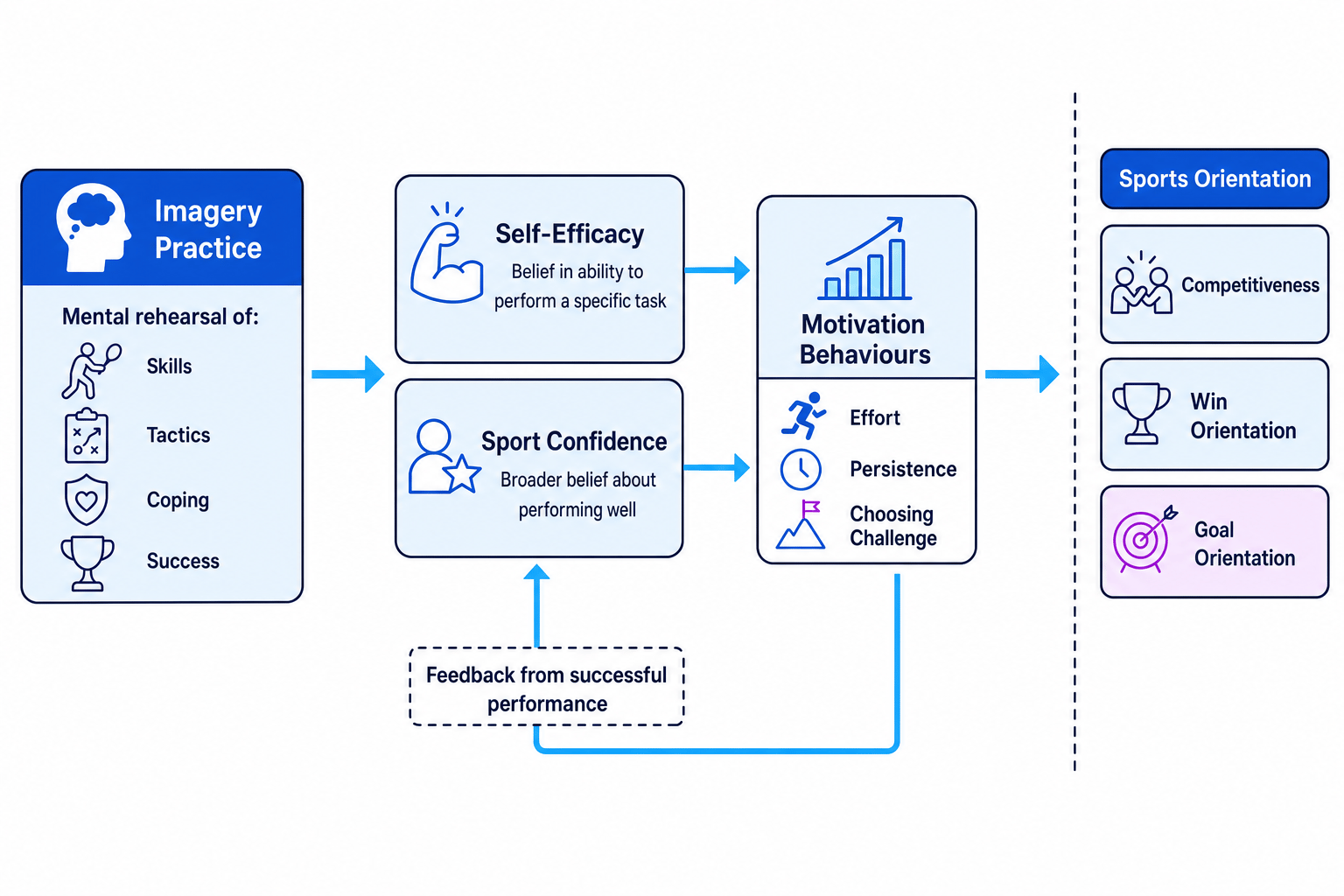
Cognitive motivation
An athlete’s motivation is strongly influenced by what they believe they can do and what they mentally rehearse before performing.
Self-efficacy
Self-efficacy
Self-efficacy is a person’s belief that they can successfully carry out a specific task in a particular situation.
This idea is associated with Bandura’s social cognitive theory. In sport, self-efficacy is not just “general confidence”. It is more precise.
For example:
- “I can score this penalty under pressure.”
- “I can complete this 5 km run without stopping.”
- “I can recover after making a mistake in the first half.”
High self-efficacy tends to increase:
- effort
- persistence
- willingness to attempt difficult tasks
- emotional control under pressure
Low self-efficacy can lead to avoidance, giving up early, or interpreting normal nerves as proof of failure.
Sources of self-efficacy
Bandura suggested several sources of self-efficacy:
- Mastery experiences: past success at the task.
- Vicarious experiences: seeing someone similar succeed.
- Verbal persuasion: encouragement or feedback from coaches and teammates.
- Physiological and emotional states: interpreting arousal as readiness rather than panic.
Applying self-efficacy to a penalty taker
A footballer has missed two penalties recently and now avoids volunteering for penalty practice.
- Identify the specific belief: the issue is not “low confidence in football” generally, but low self-efficacy for taking penalties under pressure.
- Choose the most relevant source of self-efficacy: recent failures have damaged mastery experiences, so the coach should create successful, realistic penalty practice in stages.
- Predict the motivational effect: if the player experiences controlled success, their self-efficacy should increase, making them more likely to practise penalties and volunteer in matches.
Self-efficacy is task-specific
Do not define self-efficacy as “confidence” in a vague way. It is confidence in being able to perform a particular behaviour in a particular context.
Sport confidence
Sport confidence
Sport confidence is the degree of certainty an athlete has that they can be successful in sport.
Sport confidence is broader than self-efficacy. Self-efficacy might focus on one task, such as “I can make this tackle”. Sport confidence can involve a wider belief such as “I am a capable rugby player”.
Sport confidence can come from:
- physical preparation
- skill level
- tactical understanding
- coach support
- social support
- previous success
- feeling mentally prepared
Self-efficacy vs sport confidence
A useful distinction:
- Self-efficacy: “Can I do this specific action?”
- Sport confidence: “Can I perform successfully in this sport?”
They often overlap. If an athlete improves self-efficacy for key skills, their wider sport confidence may also increase.
AO2 shortcut
In application questions, always make the belief specific. Instead of writing “the athlete lacks confidence”, write “the athlete has low self-efficacy for serving accurately in competition”.
Imagery
Imagery
Imagery is the creation or recreation of experiences in the mind, using senses such as sight, sound, movement, and emotion, without actually performing the action.
Imagery is sometimes called mental rehearsal. Athletes may imagine:
- performing a skill correctly
- following a tactic
- coping with pressure
- achieving a goal
- staying calm after a mistake
Imagery is cognitive because it changes internal mental representations. The athlete practises not only the physical movement, but also the expectation: I can do this.
Types of imagery in sport
A helpful way to organise imagery is by its function:
- Cognitive specific imagery: imagining a specific skill, such as a tennis serve.
- Cognitive general imagery: imagining strategies or routines, such as a team formation.
- Motivational specific imagery: imagining a goal, such as winning a race.
- Motivational general-arousal imagery: imagining feelings of excitement, nerves, or energy.
- Motivational general-mastery imagery: imagining being confident, focused, and mentally tough.
For motivation, mastery imagery is especially important because it directly targets confidence, coping, and persistence.
Why imagery motivates
Imagery can make success feel more controllable and familiar, which increases self-efficacy and makes effort feel worthwhile.
Sports orientation
Sports orientation
Sports orientation refers to an athlete’s typical attitude towards achievement in sport, especially how much they value competing, winning, and personal improvement.
It is often broken into three parts:
- Competitiveness: enjoying competition and striving against others.
- Win orientation: placing high importance on winning.
- Goal orientation: focusing on personal goals, improvement, and mastery.
This matters because athletes are not all motivated by the same thing. One athlete may be driven by beating opponents, while another may be driven by improving their personal best.
Applying sports orientation
If an athlete is strongly win-oriented, losing may seriously damage confidence. A coach may need to reframe success around controllable goals, such as decision-making, effort, or technique.
If an athlete is strongly goal-oriented, they may respond well to progress charts, personal targets, and feedback on improvement.
Choosing a motivational focus
A young sprinter becomes demotivated because she keeps finishing fourth, even though her times are improving.
- Compare possible orientations: if she is mainly win-oriented, she may see fourth place as failure; if she is goal-oriented, improved times should feel rewarding.
- Reframe the target: the coach can set a personal goal, such as improving the start reaction and maintaining form in the final 20 metres.
- Link the target to motivation: focusing on controllable improvement should protect self-efficacy because success no longer depends only on other athletes’ performance.
Key research: Munroe-Chandler et al. (2008)
Background and aim
Munroe-Chandler, Hall and Fishburne (2008) carried out the study “Playing with confidence: The relationship between imagery use and self-confidence and self-efficacy in youth soccer players.”
The researchers wanted to investigate whether young soccer players who used imagery more often also reported higher self-confidence and self-efficacy.
This is important because much sport imagery research had focused on older or elite athletes. Munroe-Chandler et al. looked at youth soccer players, making the study directly relevant to coaching younger athletes.
Method
This was a correlational questionnaire study. A correlational study looks for a relationship between variables, but it does not manipulate an independent variable.
The main variables were:
- imagery use
- self-confidence
- self-efficacy
The participants were youth soccer players, typically recruited through soccer programmes or clubs. They completed standardised questionnaires about how they used imagery and how confident they felt in their soccer ability.
The imagery measure included different functions of imagery, such as skill imagery and mastery imagery. Self-efficacy was measured by asking players how confident they were about performing soccer-related skills or behaviours.
Results
The key finding was that imagery use was positively related to confidence beliefs.
In particular, players who reported using imagery more, especially imagery linked to mastery, focus, and coping, tended to report higher self-confidence and self-efficacy.
Conclusions
Munroe-Chandler et al. concluded that imagery may be an important psychological tool for young athletes. If athletes imagine themselves performing confidently and successfully, this may support the beliefs that keep them motivated.
Correlation is not causation
Munroe-Chandler et al. found a relationship between imagery and confidence, but this does not prove that imagery caused the confidence. Confident athletes might simply choose to use imagery more often.
Evaluating Munroe-Chandler et al. (2008)
Strengths
A major strength is usefulness. The study has clear practical applications for coaches, PE teachers, and sport psychologists. If imagery is linked to confidence, then imagery training can be built into practice sessions.
The study also has good ecological validity because it used real youth soccer players, not artificial laboratory tasks. This makes the findings more relevant to real sport settings.
Using questionnaires also creates a degree of standardisation. If all participants answer the same items, researchers can compare scores more reliably.
Weaknesses
The biggest weakness is the correlational design. The study can show an association, but it cannot prove cause and effect.
Another weakness is reliance on self-report. Players may overestimate how often they use imagery or give answers that make them seem more confident. This creates a risk of social desirability bias.
There may also be sampling bias. Youth soccer players may not represent adult athletes, elite athletes, individual-sport athletes, or athletes from other cultures. This limits generalisability.
Ethics
Because the participants were young people, ethical care is especially important. Under the BPS Code of Human Research Ethics, researchers should consider:
- informed consent from participants and, where appropriate, parents or guardians
- the right to withdraw
- confidentiality of questionnaire responses
- protection from psychological harm
- debriefing after participation
This study is relatively low risk because it used questionnaires, but researchers still need to avoid making young athletes feel judged or labelled as “unconfident”.
Research methods link
Munroe-Chandler et al. is a useful study for linking Component 03 to research methods.
Questionnaire responses are often treated as ordinal data because ratings can be ranked, although total scores are sometimes treated more like interval data. A relationship between imagery scores and self-efficacy scores could be tested using Spearman’s Rho, the named non-parametric test for correlations.
Other test choices depend on the design:
- Mann-Whitney U: difference between two independent groups, using ordinal data.
- Wilcoxon Signed Ranks: difference between two related conditions or matched pairs, using ordinal data.
- Chi-square: association or difference using nominal categories.
- Binomial Sign test: related data where only the direction of change is counted.
- Spearman’s Rho: correlation between two ranked or ordinal variables.
A parametric test would usually require interval-level data, an approximately normal distribution, no serious outliers, and appropriate design assumptions.
In psychology, significance is usually judged using probability, often p<0.05p < 0.05p<0.05. A Type I error is claiming a significant effect when there is not one. A Type II error is missing a real effect.
For graphs:
- use a scatter diagram for imagery and self-efficacy correlations
- use a bar chart for category comparisons
- use a line graph for change across training weeks
- use a pie chart for proportions
- use a histogram for distributions of continuous scores
Application: using imagery to motivate athletes
A practical strategy is an imagery-based confidence programme. The aim is to increase self-efficacy by helping athletes mentally rehearse successful performance.
A simple imagery strategy
- Identify the specific skill or situation where motivation is low.
- Create a short imagery script involving successful performance.
- Include multiple senses: what the athlete sees, hears, feels, and thinks.
- Include coping imagery, such as staying focused after a mistake.
- Practise imagery regularly before or after physical training.
- Review whether confidence, effort, and persistence improve.
A useful framework is PETTLEP imagery:
- Physical: imagine the body position and movements.
- Environment: imagine the real setting.
- Task: match the imagery to the actual skill.
- Timing: imagine the action at realistic speed.
- Learning: update the imagery as the athlete improves.
- Emotion: include realistic feelings, such as nerves or excitement.
- Perspective: use either internal perspective or external perspective, depending on the athlete.
Designing imagery for a nervous goalkeeper
A goalkeeper loses motivation after conceding several goals and now avoids diving practice.
- Define the target behaviour: the key issue is low self-efficacy for diving saves, especially after mistakes.
- Build mastery imagery: the goalkeeper imagines reading the striker’s body shape, pushing off strongly, and saving the shot.
- Add coping imagery: the goalkeeper imagines conceding one goal, taking a breath, resetting, and making the next save.
- Match the imagery to the real context: the script includes the pitch, teammates calling, gloves, crowd noise, and match pressure.
- Predict the motivational outcome: repeated imagery should make successful saves feel more achievable, increasing effort and persistence in diving practice.
Imagery is not just daydreaming
Effective imagery is planned, specific, realistic, and linked to performance goals. Vague positive thinking is much less useful.
AO3: evaluating imagery as a motivation strategy
Imagery is useful because it is cheap, flexible, and can be used alongside physical practice. It is especially suitable for injured athletes because they can mentally rehearse even when they cannot train fully.
However, imagery may not work equally well for everyone. Some athletes find it hard to create vivid mental images. Others may accidentally rehearse failure if they imagine mistakes or embarrassment. This means imagery should be guided carefully.
Imagery is also not a replacement for physical practice. A tennis player cannot improve a serve only by imagining it. The best approach combines imagery with real training, feedback, and achievable goals.
In the exam
- For AO1, define the cognitive concept clearly: self-efficacy is task-specific, sport confidence is broader, and imagery is mental rehearsal.
- For AO2, apply the idea to the exact athlete or scenario: name the sport, skill, pressure, and likely effect on effort or persistence.
- For AO3, evaluate carefully: Munroe-Chandler et al. supports a relationship, but the correlational design and self-report data limit causal conclusions.
Check yourself
- How is self-efficacy different from general sport confidence?
- Why does Munroe-Chandler et al. (2008) not prove that imagery causes confidence?
- How could a coach use imagery to motivate an athlete who avoids difficult skills?

