What you'll learn
- Why an audience can facilitate or inhibit sports performance.
- How Zajonc’s explanation uses arousal and the dominant response.
- What Zajonc et al. (1969) found in their cockroach study.
- How to apply audience effects to training strategies and home advantage.
The basic idea: audiences change performance
In sport, performers are rarely acting in a social vacuum. Spectators, coaches, teammates, opponents, officials, cameras, and online viewers can all make an athlete feel observed. This can improve performance, but it can also make performance worse.
Audience effects
Audience effects are changes in performance caused by the real, imagined, or implied presence of other people watching or evaluating the performer.
The key point is that an audience does not have one simple effect. It depends on the performer, the task, and the situation.
Social facilitation and social inhibition
Social facilitation and social inhibition
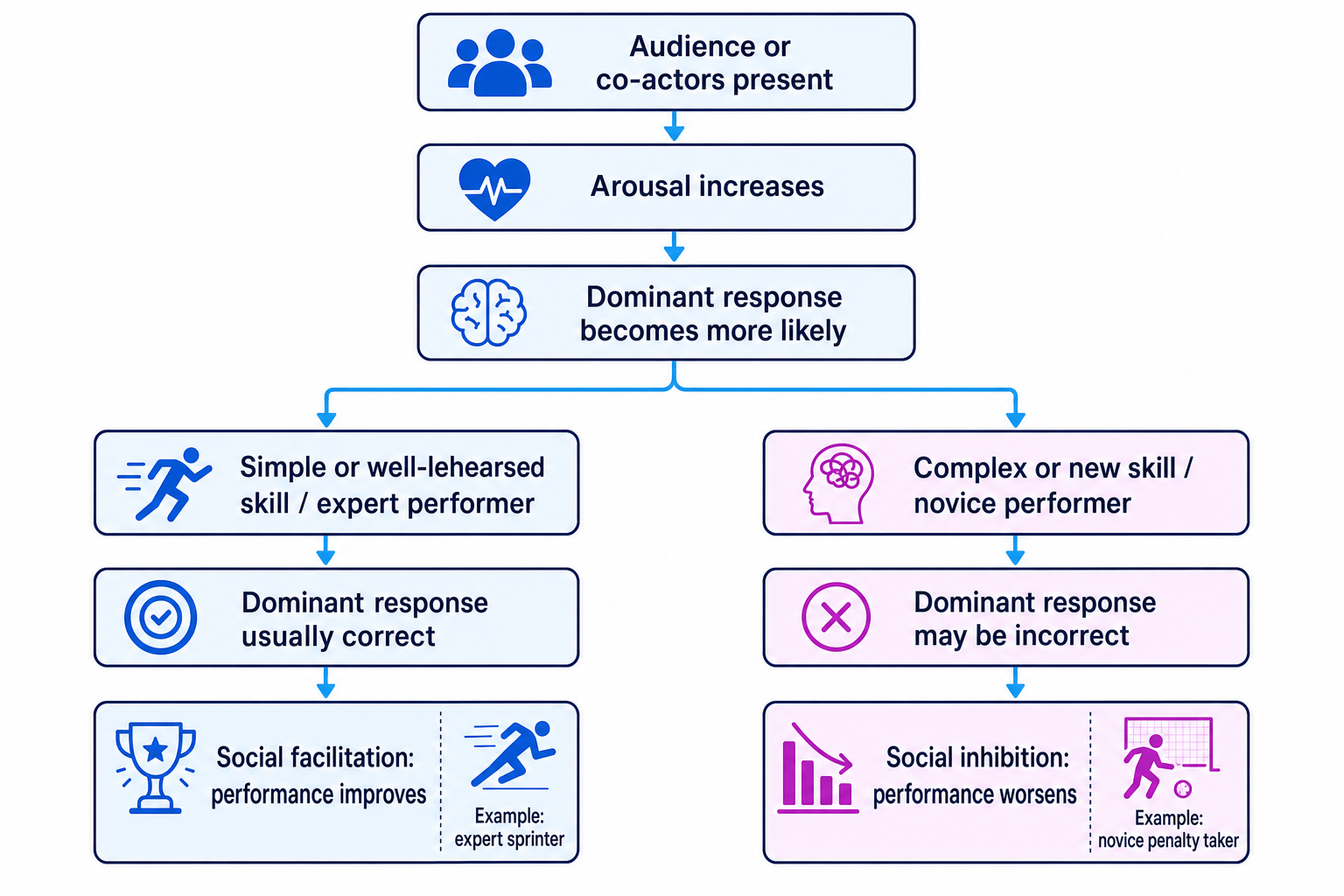
Social facilitation is when the presence of others improves performance. Social inhibition is when the presence of others worsens performance.
In sport, social facilitation might be an experienced sprinter running faster in a packed stadium. Social inhibition might be a beginner tennis player double-faulting more often when people are watching.
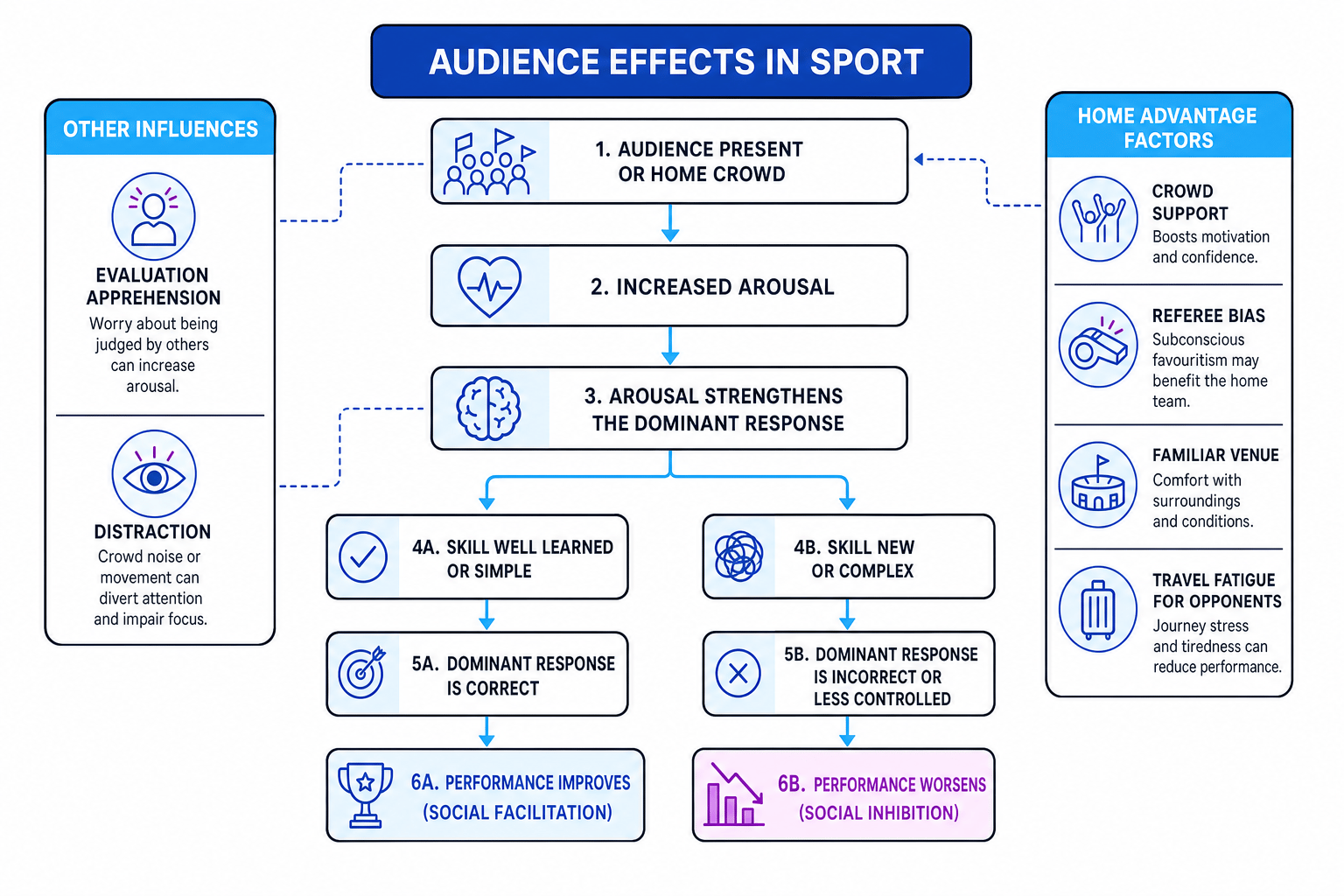
Zajonc’s explanation is that audiences increase arousal, and arousal strengthens the response the performer is most likely to give.
The big takeaway
An audience tends to help when the performer’s dominant response is correct, but tends to hinder when the dominant response is incorrect or poorly controlled.
Predicting an audience effect
A novice basketball player and an experienced basketball player both take free throws in front of a noisy crowd.
-
Identify the skill level and likely dominant response. The experienced player has a well-learned shooting action, so their dominant response is likely to be accurate. The novice player’s technique is less stable, so their dominant response may include errors such as poor wrist control or rushing.
-
Apply the effect of the audience. The noisy crowd increases arousal, which strengthens each player’s dominant response.
-
Predict the outcome. The experienced player may show social facilitation because arousal strengthens a correct response. The novice player may show social inhibition because arousal strengthens an unreliable or incorrect response.
Arousal, dominant response, and drive theory
Arousal
Arousal is a state of physiological and psychological activation, such as increased alertness, heart rate, tension, or readiness to act.
Some arousal is useful in sport because it energises performance. Too little arousal can lead to sluggishness. Too much can lead to anxiety, rushing, or loss of fine control.
Dominant response
The dominant response is the behaviour that is most likely to occur in a situation because it is habitual, automatic, or strongly learned.
For a highly practised athlete, the dominant response is often the correct technique. For a beginner, the dominant response may be a mistake. This is why the same audience can help one person and harm another.
Zajonc’s drive theory argues that the mere presence of others increases arousal or drive. This arousal then increases the likelihood of the dominant response.
Simple or well-learned tasks
For simple tasks, or skills that have been practised until they are automatic, the dominant response is usually correct. Audience pressure can therefore improve performance.
Examples include:
- A skilled sprinter exploding from the blocks.
- An experienced gymnast performing a routine they have rehearsed many times.
- A professional footballer taking a familiar type of shot.
Complex or newly learned tasks
For complex tasks, or skills that are new, the dominant response is more likely to be incorrect. Audience pressure can therefore make errors more likely.
Examples include:
- A beginner learning a new dive.
- A novice golfer trying to change their swing technique.
- A young player taking a penalty in a final for the first time.
Audience does not always mean better performance
Do not write that crowds automatically improve performance. The better answer is conditional: audiences increase arousal, and whether this helps depends on whether the dominant response is correct.
Why does an audience increase arousal?
There are several explanations. Zajonc emphasised mere presence, meaning that simply having others nearby can raise arousal, even if they are not judging the performer.
Other explanations are more cognitive.
Evaluation apprehension
Evaluation apprehension is anxiety caused by believing that other people are judging your performance.
This is very relevant in sport. A footballer taking a penalty may worry about teammates, fans, coaches, media, and future selection decisions.
Distraction-conflict
Distraction-conflict is when attention is split between the task and distracting social cues, such as crowd noise, movement, or comments.
This can harm performance because sport often requires selective attention. A tennis player needs to focus on ball toss and timing, not on the crowd or the scoreboard.
AO2 application shortcut
When applying audience effects to a scenario, ask: Who is watching? How skilled is the performer? Is the task simple or complex? Is the audience supportive, hostile, or evaluative?
Home advantage
Home advantage
Home advantage is the tendency for teams or athletes to perform better, or win more often, when competing at their own venue.
Audience effects are one explanation for home advantage, but not the only one. Home crowds can increase motivation, confidence, and effort. They may also intimidate opponents.
Other factors include:
- Familiarity with the venue, surface, lighting, weather, changing rooms, or routines.
- Travel fatigue for the away team.
- Territoriality, where the home team feels protective of its space.
- Referee or judge bias, where crowd pressure may subtly influence decisions.
- Tactical advantage, because home teams may choose conditions or routines that suit them.
However, home advantage can turn into home pressure. A supportive crowd may become an evaluative audience, especially if expectations are high.
Explaining home advantage in a scenario
A home netball team usually performs well at its own venue, but in a cup final they make more passing errors than usual.
-
Separate the possible positive and negative effects. The home crowd may increase motivation and confidence, supporting home advantage. But the cup final also increases pressure and evaluation apprehension.
-
Consider the task demands. Passing under defensive pressure requires timing, decision-making, and fine control, so excessive arousal could disrupt performance.
-
Apply the dominant response idea. If the players’ passing routines are not fully automatic under pressure, the audience may strengthen rushed or inaccurate responses, producing social inhibition despite being at home.
Key research: Zajonc et al. (1969)
The named study for this topic is Zajonc et al. (1969), “Social enhancement and impairment of performance in the cockroach.”
Background and aim
Earlier research on social facilitation seemed contradictory. Sometimes the presence of others improved performance; sometimes it made performance worse. Zajonc suggested that the difference depended on whether the task was simple or complex.
The aim was to test whether the presence of others would improve performance on a simple task but impair performance on a complex task.
Method
Zajonc et al. used a laboratory experiment, meaning they studied behaviour in a controlled setting while manipulating variables.
The participants were cockroaches. This matters because cockroaches are unlikely to experience human-style embarrassment or self-presentation, so the study tested whether social effects could occur without complex human cognition.
The researchers manipulated:
- Task difficulty: a simple straight runway or a more complex maze.
- Social condition: cockroaches completed the task alone or with other cockroaches present, either as co-actors or as an audience in transparent boxes.
The dependent variable was performance, measured by how quickly the cockroaches reached a darkened goal area. Cockroaches naturally move away from bright light, so the light acted as motivation to escape.
Results
On the simple runway task, cockroaches performed faster when other cockroaches were present.
On the complex maze task, cockroaches performed worse when other cockroaches were present.
Conclusions
The findings supported Zajonc’s explanation. The presence of others increased arousal. On simple tasks, this strengthened the correct dominant response, improving performance. On complex tasks, it strengthened ineffective responses, impairing performance.
What Zajonc et al. showed
The study supports the idea that audience effects are not just about human embarrassment. Even in cockroaches, the presence of others can enhance simple performance and impair complex performance.
Evaluating Zajonc et al. (1969)
Strengths
A major strength is control. Because this was a laboratory experiment, the researchers could control the task, environment, audience condition, and measurement of performance. This improves internal validity because differences in performance can be more confidently linked to the presence of others and task difficulty.
The study is also relatively replicable. The apparatus and procedure can be standardised, which means other researchers could repeat the study to test reliability.
Using cockroaches also reduces some human confounding variables. Cockroaches are unlikely to show demand characteristics, where participants guess the aim and change behaviour to please or resist the researcher.
Weaknesses
The biggest weakness is limited generalisability to human sport. Human athletes have goals, emotions, team relationships, reputations, coaching histories, and conscious worries about evaluation. Cockroach maze-running is much simpler than performing in front of thousands of spectators.
The study also has limited ecological validity. A bright laboratory maze is very different from a stadium, pitch, court, track, or gymnasium.
There is also a question of construct validity. Speed of reaching a dark box is being used as a measure of performance under social conditions, but sport performance involves many more components, such as tactics, decision-making, endurance, confidence, and communication.
Ethically, this is animal research rather than human participant research, so the BPS Code of Human Research Ethics is not directly applied in the same way. However, the ethical principles still matter: researchers should justify the use of animals, minimise distress, and use the principles of replacement, reduction, and refinement where possible.
Overclaiming from cockroaches
Zajonc et al. supports a basic arousal explanation, but it does not prove that all human sport performance works in the same way. Human athletes can also be affected by confidence, expectations, team culture, and conscious evaluation.
Applying audience effects to sport
For OCR Component 03, you need to apply this theory to practical strategies for training and playing spectator sports.
Strategy 1: Overlearn skills before high-pressure performance
If audiences strengthen the dominant response, then athletes should practise until the correct technique becomes automatic. This is called overlearning, where a skill is practised beyond the point of basic competence so it remains stable under pressure.
For example, a gymnast might repeatedly practise a beam dismount until the movement pattern is automatic, then practise it again with teammates watching, music playing, and competition-style judging.
Strategy 2: Simulate audience pressure in training
Training should gradually include audience-like conditions:
- Teammates watching.
- Recorded crowd noise.
- Scoreboards and time limits.
- Competition clothing and routines.
- Coaches acting as judges.
- Practice penalties or serves after physical fatigue.
This makes the athlete more used to arousal and reduces the shock of a real audience.
Strategy 3: Use attentional control and routines
A pre-performance routine is a consistent sequence of thoughts and actions before a skill. It can reduce distraction and help the athlete focus on task-relevant cues.
Examples include:
- A tennis player bouncing the ball the same number of times before serving.
- A rugby kicker using a breathing pattern and visual target.
- A diver using imagery before stepping onto the board.
- A sprinter using cue words such as “drive” or “relax”.
Strategy 4: Regulate arousal
Athletes can use arousal-control techniques depending on whether they are over-aroused or under-aroused.
If over-aroused, they might use:
- Slow breathing.
- Progressive muscle relaxation.
- Calming self-talk.
- Narrow attentional focus.
If under-aroused, they might use:
- Energising music.
- Motivational self-talk.
- Dynamic warm-ups.
- Team huddles or crowd engagement.
Designing a training strategy
A young footballer performs accurate penalties in training but misses when parents and teammates watch.
-
Diagnose the problem using audience effects. The audience is increasing arousal and evaluation apprehension. Because the player is young, the penalty technique may not be fully automatic under pressure.
-
Choose a strategy based on the dominant response. The coach should increase repetition of the correct penalty routine so the accurate technique becomes the dominant response.
-
Add gradual audience simulation. The player could first practise with one teammate watching, then a small group, then crowd noise and a goalkeeper, so pressure is introduced progressively rather than all at once.
-
Add attentional control. A short routine, such as placing the ball, breathing, looking at the target, and using a cue word, helps attention stay on the task rather than the audience.
Writing about this topic: AO1, AO2, AO3
For AO1, describe the key terms clearly: audience effects, social facilitation, social inhibition, arousal, dominant response, and home advantage. Then describe Zajonc et al.’s method, results, and conclusions.
For AO2, apply the theory to a novel sports situation. Make sure you link the performer’s skill level and task difficulty to whether the audience improves or worsens performance.
For AO3, evaluate. Useful points include the strength of Zajonc et al.’s controlled experimental method, but also the weakness of generalising from cockroaches to complex human sport.
In the exam
-
Start with the conditional rule: audiences increase arousal, and arousal strengthens the dominant response.
-
For application questions, always connect skill level plus task difficulty to either social facilitation or social inhibition.
-
For evaluation, balance Zajonc et al.’s strong control and reliability against weak ecological validity and limited generalisability to human athletes.
Check yourself
- Why might a crowd improve an expert’s performance but harm a beginner’s performance?
- How did Zajonc et al. use cockroaches to test social facilitation and inhibition?
- What training strategy could reduce social inhibition in a young athlete?