What you'll learn
- What cognitive development means and why it matters for education.
- How ideas from Piaget and Vygotsky explain children’s learning.
- The key research: Wood, Bruner and Ross (1976) on tutoring and problem-solving.
- How to apply a cognitive strategy, such as scaffolded retrieval practice, to improve revision and learning.
1. Starting point: what is cognitive development?
Cognitive development
Cognitive development means the way children’s thinking changes as they grow, including memory, reasoning, attention, language, problem-solving and understanding.
In the cognitive area of psychology, psychologists study internal mental processes. Because we cannot directly see a child’s thoughts, researchers infer them from behaviour — for example, whether a child can solve a puzzle, explain an answer, remember instructions, or use a strategy.
Education is strongly linked to cognitive development because teaching has to match what a child is currently able to understand. If work is too easy, the child does not progress. If it is too difficult, the child may become frustrated or dependent.
Education depends on thinking level
A child learns best when teaching is pitched just beyond what they can already do independently, with support that is gradually removed.
2. Two useful background approaches
Piaget: children as active thinkers
Jean Piaget argued that children actively build knowledge through experience. He suggested that children develop schemas, which are mental frameworks for understanding the world.
Schema
A schema is a mental structure that organises knowledge, such as a child’s idea of what “school”, “number” or “fairness” means.
Piaget’s view influenced education by encouraging discovery learning, where children explore materials and solve problems rather than simply being told answers. It also supports the idea of readiness: teaching should fit the child’s current stage of thinking.
However, Piaget can be criticised for underestimating how much children can achieve with adult guidance. This is where Vygotsky becomes especially important.
Vygotsky: learning through social interaction
Lev Vygotsky argued that children’s thinking develops through interaction with more knowledgeable people, such as adults, teachers or more skilled peers.
More knowledgeable other
A more knowledgeable other is someone who has more skill or understanding than the learner in a particular task.
Vygotsky’s key idea is the zone of proximal development, often shortened to ZPD.
Zone of proximal development
The zone of proximal development is the gap between what a learner can do alone and what they can do with guidance.
A teacher’s job is not simply to give answers. Instead, they should provide just enough support to help the child succeed, then reduce that support as the child becomes more independent. This temporary support is called scaffolding.
Scaffolding
Scaffolding is temporary support given by a teacher, tutor or peer that helps a learner complete a task they could not yet do alone.
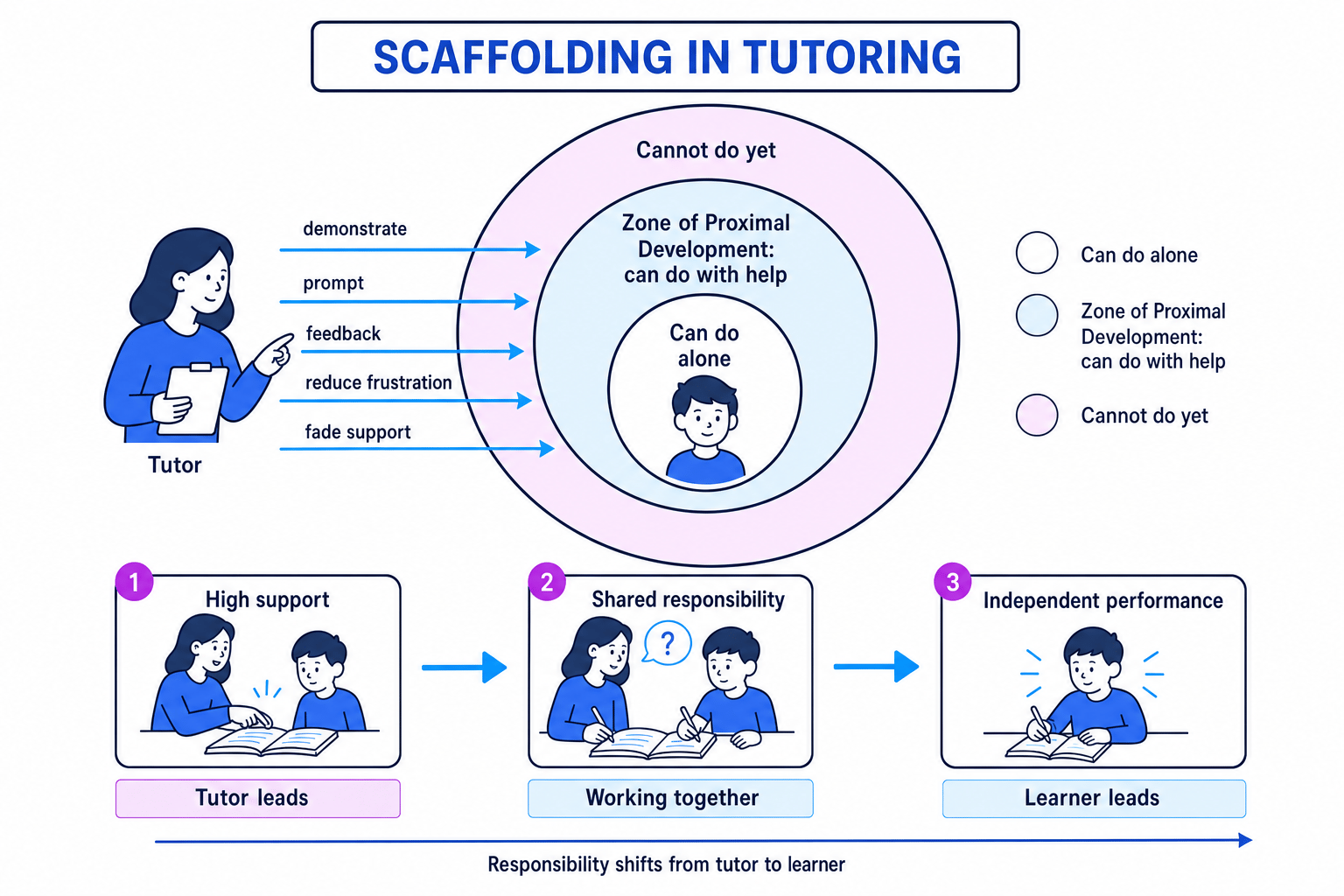
Applying the zone of proximal development
A teacher wants a child to write a paragraph evaluating a study.
- First, the teacher checks what the child can already do independently: the child can describe the study but cannot explain strengths and weaknesses.
- The teacher identifies the ZPD: writing an evaluation paragraph is not yet independent, but it is achievable with prompts and examples.
- The teacher gives scaffolding, such as sentence starters: “One strength is…” and “This improves validity because…”.
- Once the child can complete the paragraph with prompts, the teacher removes some support so the child has to choose the evaluation points alone.
- The aim is independent performance: the child can later write a new evaluation paragraph without the scaffold.
Scaffolding is not doing the task for the child
If the tutor simply gives the answer, the child may finish the task but may not develop the thinking needed to do it independently next time.
3. Key research: Wood, Bruner and Ross (1976)
The key study for this topic is Wood, Bruner and Ross (1976), “The role of tutoring in problem-solving.”
This study is important because it helped develop the concept of scaffolding in educational psychology.
Background to the study
Wood et al. were interested in how children learn to solve problems with help from an adult. Their work links closely to Vygotsky because it focuses on how support from a tutor can move a child from needing help to becoming more independent.
They wanted to understand what effective tutoring actually looks like in practice.
Method
Wood et al. used a controlled observation of children completing a construction task.
Design
The study compared children of different ages, so age acted as a naturally occurring variable. This means it was not a true experiment where children were randomly allocated to age groups.
Sample
The sample included 30 children, with ten children aged 3, ten aged 4 and ten aged 5.
Materials and task
Children were asked to build a three-dimensional pyramid-like structure using wooden blocks. The task was chosen because it was difficult enough to require problem-solving, especially for younger children.
Procedure
A tutor worked individually with each child. The tutor supported the child when they struggled, but the level of help varied depending on what the child seemed able to do.
The tutor could use different forms of support, such as:
- getting the child interested in the task
- simplifying the task
- keeping the child focused
- pointing out important features
- controlling frustration
- demonstrating part of the solution
These are often described as the functions of scaffolding.
Contingent tutoring
Effective tutoring is contingent, meaning the tutor changes the level of help depending on the learner’s performance: more help after difficulty, less help after success.
Results
Wood et al. found that younger children needed more direct support than older children. The 3-year-olds struggled most with the task, while the 5-year-olds were more able to work independently.
A key finding was that successful tutoring was not simply about giving lots of help. It was about giving the right amount of help at the right time.
The most effective tutor support was flexible. If a child made progress, the tutor reduced help. If a child struggled, the tutor increased help.
Conclusions
Wood et al. concluded that tutoring supports cognitive development when it is matched to the child’s current level of understanding.
The study supports the idea that education should not be one-size-fits-all. Children benefit when teachers adjust support, guide attention, model strategies and gradually hand responsibility back to the learner.
4. Evaluating Wood et al. (1976)
Strengths
One strength is practical usefulness. The study has clear applications to education because it shows teachers how to help children learn: use prompts, demonstrations and feedback, then fade support over time.
Another strength is that the task allowed researchers to observe problem-solving directly. This improves validity, because the study examined real behaviour rather than simply asking children what they could do.
The study also gives detailed insight into tutor-child interaction, which is useful for understanding the process of learning rather than just measuring the final score.
Weaknesses
A weakness is the small sample size. With only 30 children, it is difficult to generalise confidently to all children.
The task was also quite specific. Building a block structure may not represent all educational learning, such as reading, writing, maths or essay skills. This may limit ecological validity, which refers to how well findings apply to real-life settings.
There may also be observer bias if researchers interpreted children’s behaviour in a way that fitted their expectations about tutoring.
Ethnocentrism
Ethnocentrism means judging behaviour mainly from the viewpoint of one culture, which may make findings less valid for other cultural groups.
The study may be culturally limited because one-to-one adult tutoring is not equally common or equally valued in all cultures. In some classrooms, peer learning or whole-class teaching may be more typical.
Ethics
Because the participants were children, ethical care is especially important. Using the modern BPS Code of Human Research Ethics, researchers would need parental consent, child assent, protection from distress, confidentiality and the right to withdraw.
The task was low risk, but children could have felt frustrated if they could not complete it. A good tutor should reduce frustration and make sure the child does not feel like they have failed.
AO3 ethics phrase
For children, always mention the power imbalance: they may feel less able to say no, so consent and withdrawal need to be handled very carefully.
5. Application: improving revision and learning
The application part of this topic asks you to use cognitive psychology to improve education. One strong strategy is scaffolded retrieval practice.
Retrieval practice
Retrieval practice means deliberately trying to recall information from memory, rather than just re-reading notes.
Retrieval practice is useful because it strengthens memory and shows you what you do not yet know. It becomes even stronger when combined with scaffolding: you begin with support, then gradually remove it.
You can also add spacing, which means spreading revision across time rather than cramming in one long session.
Metacognition
Metacognition means awareness and control of your own thinking, such as planning how to revise, monitoring what you understand and evaluating what worked.
A scaffolded revision strategy might look like this:
- Start with a short self-test to find what you can do alone.
- Use prompts, diagrams or model answers for content that is in your ZPD.
- Attempt retrieval without notes.
- Check your answer and correct errors.
- Repeat later with fewer prompts.
- Eventually answer independently under timed conditions.
Designing a scaffolded revision session
A student can describe Wood et al. but struggles to evaluate it.
- Identify the independent level: the student can recall the aim, sample and procedure without notes.
- Identify the target skill: the student needs to explain evaluation points such as validity, sample bias and ethics.
- Choose scaffolds that match the ZPD: give the student three headings — “validity”, “sample” and “ethics” — plus one model sentence for each.
- Practise retrieval: the student writes one evaluation paragraph from memory, using only the headings.
- Fade the support: next session, remove the headings and ask the student to generate two strengths and two weaknesses independently.
Re-reading feels fluent
Re-reading notes can feel easy because the material looks familiar, but familiarity is not the same as recall. Retrieval practice is harder, but usually more useful.
6. How to write about this in essays
For AO1, describe the background theory clearly: cognitive development, Vygotsky, ZPD, scaffolding and Wood et al.
For AO2, apply the ideas to a new situation. For example, if a teacher gives hints, models an answer and gradually removes support, that is scaffolding. If a student uses cue cards first and then removes them, that is scaffolded retrieval.
For AO3, evaluate the evidence and application. You can discuss validity, reliability, ethics, sample bias, usefulness, ethnocentrism and whether the research is too reductionist.
Best overall evaluation
Wood et al. is highly useful for education, but its findings come from a small, specific task, so you should be cautious when generalising to all learning situations.
In the exam
- Structure applied-topic answers as background → key research → application → evaluation.
- Use the phrase “temporary support gradually removed” when defining scaffolding.
- For AO2 scenarios, ask: what can the learner do alone, what can they do with help, and how is support faded?
- For AO3, balance usefulness with limitations such as small sample, task specificity, ethics and cultural bias.
Check yourself
- What is the difference between the zone of proximal development and scaffolding?
- Why is Wood et al. (1976) useful for education?
- How could you turn retrieval practice into a scaffolded revision strategy?
