What you'll learn
- How exercise can improve mental health through biological mechanisms such as neurotransmitters, hormones and sleep.
- Why Parkinson’s disease is a useful context for studying exercise and mood.
- The key research: Lewis et al. (2014) on social dance sessions and mood changes in people with Parkinson’s disease.
- How to apply this research to design an exercise strategy for improving mental health.
Where this topic fits in H567
This is a Component 03 applied psychology topic in Sport and exercise psychology. That means you need three things:
- Background: general knowledge about exercise and mental health.
- Key research: the named study, Lewis et al. (2014).
- Application: using the evidence to suggest practical exercise strategies.
For essays, keep thinking in AO1, AO2 and AO3:
- AO1: describe the biological explanation, the study and the application.
- AO2: apply ideas to a new person, programme or scenario.
- AO3: evaluate evidence, ethics, validity and usefulness.
Mental health and exercise: the basics
Mental health
Mental health refers to emotional, psychological and social wellbeing. It includes mood, anxiety, stress, self-esteem, motivation, quality of life and ability to cope with everyday demands.
Exercise
Exercise is planned, structured physical activity carried out to improve or maintain health, fitness or wellbeing. It is different from general physical activity because it has a deliberate purpose.
Exercise is linked with lower symptoms of depression, anxiety and stress, and with higher self-esteem, sleep quality and quality of life. In sport and exercise psychology, you should avoid saying exercise “cures” mental illness. A safer claim is that exercise can be a helpful protective factor or supportive intervention, especially when matched to the person’s needs.
Acute and chronic effects
An acute effect is an immediate change after one exercise session. A chronic effect develops after repeated sessions over weeks or months.
Lewis et al. (2014) mainly investigated acute mood changes after social dance sessions, so do not overclaim that the study proves long-term treatment effects.
Overclaiming exercise effects
Do not write “exercise cures depression” or “dance cures Parkinson’s disease”. A stronger A-Level answer says exercise may improve mood and wellbeing, but effects vary and should be considered alongside medical and psychological support.
The biological explanation
The biological approach explains behaviour and mental health in terms of the body and brain. For this topic, the key idea is that exercise can change biological systems that influence mood.
Neurotransmitter
A neurotransmitter is a chemical messenger that carries signals between neurons in the nervous system. Examples linked to mood include dopamine, serotonin and noradrenaline.
Exercise may improve mood through several overlapping mechanisms:
Endorphins
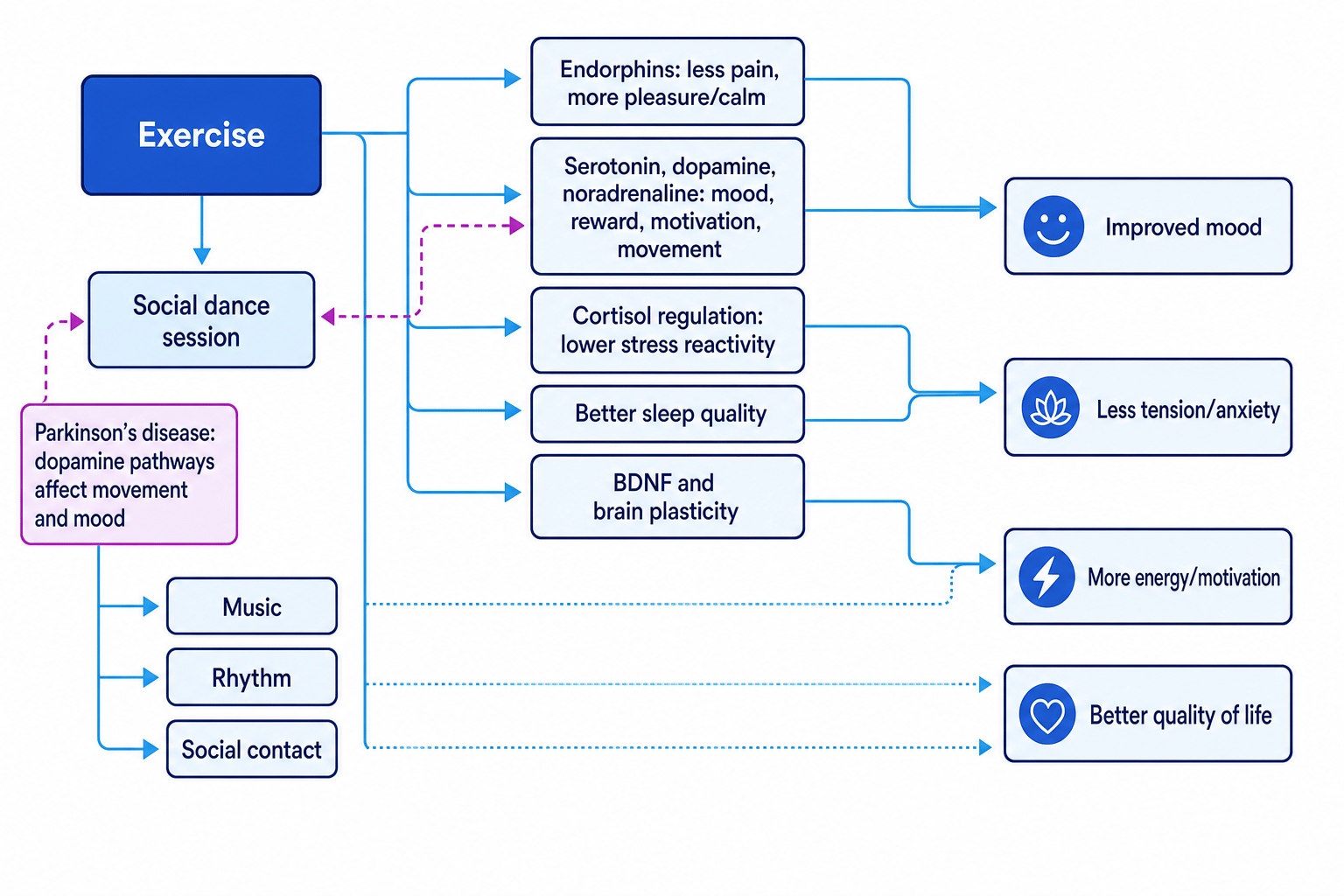
Endorphins are chemicals produced by the body that can reduce pain and create feelings of pleasure or calm. They are often linked to the “feel-good” effect after exercise.
Monoamines: serotonin, dopamine and noradrenaline
Serotonin is linked with mood regulation. Dopamine is linked with reward, motivation and movement. Noradrenaline is linked with alertness and arousal. Exercise may influence these neurotransmitter systems, which could help explain improvements in mood and motivation.
Cortisol and stress regulation
Cortisol is a hormone released during stress. Regular moderate exercise may help regulate stress responses, making the body less reactive to everyday stressors.
Sleep and recovery
Exercise can improve sleep quality for many people. Better sleep can then improve mood, attention and emotional control.
Brain plasticity and BDNF
Brain plasticity means the brain’s ability to change and adapt. Exercise may increase brain-derived neurotrophic factor, often shortened to BDNF, which supports growth and maintenance of neurons. This is one reason exercise is discussed as potentially useful for mental health and ageing.
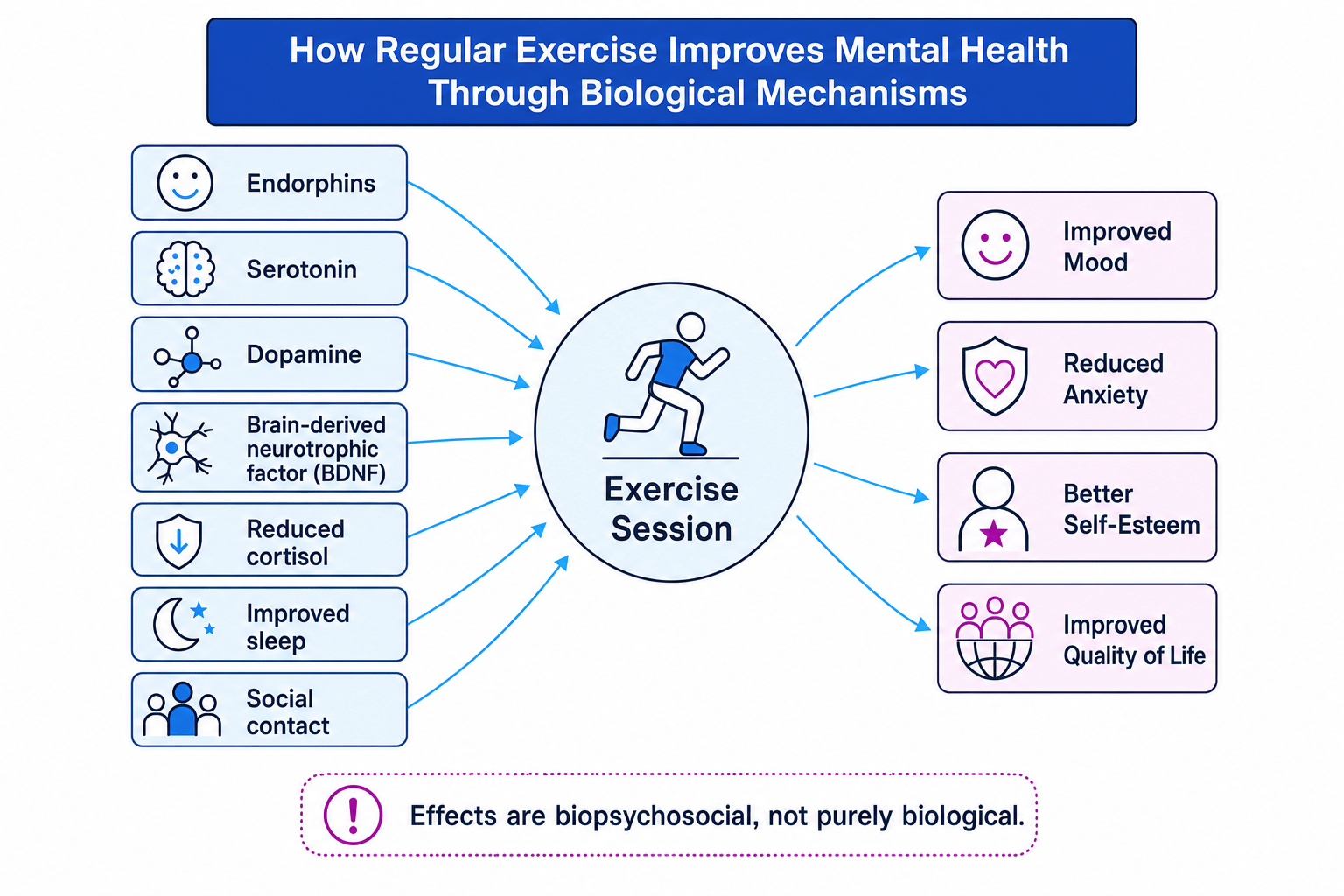
The diagram shows how these biological mechanisms connect to mental health outcomes, while also reminding you that social and psychological factors matter too.
Biopsychosocial, not just biological
Exercise affects the brain and body, but mental health improvements are usually biopsychosocial: biological changes interact with psychological factors such as confidence and social factors such as support from others.
Linking exercise to mood change
A student feels tense, sleeps badly and has low mood during exams. They start doing moderate exercise three times a week.
- Identify the likely biological targets. Tension and poor sleep suggest high stress arousal, so cortisol regulation and sleep improvement are relevant mechanisms.
- Link exercise to body and brain changes. Moderate exercise may increase endorphins and monoamine activity, while also helping the body settle into a better sleep-wake rhythm.
- Predict a cautious outcome. The student may feel calmer and more positive, but you should say exercise may help rather than guarantee improvement, because mood is affected by many other factors too.
Parkinson’s disease and mental health
Parkinson’s disease
Parkinson’s disease is a neurological condition involving loss of dopamine-producing neurons, especially in brain pathways involved in movement. Symptoms can include tremor, stiffness, slowness of movement and balance difficulties, as well as non-motor symptoms such as depression, anxiety and reduced quality of life.
Parkinson’s disease is relevant because it affects both movement and mood. A person may experience reduced independence, social isolation and anxiety about symptoms. Biologically, dopamine systems are also involved in both movement and reward, so exercise-based interventions are especially interesting.
Dance is a particularly useful form of exercise for people with Parkinson’s disease because it combines:
- movement and balance practice;
- rhythm and music, which can cue movement;
- social contact;
- enjoyment and self-expression;
- a structured routine.
Key research: Lewis et al. (2014)
The named study is Lewis et al. (2014), “Mood changes following social dance sessions in people with Parkinson’s Disease.”
Aim
The aim was to investigate whether taking part in social dance sessions was associated with changes in mood in people with Parkinson’s disease.
Method
This was a field study because it took place in a real social dance setting rather than a highly controlled laboratory. It used a repeated-measures design, meaning the same participants were measured before and after the activity.
The sample was a small volunteer or opportunity sample of people with Parkinson’s disease attending dance sessions, with the wider dance setting also involving others such as partners, carers or volunteers.
Participants completed a self-report mood measure before and after social dance sessions. A self-report measure asks participants to report their own feelings, often using rating scales or mood adjectives.
The dance sessions involved group-based social dance with music and interaction. The important comparison was mood before the session versus mood after the session.
Results
Overall, mood tended to improve after dance sessions. Participants reported more positive mood, such as feeling happier or more energetic, and lower negative mood, such as feeling less tense, angry, sad or confused.
A research methods link: because the data compare the same people before and after an activity, a suitable non-parametric test for ordinal mood ratings would often be the Wilcoxon Signed Ranks Test. If a study reports p<0.05p < 0.05p<0.05, this means the result is conventionally statistically significant: there is less than a 5% probability of the result occurring by chance if the null hypothesis is true.
Conclusions
Lewis et al. concluded that social dance can produce immediate positive mood changes in people with Parkinson’s disease. This supports the idea that exercise can benefit mental health, especially when the exercise is enjoyable, social and adapted to the participant group.
Best way to remember Lewis et al.
Think: Parkinson’s + social dance + before/after mood ratings + improved mood. That gives you the core AO1 structure.
Evaluating Lewis et al. (2014)
Strengths
The study has strong ecological validity because it took place in a real dance setting. This means the findings may apply well to real-life exercise programmes.
It is also highly useful. If social dance improves mood, it could be offered as a relatively low-cost, enjoyable intervention for people with Parkinson’s disease.
The repeated-measures design is useful because each participant acts as their own comparison. This reduces participant variables, such as personality or baseline mood, because the same people are measured before and after.
Weaknesses
The sample was small and self-selected. People who volunteer for dance sessions may already be motivated, sociable or positive about exercise. This creates sampling bias, so the findings may not generalise to all people with Parkinson’s disease.
The study relied on self-report mood ratings. These are useful for measuring subjective feelings, but they may be affected by demand characteristics, where participants guess the aim and report improvement because they think they are expected to.
There are also possible confounding variables. Mood improvement might be due to music, social contact, attention from instructors or simply leaving the house, rather than exercise alone.
Judging whether dance caused the mood improvement
- Start with the design. Mood was compared before and after dance in the same participants, so the study can show a change across the session.
- Check for alternative explanations. The change could be caused by dancing, but also by music, social interaction, expectation effects or support from the group.
- Reach a balanced conclusion. It is reasonable to say social dance is associated with improved mood, but less safe to claim dance alone definitely caused the improvement.
Ethics
The study involves people with a neurological condition, so researchers must follow the BPS Code of Human Research Ethics. This includes informed consent, right to withdraw, confidentiality and protection from harm.
Physical risk matters too. Dance sessions should be adapted to ability, with appropriate supervision, warm-up, cool-down and awareness of falls risk or fatigue.
Application: an exercise strategy to improve mental health
A strong application is a social dance programme for people experiencing low mood, anxiety or reduced quality of life, especially if they also face isolation or movement difficulties.
FITT principle
The FITT principle is a way to plan exercise: Frequency means how often, Intensity means how hard, Time means how long, and Type means the kind of exercise.
A possible strategy:
- Frequency: one or two supervised sessions per week.
- Intensity: light to moderate, so participants can still talk and feel safe.
- Time: around 45–60 minutes including warm-up and cool-down.
- Type: social dance with music, simple repeated movements, partner or group work, and seated or supported options if needed.
For mental health, the strategy should also include:
- choice of music and dance style to increase enjoyment;
- social support from instructors and peers;
- gradual progression to build confidence;
- mood monitoring before and after sessions;
- signposting to professional help if someone reports severe distress.
Designing a social dance plan
A community centre wants to support older adults with low mood and early Parkinson’s symptoms.
- Match the activity to the group. Because Parkinson’s can affect balance and movement speed, choose low-impact social dance with rhythm, repetition and optional seated movements.
- Apply FITT. Set one 60-minute supervised session each week at light-to-moderate intensity, with warm-up, dance practice, social break and cool-down.
- Link to biological and social benefits. Movement may support neurotransmitter activity and stress regulation, while music and group contact may improve motivation and reduce isolation.
- Build in evaluation. Ask participants to rate mood before and after sessions and monitor attendance, enjoyment and any fatigue or safety concerns.
When exercise is not enough
If someone has severe depression, suicidal thoughts, an eating disorder, or a medical condition that makes exercise risky, exercise should not be presented as a standalone solution. It should be part of a wider support plan involving qualified professionals.
Using this in essays
For AO1, describe the biological mechanisms and the Lewis et al. study clearly.
For AO2, apply the ideas to the exact person in the question. For example, if the scenario mentions isolation, explain why group exercise may be useful. If it mentions anxiety, link exercise to arousal and stress regulation.
For AO3, evaluate both the evidence and the application. Useful points include ecological validity, self-report bias, small samples, ethical protection, usefulness, and the fact that social dance is not purely biological.
In the exam
- For AO1, structure Lewis et al. as aim, method, results and conclusion: social dance, people with Parkinson’s disease, pre/post mood ratings, improved mood.
- For AO2, make every application specific: choose exercise type, frequency, intensity and why it fits the person’s symptoms or needs.
- For AO3, be balanced: exercise is useful and ethical when adapted, but evidence may be limited by self-report, sampling bias and confounding variables.
Check yourself
- Why is social dance a useful exercise strategy for people with Parkinson’s disease?
- What biological mechanisms could explain exercise-related mood improvement?
- What are two limitations of using Lewis et al. (2014) as evidence that exercise improves mental health?