What you'll learn
- What context-dependent memory means and why it matters for students.
- How Grant et al. (1998) tested memory using silence and background noise.
- The key method, results and conclusions you need for AO1.
- How to evaluate the study and compare it with Loftus and Palmer (1974).
First, the basic idea: memory uses cues
When you learn something, you do not only encode the “main content”. You may also encode extra information from the situation around you: the room, sounds, smells, lighting, or even your internal state.
A cue is anything that helps trigger retrieval of information from memory. For example, hearing a song might help you remember a holiday because the song was present when the memory was formed.
Context-dependent memory
Context-dependent memory is when recall is better if the external environment at retrieval matches the external environment at encoding.
In Grant et al. (1998), the key external context was auditory context: silence or background cafeteria noise.
Encoding and retrieval
Encoding is the process of putting information into memory. Retrieval is the process of accessing information from memory later.
The background: encoding specificity
Grant et al. were influenced by the encoding specificity principle, associated with Tulving. This principle suggests that memory is best when cues present at encoding are also present at retrieval.
A famous earlier example is Godden and Baddeley’s diver study, where divers remembered words better when learning and recall both happened in the same environment: either on land or underwater. Grant et al. wanted to test whether this effect also happens with more realistic student learning material.
The big takeaway
Grant et al. did not simply ask whether noise makes memory worse. They asked whether memory improves when the study context and test context match.
Noise is not the whole explanation
Do not write “noise reduced memory” as the main conclusion. The important finding was an interaction: performance was better when the learning and testing contexts were the same.
Aim of the study
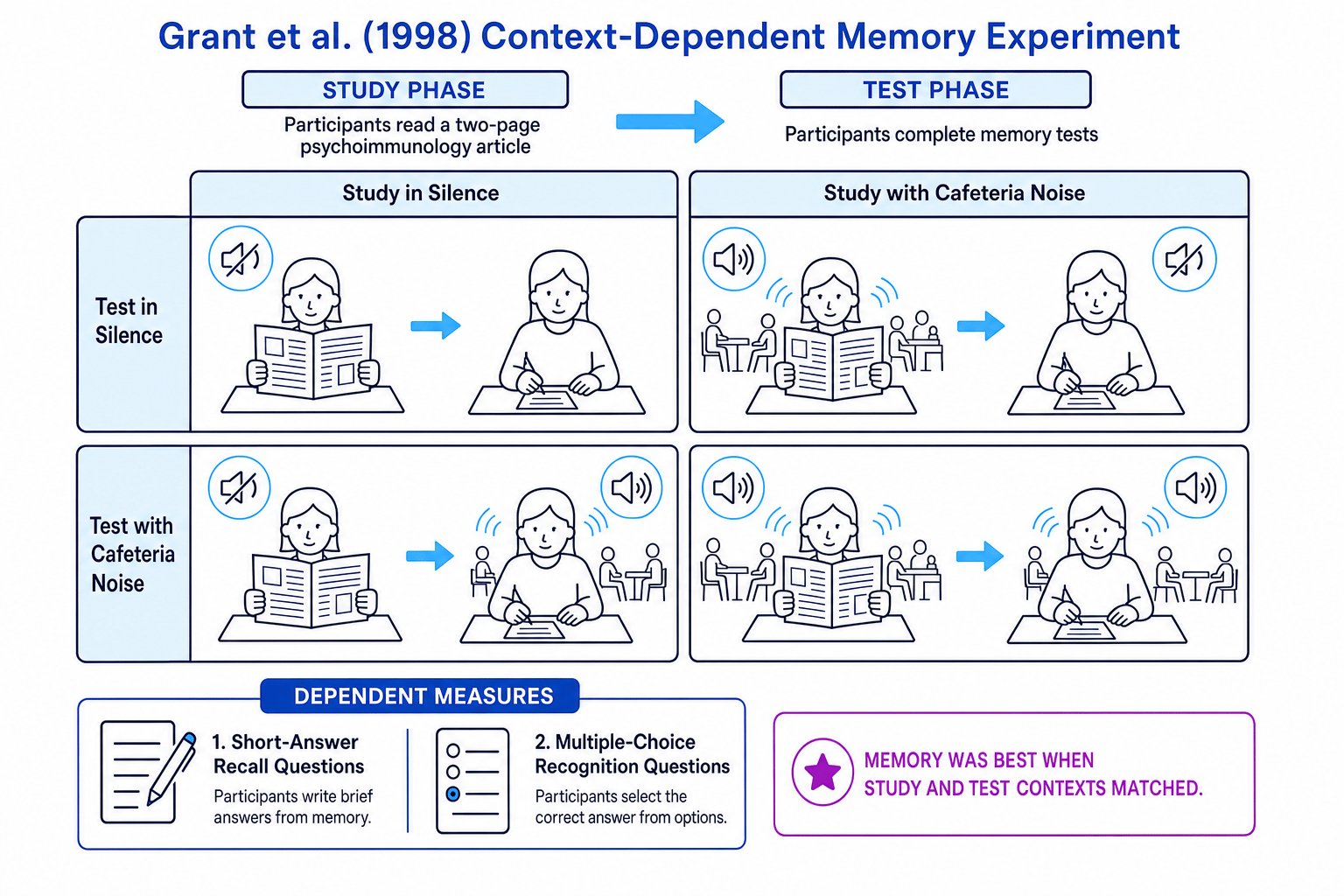
Grant et al. (1998) aimed to investigate whether context-dependent memory occurs for meaningful material: a two-page article, rather than just word lists.
They also wanted to see whether the effect appeared in two types of memory test:
- Recall, where participants have to produce the answer themselves.
- Recognition, where participants identify the correct answer from options.
Recall and recognition
Recall means retrieving information without being given the answer, such as a short-answer question. Recognition means identifying previously learned information, such as choosing the correct answer in a multiple-choice question.
Method: “tell the story”
Design
Grant et al. used a laboratory experiment, meaning the researchers manipulated variables in a controlled setting.
Independent variable and dependent variable
An independent variable is what the researcher changes. A dependent variable is what the researcher measures.
There were two independent variables:
- Whether participants studied in silence or with background cafeteria noise.
- Whether participants were tested in silence or with background cafeteria noise.
This created four conditions:
- Silent study / silent test.
- Silent study / noisy test.
- Noisy study / silent test.
- Noisy study / noisy test.
The dependent variables were:
- Score on a short-answer recall test.
- Score on a multiple-choice recognition test.
The study used an independent measures design, meaning each participant took part in only one condition.
Independent measures design
An independent measures design is where different participants are used in each experimental condition.
Sample
The sample was 56 undergraduate students: 39 female and 17 male. They were from an American university setting.
Participants were randomly allocated to one of the four conditions, with 14 participants in each condition.
Random allocation
Random allocation means assigning participants to conditions by chance, reducing the risk that one condition contains systematically “better” or “worse” participants.
Materials
The main materials were:
- A two-page article about psychoimmunology, chosen as meaningful but unfamiliar material.
- A recording of background cafeteria noise.
- Headphones, so the noise or silence could be controlled.
- A short-answer test.
- A multiple-choice test.
Procedure
Participants wore headphones during both the study phase and the test phase.
They read the article either in silence or with cafeteria noise. Later, they were tested either in silence or with the same type of cafeteria noise.
The short-answer test came before the multiple-choice test. This mattered because multiple-choice options could give clues that might help with later recall.
Why the test order matters
If participants completed the multiple-choice test first, the answer options might act as retrieval cues for the short-answer test. Putting recall first helped protect the recall measure.
Results
The key result was that participants performed better when the study and test contexts matched.
For short-answer recall, the commonly reported mean scores were approximately:
- Silent study / silent test: 6.7
- Silent study / noisy test: 5.4
- Noisy study / silent test: 4.6
- Noisy study / noisy test: 6.2
For multiple-choice recognition, the pattern was also better in matching conditions:
- Silent study / silent test: 14.3
- Silent study / noisy test: 12.7
- Noisy study / silent test: 12.7
- Noisy study / noisy test: 14.3
Quantifying the context match effect
-
Identify the matching conditions: silent study / silent test and noisy study / noisy test.
-
Average the matching short-answer scores:
Matching mean=6.7+6.22=6.45\begin{aligned} \text{Matching mean} &= \frac{6.7 + 6.2}{2} \\ &= 6.45 \end{aligned}Matching mean=26.7+6.2=6.45 -
Average the mismatching short-answer scores:
Mismatching mean=5.4+4.62=5.00\begin{aligned} \text{Mismatching mean} &= \frac{5.4 + 4.6}{2} \\ &= 5.00 \end{aligned}Mismatching mean=25.4+4.6=5.00 -
Compare the two averages:
Context match advantage=6.45−5.00=1.45\begin{aligned} \text{Context match advantage} &= 6.45 - 5.00 \\ &= 1.45 \end{aligned}Context match advantage=6.45−5.00=1.45 -
This supports context-dependent memory because the advantage comes from matching context, not simply from studying in silence.
Interaction effect
An interaction effect occurs when the effect of one independent variable depends on the level of another independent variable. In this study, the effect of study context depended on whether the test context matched it.
Conclusions
Grant et al. concluded that context-dependent memory can occur with meaningful learning material, not just artificial word lists.
The study suggests that environmental cues present during learning may become linked to the information being learned. When the same cues are present at retrieval, they help trigger memory.
For students, this has a practical message: if your exam will be in silence, revising in silence may be useful because the learning context is more similar to the retrieval context.
Student application
Grant et al. supports the advice that revision and testing conditions should be as similar as possible, especially for important learning.
Evaluation: strengths and weaknesses
Strength: high control
Because this was a laboratory experiment, Grant et al. could control key variables. For example, all participants used headphones, and the same article and noise recording were used.
This improves reliability, meaning the procedure could be repeated in the same way.
Reliability
Reliability refers to consistency. A reliable study produces similar results when repeated under similar conditions.
Weakness: independent measures and participant variables
Because each participant only took part in one condition, individual differences may have affected results. Some participants may have had better reading ability, stronger motivation, or more prior knowledge.
Random allocation helps reduce this problem, but it does not remove it completely.
Strength: more ecological validity than many memory studies
The study used meaningful written material, similar to what students might read when studying. This gives it more ecological validity than studies using random word lists.
Ecological validity
Ecological validity is the extent to which a study reflects real-life behaviour or settings.
Weakness: still artificial
Although the article was meaningful, the setting was still controlled and short-term. Real revision may happen over days or weeks, and real exams involve pressure, timing, and more complex knowledge.
So, the study is useful, but it does not perfectly recreate real education.
Sampling bias
The sample consisted of American undergraduate students, with more females than males. This limits population validity, meaning the findings may not generalise fully to all ages, cultures, or educational backgrounds.
Sampling bias
Sampling bias occurs when a sample is not representative of the wider target population.
Ethnocentrism
The study was conducted in a Western university context. The basic cognitive process may be universal, but the specific setting — students reading an academic article and taking a test — is culturally specific.
So, the study is not strongly ethnocentric in its theory, but its sample and educational context are culturally narrow.
Ethics
The study has relatively few ethical concerns. Participants were adults, the task was low risk, and the background noise was not harmful.
Using the BPS Code as a guide, the study appears fairly strong on:
- Respect, because participants should be treated with dignity and allowed to withdraw.
- Responsibility, because the noise should not cause distress or harm.
- Integrity, because any deception or withholding of the full aim would need to be justified and followed by debriefing.
Comparison with Loftus and Palmer (1974)
Grant et al. is the contemporary study in the Memory theme. Its paired classic study is Loftus and Palmer (1974).
Loftus and Palmer investigated how leading questions affect eyewitness memory. Participants watched film clips of car crashes and then answered questions. Changing the verb, such as “hit” or “smashed”, affected speed estimates and later reports of broken glass.
Similarities
Both studies are in the Cognitive area because they investigate internal mental processes through observable behaviour.
Both used controlled experimental methods and collected quantitative data. This makes them more scientific and easier to replicate.
Both also show that memory is not like a perfect recording. Memory can be influenced by other factors: wording in Loftus and Palmer, and environmental context in Grant et al.
Differences
Loftus and Palmer focused on reconstructive memory, especially how post-event information can distort recall. Grant et al. focused on retrieval cues, showing that matching context can improve access to stored information.
Loftus and Palmer has stronger application to the legal system and eyewitness testimony. Grant et al. is more directly useful for education and revision.
Grant et al. has fewer ethical issues because reading an article with background noise is unlikely to cause distress. Loftus and Palmer involved crash films, which could be mildly upsetting, although still low risk compared with real accidents.
Do not mix up the two memory studies
Loftus and Palmer is about leading questions changing memory. Grant et al. is about matching contexts improving memory.
Link to the Cognitive area
The Cognitive area studies mental processes such as memory, attention, perception, and thinking. These processes cannot be directly observed, so psychologists infer them from behaviour.
Grant et al. measured memory using test scores. The researchers could not see memory directly, but they could compare performance across conditions.
This fits the Cognitive area because it treats memory as an information-processing system affected by encoding and retrieval cues.
Reductionism
Reductionism means explaining complex behaviour by breaking it down into smaller parts. Grant et al. reduces memory performance to test scores across controlled conditions.
This reductionism is useful because it allows scientific testing, but it may oversimplify real learning, where motivation, emotion, sleep, stress, and teaching quality also matter.
AO2: applying Grant et al. to a new situation
If a student revises every evening with loud music and then sits an exam in silence, Grant et al. would predict a possible disadvantage because the study and test contexts do not match.
However, this does not mean the student should play music in the exam. The more sensible application is to practise retrieval in conditions similar to the exam: quiet, timed, and without extra cues.
Applying context-dependent memory to revision
-
Identify the encoding context: the student learns biology notes while listening to loud music.
-
Identify the retrieval context: the student sits the exam in a silent hall.
-
Compare the contexts: loud music and silence are mismatched auditory contexts.
-
Apply Grant et al.: memory may be weaker because the environmental cues present during learning are absent during retrieval.
-
Give practical advice: the student should include some silent revision and timed practice so the learning context becomes more similar to the exam context.
Final judgement
Grant et al. is a well-controlled and useful study showing that context can affect memory. Its main strength is that it tested a real-world issue using meaningful material while still maintaining experimental control.
Its main limitation is generalisability: the sample was narrow, and the task was still simpler than real long-term study and examination. For essays, a balanced conclusion is best: the study is scientifically useful, but its application to everyday learning should be made carefully.
In the exam
-
For AO1, tell the story clearly: aim, sample, design, materials, procedure, results, conclusions.
-
For AO2, apply the idea of matching versus mismatching context to the scenario rather than just saying “noise affects memory”.
-
For AO3, evaluate both sides: strong control and reliability, but limited ecological validity, sampling bias, and some issues with generalising to real education.
Check yourself
- What were the four conditions in Grant et al.’s experiment?
- Why is the main finding an interaction rather than simply an effect of noise?
- How is Grant et al. different from Loftus and Palmer’s study of eyewitness memory?
