Welcome to your study notes for one of the most famous, influential, and controversial investigations in the history of psychology: Stanley Milgram's (1963) Behavioral Study of Obedience. This classic study forms a cornerstone of the Social Area in your OCR A-Level specification under the key theme of Responses to people in authority.
What you'll learn
- The historical context and theories that prompted Milgram to study destructive obedience.
- How Milgram designed and conducted his controlled laboratory observation.
- The startling quantitative and qualitative results that shook the psychological community.
- How to evaluate the study's ethics, validity, reliability, and sampling issues for your exam.
1. Background to the Study
To understand why Milgram set up this study, we must look back to the historical context of the mid-20th century. Following World War II and the horrors of the Holocaust, many people struggled to understand how ordinary citizens could participate in the systematic murder of millions of people.
At the time, the prevailing view was the dispositional hypothesis.
Dispositional Hypothesis
The dispositional hypothesis argues that an individual's behavior is caused by their unique, internal personality characteristics (their "disposition") rather than external factors.
In the context of WWII, many Westerners believed in the "Germans are different" hypothesis—the idea that German people possessed a unique personality flaw that made them unusually submissive to authority and prone to destructive obedience.
Milgram, a Jewish-American psychologist at Yale University, questioned this assumption. He proposed an alternative view: the situational hypothesis.
Situational Hypothesis
The situational hypothesis argues that behavior is primarily determined by the immediate environment, social context, and external pressures of a situation, rather than an individual's personality traits.
The Core Question
Milgram wanted to test whether ordinary individuals would obey an authority figure's instructions to administer severe, potentially lethal electric shocks to an innocent person, simply because they were told to do so by an authority figure in a laboratory setting.
2. Methodology
OCR requires you to "tell the story" of the study. Let's break down the method into its key components.
Research Design
Milgram’s study is often loosely referred to as an "experiment," but strictly speaking, it is a controlled laboratory observation.
This is because there was no active Independent Variable (IV) being manipulated in the baseline 1963 study. All participants underwent the exact same conditions to see how far down the "shock scale" they would go (the Dependent Variable).
The Sample
- Participants: 40 males, aged 20 to 50 years.
- Location: New Haven, Connecticut, USA.
- Sampling Technique: Self-selected (volunteer) sampling. Milgram placed a newspaper advertisement and sent direct mail out to local residents.
- Incentive: Participants were offered $4.50 (equivalent to roughly $40 today) simply for turning up, regardless of whether they completed the study.
- Demographics: The sample was diverse, including postal clerks, high school teachers, salesmen, engineers, and laborers. This avoided using only university students, which was common in research at the time.
Confusing the Sample
Students often write that the sample consisted of "students from Yale University." This is incorrect! While the study was conducted at Yale University, the participants were local men from the surrounding community with a wide range of occupations.
Apparatus and Laboratory Layout
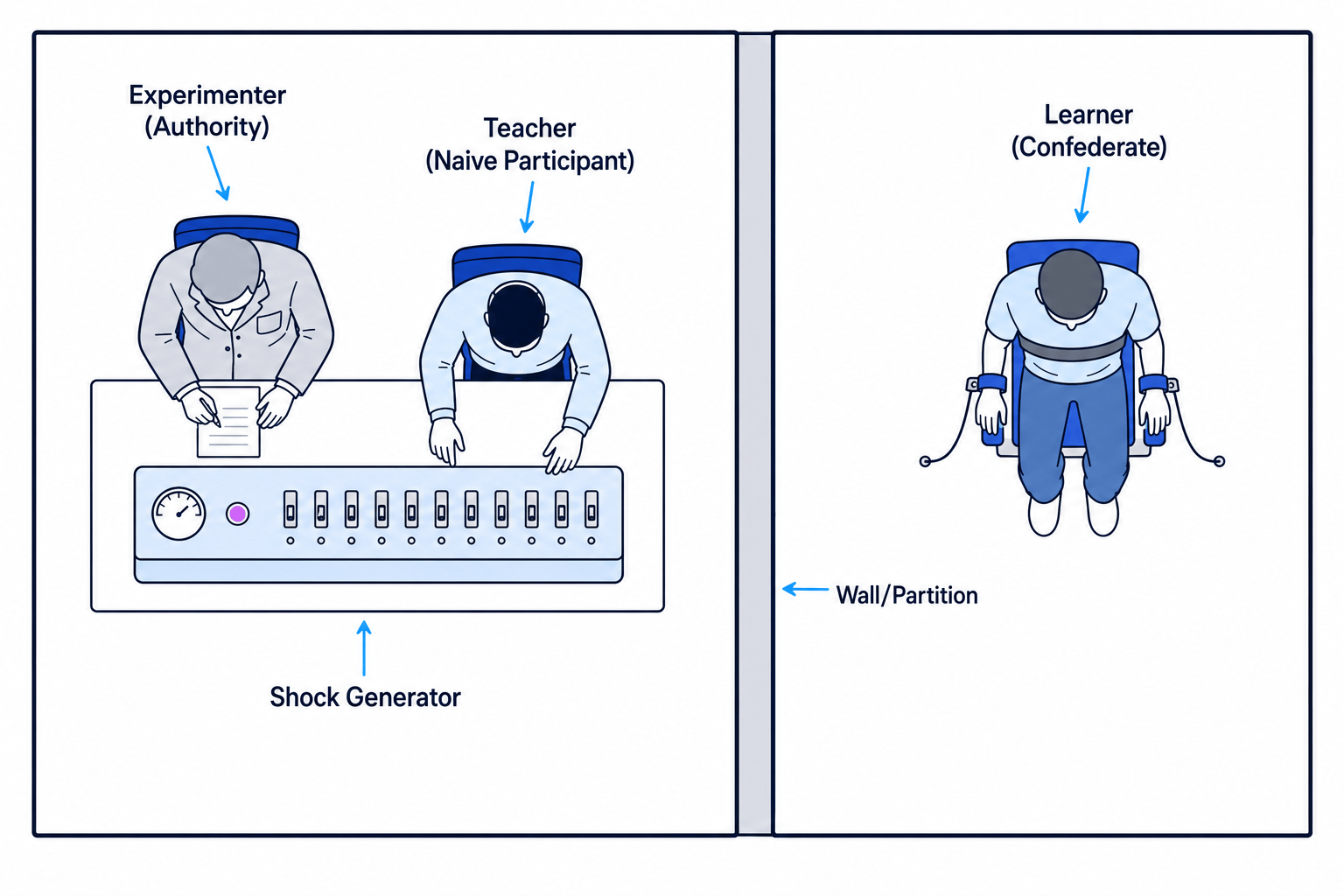
The study took place in a prestigious laboratory at Yale University. The key piece of equipment was a realistic, custom-built shock generator.
- The generator had 30 toggle switches arranged in a horizontal line.
- The switches started at 15 Volts (V) and increased in increments of 15V up to 450V.
- Labels were clearly printed below groups of switches, ranging from "Slight Shock" (15V) to "Danger: Severe Shock" (375V) and finally an ominous "XXX" (435V and 450V).
To help visualize how the interaction took place, examine the laboratory layout below:
3. The Procedure Step-by-Step
The procedure was highly standardized and executed with theatrical precision to ensure participants fully believed the setup was real.
Step 1: The Cover Story and the "Draw"
When a participant arrived, they met another "participant" who was actually a confederate (an actor working for the researcher) named Mr. Wallace, a mild-mannered, 47-year-old accountant.
The Experimenter (played by a stern, biology teacher dressed in a grey technician's coat) explained that the study was investigating "the effects of punishment on learning."
The participant and confederate drew slips of paper from a hat to determine who would be the "Teacher" and who would be the "Learner." However, the draw was rigged: both slips of paper said "Teacher," meaning the genuine participant was always assigned the role of the Teacher, and the confederate was always the Learner.
Step 2: Setting up the Learner
The Learner was taken into an adjacent room, strapped into a chair to prevent excessive movement, and had an electrode attached to his wrist.
To make the shocks believable, the Experimenter gave the Teacher a sample shock of 45V (delivered by a battery wired into the generator). This was the only real shock delivered in the entire study.
Step 3: The Learning Task
The Teacher was seated in front of the shock generator in the main room. Their task was to read a series of word-pairs to the Learner over an intercom system (e.g., blue-box, nice-day).
The Teacher would then read the first word (e.g., blue) along with four multiple-choice options. The Learner had to indicate his answer by pressing one of four switches, which lit up a corresponding box on top of the shock generator.
Step 4: Administering the Shocks
The rules explained by the Experimenter were strict:
- Every time the Learner made a mistake, the Teacher had to administer an electric shock.
- The shock level had to increase by 15V for each subsequent mistake.
- The Teacher was instructed to announce the voltage level before flipping the switch.
Step 5: Standardized Responses and "Prods"
The Learner’s answers were predetermined: he gave approximately three wrong answers for every correct one. As the voltage increased, the Learner (who was actually a taped voice recording synchronized with the switches) began to protest:
- At 300V, the Learner pounded loudly on the wall of the room.
- From 315V onward, the Learner was completely silent and stopped responding to the multiple-choice questions altogether.
If the Teacher hesitated or asked to stop, the Experimenter was trained to deliver four standardized verbal prods in a firm, calm voice:
- Prod 1: "Please continue." or "Please go on."
- Prod 2: "The experiment requires that you continue."
- Prod 3: "It is absolutely essential that you continue."
- Prod 4: "You have no other choice, you must go on."
If the participant refused to obey after Prod 4, the experiment was terminated. Otherwise, it ended when they administered the maximum 450V shock three times in a row.
4. Key Results
Milgram gathered both quantitative (numerical) and qualitative (descriptive) data.
Quantitative Data
Before the study, Milgram asked 14 Yale University psychology seniors to predict how many participants would administer the maximum 450V shock. They estimated that only a tiny fraction—between 1% and 3%—would go all the way.
The actual results completely contradicted these predictions:
- 100% (40/40) of participants continued up to 300V.
- 65% (26/40) of participants went all the way to 450V (they were fully obedient).
- 35% (14/40) of participants defied the experimenter and stopped between 300V and 450V.
Quantitative Clarity
Make sure you memorize these two key figures: 100% to 300V and 65% to 450V. They are highly likely to show up in multiple-choice or short-answer AO1 questions!
Qualitative Data
Milgram observed extreme physical and emotional tension in his participants. These qualitative observations proved that the participants were not cold-blooded sadists, but were caught in a severe conflict between their moral values and their perceived obligation to authority.
- Participants showed signs of sweating, trembling, stuttering, and biting their lips.
- Frequent groaning and nervous laughing fits were recorded.
- Three participants experienced full-blown uncontrollable seizures due to the extreme stress.
5. Calculations and Research Methods Application
In Component 01 (Research Methods) and Component 02 (Core Studies), you are expected to understand descriptive statistics, levels of measurement, and how to apply them to core study data.
Let's look at how we can analyze Milgram's quantitative data using A-Level Research Methods principles.
Analyzing obedience rates and levels of measurement
Suppose an exam question asks you to identify the level of measurement for Milgram's primary dependent variable (whether a participant was fully obedient or disobedient) and calculate the percentage of obedient participants from the raw data.
Step 1: Identify the level of measurement. The dependent variable of "fully obedient" versus "disobedient" categorizes participants into distinct, mutually exclusive groups. Because this is categorical data without any inherent order or numerical value, the level of measurement is nominal data.
Step 2: State the formula for calculating percentages. Write down the percentage formula clearly:
Percentage=(Frequency of CategoryTotal Sample Size)×100 \text{Percentage} = \left( \frac{\text{Frequency of Category}}{\text{Total Sample Size}} \right) \times 100 Percentage=(Total Sample SizeFrequency of Category)×100Step 3: Substitute Milgram's raw figures into the formula. The frequency of participants who administered the maximum 450V was 262626, and the total sample size NNN was 404040.
Percentage=(2640)×100 \text{Percentage} = \left( \frac{26}{40} \right) \times 100 Percentage=(4026)×100Step 4: Solve the equation. First, divide 262626 by 404040, which gives 0.650.650.65. Then, multiply by 100100100:
0.65×100=65% 0.65 \times 100 = 65\% 0.65×100=65%Thus, the percentage of fully obedient participants is 65%65\%65%.
6. Milgram's Conclusions
Milgram drew two main conclusions from his findings:
- The power of the situation overrides individual morality: Normal, everyday individuals are highly susceptible to obeying destructive instructions when placed in a situation with a legitimate authority figure.
- Obedience is driven by a state of conflict: People experience intense psychological conflict when obeying commands that violate their personal moral frameworks, yet they struggle to break free from the social constraints of the situation.
Milgram argued several situational factors contributed to this high level of obedience:
- The prestigious reputation of Yale University.
- The perceived worthiness and scientific value of the study.
- The belief that the Learner had volunteered and consented to participate.
- The obligation created by being paid ($4.50) just for turning up.
7. Evaluating Milgram (AO3)
Evaluating core studies is crucial for your longer essay questions. Let’s look at the strengths and weaknesses of Milgram's study across key evaluation criteria.
Ethical Issues
Milgram’s study is famous for its ethical compromises. If evaluated under the modern British Psychological Society (BPS) Code of Ethics, it would not be allowed today:
- Deception: Participants were lied to about the aim of the study, the rigged draw, and whether the shocks were real.
- Protection of Participants: Participants were subjected to immense psychological distress (sweating, shaking, seizures), which represents a failure to protect them from harm.
- Right to Withdraw: The verbal prods (e.g., "You have no other choice, you must go on") made it incredibly difficult for participants to exercise their right to withdraw.
The Ethics Defense
While these criticisms are highly valid, do not forget Milgram's defense: he thoroughly debriefed all participants, introduced them to the healthy Learner, and followed up a year later with a psychiatrist. 84% of participants reported they were glad or very glad to have participated.
Validity
- Ecological Validity (Low): The task of delivering electric shocks to a stranger in a laboratory for failing a word-association test is highly artificial and does not reflect real-world obedience.
- Internal Validity: Did the participants genuinely believe they were harming someone? Orne and Holland argued that participants showed demand characteristics, guessing that the shocks were fake. However, the extreme physical reactions (seizures, sweating) suggest they truly believed the scenario was real.
Reliability
- High Standardized Reliability: The procedure was highly standardized (same script, same taped responses, same prods, same setting). This makes the study highly replicable, and Milgram successfully repeated it with many variations (e.g., changing the setting, proximity of the experimenter).
Sampling Bias and Ethnocentrism
- Androcentric (Gender Bias): The 1963 sample used only males. We cannot assume females would behave the same way (though Milgram later ran a variation with females and found an identical 65% obedience rate).
- Ethnocentric: The sample was drawn entirely from New Haven, USA, presenting a individualistic, Western view of obedience.
8. Linking to Areas, Themes, and Debates
To get top marks in Section B and C of Component 02, you must link the study to broader psychological concepts.
Connection to the Social Area
The Social Area assumes that our behavior is deeply influenced by the actual, imagined, or implied presence of others. Milgram's study fits perfectly here because it demonstrates how a participant's behavior (administering shocks) was directly dictated by the presence of an authority figure (the Experimenter), completely overriding their internal personal morals.
Connection to the Key Theme: Responses to People in Authority
Milgram's study shows that people will obey commands to harm an innocent person if the command comes from an individual perceived to have legitimate authority. It highlights that obedience is a product of situational forces rather than individual malice.
The Individual vs. Situational Debate
Milgram’s findings strongly support the situational explanation of behavior. Despite being normal citizens with no history of violence, the pressure of the prestigious environment, scientific context, and verbal prods caused them to act destructively. However, it also points to individual differences: 35% of the participants resisted the situational pressures and refused to go to 450V, showing that personal values or personality traits can play a role in defiance.
9. Comparing Milgram with Bocchiaro et al. (2012)
In your OCR exam, you will be asked to compare the classic study (Milgram) with its paired contemporary study (Bocchiaro et al., 2012).
| Feature | Milgram (1963) - Classic | Bocchiaro et al. (2012) - Contemporary |
|---|---|---|
| Focus | Physical obedience (delivering shocks). | Verbal/written obedience and whistleblowing (writing a supportive letter for an unethical study). |
| Sample | 40 community males (aged 20–50). | 149 university students (96 female, 53 male). |
| Location | Yale University, USA. | VU University, Amsterdam, Netherlands. |
| Method | Controlled laboratory observation. | Scenario study / Laboratory observation. |
| Key Finding | 65% fully obedient. | 76.5% fully obedient (significantly higher than predicted). |
In the exam
- Always use the term "destructive obedience" when describing what Milgram was measuring. It shows a sophisticated understanding of the psychological consequences of their actions.
- Be precise with your percentages: Remember that 100%100\%100% of participants reached 300V300\text{V}300V, and 65%65\%65% went to the full 450V450\text{V}450V. Misquoting these numbers is a common way to lose easy AO1 marks.
- Differentiate between design types: If asked about research design, specify that it is a controlled observation rather than a true experiment, because there was no Independent Variable (IV) being manipulated in the main 1963 study.
- Link explicitly to the Social Area: When asked how Milgram relates to the Social Area, make sure to state that it shows how the environment (the presence of an authority figure and prestigious Yale lab) alters behavior, conforming to the social context rather than individual personality traits.
Check yourself
- Can you list the four standardized verbal prods used by the Experimenter in the exact order they were delivered?
- Why is Milgram's study considered a "controlled observation" rather than a "true laboratory experiment"?
- How did the results of Milgram's study challenge the "Germans are different" (dispositional) hypothesis?
