What you'll learn
- How early visual input can shape the developing brain.
- The full AO1 “story” of Blakemore and Cooper (1970): background, method, results and conclusions.
- How to evaluate the study using validity, reliability, ethics and sampling issues.
- How to compare it with Maguire et al. (2000) for the key theme of brain plasticity.
The big idea: brain plasticity
Blakemore and Cooper (1970) is a classic core study in the Biological area of OCR H567. It sits under the key theme of brain plasticity.
Brain plasticity
Brain plasticity is the brain’s ability to change its structure or function as a result of experience, development, learning or damage.
This study matters because it suggests that the visual environment during early development can affect how the brain processes the world later on. In other words, perception is not only “built in”; it can also be shaped by experience.
The main takeaway
Blakemore and Cooper found that kittens reared with only one type of visual input developed brains that responded mainly to that type of input, showing that early experience can shape the visual cortex.
Prerequisite ideas
The visual cortex
The visual cortex is the area at the back of the brain that processes visual information, such as edges, movement, shape and orientation.
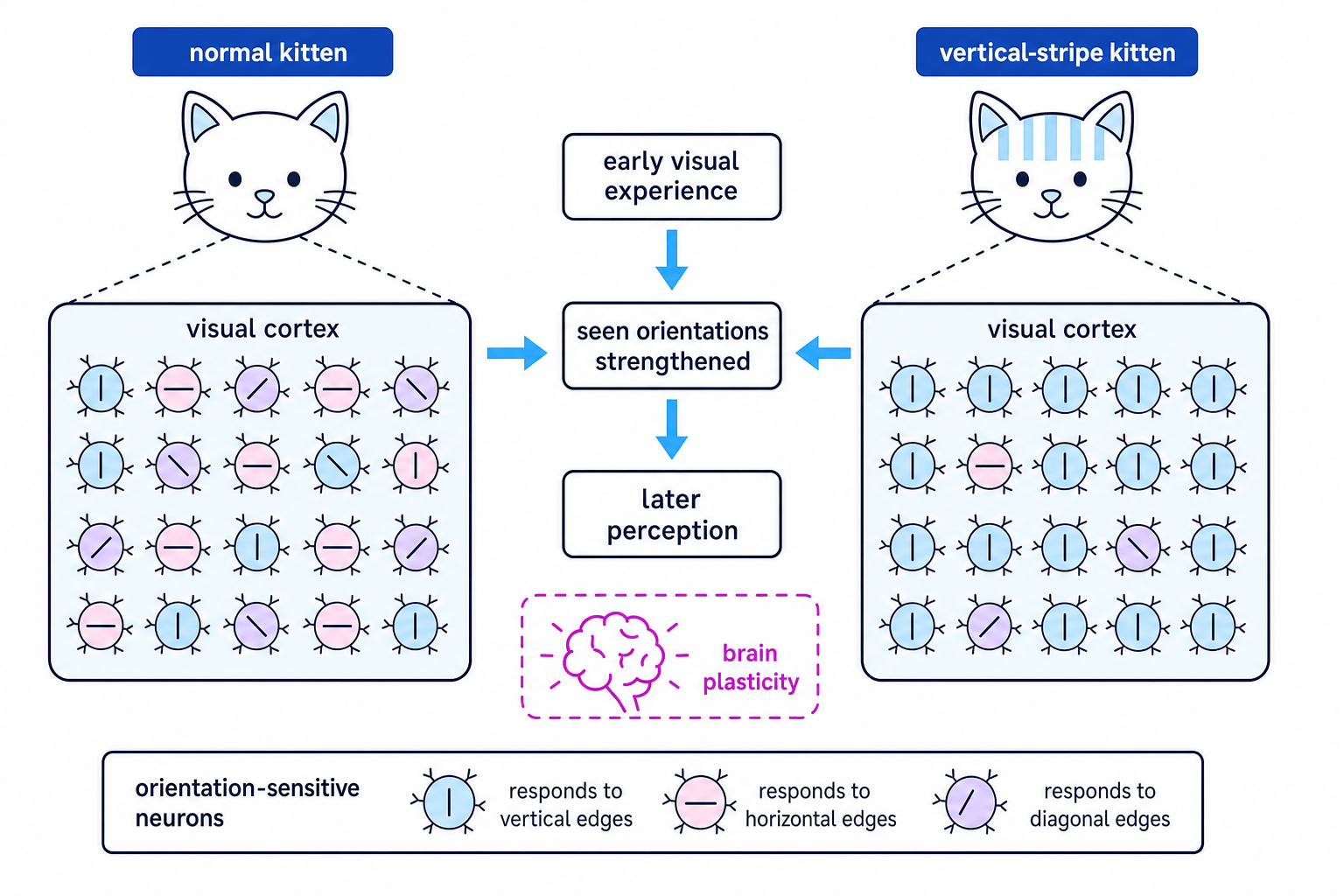
A neuron is a nerve cell that transmits information using electrical and chemical signals. Some neurons in the visual cortex are orientation-sensitive, meaning they respond best to lines or edges at a particular angle, such as vertical, horizontal or diagonal.
Orientation-sensitive neuron
An orientation-sensitive neuron is a neuron in the visual cortex that fires most strongly when it detects an edge or line at a particular angle.
Normally, an animal’s visual cortex contains neurons that respond to many different orientations. Blakemore and Cooper tested whether this pattern depends on early visual experience.
Sensitive periods
A sensitive period is a stage of development when the brain is especially responsive to particular experiences. If the right stimulation is missing during this period, later development may be affected.
You may also see the term critical period, which is often used when a developmental window is treated as more strict or biologically necessary.
Background to the study
Before Blakemore and Cooper, biological psychologists already knew that the visual cortex contained neurons that responded to specific features, including line orientation. The question was: are these neural responses fixed from birth, or can they be shaped by early visual experience?
Blakemore and Cooper used kittens because cats have a well-studied visual system and, like humans, they rely heavily on vision. However, this immediately raises an AO3 issue: findings from cats may not apply perfectly to humans.
Aim
The aim of Blakemore and Cooper (1970) was to investigate whether early visual experience affects the development of the visual cortex and later visual perception.
More specifically, they wanted to see whether kittens raised in an environment containing only vertical or only horizontal lines would later be able to perceive both types of orientation.
Method: telling the AO1 story
Design
This was a laboratory experiment, meaning it took place in a highly controlled setting.
An independent variable, or IV, is the factor deliberately changed by the researcher. Here, the IV was the type of visual environment: vertical stripes or horizontal stripes.
A dependent variable, or DV, is what the researcher measures. Here, the DVs included:
- the kittens’ behaviour when later placed in a normal visual environment
- the responses of neurons in the visual cortex
Sample
The participants were kittens. The sample was small and non-human, which is important for evaluation. The study is therefore strong for control but weaker for generalising to humans.
Apparatus and materials
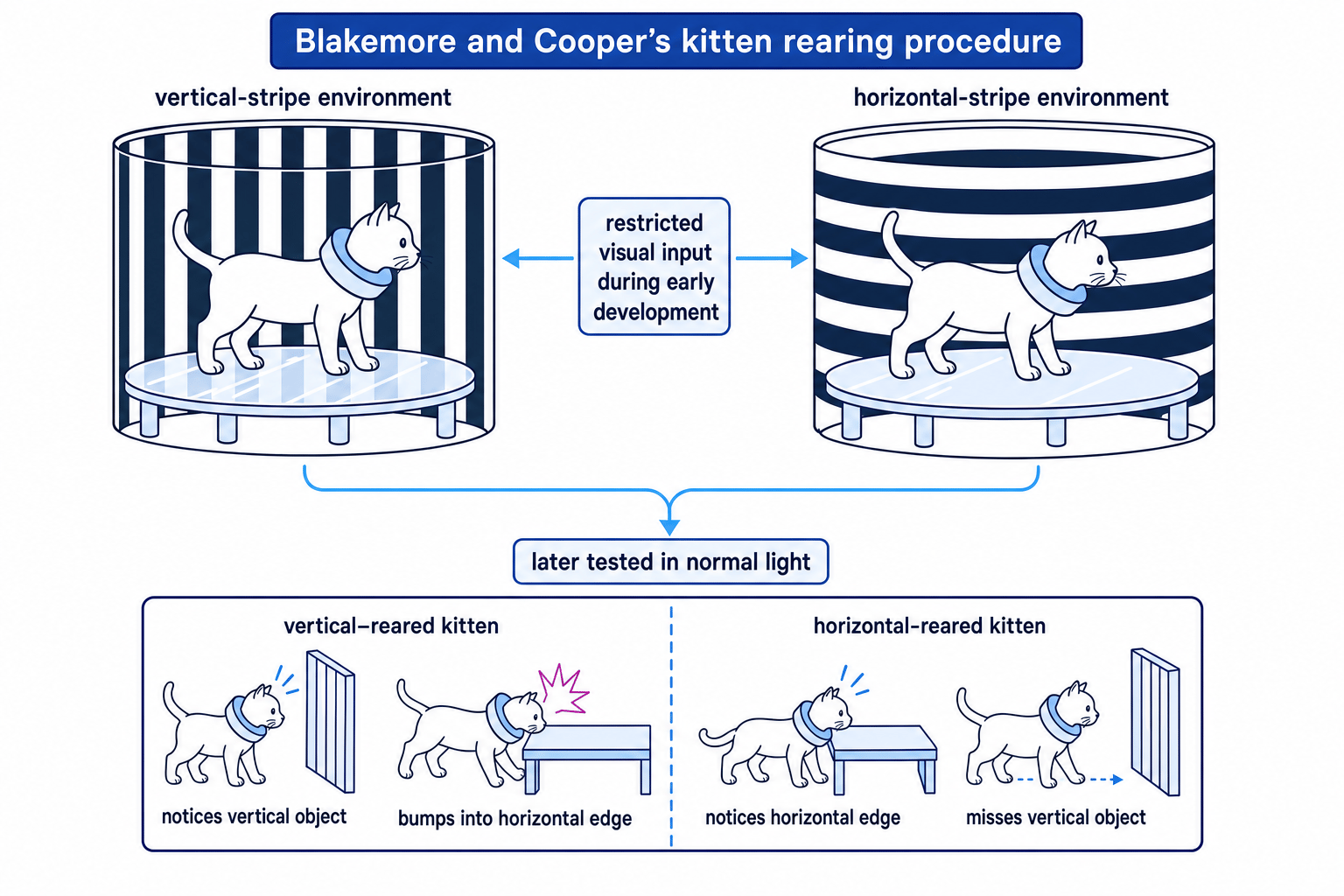
The kittens were reared in special cylindrical environments. The inside walls were covered with either vertical black-and-white stripes or horizontal black-and-white stripes.
The kittens wore collars that prevented them from seeing their own bodies, and they stood on a clear platform. This meant their visual input was restricted mainly to the striped pattern around them.
Procedure
From early life, the kittens were kept in darkness except for controlled exposure to one of the striped environments. They spent time each day in either the vertical-stripe cylinder or the horizontal-stripe cylinder.
After several months, they were placed in a normally lit room and observed. Researchers looked at how they responded to objects, edges and visual threats.
Finally, the researchers examined neural responses in the visual cortex to see which orientations the neurons responded to.
AO1 memory hook
Think: dark rearing → striped cylinder → normal room test → visual cortex recordings. That sequence helps you tell the story clearly.
Results
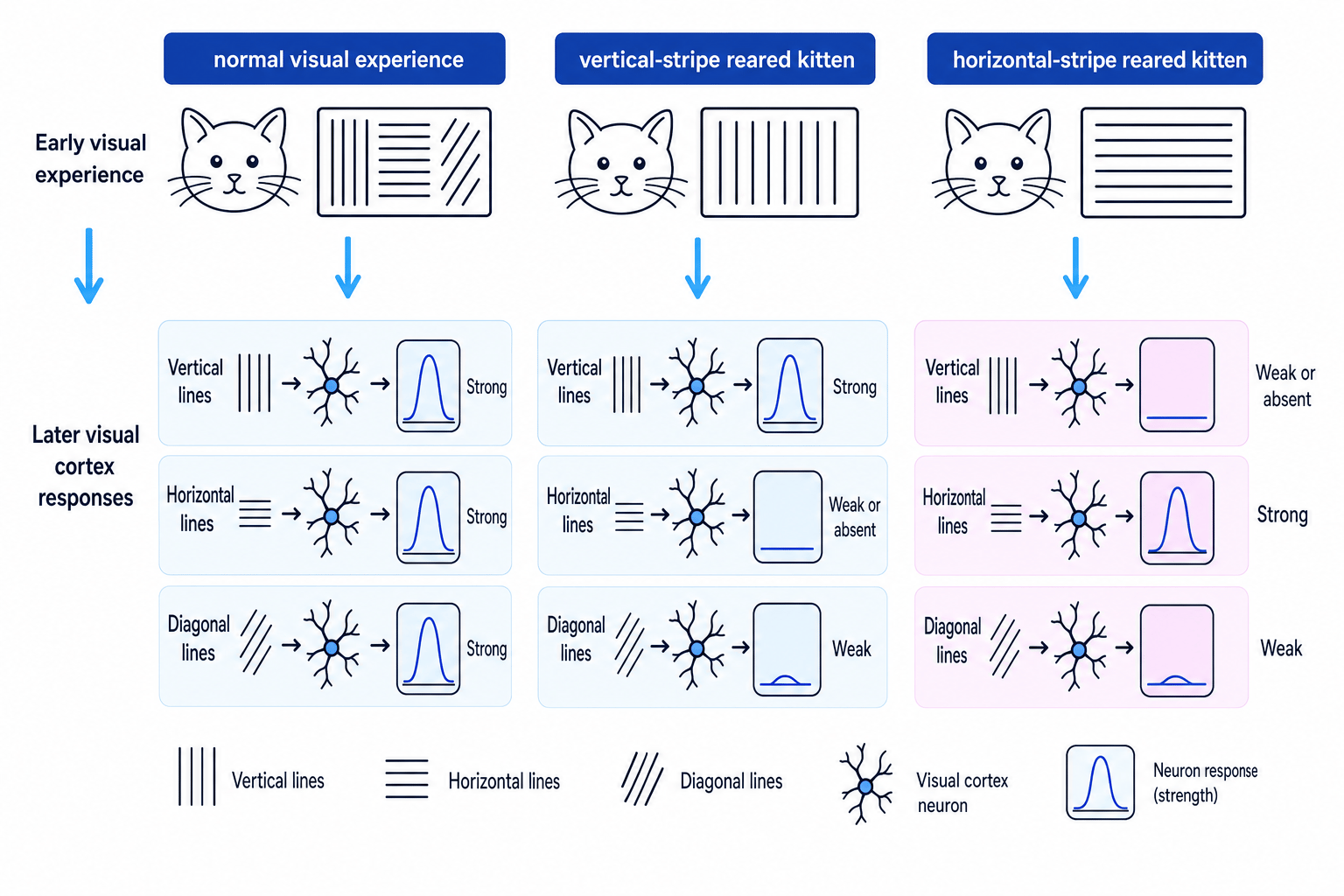
The kittens were not simply blind. Their eyes worked, and some basic visual responses were present. However, their perception was strongly affected by the environment they had experienced.
Kittens reared with vertical stripes responded well to vertical edges but had difficulty detecting horizontal ones. Kittens reared with horizontal stripes showed the opposite pattern.
The physiological recordings supported this behavioural evidence. Neurons in the visual cortex responded mainly to the orientation the kitten had experienced during early development.
Do not write that the kittens were completely blind
The key finding is more precise: the kittens struggled to perceive orientations they had not experienced, even though their eyes were functioning.
Using a result to show plasticity
-
Identify the environmental difference: one kitten experienced mainly vertical lines, while another experienced mainly horizontal lines.
-
Link this to brain function: the neurons in the visual cortex responded mostly to the orientation the kitten had experienced.
-
Link this to behaviour: the kittens then struggled to perceive the opposite orientation in a normal environment.
-
Draw the plasticity conclusion: early visual experience changed how the brain processed visual information.
Conclusions
Blakemore and Cooper concluded that early visual experience can shape the development of the visual cortex.
This supports the idea that perception is influenced by nurture, because the kittens’ later visual abilities depended on what they had experienced early in life. However, it is not nurture-only: the kittens still had a biological visual system. The study is best understood as showing an interaction between biology and environment.
AO2: applying the study
In an exam, AO2 might ask you to apply this study to a new situation, such as a child born with cataracts or a young animal raised in a visually restricted environment.
A cataract is a clouding of the lens of the eye that can reduce visual input. If a child receives very little patterned visual stimulation early in life, Blakemore and Cooper would suggest that normal visual processing may be affected.
Applying the study to early cataract treatment
-
Identify the deprivation: a child with untreated cataracts may receive reduced or distorted visual input during early development.
-
Apply the sensitive period idea: if the visual cortex does not receive clear patterned input during this early stage, some neural connections may not develop normally.
-
Predict the implication: early treatment may be more effective than delayed treatment because the brain is more plastic during development.
-
Add caution: Blakemore and Cooper used kittens, so the study supports the general principle but cannot give an exact timetable for human treatment.
AO3 evaluation
Strength: high control
The study had strong control over the kittens’ visual experience. Because the researchers carefully restricted what the kittens could see, they could make a stronger cause-and-effect claim: the visual environment caused changes in perception and neural response.
This is a strength for internal validity, which means the study measures the causal relationship it claims to measure.
Strength: objective biological evidence
The study did not rely only on behavioural observations. It also used physiological evidence from the visual cortex.
This is useful because the behavioural findings and neural findings supported each other. That makes the conclusion more convincing.
Weakness: low ecological validity
The rearing environment was highly artificial. Kittens do not naturally grow up seeing only vertical or only horizontal stripes.
This lowers ecological validity, which means the findings may not fully reflect visual development in real-life environments.
Weakness: generalisability
The study used kittens, not humans. Cats and humans both have complex visual systems, but they are not identical.
This creates a problem of sampling bias, because the sample was narrow: one species, a small number of animals, and highly controlled laboratory conditions.
Ethics
This study raises serious ethical concerns. The kittens were visually deprived during early development, which could cause distress or long-term impairment. The later examination of the visual cortex also involved invasive biological procedures.
The BPS Code of Ethics and Conduct is mainly written for human research, but its principles still help us think ethically: psychologists should show responsibility, minimise harm, and justify the value of the research. Modern animal research would also be judged using principles such as reducing the number of animals, refining procedures to minimise suffering, and replacing animal research where possible.
Ethics in animal studies
Do not say “there are no ethical issues because they were animals”. Animal studies still require careful cost-benefit justification and welfare protection.
Debates and wider issues
Nature versus nurture
This study is excellent for the nature-nurture debate. The kittens had a biological visual system, but the way that system developed depended on the environment.
A strong essay point is that Blakemore and Cooper show an interactionist view: nature provides the brain structures, while nurture helps organise how they function.
Reductionism
The study is biologically reductionist because it explains perception by focusing on neurons in the visual cortex. This is useful because it gives a precise, scientific explanation, but it may ignore broader influences such as movement, exploration and natural social experience.
Psychology as a science
Blakemore and Cooper supports psychology as a science because it used controlled conditions and objective physiological recordings. However, the artificiality of the procedure means scientific control came at the cost of everyday realism.
Usefulness
The study is useful because it helps explain why early sensory experience matters. It has implications for child development, treatment of early visual problems, and understanding sensitive periods in the brain.
Comparison with Maguire et al. (2000)
The paired contemporary study for the brain plasticity theme is Maguire et al. (2000), which studied London taxi drivers and found differences in hippocampal structure linked to navigation experience.
Both studies show that the brain can change with experience, but they do this in different ways.
Blakemore and Cooper used animals in a controlled laboratory experiment, focusing on early visual development and the visual cortex. Maguire et al. used human adults and brain scans, focusing on navigation experience and the hippocampus.
Comparing with Maguire et al. (2000)
-
Identify the shared theme: both studies support brain plasticity because experience is linked to measurable brain differences.
-
Contrast the method: Blakemore and Cooper manipulated early visual experience in kittens, whereas Maguire et al. studied naturally occurring navigation experience in taxi drivers.
-
Contrast the strength of evidence: Blakemore and Cooper gives stronger cause-and-effect evidence, but Maguire et al. has stronger relevance to humans.
-
Make the essay judgement: together, they suggest plasticity occurs in both developing brains and adult brains, but evidence from each study has different limitations.
How to write it in an essay
For AO1, tell the study as a clear story: background, aim, method, results and conclusions.
For AO2, apply the logic of the study to a new example: restricted early experience can affect later brain function and perception.
For AO3, avoid generic evaluation. Link every point directly to this study: kittens, striped cylinders, visual cortex recordings, early deprivation, and animal ethics.
In the exam
-
For AO1, include the key sequence: kittens were reared with restricted visual input, then tested behaviourally, then their visual cortex responses were examined.
-
For AO3, balance a strength of control and objective measurement against weaknesses such as artificiality, animal generalisability and ethics.
-
For comparison with Maguire et al. (2000), focus on the same theme — brain plasticity — but contrast animal experiment versus human brain-scan research.
Check yourself
- What did the vertical-stripe and horizontal-stripe environments allow Blakemore and Cooper to test?
- Why does this study support the idea of a sensitive period in visual development?
- How is Blakemore and Cooper (1970) similar to and different from Maguire et al. (2000)?