What you'll learn
- Why eyewitness testimony can be affected by the wording of questions.
- How Loftus and Palmer tested this in two controlled experiments.
- The key results, conclusions, and evaluation points for AO1, AO2, and AO3.
- How this study links to the Memory theme and the Cognitive area in OCR H567.
The basic problem: can witnesses trust their memories?
In everyday life, we often think memory works like a video recording: you see an event, store it, and play it back later. Loftus and Palmer challenged this. They argued that memory is more reconstructive: when you remember something, you rebuild it using the original event plus later information, expectations, and wording.
Eyewitness testimony
Eyewitness testimony is evidence given by someone who has seen an event, such as a crime or accident. In psychology, it is important because courts and police investigations may rely heavily on what witnesses report.
Reconstructive memory
Reconstructive memory means memory is not a perfect copy of an event. Instead, recall is rebuilt using stored information, later information, and schemas — mental frameworks based on previous experience.
The overall idea is that a witness sees an event, then later receives information through questions. That later information can influence what they report, especially if the question is leading.
The headline finding
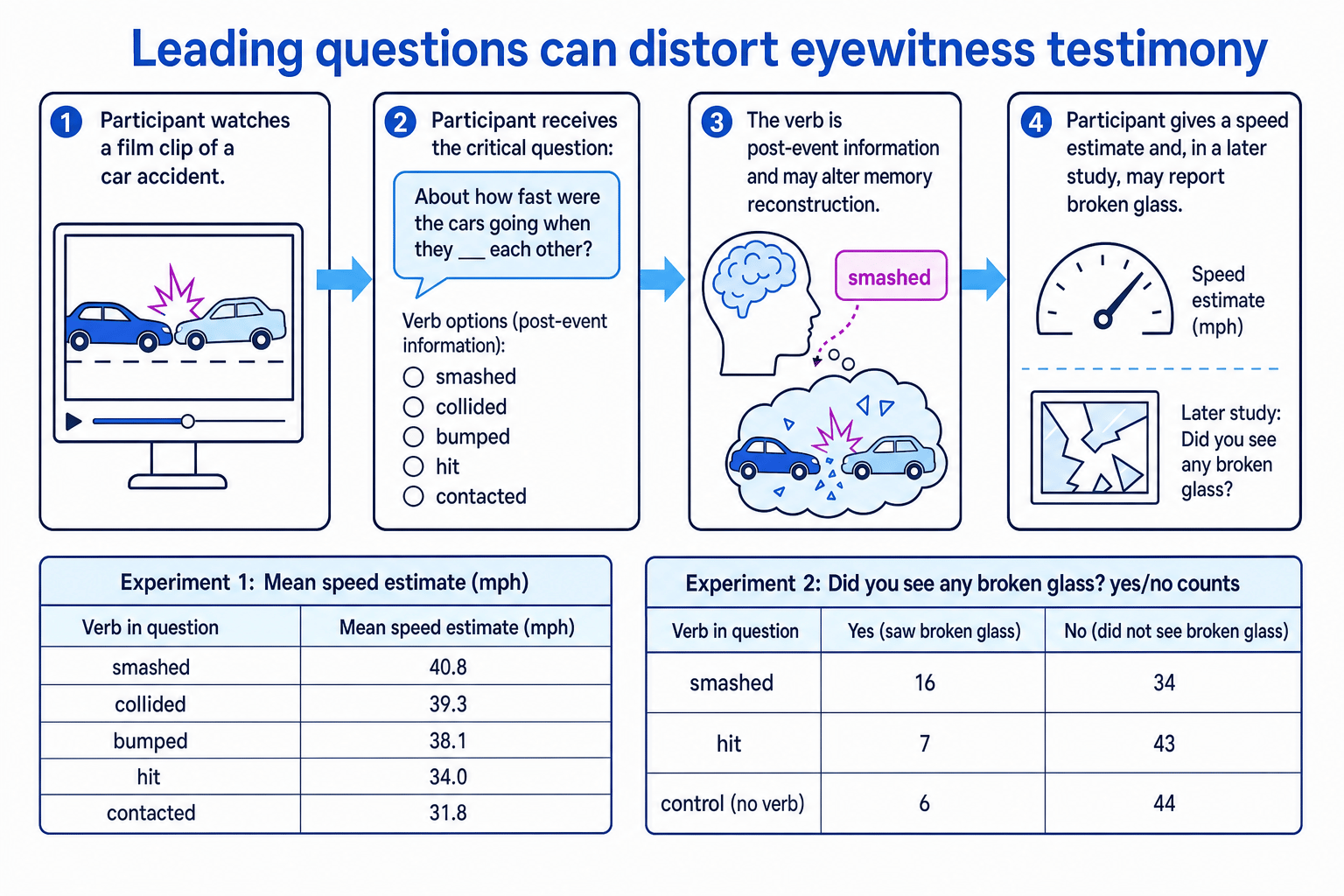
Loftus and Palmer showed that the wording of a question can change eyewitness reports. More dramatic verbs, such as “smashed”, produced higher speed estimates and made participants more likely to report seeing broken glass that was not there.
Key concepts before the study
Leading questions
Leading question
A leading question is a question that suggests a particular answer or contains information that may influence the person’s response.
For example, “How fast was the car going when it smashed into the wall?” suggests a more violent collision than “How fast was the car going when it contacted the wall?”
Post-event information
Post-event information
Post-event information is information received after an event has happened, such as comments from other witnesses, media reports, or the wording of police questions.
Loftus and Palmer were interested in whether post-event information could alter memory, not just alter the way people describe it.
Applying leading questions to a witness interview
A witness sees two cars collide gently. Later, a police officer asks, “How fast was the blue car going when it smashed into the red car?”
- The word “smashed” implies a severe crash, so it is more leading than a neutral word such as “hit” or “contacted”.
- The witness may use this post-event information when reconstructing the memory, imagining a more forceful impact than they originally saw.
- If asked later about details such as broken glass, the witness may be more likely to report glass because it fits the stronger reconstructed version of the accident.
Background to Loftus and Palmer
Loftus and Palmer’s paper was called “Reconstruction of Automobile Destruction”. Their work sits in the Cognitive area, which studies internal mental processes such as memory, attention, perception, and thinking.
The key real-world issue was legal: if witnesses can be influenced by question wording, then police interviews and courtroom questioning need to be handled very carefully.
Experiment 1: speed estimates
Aim
The aim was to investigate whether the wording of a question would affect participants’ estimates of how fast cars were travelling in film clips of traffic accidents.
Method
Laboratory experiment
A laboratory experiment is a study carried out in a controlled setting where the researcher manipulates an independent variable and measures a dependent variable.
Independent and dependent variables
The independent variable is what the researcher changes. The dependent variable is what the researcher measures.
- Sample: 45 students from the University of Washington.
- Design: an independent measures design, meaning each participant took part in only one condition of the critical question.
- Independent variable: the verb used in the question: smashed, collided, bumped, hit, or contacted.
- Dependent variable: the participant’s estimated speed in miles per hour.
- Materials: seven short film clips of car accidents.
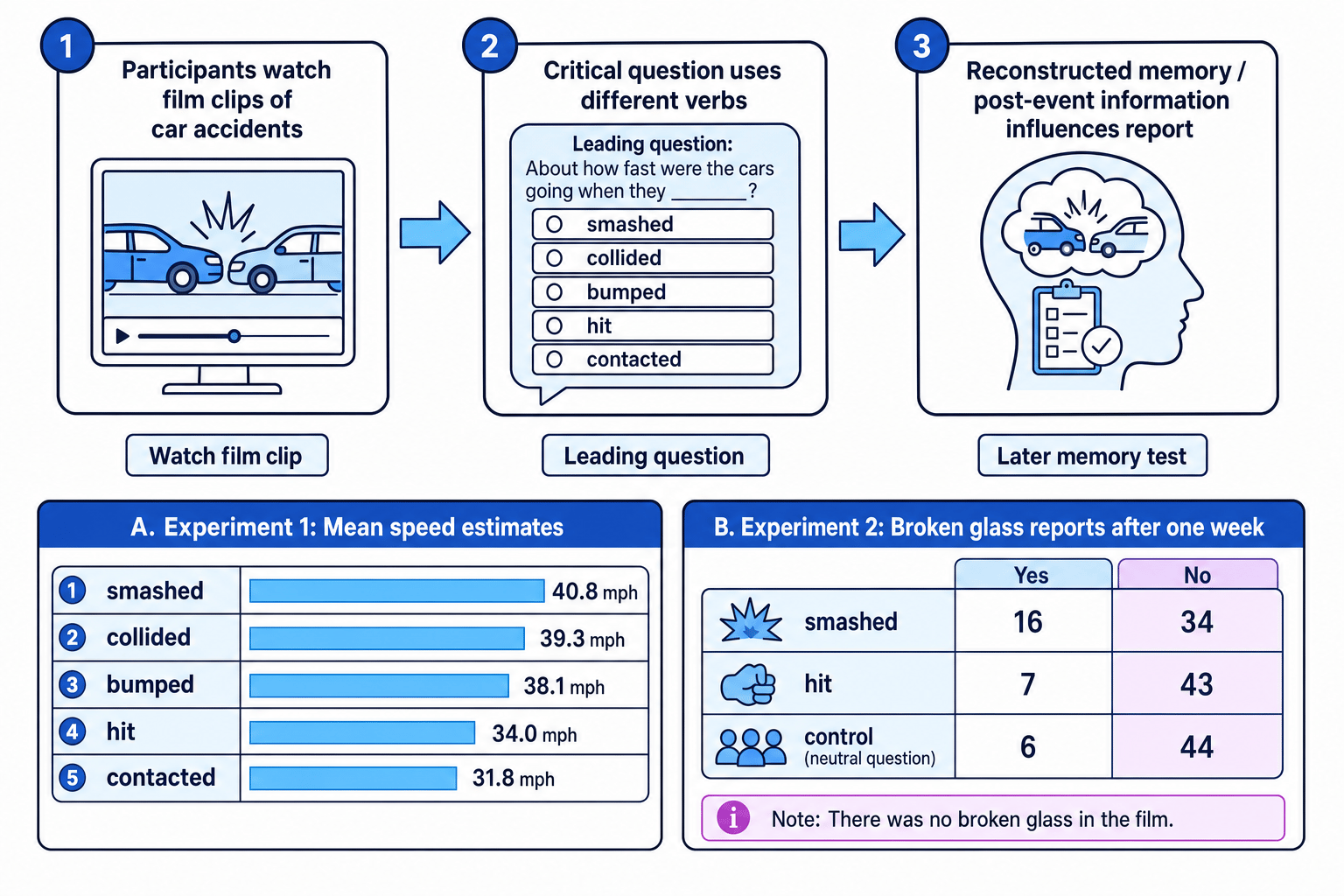
- Procedure: participants watched the clips, then answered questions. The critical question was: “About how fast were the cars going when they ___ each other?”
Results
Mean speed estimates were:
- Smashed: 40.8 mph
- Collided: 39.3 mph
- Bumped: 38.1 mph
- Hit: 34.0 mph
- Contacted: 31.8 mph
The more forceful the verb, the higher the estimated speed.
Interpreting the speed estimate results
- Compare the strongest verb with the weakest verb: smashed produced a mean estimate of 40.8 mph, while contacted produced 31.8 mph.
- Calculate the difference: 40.8−31.8=9.040.8 - 31.8 = 9.040.8−31.8=9.0.
- Interpret the difference: participants given the word smashed estimated the cars as travelling about 9 mph faster than participants given the word contacted, even though they had seen the same films.
Conclusion from Experiment 1
The wording of the question affected speed estimates. Loftus and Palmer suggested two possible explanations:
- Response bias: participants’ memories did not change, but the verb influenced the answer they chose to give.
- Memory reconstruction: the verb actually altered the participant’s memory of the event.
Experiment 2: did memory actually change?
Experiment 2 was designed to test whether the leading question could affect later memory for details that were not present.
Method
- Sample: 150 students.
- Design: independent measures.
- Independent variable: question condition: smashed, hit, or control.
- Dependent variable: whether participants later reported seeing broken glass.
- Procedure: participants watched a film of a multiple-car accident. One group was asked how fast the cars were going when they smashed into each other. Another group was asked the same question with hit. The control group was not asked a speed question. One week later, all participants were asked: “Did you see any broken glass?”
- Important detail: there was no broken glass in the film.
Results
Number who reported seeing broken glass:
- Smashed: 16 yes, 34 no
- Hit: 7 yes, 43 no
- Control: 6 yes, 44 no
Calculating broken-glass percentages
- For the smashed condition, convert the number saying “yes” into a percentage: 1650×100=32%\frac{16}{50} \times 100 = 32\%5016×100=32%.
- For the hit condition: 750×100=14%\frac{7}{50} \times 100 = 14\%507×100=14%.
- For the control condition: 650×100=12%\frac{6}{50} \times 100 = 12\%506×100=12%.
- Compare the conditions: the smashed group was much more likely to report broken glass, supporting the idea that the leading question affected memory reconstruction.
Conclusion from Experiment 2
Experiment 2 supports the idea that post-event information can alter memory, not just the wording of a response. The word smashed may have created a stronger mental image of a severe accident, making broken glass seem more likely.
Don’t say the participants really saw broken glass
The participants did not see broken glass in the film. The key point is that some later reported seeing it, showing how memory can be distorted.
Evaluation: strengths and weaknesses
Scientific control and reliability
The study was highly controlled. Participants watched the same film clips and answered standardised questions, so Loftus and Palmer could isolate the effect of the verb.
Reliability
Reliability means consistency. A reliable procedure can be repeated in the same way and should produce similar findings.
This is a strength because the procedure was standardised and easy to replicate. The study also produced quantitative data, such as mean speed estimates, which makes comparisons clear.
Validity issues
Validity
Validity means whether a study measures what it claims to measure.
The study may have lower ecological validity, meaning it may not reflect real-life eyewitness situations. Watching a film clip in a laboratory is not the same as witnessing a real accident. Real witnesses may experience shock, fear, personal involvement, and a stronger motivation to be accurate.
However, the controlled setting gives the study higher internal validity, because changes in estimates can be linked more confidently to the wording of the question.
Balanced AO3 point
A strong evaluation does not just say “lab study = bad”. Say that laboratory control improves cause-and-effect conclusions, but the artificial task may reduce real-world validity.
Sampling bias and generalisability
The participants were students, so the sample may not represent the wider population. Students may be younger, more used to psychological tasks, and less experienced drivers than older adults.
Generalisability
Generalisability is the extent to which findings from a sample can apply to other people, settings, or situations.
This limits how confidently we can apply the findings to all eyewitnesses.
Demand characteristics
Demand characteristics
Demand characteristics are cues in a study that lead participants to guess the aim and change their behaviour.
Participants may have guessed that the verb mattered and adjusted their estimates. This is especially possible because they were students in a psychology-related setting.
Ethics and the BPS Code
The study involved mild deception because participants were not fully told that the wording of questions was the focus. Under the British Psychological Society Code of Ethics and Conduct, researchers should consider informed consent, deception, right to withdraw, protection from harm, confidentiality, and debriefing.
The ethical risk was low because participants watched films rather than real traumatic events. Still, a debrief would be important so participants understood the true aim afterwards.
Links to the Cognitive area and Memory theme
This study is a classic example of the Cognitive area because it investigates an internal mental process: memory. It also uses controlled experiments, supporting the idea that cognition can be studied scientifically.
For the Memory theme, the study shows that memory is active and reconstructive. Eyewitnesses may be sincere but still inaccurate.
Usefulness
Loftus and Palmer is useful because it influenced police interviewing, legal procedures, and awareness of how leading questions can distort eyewitness testimony.
Comparison with the paired study: Grant et al. (1998)
The contemporary paired study in the Memory theme is Grant et al. (1998), which investigated context-dependent memory. Grant et al. found that recall was better when the learning and testing environments matched, such as studying and being tested in the same noise condition.
Similarities:
- Both are in the Cognitive area and study memory.
- Both use controlled experimental methods.
- Both use student participants, which raises generalisability issues.
- Both show that memory is influenced by more than the original information.
Differences:
- Loftus and Palmer studied distortion of eyewitness memory through leading questions.
- Grant et al. studied retrieval and whether matching context helps people remember information.
- Loftus and Palmer has strong forensic application, while Grant et al. is more useful for education and revision strategies.
- Loftus and Palmer’s topic is more ethically and socially sensitive because it relates to legal evidence.
In the exam
- For AO1, tell the story in order: background, method, results, conclusion. Include both Experiment 1 and Experiment 2.
- For AO2, apply the idea of leading questions to the specific wording in the scenario. Identify the verb or phrase that could distort memory.
- For AO3, balance your evaluation: controlled lab procedure improves reliability and internal validity, but films, students, and low emotion reduce ecological validity and generalisability.
Check yourself
- What is the difference between response bias and memory reconstruction?
- Why was Experiment 2 needed after Experiment 1?
- How does Loftus and Palmer compare with Grant et al. (1998) within the Memory theme?