What you'll learn
- Why Lee et al. studied children’s judgements about lying, truth-telling, and culture.
- How the study was carried out: design, sample, materials, procedure, results and conclusions.
- How to evaluate the study using validity, reliability, sampling, ethics and ethnocentrism.
- How to compare Lee et al. with the paired classic study: Kohlberg’s research into moral development.
The big picture: moral development
Lee et al. (1997) is the contemporary core study for the OCR theme of moral development in the Developmental area.
Moral development
Moral development means changes in how people understand right and wrong as they grow older. It includes what children judge as good or bad, and the reasons they give for those judgements.
A key idea in this topic is that children do not simply learn one fixed rule such as “lying is always wrong”. Instead, they may consider context: Why did someone lie? Who benefited? What does their culture teach them to value?
Context matters
Lee et al. showed that children’s evaluations of lying and truth-telling depend on the social situation and on cultural values, not just on whether the statement is factually true or false.
Key concepts before the study
Lying and truth-telling
A lie is an intentionally false statement. Truth-telling is giving an accurate statement about what happened.
However, Lee et al. were interested in two different contexts:
- Pro-social behaviour: behaviour intended to help or benefit others.
- Anti-social behaviour: behaviour that harms others, breaks rules, or causes trouble.
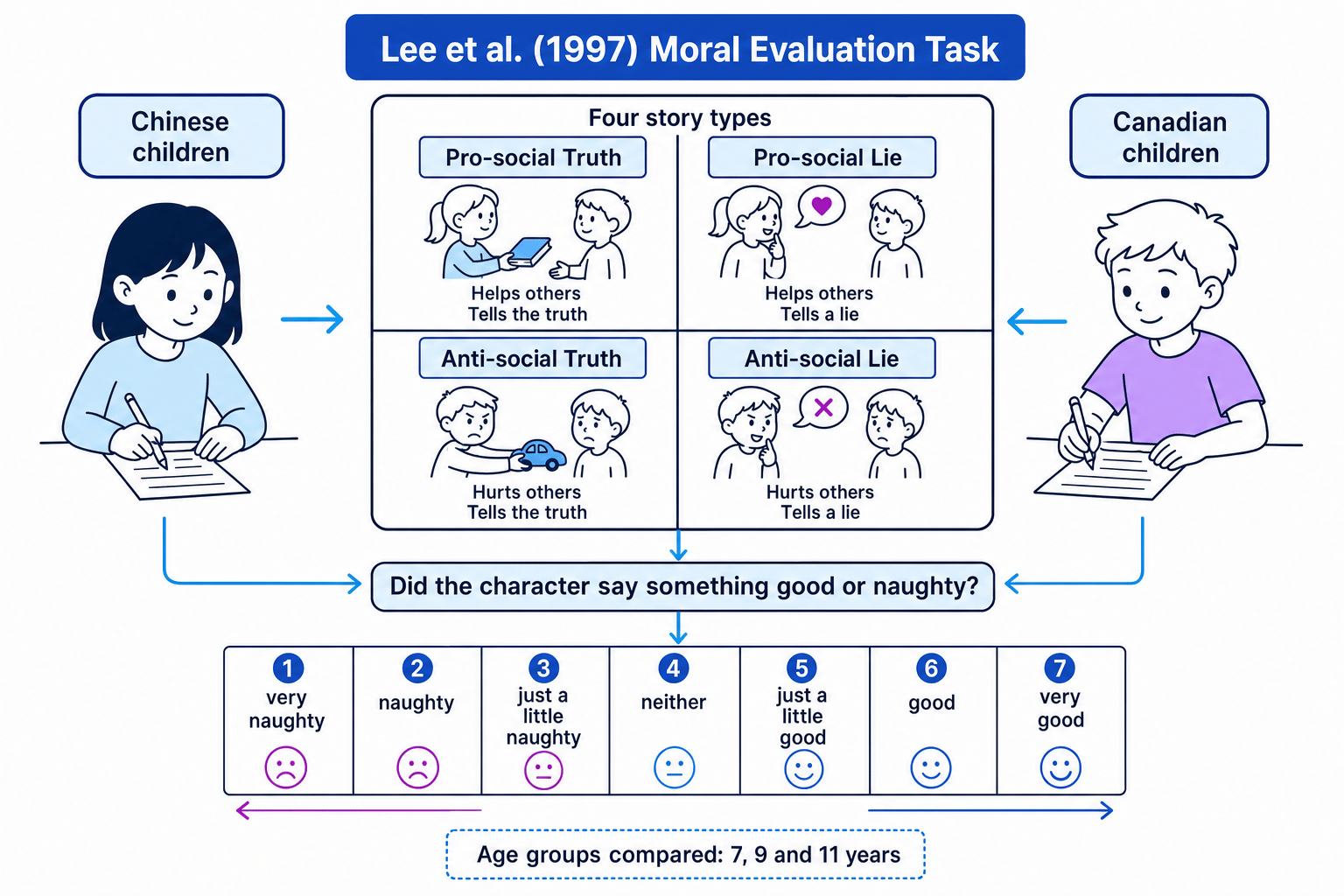
So a child in a story might do something helpful and then either tell the truth about it or lie to hide it. Or they might do something naughty and then either confess truthfully or lie to cover it up.
Culture: individualist and collectivist values
Lee et al. compared children from Canada and China.
Individualist and collectivist cultures
An individualist culture tends to emphasise personal achievement, self-expression and individual rights. A collectivist culture tends to emphasise group harmony, modesty, duty and the needs of others.
In a Canadian context, openly saying “I helped” may be seen as honest and acceptable. In a Chinese context, especially where modesty is valued, admitting to a good deed may be seen as showing off. So a “pro-social lie” may be judged less harshly if it protects modesty.
Oversimplifying culture
Do not write as if “all Chinese people think X” or “all Canadians think Y”. Lee et al. studied specific groups of children, so the findings suggest cultural patterns, not universal truths about everyone in those countries.
Background and aims
Lee et al. wanted to test whether children’s moral evaluations of lying and truth-telling vary with:
- Age: 7, 9 and 11 years old.
- Culture: Chinese and Canadian children.
- Type of action: pro-social or anti-social.
- Type of statement: truth or lie.
The study was partly a challenge to the idea that moral development follows one universal sequence for all children. If culture affects children’s moral evaluations, then moral development may be shaped by social learning and cultural expectations.
Method
Design
This was a cross-cultural quasi-experiment using structured stories.
Quasi-experiment
A quasi-experiment is a study where the researcher compares naturally occurring groups, such as culture or age, rather than randomly allocating participants to conditions.
The main independent variables were:
- Culture: Chinese or Canadian.
- Age group: 7, 9 or 11 years.
- Story type: pro-social or anti-social behaviour.
- Statement type: truth-telling or lie-telling.
The main dependent variable was the child’s moral rating of what the story character said, using a rating scale from very naughty to very good.
Sample
The sample contained 228 children:
- 120 Chinese children
- 108 Canadian children
They were aged 7, 9 and 11, with children spread across the age groups. The participants were schoolchildren, and the study included both boys and girls.
Materials
The materials were short moral stories, sometimes called vignettes.
Vignette
A vignette is a short fictional scenario used in research to see how participants judge or respond to a situation.
Each story described a child who did either a good deed or a bad deed, then either told the truth or lied about it. For example, a character might help another child and then deny helping, or damage something and then admit doing it.
Children used a rating scale to judge whether the character’s statement was good or naughty.
Procedure
Children were interviewed individually. They heard stories and were asked to evaluate the character’s behaviour and statement.
The key four combinations were:
| Behaviour | Statement | Example judgement being tested |
|---|---|---|
| Pro-social | Truth | Is it good to admit you helped? |
| Pro-social | Lie | Is it good or naughty to hide a good deed? |
| Anti-social | Truth | Is it good to confess after doing wrong? |
| Anti-social | Lie | Is it naughty to lie after doing wrong? |
Classifying a story type
A child hears this story: “A pupil secretly tidies the classroom to help the teacher. When the teacher asks who did it, the pupil says, ‘It wasn’t me.’”
- The behaviour is helpful because the pupil tidies the classroom for someone else’s benefit, so it is pro-social.
- The statement is false because the pupil denies doing the helpful action, so it is a lie.
- The story is therefore a pro-social lie, which is the key condition where Chinese and Canadian children were expected to differ most.
Results
The clearest findings were about the difference between anti-social and pro-social situations.
Anti-social behaviour
Both Chinese and Canadian children generally judged:
- Anti-social lies as naughty.
- Anti-social truths as good, because the character confessed.
This suggests some cross-cultural agreement: lying to cover up wrongdoing was viewed negatively.
Pro-social behaviour
The cultural differences appeared most strongly when the character had done something helpful.
Canadian children tended to rate truth-telling about a good deed positively. This fits the idea that honesty and open self-expression are valued.
Chinese children, especially older children, became less positive about telling the truth after doing a good deed. Older Chinese children were more likely to approve of lying to conceal a good deed, which fits cultural values around modesty and not seeking praise.
Main result
The biggest cultural difference was not about lying after bad behaviour. It was about whether children approved of admitting to a good deed or modestly hiding it.
Conclusions
Lee et al. concluded that children’s moral evaluations are shaped by both development and culture.
Younger children may rely more on a simple rule such as “truth is good” and “lying is bad”. As children get older, they increasingly apply social and cultural rules, such as whether it is appropriate to be modest.
This supports the idea that moral development is not only cognitive. It is also influenced by social expectations, education and cultural norms.
AO2: applying Lee et al. to a novel situation
If you are given a source about a child judging honesty, look for the context of the statement.
Applying Lee et al. to a new situation
A 10-year-old says it is “good” for a child to deny winning a prize because “they should not boast”.
- The child is evaluating a statement after a positive achievement, so the relevant context is similar to a pro-social truth or lie situation.
- The reason focuses on avoiding boasting, which links to modesty rather than simply factual honesty.
- Lee et al. would predict this kind of judgement may be more likely in a cultural setting where modesty and group harmony are strongly encouraged.
Evaluation
Validity
The study had good control because all children responded to structured stories and rating scales. This improves internal validity, because the researchers could compare responses across age and culture in a consistent way.
However, the stories were artificial. In real life, children’s moral decisions involve emotions, consequences, parents, teachers and peer pressure. This lowers ecological validity, because judging a story is not the same as actually deciding whether to lie.
Calling all story studies invalid
Do not simply write “the study lacks validity because it used stories.” Vignettes can be useful because they standardise the situation. A stronger evaluation is that they improve control but may reduce ecological validity.
Reliability
The procedure was highly standardised. Children heard similar types of stories and used the same rating scale, so the study could be repeated with other samples.
The rating scale also produced quantitative data, making comparisons easier. However, children from different cultures may interpret rating words such as “naughty” or “good” slightly differently, which could reduce cross-cultural reliability.
Sampling bias
The sample size was reasonable, and the study included children from two cultures and three age groups. This is a strength because it allows developmental and cultural comparisons.
However, the sample cannot represent all Chinese or all Canadian children. The children came from particular schools and social contexts. There may also be differences in schooling, family values, language and social expectations that are linked with culture but not caused by culture alone.
Ethnocentrism
Lee et al. is less ethnocentric than many older studies because it deliberately compares two cultures rather than assuming one culture is the norm.
Ethnocentrism
Ethnocentrism means judging other cultures using the standards or assumptions of your own culture.
Even so, there is still a risk of over-interpreting the results through broad labels such as “collectivist” and “individualist”. Cultures are diverse, and children within the same country may be raised with different values.
Ethics
The study involved children, so ethical care was important. Under the principles of the BPS Code of Human Research Ethics, researchers should protect participants from harm, gain appropriate consent, respect withdrawal and maintain confidentiality.
The study was low risk because children only heard fictional stories. However, because they were children, researchers needed permission from schools or parents, and the children should have been treated in an age-appropriate way.
Usefulness
Lee et al. is useful because it shows that adults should be careful when judging children’s honesty. A child may not see all lies as equally wrong. Their judgement may depend on whether the lie protects someone, avoids shame, or maintains group harmony.
The study is also useful for education, parenting and cross-cultural understanding, because it shows that moral teaching varies across societies.
Comparison with Kohlberg
The paired classic study for moral development is Kohlberg’s research into moral reasoning. Kohlberg used moral dilemmas, such as the Heinz dilemma, to investigate how children and adolescents reason about right and wrong.
Similarities
Both studies:
- Investigate moral development.
- Use hypothetical moral scenarios.
- Involve children or young people.
- Examine how moral thinking changes with age.
Differences
Kohlberg focused on the reasoning behind moral judgements and proposed a stage theory of moral development. Lee et al. focused more specifically on evaluations of lying and truth-telling in different social contexts.
Kohlberg’s work has been criticised as ethnocentric because it was based mainly on Western ideas of justice and individual rights. Lee et al. directly tested cultural differences, so it provides stronger evidence that moral development can be culturally variable.
Kohlberg’s method was more qualitative, relying on interviews and interpretation of reasoning. Lee et al. used rating scales, producing more quantitative data and making comparisons easier.
Quick comparison sentence
A strong comparison is: “Kohlberg suggests moral development follows universal stages, whereas Lee et al. shows that children’s moral evaluations can vary depending on cultural values such as modesty.”
Link to the Developmental area
Lee et al. belongs in the Developmental area because it investigates how moral judgements change with age. The study compares 7-, 9- and 11-year-olds, so it is interested in developmental change rather than adult behaviour alone.
It also shows that development happens within a social and cultural environment. Children are not just becoming “more logical”; they are learning the moral expectations of their community.
In the exam
- For AO1, tell the story in order: background, sample, design, materials, procedure, results and conclusions.
- For AO2, apply the study by identifying whether the scenario involves a pro-social or anti-social action, and whether the character tells the truth or lies.
- For AO3, avoid generic evaluation. Link each point directly to Lee et al., such as the use of vignettes, the cross-cultural sample, the rating scale, and the issue of modesty.
Check yourself
- What are the four story combinations used in Lee et al.’s study?
- Why did older Chinese children judge pro-social lies differently from Canadian children?
- How does Lee et al. challenge Kohlberg’s idea of universal moral development?
