What you'll learn
- What Kohlberg meant by moral development and moral reasoning.
- How the famous Heinz dilemma was used to investigate children’s thinking.
- The six stages of Kohlberg’s theory, grouped into three levels.
- How to evaluate Kohlberg’s study and compare it with Lee et al. (1997).
The big idea: moral development
Moral development
Moral development is the way a person’s understanding of right and wrong changes with age, experience and cognitive development.
Kohlberg was interested in how children decide whether an action is right or wrong. Importantly, he was less interested in the final answer and more interested in the reasoning behind it.
For example, two people might both say “Heinz should steal the drug”, but one might justify it by saying “he won’t get caught”, while another might say “human life is more important than property law”. For Kohlberg, those answers show very different levels of moral reasoning.
Moral reasoning
Moral reasoning means the thinking process a person uses to justify a decision about right and wrong.
Background: Piaget’s influence
Kohlberg built on the work of Piaget, who argued that children’s moral understanding develops as they mature. Piaget suggested younger children tend to see rules as fixed and made by authority figures, while older children become better at considering intentions, fairness and context.
Kohlberg extended this by proposing a more detailed stage theory of moral development.
Stage theory
A stage theory says development happens in a fixed sequence of qualitatively different steps. In Kohlberg’s theory, people should move through the stages in order, without skipping stages.
Kohlberg’s six stages
Kohlberg grouped moral development into three levels, each containing two stages.
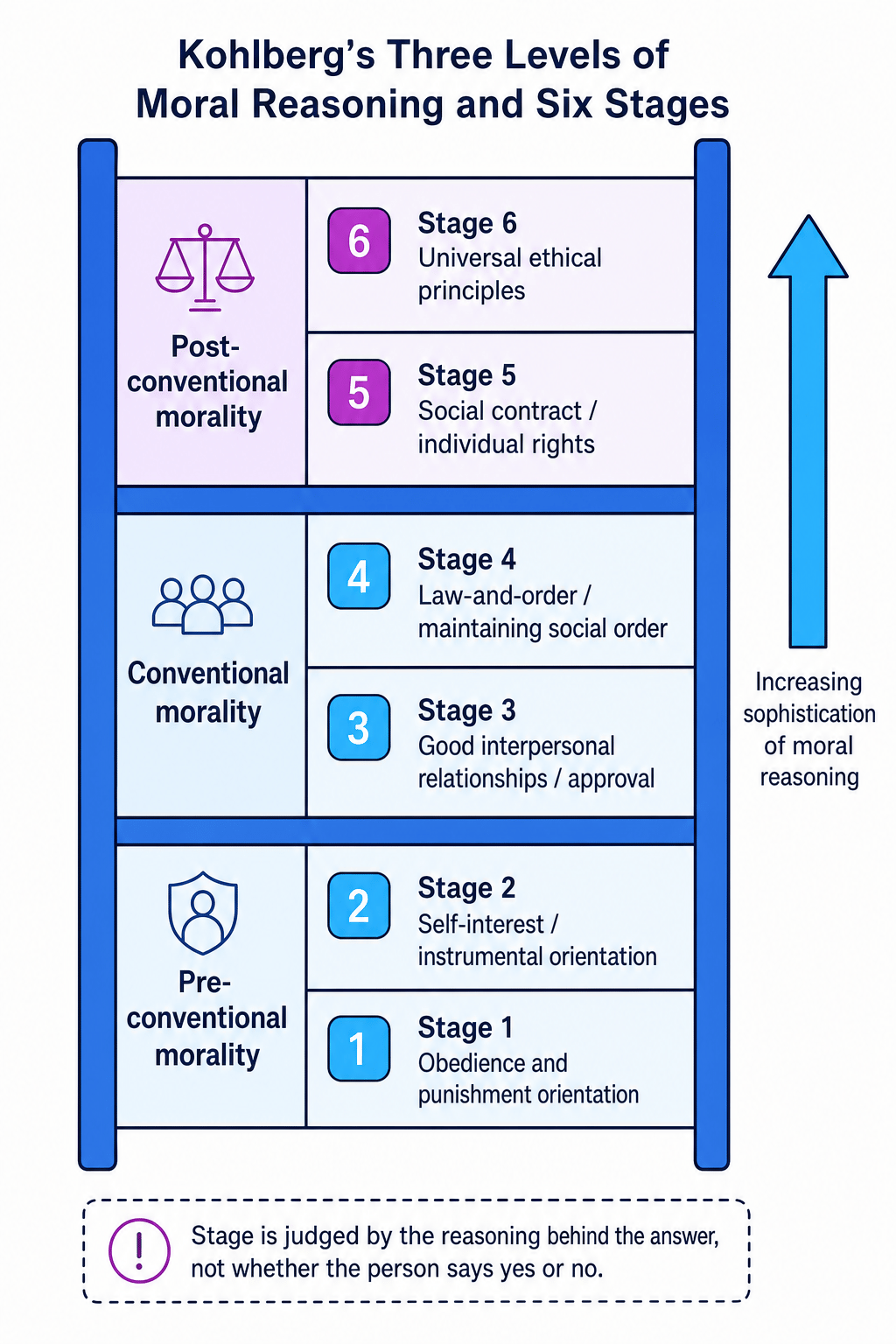
Level 1: Pre-conventional morality
At this level, moral reasoning is mainly based on personal consequences.
-
Stage 1: Obedience and punishment orientation
An action is seen as wrong if it leads to punishment. -
Stage 2: Self-interest or instrumental orientation
An action is judged by whether it benefits the individual: “What’s in it for me?”
Level 2: Conventional morality
At this level, moral reasoning is based on social approval and maintaining rules.
-
Stage 3: Good interpersonal relationships / approval
A person wants to be seen as “good”, kind or helpful by others. -
Stage 4: Law-and-order orientation
A person believes rules and laws should be followed to maintain society.
Level 3: Post-conventional morality
At this level, moral reasoning is based on abstract principles, such as justice, rights and human dignity.
-
Stage 5: Social contract / individual rights
Laws are important, but they can be changed if they fail to protect people’s rights. -
Stage 6: Universal ethical principles
Moral decisions are based on self-chosen principles, such as equality, justice or respect for life, even if these conflict with the law.
The stage is in the reason
Kohlberg would not score someone simply on whether they said “yes” or “no”. He scored the quality of the reasoning used to justify the decision.
Classifying a response to Heinz
Imagine a participant says: “Heinz should steal the drug because his wife’s life is more important than the druggist’s profit. Laws matter, but they should protect human life first.”
- Compare the response with pre-conventional reasoning. It is not mainly about avoiding punishment or gaining a reward, so Stage 1 or Stage 2 is unlikely.
- Compare it with conventional reasoning. The participant is not simply saying Heinz should obey the law or be seen as a good husband, so Stage 3 or Stage 4 is not the best fit.
- Compare it with post-conventional reasoning. The response weighs the law against a higher principle: the value of human life. This suggests Stage 5, and possibly Stage 6 if the reasoning is clearly based on universal ethical principles.
The classic study: Kohlberg (1968)
Aim
Kohlberg aimed to investigate whether children’s moral reasoning develops through a fixed sequence of stages. He wanted to see whether age was linked to increasingly sophisticated moral reasoning.
Design
Kohlberg’s research used longitudinal interviews.
Longitudinal study
A longitudinal study follows the same participants over time to observe how they change.
This was useful because Kohlberg wanted to study development, not just compare different age groups at one moment.
Sample
Kohlberg’s original sample involved American boys from Chicago, aged around 10 to 16 at the start of the research. They were followed up over a period of years. The sample was therefore limited in terms of gender and culture, which becomes important in evaluation.
Materials: moral dilemmas
Participants were presented with moral dilemmas.
Moral dilemma
A moral dilemma is a situation where a person must choose between competing moral values, such as obeying the law versus saving a life.
The most famous example is the Heinz dilemma: Heinz’s wife is dying, but the drug that could save her is too expensive. The druggist refuses to lower the price. Heinz considers stealing the drug.
Procedure
Participants were interviewed individually. They were asked what Heinz should do and, crucially, why. The interviewer used follow-up questions to explore the reasoning behind the answer.
Kohlberg then analysed the responses and classified them into stages of moral development.
Results
Kohlberg found that younger children tended to give pre-conventional responses, focusing on punishment or personal gain. Older children and adolescents were more likely to show conventional reasoning, focusing on approval, duty and law.
Some older participants reached post-conventional reasoning, but this was much less common. Stage 6 was especially rare and has been one of the most debated parts of the theory.
Conclusions
Kohlberg concluded that moral reasoning develops through an orderly sequence of stages. He argued that people move from simple consequence-based reasoning towards more abstract reasoning about rights, justice and ethical principles.
AO1 summary
For AO1, you need the story: Kohlberg used interviews with boys about moral dilemmas, especially the Heinz dilemma, and concluded that moral reasoning develops through six ordered stages.
Evaluation of Kohlberg (1968)
Strength: rich qualitative data
Because Kohlberg used interviews, he collected detailed explanations of participants’ reasoning. This gave him insight into the process behind moral judgement, not just the final decision.
This is a strength because moral development is complex. A simple questionnaire might not reveal whether a child is thinking about punishment, social approval, law or justice.
Strength: longitudinal design
The longitudinal design allowed Kohlberg to track changes in the same individuals over time. This is useful for developmental psychology because it shows how reasoning changes with age.
However, longitudinal research can suffer from attrition, which means participants drop out over time.
Attrition
Attrition is the loss of participants from a study over time, especially in longitudinal research.
Weakness: gender bias
Kohlberg’s sample was male. This raises the issue of androcentrism, where male experience is treated as the norm.
Carol Gilligan later argued that Kohlberg’s theory may undervalue a more care-based moral orientation, which focuses on relationships and responsibility rather than abstract justice.
Saying girls are less moral
Do not write that Kohlberg proved females are less morally developed. A better evaluation is that his stage system may be biased because it prioritises justice-based reasoning over care-based reasoning.
Weakness: cultural bias
Kohlberg’s highest stages reflect values such as individual rights and social contracts, which fit many Western liberal societies. In more collectivist cultures, moral reasoning may focus more on family duty, social harmony or community expectations.
This means the theory may be ethnocentric.
Ethnocentrism
Ethnocentrism means judging other cultures using the standards or values of your own culture.
Weakness: ecological validity
The dilemmas were hypothetical. Saying what Heinz should do in an interview is not the same as making a real-life moral decision under pressure.
This lowers ecological validity, because real moral decisions involve emotions, consequences, relationships and risk.
Ethics
Kohlberg’s study was relatively low risk compared with studies such as Milgram (1963), but ethical issues still matter. The participants were children, so researchers would need appropriate consent, protection from distress, confidentiality and the right to withdraw.
Using the BPS Code of Human Research Ethics, you could discuss respect, competence, responsibility and integrity. The dilemmas involved death, theft and illness, so researchers should be sensitive to possible discomfort.
Evaluation balance
A strong AO3 paragraph usually makes a point, explains why it matters, and links it back to the study. For example: “The sample was all male, so the findings may not generalise to girls, reducing population validity.”
Applying Kohlberg to a new situation
AO2 often asks you to apply Kohlberg’s stages to a scenario. Focus on the person’s reason, not the action.
Applying stages to a school scenario
A student says: “I won’t cheat in the test because if I get caught, I’ll get detention.” Another says: “I won’t cheat because exams only work if everyone follows the same rules.”
- The first student focuses on punishment. This matches Stage 1: obedience and punishment orientation.
- The second student focuses on rules being necessary for the system to work. This matches Stage 4: law-and-order orientation.
- Although both students choose the same behaviour, their reasoning is different, so Kohlberg would place them at different stages.
Comparison with Lee et al. (1997)
Kohlberg is paired in the moral development theme with Lee et al. (1997), a contemporary study of children’s evaluations of lying and truth-telling in China and Canada.
Similarities
Both studies investigated moral development in children and used stories or scenarios to explore moral judgement. Both are part of the developmental area, because they examine how children’s thinking changes with age.
Differences
Kohlberg proposed a universal stage theory, whereas Lee et al. showed that culture affects children’s moral evaluations. For example, children in China and Canada judged truth-telling and lying differently depending on whether the behaviour was pro-social or anti-social.
Kohlberg’s study was mainly based on American boys and focused on justice-based dilemmas. Lee et al. used a cross-cultural comparison, making cultural influences more visible.
Comparison takeaway
Kohlberg suggests moral reasoning follows a universal sequence, while Lee et al. provides evidence that moral evaluations are shaped by culture and social learning.
Link to the developmental area
The developmental area of psychology studies how behaviour and thinking change over time. Kohlberg fits this area because he investigated age-related changes in moral reasoning.
His study also links to the nature–nurture debate. Moral development may depend partly on cognitive maturation, but social experience, education and culture also shape how children reason about right and wrong.
It also links to the individual–situational debate. Kohlberg focused on the individual’s stage of reasoning, but the situation and cultural context may influence the response.
In the exam
- For AO1, tell the study story in order: aim, sample, method, dilemmas, procedure, results and conclusions.
- For AO2, identify the reasoning in the scenario before choosing a stage.
- For AO3, evaluate with named issues such as gender bias, ethnocentrism, ecological validity, ethics, reliability and usefulness.
Check yourself
- Why did Kohlberg care more about the reason than the yes/no answer?
- What is the difference between Stage 1 and Stage 4 reasoning?
- How does Lee et al. (1997) challenge Kohlberg’s claim that moral development is universal?
