What you'll learn
- How Chaney et al. (2004) used the Funhaler to influence children’s asthma medication behaviour.
- The full “story” of the study: background, method, results and conclusions.
- How to evaluate the study using validity, reliability, ethics and sampling issues.
- How to compare Chaney et al. with its paired classic study, Bandura et al. (1961).
Where this study fits
Chaney et al. (2004) is the contemporary core study for the OCR H567 theme External influences on children’s behaviour in the Developmental area.
The study asks a very practical question: can a child’s behaviour be improved by changing the environment around the behaviour? In this case, the target behaviour is taking asthma medication properly.
A quick spelling note: the device is usually written as Funhaler in the research article, even though you may see the topic written as “Funhaller” in some resources.
The big idea
Chaney et al. shows that children’s health behaviour can be shaped by external rewards and feedback, not just by parental instruction or the child’s own motivation.
Background: asthma, adherence and reinforcement
Asthma and inhaler use
Asthma is a medical condition where the airways can become inflamed and narrowed, making breathing difficult. Many children with asthma use an inhaler. Young children often use a spacer, which is a chamber attached to an inhaler that helps them breathe in the medication more effectively.
The problem is that young children may resist medication, use the spacer incorrectly, or not take enough breaths after the medicine is released.
Adherence / compliance
Adherence means how far a person follows medical advice, such as taking medication at the right time and in the right way. OCR resources may also use compliance, though “adherence” is often preferred because it sounds less like simple obedience.
Operant conditioning and positive reinforcement
Chaney et al. is closely linked to operant conditioning, which is learning through the consequences of behaviour. If a behaviour is followed by a pleasant consequence, that behaviour is more likely to happen again.
Positive reinforcement
Positive reinforcement is when something pleasant is added after a behaviour, making that behaviour more likely to be repeated.
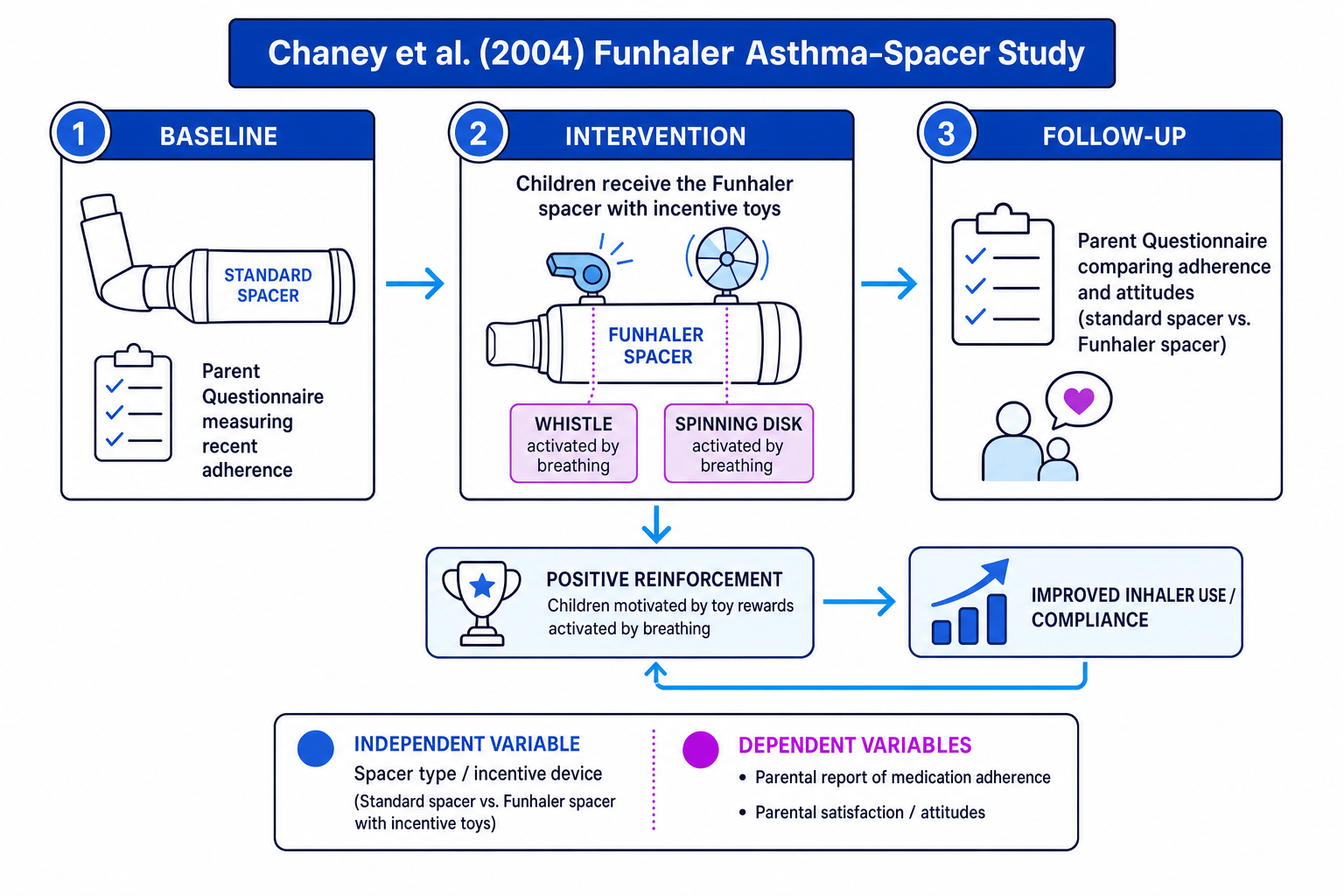
In the Funhaler, the child’s breathing activates fun features such as a whistle and spinning disc. These act as immediate rewards and feedback.
Applying positive reinforcement to the Funhaler
-
Identify the target behaviour: the child needs to breathe through the spacer properly after the asthma medication is released.
-
Identify the consequence: when the child breathes correctly, the Funhaler produces enjoyable effects, such as a whistle sound or a spinning disc.
-
Apply the learning principle: because the enjoyable effect follows the desired breathing behaviour, the child is more likely to repeat that behaviour in future medication sessions.
The Funhaler device
The Funhaler was a modified spacer designed to make inhaler use more engaging for young children. Instead of medication time feeling like a chore or a battle with parents, the device made the process more playful.
Calling it just a toy
The Funhaler was not simply a toy. It was a medical spacer with incentive features designed to improve correct inhaler use through reinforcement.
AO1: Telling the story of the study
Aim
Chaney et al. aimed to investigate whether using the Funhaler would improve young children’s adherence to asthma medication compared with their usual spacer device.
The researchers were also interested in parental attitudes, because parents are heavily involved in managing young children’s medication.
Research method and design
This was a field study because the behaviour being investigated was real medication use rather than an artificial task in a laboratory.
It is usually described as a repeated-measures or within-participants design because the same children were considered in relation to their usual spacer and then the Funhaler.
Repeated-measures design
A repeated-measures design is when the same participants take part in more than one condition, so their behaviour can be compared across conditions.
Classifying the design
-
Check whether the same children experienced both comparison points: they had experience of their usual spacer and then used the Funhaler.
-
Because the same participants are involved in both conditions, this supports calling it a repeated-measures design.
-
Consider the setting: because the study involved real asthma medication behaviour rather than a lab task, it has features of a field study.
Sample
The sample consisted of 32 young Australian children with asthma, aged roughly 1.5 to 6 years, along with their parents or carers.
This is a small, specialised sample. That matters for evaluation because the findings may apply best to young children with asthma in similar healthcare and family contexts.
Materials and apparatus
The key materials included:
- The child’s usual inhaler and spacer.
- The Funhaler spacer with incentive features.
- Parent questionnaires or interview questions about medication use, child cooperation and parental attitudes.
The Funhaler included features such as a whistle and spinning disc, which were activated by the child’s breathing.
Procedure
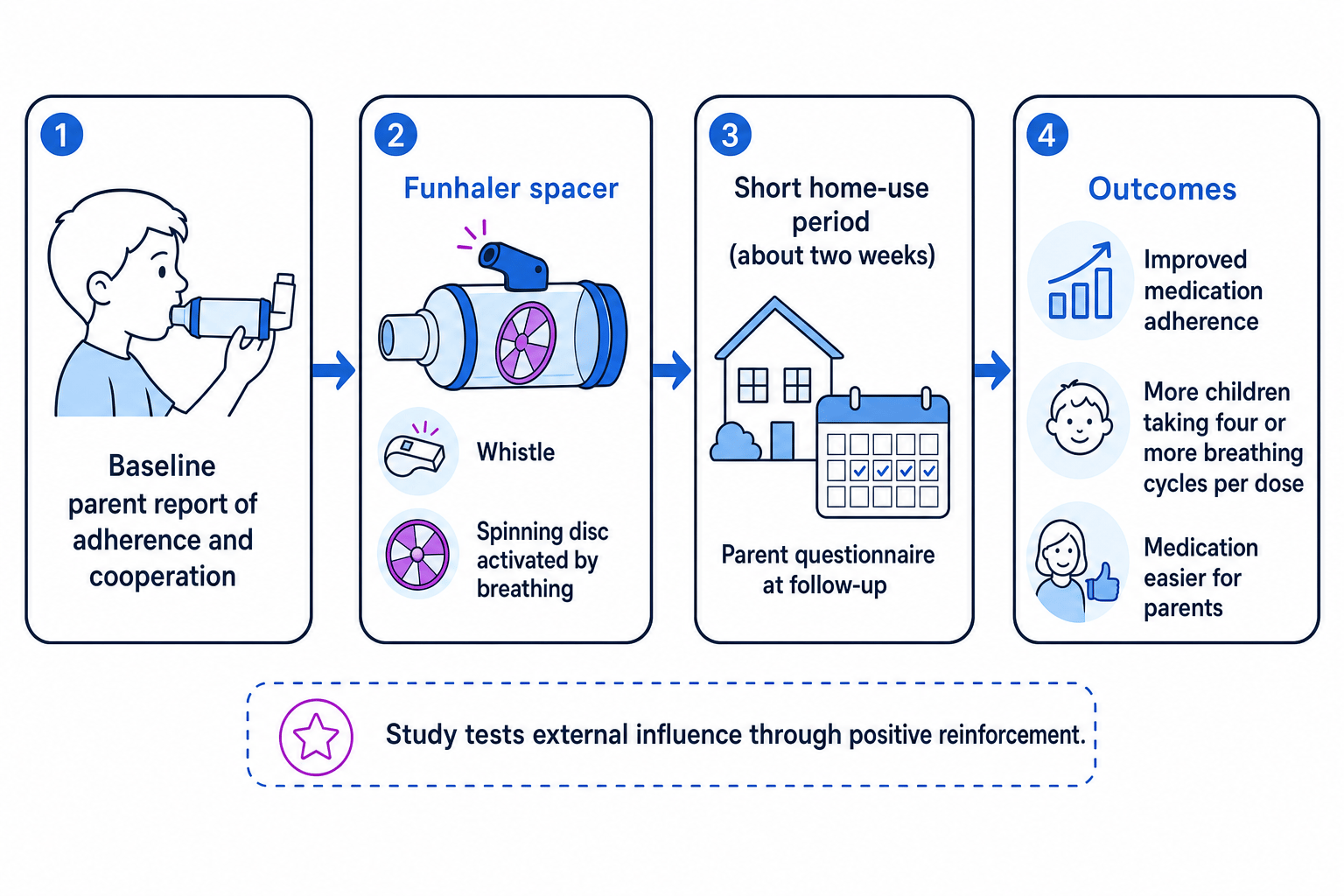
Parents were first asked about their child’s use of their existing spacer. This provided a baseline measure of adherence and attitudes.
The children were then given the Funhaler to use for a short period, often summarised as around two weeks. After this, parents reported on their child’s use of the Funhaler and compared it with their previous experience.
The main dependent variables were parent-reported measures of medication adherence, child cooperation and attitudes towards the device.
Dependent variable
A dependent variable is what the researcher measures. In Chaney et al., this included reported medication adherence and parent/child responses to the Funhaler.
Results
The results suggested that the Funhaler improved adherence and cooperation.
Commonly reported findings include:
- More parents reported medicating their child the previous day when using the Funhaler.
- There was a reported increase in children taking the recommended number of breathing cycles per dose.
- Parents tended to report that the Funhaler made medication use easier and more acceptable.
One useful figure to remember is that summaries often describe a 38% increase in parents medicating their children the previous day when using the Funhaler. Another commonly cited result is that 60% more children took the recommended four or more breathing cycles per aerosol delivery.
Conclusions
Chaney et al. concluded that making medication use more fun and rewarding could improve adherence in young children with asthma.
The study supports the idea that children’s behaviour can be influenced by external environmental factors, especially immediate reinforcement and feedback.
Overclaiming the conclusion
Do not say Chaney et al. proved the Funhaler cured asthma. The study was about improving medication-taking behaviour, not eliminating the medical condition.
AO3: Evaluating Chaney et al.
Strength: ecological validity
Ecological validity means how far a study reflects real-life behaviour and settings.
Chaney et al. has fairly good ecological validity because it investigated a real health behaviour: children using asthma medication. This makes the study more useful than a highly artificial task.
Strength: usefulness
The study has strong practical value. If a simple design change can increase adherence, it could improve children’s health and reduce stress for families.
This is especially important because parents often struggle to get young children to cooperate with medical routines.
Weakness: self-report data
Much of the evidence came from parents’ reports. This creates possible issues with social desirability bias, where people give answers that make them look responsible or caring.
Parents may also have guessed that the researchers wanted the Funhaler to be seen positively, creating demand characteristics.
Using self-report as an evaluation point
-
Identify the measurement method: parents reported how often and how successfully their children used the spacer.
-
Consider a possible bias: parents may over-report good medication behaviour because they want to appear responsible.
-
Link to validity: this lowers measurement validity because the report may not perfectly reflect the child’s actual medication use.
Weakness: small and specialised sample
The sample was small and limited to young children with asthma. This reduces generalisability, which means how far the findings can be applied beyond the original sample.
The Funhaler may not work equally well for older children, children with different medical conditions, or families from different cultures and healthcare systems.
Weakness: possible novelty effect
A novelty effect happens when behaviour improves simply because something is new and exciting.
Children may have used the Funhaler more enthusiastically at first, but the study does not fully show whether that motivation would last over months or years.
Validity and reliability
Internal validity is about whether the independent variable really caused the change in the dependent variable. Chaney et al. has some internal validity concerns because there was no strong independent control group and the Funhaler was always experienced after the usual spacer.
Reliability means consistency. The study could be repeated using the same questionnaires and device, but parental self-report may not be as reliable as objective measures such as electronic monitoring of inhaler use.
Ethics
Using the BPS Code of Human Research Ethics as a framework, Chaney et al. is relatively low-risk compared with many child studies.
Parents could give informed consent, and the study aimed to improve children’s wellbeing. There was little deception, and the task involved a normal medical routine.
However, children were very young, so they could not give fully informed consent themselves. Researchers still needed to respect child comfort, avoid distress, protect confidentiality and ensure the device did not interfere with proper medical care.
Ethics comparison
Chaney et al. is much easier to defend ethically than Bandura et al. because it tries to improve a health behaviour rather than exposing children to aggressive adult models.
Comparison with Bandura et al. (1961)
Chaney et al. is paired with Bandura et al. (1961), the classic Bobo doll study. Both are in the Developmental area and both show that children’s behaviour can be influenced by external factors.
| Issue | Bandura et al. (1961) | Chaney et al. (2004) |
|---|---|---|
| Main influence | Adult role model | Rewarding device and feedback |
| Key theory | Social learning theory | Operant conditioning / positive reinforcement |
| Behaviour studied | Aggression and imitation | Asthma medication adherence |
| Setting | Controlled laboratory-style environment | More natural health-related setting |
| Ethics | More concern due to modelling aggression | Lower risk and potentially beneficial |
| Usefulness | Helps explain learned aggression | Direct practical health application |
The key similarity is that both studies challenge the idea that children’s behaviour is only caused by inner personality or maturation. Both show that the social or physical environment can shape behaviour.
The key difference is that Bandura focuses on observational learning, while Chaney focuses more on reinforcement.
Linking to debates
Nature versus nurture
Chaney et al. supports the nurture side because behaviour changed when the environment changed. However, the biological condition of asthma is also important, so a balanced answer can mention both biology and environment.
Individual versus situational explanations
The study supports a situational explanation because the Funhaler device influenced behaviour. It pays less attention to individual differences such as temperament, parenting style or previous medical experiences.
Reductionism versus holism
Chaney et al. can be seen as somewhat reductionist because it explains medication adherence mainly through reinforcement. A more holistic explanation would include family routines, child anxiety, healthcare access and parent-child relationships.
Psychology as a science
The study uses measurable behaviour and a clear intervention, which supports psychology as a science. However, reliance on parent questionnaires makes it less objective than studies using direct observation or electronic monitoring.
In the exam
-
For AO1, tell the study in order: background, aim, sample, design, materials, procedure, results and conclusions.
-
For AO3, avoid vague points like “it was biased”. Name the issue, such as self-report bias, small sample, novelty effect, ecological validity or usefulness.
-
When comparing with Bandura et al., use the theme: both show external influences on children’s behaviour, but Bandura uses modelling while Chaney uses reinforcement.
Check yourself
- How does the Funhaler use positive reinforcement to influence children’s behaviour?
- Why might parent-report data reduce validity in Chaney et al.?
- Give one similarity and one difference between Chaney et al. and Bandura et al. (1961).