What you'll learn
- What the individual differences area studies and why it matters in psychology.
- How Freud (1909) and Baron-Cohen et al. (1997) illustrate this area.
- How to evaluate the area using debates such as nature/nurture, reductionism/holism, ethics and usefulness.
- How research-methods ideas link to individual-differences research, especially when comparing groups.
The big idea: people are not all the same
Psychology often looks for general rules about behaviour. The individual differences area asks a slightly different question: why do people differ from each other?
It studies differences in personality, intelligence, mental health, ability, motivation, emotion, perception and atypical development. It is especially important in clinical and educational psychology, where understanding the individual can lead to better support.
Individual differences area
The individual differences area is the part of psychology that investigates how and why people vary in behaviour, thinking, emotion and experience.
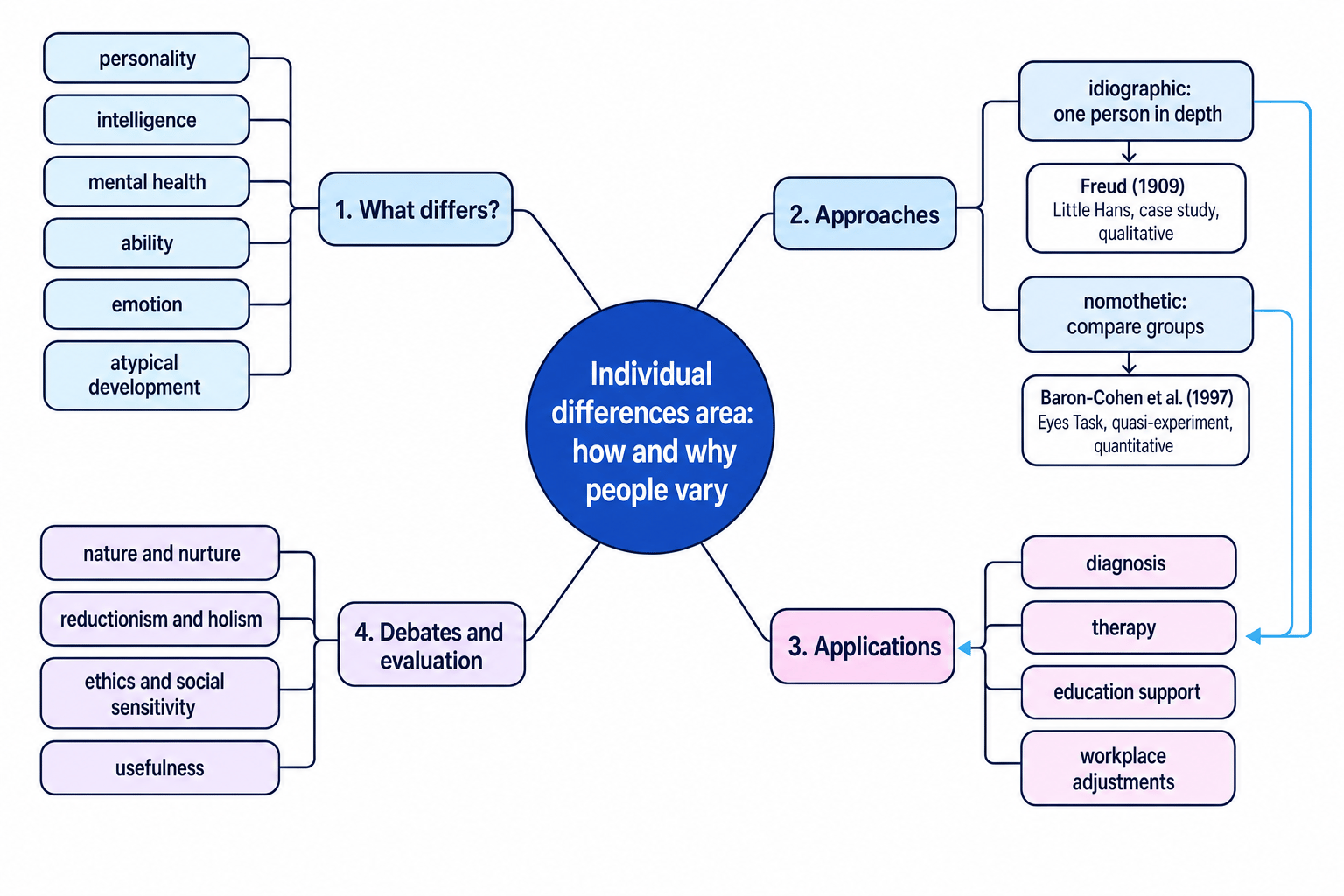
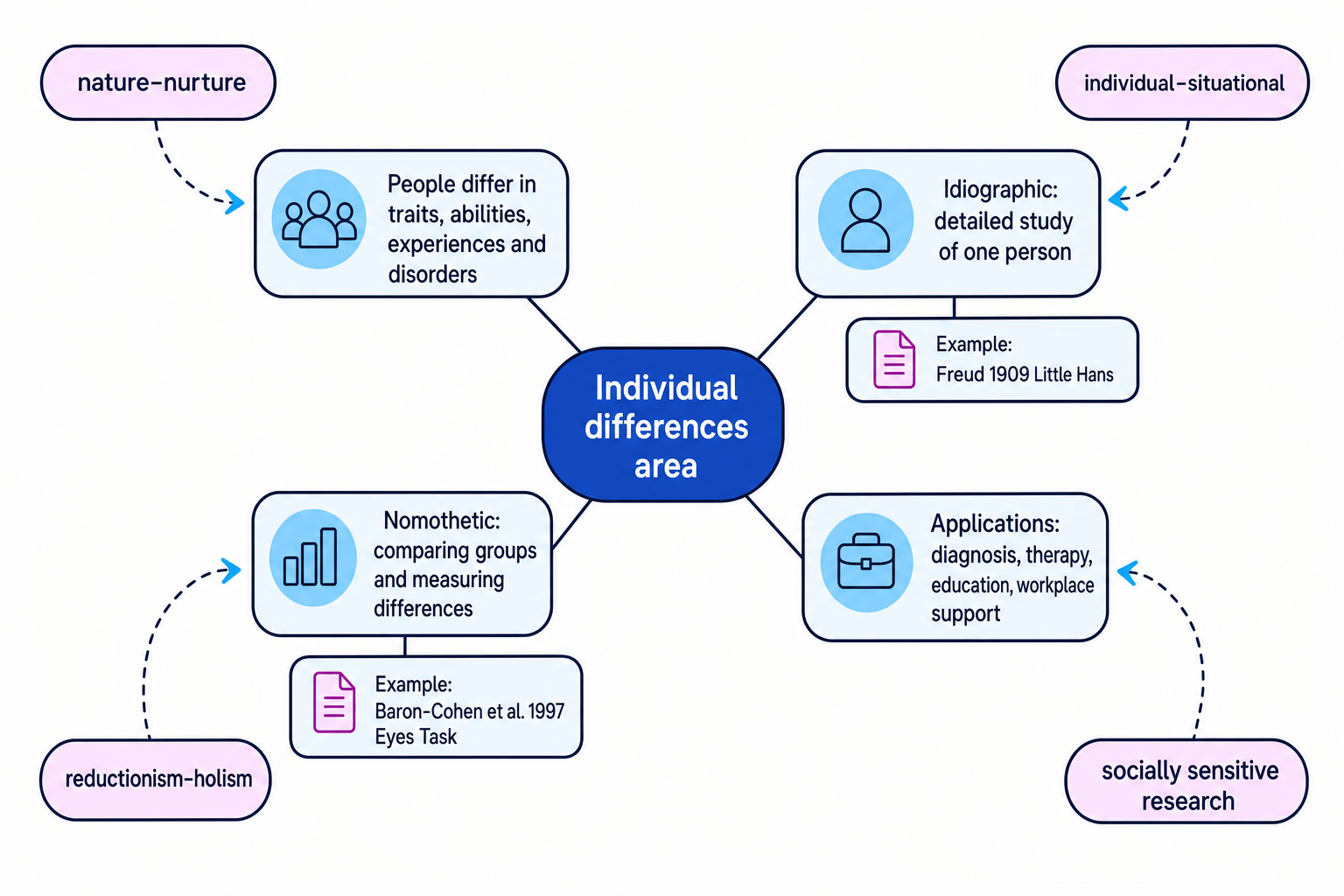
This concept map shows the main “routes” through the area: studying unique individuals, comparing groups, applying findings, and linking to debates.
Core assumption
The individual differences area assumes that variation between people is psychologically meaningful, not just “noise” around an average.
Defining principles of the area
1. People differ in stable and meaningful ways
A trait is a relatively stable characteristic, such as anxiety, impulsivity or empathy. Individual-differences psychologists may measure traits using questionnaires, tests or observations.
The area also studies atypical behaviour, meaning behaviour or experience that differs from what is statistically common or socially expected. This includes phobias, autism, depression and other clinical or developmental conditions.
Atypical does not mean inferior
Avoid writing as if “different” automatically means “worse”. In modern psychology, especially around neurodiversity, careful language matters.
2. It can be idiographic or nomothetic
Idiographic and nomothetic
An idiographic approach studies one person or a very small number of people in depth. A nomothetic approach studies groups to find general patterns or laws.
Individual differences uses both. Freud’s study of Little Hans is idiographic because it focuses on one child in great detail. Baron-Cohen et al.’s Eyes Task study is more nomothetic because it compares groups and uses quantitative scores.
3. Explanations may be biological, cognitive, social or psychodynamic
The area is not tied to just one perspective. For example:
- A biological explanation might look at genes, brain structures or neurotransmitters.
- A cognitive explanation might examine attention, memory or theory of mind.
- A psychodynamic explanation might focus on unconscious conflict, as in Freud.
- A social explanation might look at family, culture, labelling or stigma.
This means the area often links strongly to the nature/nurture debate: are differences caused by inherited biology, life experiences, or an interaction between both?
Core research illustrating the area
Freud (1909): Little Hans
Freud’s classic case study investigated a young boy known as Little Hans, who had a phobia of horses. Freud used reports from Hans’ father, plus one direct meeting, to interpret Hans’ fears through psychoanalytic theory.
Case study
A case study is an in-depth investigation of one person, group or event, often using rich qualitative data such as interviews, observations and personal records.
Freud argued that Hans’ fear of horses was a displaced fear of his father. He linked this to the Oedipus complex, where a young boy is said to experience unconscious desire for his mother and rivalry with his father.
AO1 details you could use:
- Method: longitudinal case study using letters and conversations reported by Hans’ father.
- Sample: one young boy, Hans.
- Data: mainly qualitative descriptions of dreams, fantasies and fears.
- Conclusion: Freud claimed Hans’ phobia supported psychoanalytic ideas about unconscious conflict and psychosexual development.
AO3 evaluation:
- Very rich detail, so it gives insight into one individual.
- Low generalisability because Hans was only one child from a particular family background.
- Low reliability because Freud’s interpretations are subjective and difficult to replicate.
- Ethical issues include studying a child, possible lack of informed consent, and the father acting as both parent and data collector.
Baron-Cohen et al. (1997): Autism and the Eyes Task
Baron-Cohen et al. investigated whether adults with autism or Asperger syndrome had difficulty with theory of mind.
Theory of mind
Theory of mind is the ability to infer other people’s mental states, such as beliefs, intentions, feelings and desires.
Participants completed the Eyes Task, where they looked at photographs of the eye region of faces and chose which mental-state word best described what the person was thinking or feeling.
AO1 details you could use:
- Method: quasi-experiment because the participant groups, such as autism diagnosis, were naturally occurring.
- Sample: adults with autism or Asperger syndrome, neurotypical adults, and adults with Tourette syndrome.
- Materials: photographs of eyes with mental-state word choices.
- Results: the autism/Asperger group scored lower on the Eyes Task than the comparison groups.
- Conclusion: the findings supported the idea that autism involves difficulties with advanced theory of mind.
Quasi-experiment
A quasi-experiment compares naturally occurring groups, so the researcher does not directly manipulate the independent variable.
AO3 evaluation:
- More standardised and replicable than Freud’s case study.
- Useful because it influenced understanding of autism and social cognition.
- However, the Eyes Task may lack ecological validity because real social interaction involves voice, movement, context and relationships.
- It is socially sensitive because research on autism can affect public attitudes, diagnosis and stigma.
Language for autism research
You can refer to the original “autism/Asperger” group when describing Baron-Cohen et al. (1997), but in evaluation use respectful modern language and avoid implying a deficit in personal worth.
Comparing the two individual-differences studies
Freud (1909) and Baron-Cohen et al. (1997) both fit the area because they focus on how one person or group differs from typical experience.
However, they differ sharply in method:
- Freud is idiographic, qualitative and interpretive.
- Baron-Cohen et al. is nomothetic, quantitative and more scientific in procedure.
- Freud focuses on unconscious psychodynamic causes.
- Baron-Cohen et al. focuses on cognitive processing, especially theory of mind.
- Freud has depth but weak generalisability.
- Baron-Cohen et al. has stronger controls but may simplify complex social behaviour.
Applying the area to a novel scenario
In AO2, you may be given a source about a person, group or behaviour. Your job is to connect it to the area without just repeating study details.
Identifying an individual-differences explanation
A psychologist compares anxiety questionnaire scores for students with and without a diagnosis of social anxiety.
- The focus is on variation between people, specifically differences linked to a diagnosis, so the scenario fits the individual differences area.
- Because the diagnosis already exists, the study is likely to be a quasi-experiment rather than a true experiment.
- The psychologist could use a standardised questionnaire to produce comparable scores, making the research more reliable.
- An AO3 point would be that diagnostic labels are socially sensitive: they may help people access support, but they can also lead to stigma.
Research-methods links you should recognise
Individual-differences research often involves measuring people and comparing scores, so Component 01 methods link in naturally.
Levels of measurement
- Nominal data: categories, such as diagnosis/no diagnosis or male/female.
- Ordinal data: ordered data, such as ranks or rating-scale responses.
- Interval data: numerical data with equal intervals, such as many standardised test scores.
Descriptive statistics
- Mode: most common score or category.
- Median: middle score when data are ordered.
- Mean: arithmetic average.
- Range: highest score minus lowest score.
- Variance: how spread out scores are around the mean.
- Standard deviation: typical spread of scores around the mean.
- Ratios, percentages and fractions: useful for summarising frequencies, such as “3:1”, “75%”, or “three quarters”.
Graphs
- Bar chart: separate categories, often nominal data.
- Histogram: continuous scores grouped into intervals.
- Line graph: change over time or ordered conditions.
- Pie chart: parts of a whole.
- Scatter diagram: relationship between two co-variables.
Choosing statistical tests
For OCR, know when to use the named non-parametric tests:
- Mann–Whitney U: difference between two unrelated groups.
- Wilcoxon Signed Ranks: difference between two related conditions or matched pairs.
- Chi-square: association between categories or differences in frequencies using nominal data.
- Binomial Sign Test: difference using related nominal data, often plus/minus signs.
- Spearman’s Rho: correlation between two variables, usually ordinal or ranked data.
A parametric test is considered when data are interval-level, approximately normally distributed, and meet assumptions such as similar spread of scores. If those assumptions are not met, a non-parametric test is usually safer.
Choosing a test for Eyes Task data
A researcher compares Eyes Task scores from an autism group and a neurotypical group. The participants are different people in each group.
- The researcher is testing for a difference, not a correlation, because the question asks whether two groups score differently.
- The design is unrelated, because each participant is in only one group.
- If the researcher treats the scores as non-parametric or not normally distributed, the correct test is Mann–Whitney U.
- The calculated value is checked against a table of critical values using the sample sizes, significance level and whether the hypothesis is one-tailed or two-tailed.
- If the result reaches p≤0.05p \le 0.05p≤0.05, the researcher rejects the null hypothesis, accepting a 5% or lower probability that the result occurred by chance.
Significance and errors
A Type I error is a false positive: saying there is a significant effect when there is not. A Type II error is a false negative: missing a real effect. Common significance levels include p≤0.05p \le 0.05p≤0.05, p≤0.01p \le 0.01p≤0.01 and p≤0.001p \le 0.001p≤0.001.
You may also see symbols such as =, <, <<, >>, >, ∞ and ~. In psychology methods, these are usually used to express equality, comparison, very large/small differences, infinity, or approximate similarity.
Strengths of the individual differences area
It is useful
This area has clear real-world applications. It can improve diagnosis, therapy, education plans, workplace adjustments and support for neurodivergent people.
For example, research into autism has helped psychologists understand social cognition, while research into phobias has influenced therapy for anxiety disorders.
It respects complexity
Unlike approaches that only seek average behaviour, individual differences reminds us that people vary. This can make psychology more holistic and personally relevant.
It can use both rich detail and scientific measurement
The area can combine case studies, interviews, psychometric tests and experiments. This flexibility is a strength when studying complex human behaviour.
Weaknesses of the area
It can be socially sensitive
Socially sensitive research
Socially sensitive research is research that may have consequences for the people or groups being studied, especially if findings affect labels, treatment, rights or public attitudes.
Individual-differences research often involves mental health, intelligence, diagnosis, gender or neurodiversity. Researchers must follow the BPS Code of Human Research Ethics, including valid consent, protection from harm, confidentiality, right to withdraw and careful debriefing.
It may over-focus on the individual
A weakness is that it can underplay situational causes. For example, anxiety might be explained as an individual trait, but school pressure, poverty or family stress may also matter.
It can become reductionist
Some explanations reduce complex people to a score, diagnosis or single cause. Freud may be criticised for reducing Hans’ phobia to unconscious sexual conflict. Baron-Cohen et al. may be criticised if theory of mind is treated as the only important feature of autism.
Forgetting the situation
Do not evaluate individual differences as if people exist in a vacuum. Strong AO3 often says individual factors interact with social and cultural contexts.
Similarities and differences with other areas
Social area
The social area, such as Milgram (1963) and Bocchiaro et al. (2012), focuses more on how situations and other people affect behaviour. Individual differences focuses more on personal characteristics, although both can interact.
Cognitive area
The cognitive area, such as Loftus and Palmer (1974), studies mental processes like memory and perception. Individual differences may also study cognition, but it asks why cognitive abilities or styles differ between people.
Biological area
The biological area, such as Sperry (1968), explains behaviour through the brain, nervous system and physiology. Individual differences can include biological causes, but it is broader because it also includes life history, diagnosis, personality and experience.
Developmental area
The developmental area, such as Bandura et al. (1961), studies change across age and development. Individual differences may study development too, but the emphasis is on variation between people rather than age-related patterns.
In the exam
- For AO1, define the area clearly and use named studies, especially Freud (1909) and Baron-Cohen et al. (1997).
- For AO2, link the source to variation between people, diagnosis, traits, atypical behaviour, or group comparisons.
- For AO3, balance usefulness against issues such as ethics, social sensitivity, sampling bias, validity, reliability, reductionism and ethnocentrism.
Check yourself
- Why do both Freud (1909) and Baron-Cohen et al. (1997) fit the individual differences area?
- What is the difference between idiographic and nomothetic research?
- How could individual-differences research be useful but also socially sensitive?