What you'll learn
- What the Biological area assumes about behaviour.
- How Sperry (1968) and Casey et al. (2011) illustrate biological explanations.
- How to evaluate the area using validity, reliability, ethics, reductionism and determinism.
- How the Biological area is similar to and different from other OCR areas.
What is the Biological area?
The Biological area explains behaviour by looking at physical processes in the body, especially the brain, nervous system, hormones, genes and evolution. It asks: what is happening biologically when someone thinks, feels or behaves in a certain way?
Biological area
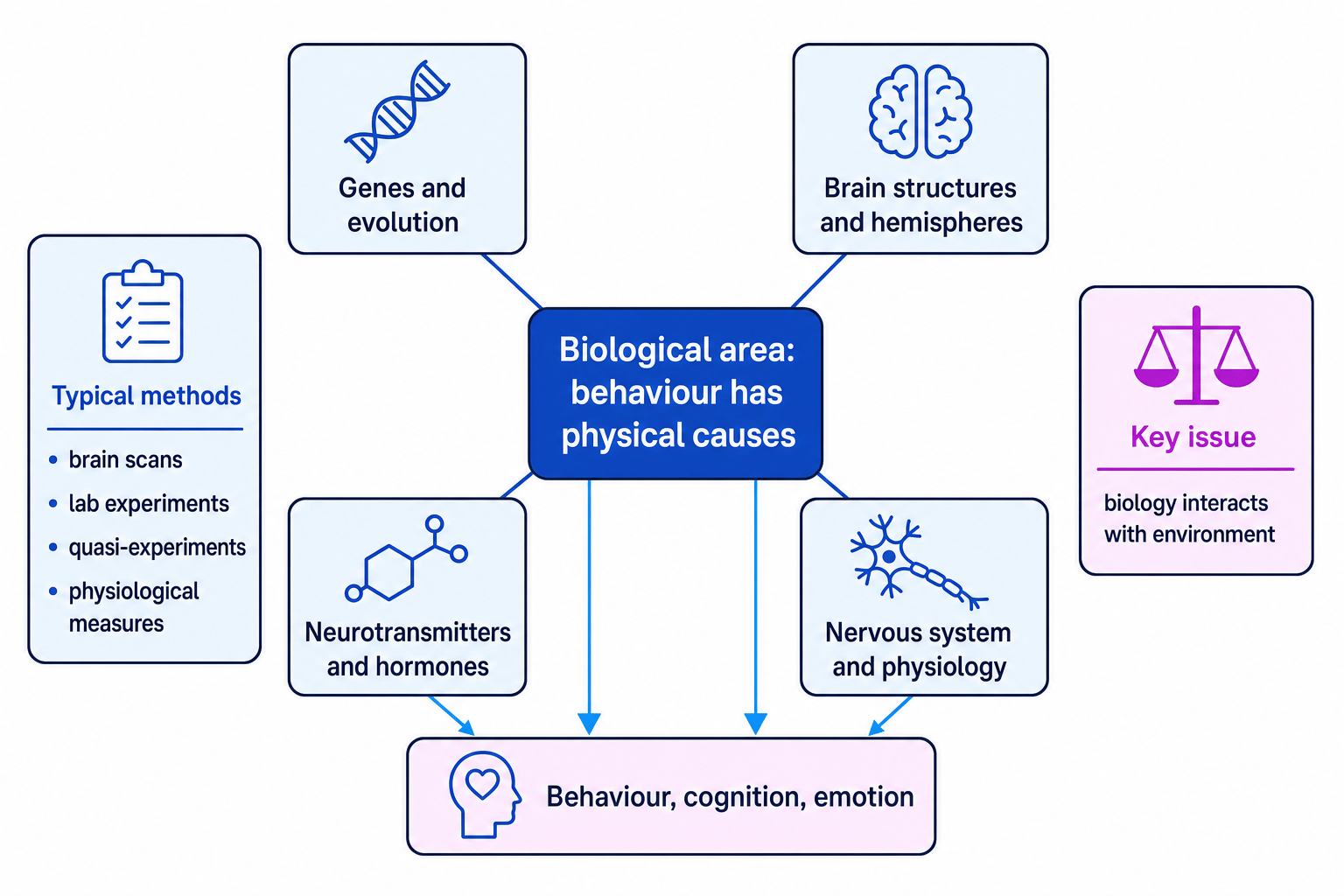
The Biological area is an area of psychology that explains behaviour, cognition and emotion in terms of biological processes such as brain structures, nervous system activity, hormones, neurotransmitters and genes.
A useful way to organise the area is to see biology as several connected levels: genes, brain structures, brain chemistry, and wider bodily systems all influencing behaviour.
The main assumption
The Biological area does not say behaviour is “only biology”. It says behaviour has biological mechanisms that can be measured and linked to what people do.
Key biological concepts
The nervous system
The nervous system is the body’s communication network. It includes the brain, spinal cord and nerves. It sends electrical and chemical signals around the body so that we can sense, think, move and respond.
A neurotransmitter is a chemical messenger that carries signals between nerve cells. A hormone is a chemical messenger released into the bloodstream, often affecting behaviour more slowly and widely than a neurotransmitter.
Genes and evolution
A gene is a section of DNA that influences characteristics, including some biological tendencies linked to behaviour. Evolution refers to changes across generations where traits that help survival or reproduction become more common.
Biological psychologists may therefore ask whether some behaviours are influenced by inherited tendencies, brain development or adaptive functions.
Biology does not mean fixed
Avoid writing as if genes or brain structures make behaviour unavoidable. A stronger answer says biology can predispose behaviour, while experience and environment can still shape outcomes.
Localisation and lateralisation
Localisation of function means that different areas of the brain are associated with different functions, such as language, movement or vision.
Lateralisation means that the two hemispheres, or halves, of the brain may specialise in different functions. For most people, the left hemisphere is strongly involved in speech and language. The right hemisphere is often linked with spatial and visual processing.
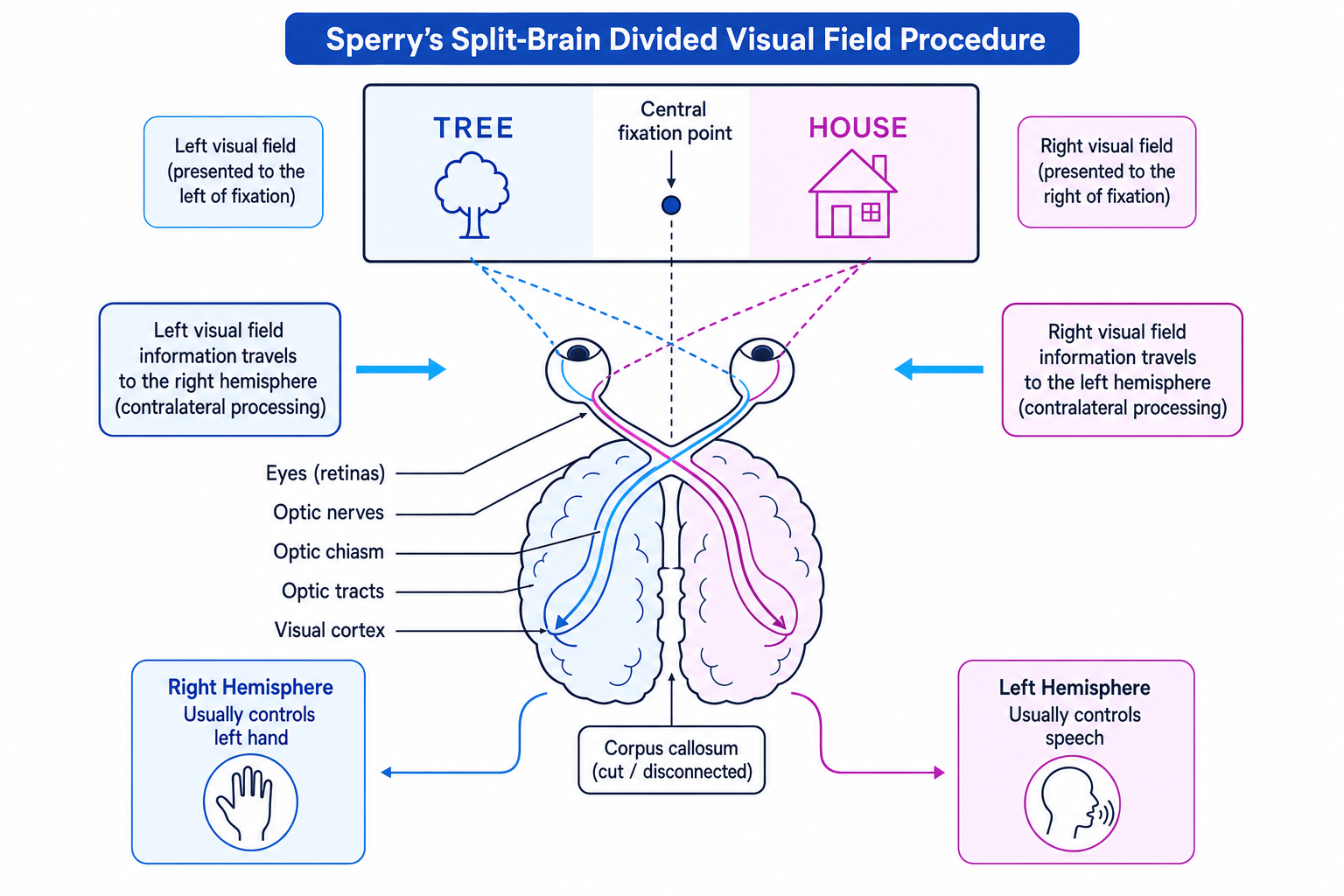
The corpus callosum is a bundle of nerve fibres connecting the two hemispheres. In split-brain patients, this connection has been cut, usually as treatment for severe epilepsy.
Predicting a split-brain response
A split-brain participant sees a picture of a key in the left visual field and is asked to say what they saw.
- Information from the left visual field is processed by the right hemisphere because visual processing is contralateral.
- In a split-brain patient, the right hemisphere cannot pass this information to the left hemisphere because the corpus callosum has been cut.
- Since speech is usually controlled by the left hemisphere, the participant is unlikely to say “key”, but may be able to select the key using the left hand, which is controlled by the right hemisphere.
Research illustrating the Biological area
Sperry (1968): split-brain research
Sperry’s classic study investigated people who had undergone split-brain surgery. This was a quasi-experiment, meaning the independent variable was naturally occurring rather than directly manipulated by the researcher. The participants already had split brains due to surgery.
Participants focused on a central point while visual information was briefly presented to either the left or right visual field. Because the image appeared so quickly, the participant could not move their eyes and send the information to both hemispheres.
Key findings included:
- Information shown to the right visual field could usually be verbally reported because it went to the left hemisphere.
- Information shown to the left visual field could not usually be spoken, but participants could often identify it using the left hand.
- This supported the idea that the hemispheres have specialised functions.
Sperry concluded that the hemispheres can operate with a degree of independence, and that the corpus callosum is important for communication between them.
Casey et al. (2011): delay of gratification and the brain
Casey et al.’s contemporary study followed up people who had originally taken part in delay of gratification research as children. Delay of gratification means resisting an immediate reward to gain a better later reward.
Adults who had been high or low delayers as children completed “go/no-go” tasks. In a go/no-go task, participants respond to some stimuli but must inhibit, or stop, their response to others. Some stimuli were emotionally tempting, such as happy faces. A subset of participants also had fMRI scans, which measure changes in blood flow in the brain as an indicator of brain activity.
The study found that low delayers had more difficulty inhibiting responses to tempting emotional stimuli. Brain activity suggested involvement of areas linked to impulse control and reward, including the inferior frontal gyrus and ventral striatum.
This illustrates the Biological area because it links self-control to brain systems involved in inhibition and reward.
AO1 shortcut
For Biological area essays, you can use Sperry for brain lateralisation and Casey et al. for brain activity, inhibition and reward. Together they show that the area studies both brain structure and brain function.
Ethics in biological research
The BPS Code of Human Research Ethics gives guidance on issues such as informed consent, right to withdraw, confidentiality, protection from harm and debriefing.
In Sperry’s study, participants were a special clinical group, so researchers needed to protect them from stress or embarrassment during unusual tasks. In Casey et al., the research involved long-term personal data and brain scanning, so confidentiality and informed consent were especially important.
Social sensitivity
Biological findings can be socially sensitive if they label people as biologically “low control”, “abnormal” or “limited”. In evaluation, explain how findings could be useful, but also how they might stigmatise individuals if misused.
Strengths of the Biological area
It is scientific
Biological research often uses controlled methods, brain scans, standardised tasks and objective measures. This can improve reliability, meaning findings can be checked or repeated.
For example, Sperry used controlled visual presentation tasks, and Casey et al. used go/no-go tasks and fMRI data. These methods make the research more precise than relying only on self-report.
It has useful applications
Biological research has clear practical value. Split-brain research helps understanding of epilepsy surgery, brain lateralisation and neuropsychological assessment. Casey et al.’s findings may help develop strategies for improving self-control, such as reducing exposure to tempting cues or training inhibition.
It can produce testable explanations
A biological explanation can often lead to a clear prediction. For example, if a brain area is involved in impulse control, then people who struggle with inhibition may show different activity in that area during a task.
Applying a biological explanation
A researcher finds that teenagers take more risks when emotionally excited than when calm.
- A biological psychologist would identify a possible physical mechanism, such as increased activity in reward systems or reduced control from brain areas involved in inhibition.
- They would make a testable prediction: risk-taking should increase most in conditions with emotionally tempting rewards.
- They could test this using a controlled task and physiological measures, such as brain scanning or heart-rate recording, rather than only asking teenagers why they took risks.
Weaknesses of the Biological area
It can be reductionist
Reductionism means explaining complex behaviour by breaking it down into simpler parts. Biological explanations can be reductionist when they explain behaviour mainly through brain areas, genes or hormones.
This can be useful because it gives precise explanations, but it may ignore thoughts, emotions, relationships, culture and learning.
It can sound deterministic
Determinism is the view that behaviour is caused by factors outside a person’s control. Biological explanations may imply that brain structures, genes or hormones determine behaviour.
A balanced AO3 point is that biological factors can strongly influence behaviour, but they usually interact with experience. Casey et al. is a good example because self-control is linked to brain systems, but also develops through childhood experience and environmental demands.
Samples can be unrepresentative
Sperry studied a very unusual group: people who had undergone split-brain surgery. This limits generalisability, meaning we must be cautious when applying findings to the wider population.
Casey et al. used a long-term sample from earlier delay of gratification research, so the sample may not represent all cultures, social classes or life experiences.
Laboratory tasks may lack everyday realism
Ecological validity means how well research reflects real-life behaviour. Split-brain tasks and go/no-go tasks are controlled, but they are not the same as everyday perception, speech or self-control.
One-sided evaluation
Do not simply say “lab studies are bad because they are artificial”. In OCR essays, balance it: artificial tasks can reduce ecological validity, but they also increase control and reliability.
Applications of the Biological area
Biological psychology can be applied in several useful ways:
- Medicine: understanding epilepsy, brain injury, language impairment and neurological disorders.
- Education: helping students manage impulsivity and delay gratification.
- Mental health: linking symptoms to brain systems can support diagnosis and treatment.
- Rehabilitation: understanding brain function can guide recovery after stroke or injury.
These applications support the usefulness of the area, one of the key evaluation debates in OCR psychology.
Similarities and differences with other areas
Biological and Cognitive
The Cognitive area studies mental processes such as memory, attention and perception. It is similar to the Biological area because both often use controlled scientific methods.
The difference is that Cognitive psychology explains behaviour through information processing, while Biological psychology explains it through physical mechanisms. For example, Loftus and Palmer (1974) explain memory distortion through cognitive reconstruction, while Sperry (1968) explains behaviour through hemispheric processing.
Biological and Developmental
The Developmental area studies how behaviour changes with age and experience. Casey et al. (2011) overlaps strongly with this area because it follows self-control from childhood into adulthood.
The difference is emphasis: Developmental psychology focuses on change over time, while Biological psychology focuses on the body and brain mechanisms involved.
Biological and Social
The Social area explains behaviour through other people, groups and situations. Milgram (1963), for example, studied obedience to authority.
Biological explanations are more internal, focusing on brain and body processes. However, they can work together: a stressful social situation may affect hormones, brain activity and behaviour.
Biological and Individual Differences
The Individual Differences area studies how people vary, including personality, disorders and atypical behaviour. Biological psychology also studies differences between people, but usually explains them through physical systems, such as brain activity or genetic vulnerability.
Best comparison point
The Biological area is most distinctive because it searches for physical mechanisms behind behaviour, but it often overlaps with other areas when biology interacts with memory, development, social pressure or individual variation.
In the exam
- For AO1, define the Biological area clearly and use accurate terms such as localisation, lateralisation, nervous system, hormones or genes.
- For AO2, apply the area to the source by identifying the behaviour first, then linking it to a specific biological mechanism.
- For AO3, balance strengths and weaknesses: scientific control and usefulness on one side; reductionism, determinism, ethics and limited generalisability on the other.
Check yourself
- How does Sperry (1968) show lateralisation of function?
- Why is Casey et al. (2011) a good example of biology interacting with development?
- What is one strength and one weakness of explaining behaviour biologically?

