What you'll learn
- How babies develop attachments and why these bonds matter.
- How Ainsworth and Bell (1970) used the Strange Situation to study attachment.
- The possible impact of failing to develop early attachments.
- How to apply attachment research to create attachment-friendly environments.
1. What is attachment?
In psychology, attachment is not just “liking” someone. It is a close emotional bond that gives a child comfort, protection and a base for exploring the world.
A caregiver is the person who provides regular care for the child. In older studies this was often the mother, but in modern psychology it can be a father, grandparent, foster carer, nursery key person, or another consistent adult.
Attachment
Attachment is a long-lasting emotional bond between a child and a caregiver, shown through behaviours such as seeking closeness, distress at separation, and comfort on reunion.
This topic belongs to the social area because attachment develops through interaction between people. The baby’s behaviour affects the caregiver, and the caregiver’s responses affect the baby.
2. How babies show attachment
Attachment is usually inferred from observable behaviour. Important signs include:
- Proximity seeking: trying to stay physically close to the caregiver.
- Separation anxiety: distress when the caregiver leaves.
- Stranger anxiety: wariness or distress around unfamiliar people.
- Reunion behaviour: what the baby does when the caregiver returns.
- Exploration: playing with and investigating the environment.
- Secure base behaviour: using the caregiver as a safe base from which to explore.
Secure base
A securely attached baby is not simply “clingy”. They usually explore more confidently because they trust that the caregiver is available if needed.
3. How attachment develops in babies
A useful way to understand development is to think of attachment as becoming more selective over time.
Early months: social responsiveness
In the first months, babies often respond to many adults. They may smile, cry and settle with different people. These early behaviours encourage adults to interact with them.
A reciprocal interaction is a two-way exchange where infant and caregiver respond to each other. For example, the baby smiles, the adult smiles back, and the baby becomes more engaged.
Interactional synchrony means the caregiver and infant coordinate their timing and behaviour, almost like a conversation before the baby can speak.
Later infancy: specific attachment
From around the second half of the first year, many babies show a stronger preference for a familiar caregiver. This is when separation anxiety and stranger anxiety become more obvious.
A caregiver who is sensitive notices the baby’s signals and responds appropriately. For example, they can tell the difference between tired crying, hungry crying and wanting comfort.
Multiple attachments
After forming a first strong attachment, many babies form multiple attachments with other familiar adults. This matters because a child’s attachment network can include parents, siblings, grandparents and childcare workers.
Secure does not mean never distressed
A securely attached baby may cry when the caregiver leaves. The key evidence is what happens on reunion: secure babies usually seek comfort, are soothed, and then return to exploration.
4. Failure to develop attachments
A privation is when a child has never had the chance to form a strong attachment. A deprivation is when an attachment has formed but is then disrupted or lost.
Failure to develop attachments can be linked to difficulties with emotional regulation, trusting others, forming relationships, and coping with stress. In severe cases, especially in poor institutional care, children may show disinhibited attachment, where they are unusually friendly or attention-seeking with unfamiliar adults.
Bowlby argued that early attachment forms an internal working model, which is a mental template for future relationships. If early care is inconsistent or absent, the child may learn that adults are unreliable.
However, this must be handled carefully. Attachment problems increase risk; they do not guarantee a fixed outcome. Stable, sensitive later care can help children recover.
Risk, not destiny
Early attachment difficulties can affect later development, but children are not “doomed”. Quality later care, stability and sensitive relationships can make a real difference.
5. Key research: Ainsworth and Bell (1970)
The key study is Ainsworth and Bell (1970), “Attachment, Exploration and Separation: Illustrated by the Behavior of One-Year-Olds in a Strange Situation.”
Their research built on the idea that attachment behaviour becomes clearest when a child is mildly stressed, such as being in an unfamiliar room, meeting a stranger, or being separated from the caregiver.
Aim
Ainsworth and Bell aimed to investigate how one-year-old infants behaved during exploration, separation and reunion with their caregiver.
Method
This was a controlled observation, meaning behaviour was observed in a standardised setting where the researchers arranged the situation.
The study involved infants aged around one year, observed with their mothers in an unfamiliar room. The procedure used toys, a stranger, brief separations, and reunions. Observers recorded behaviours such as exploration, crying, contact-seeking, avoidance and resistance.
Operationalised behaviour means behaviour is defined in observable terms. For example, “proximity seeking” might be recorded as crawling towards, reaching for, or clinging to the caregiver.
The Strange Situation procedure
The Strange Situation is a structured observation lasting about 20 minutes. It places the infant under gradually increasing stress to activate attachment behaviour.
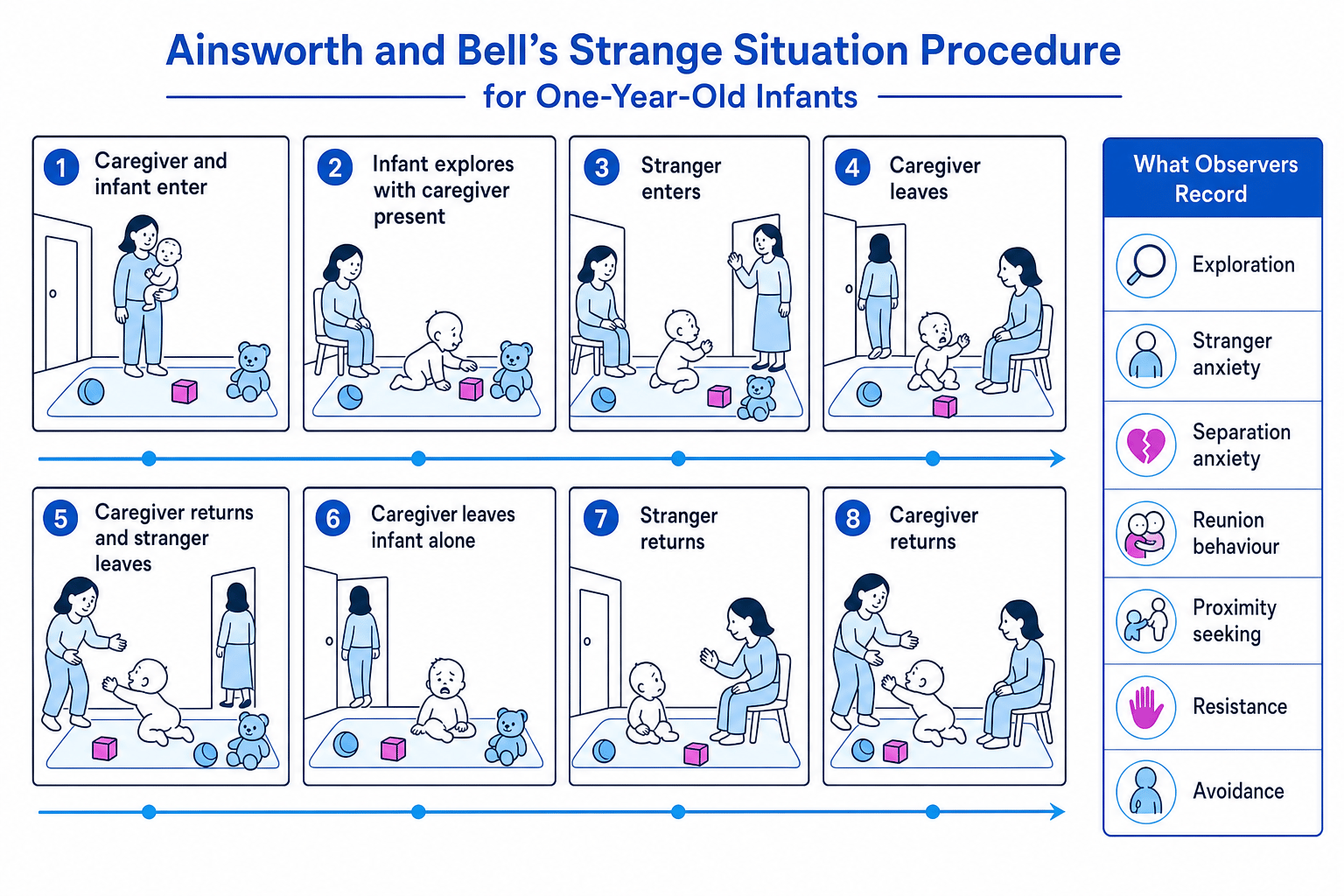
The most important part is often the reunion, because it shows whether the infant seeks comfort and whether the caregiver can soothe them.
Attachment types
Ainsworth’s work is associated with three main attachment classifications.
Secure attachment, Type B
Securely attached infants usually explore when the caregiver is present, show some distress when separated, prefer the caregiver to the stranger, and are comforted on reunion.
Insecure-avoidant attachment, Type A
Insecure-avoidant infants show little visible distress on separation and may avoid or ignore the caregiver on reunion. They may treat the stranger and caregiver similarly.
Insecure-resistant attachment, Type C
Insecure-resistant infants tend to explore less, become very distressed on separation, and show mixed reunion behaviour. They may seek contact but also resist it, for example by pushing away or struggling.
Classifying an attachment pattern
A baby plays with toys while the caregiver is in the room. When the caregiver leaves, the baby cries. When the caregiver returns, the baby crawls towards them, is comforted quickly, and then returns to playing.
- Compare the exploration behaviour: the baby plays when the caregiver is present, suggesting the caregiver is being used as a secure base.
- Consider the separation response: the baby cries, so there is clear separation anxiety, but this does not automatically mean insecurity.
- Focus on reunion behaviour: the baby seeks the caregiver, accepts comfort, settles, and returns to exploration.
- Classify the pattern as secure attachment, Type B, because the reunion behaviour shows trust in the caregiver’s availability.
Results and conclusions
Ainsworth and Bell showed that attachment and exploration are linked. When the caregiver is present and the infant feels safe, exploration increases. When the caregiver leaves, attachment behaviour increases.
The study supported the idea that reunion behaviour is especially useful for identifying attachment quality. It also helped create a practical method for classifying infant attachment.
6. Evaluating Ainsworth and Bell
Strengths
A major strength is standardisation. The same sequence of episodes was used, making the procedure easier to replicate.
The study also has good potential inter-rater reliability, which means different observers can compare ratings and check whether they agree. Because behaviours such as crying, clinging and avoidance are visible, they can be recorded systematically.
The research is also useful. It has influenced childcare, adoption, fostering, parenting support and nursery practice.
Weaknesses
One weakness is ecological validity, which is the extent to which a study reflects real-life behaviour. The Strange Situation is artificial: a baby is placed in an unfamiliar room and experiences planned separations. Some children may behave differently from how they would at home.
Another issue is sampling bias. Ainsworth’s early research focused mainly on American, middle-class families. This limits generalisability to other cultures, family structures and childcare arrangements.
There is also a risk of ethnocentrism, which means judging behaviour using the standards of one culture. For example, in cultures where babies are rarely separated from caregivers, high distress in the Strange Situation may reflect unfamiliarity with separation rather than insecure attachment.
A further issue is temperament, which means a child’s biologically influenced emotional style. A naturally anxious or calm baby may behave differently in the Strange Situation regardless of caregiver sensitivity.
Ethics
The BPS Code of Human Research Ethics highlights protection from harm, informed consent, the right to withdraw, confidentiality and debriefing. The Strange Situation deliberately causes mild stress, so researchers must ensure distress is limited and stop if the infant becomes too upset.
Best AO3 balance
Do not just write “the study was unethical because babies cried”. A stronger evaluation is that mild distress may be justified by the usefulness of the research, but only if safeguards are used.
7. Application: creating an attachment-friendly environment
An attachment-friendly environment is one that helps children form stable, trusting relationships with consistent adults.
One strong strategy is a key person system in childcare. Each baby or young child is assigned a specific adult who builds a close, predictable relationship with them.
The key person should:
- greet and settle the child regularly;
- provide comfort during distress;
- learn the child’s routines, preferences and cues;
- support gradual separations from parents;
- communicate closely with the family;
- be consistently available rather than constantly rotating staff.
This links directly to Ainsworth and Bell because children explore more confidently when they have a secure base. A familiar key person can act as that secure base in a nursery or childcare setting.
Other attachment-friendly strategies include low staff turnover, predictable routines, warm responses to distress, gradual settling-in visits, comfort objects from home, and support for adoptive or foster carers.
Designing an attachment-friendly nursery routine
A nursery reports that babies are passed between many staff members during the day. Several children cry at drop-off and do not explore the toys.
- Identify the attachment issue: many staff changes reduce consistency, so babies may not know which adult is their secure base.
- Link to research: Ainsworth and Bell showed that exploration is more likely when the caregiver is present and the child feels safe.
- Choose a strategy: introduce a key person system so each baby has one main adult for greetings, comfort, feeding and communication with parents.
- Add support for separation: use gradual settling-in sessions, allow a familiar comfort object, and make reunions calm and predictable.
- Measure improvement: observe whether the child settles more quickly, seeks the key person for comfort, and explores more confidently over time.
8. Essay links: AO1, AO2 and AO3
For AO1, describe attachment, signs of attachment, the Strange Situation procedure, attachment types, and the impact of failure to develop attachments.
For AO2, apply the ideas to a scenario. If a baby avoids the caregiver on reunion, that suggests insecure-avoidant attachment. If a nursery has high staff turnover, suggest a key person system.
For AO3, evaluate carefully. Use points about standardisation, reliability, ecological validity, culture bias, sampling bias, temperament, ethics and usefulness.
In the exam
- For Ainsworth and Bell, “tell the story”: aim, sample, procedure, behaviours recorded, attachment types, conclusions.
- For application questions, link the strategy directly to attachment concepts such as secure base, sensitivity, consistency and reunion behaviour.
- For evaluation, make balanced points: a controlled observation can be reliable, but culture, temperament and artificiality may affect validity.
Check yourself
- Why is reunion behaviour so important in the Strange Situation?
- How would you tell the difference between insecure-avoidant and insecure-resistant attachment?
- What practical changes could a nursery make to become more attachment-friendly?
