What you'll learn
- What the developmental area is and how it explains behaviour.
- The key concepts: maturation, learning, socialisation, stages, and change over time.
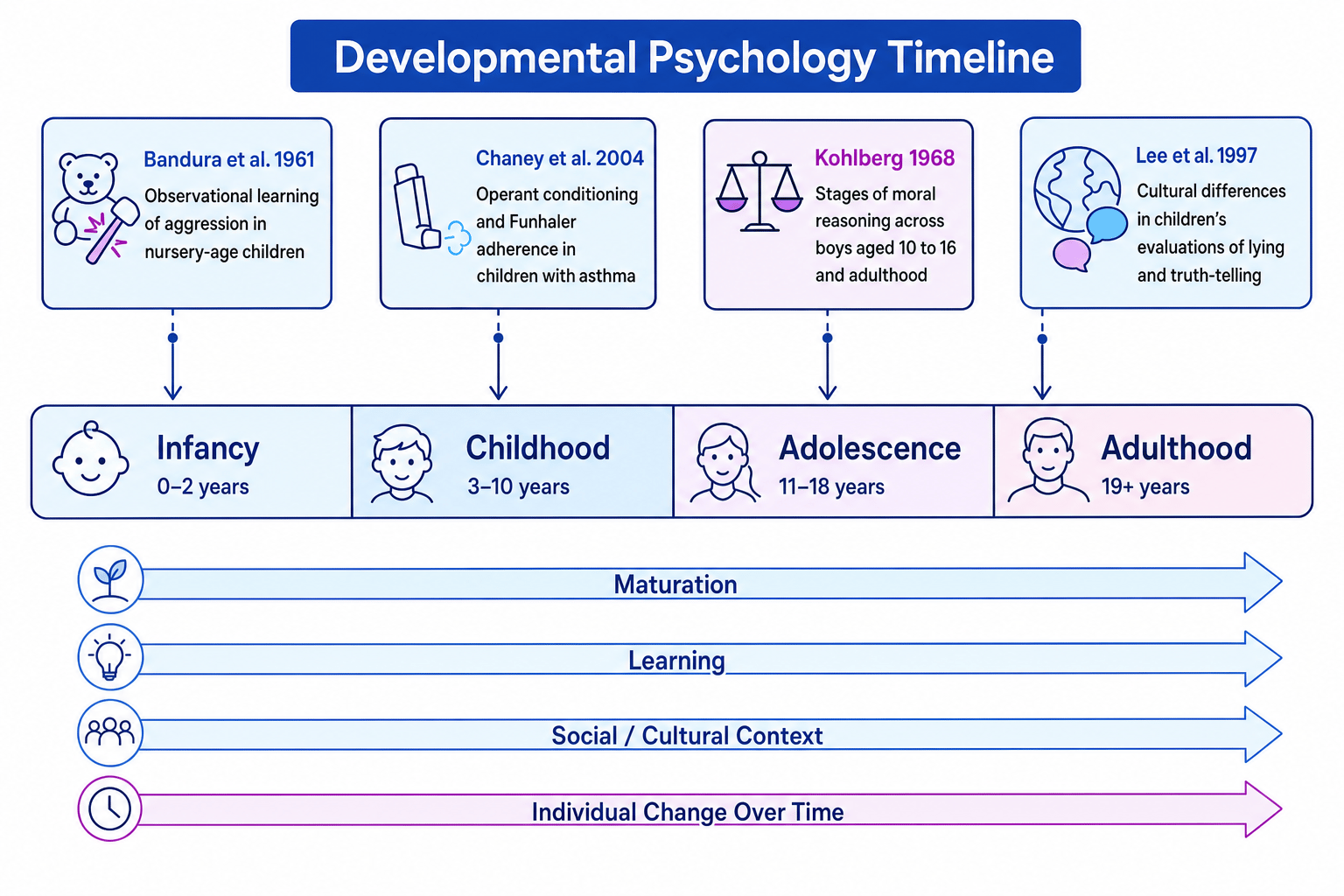
- How OCR core studies, especially Bandura et al. (1961), Chaney et al. (2004), Kohlberg (1968), and Lee et al. (1997), illustrate the area.
- How to evaluate the developmental area for AO3 essays.
What is an “area” in psychology?
An area is a broad branch of psychology that focuses on a particular kind of behaviour, explanation, or research tradition. For OCR H567, the main areas include social, cognitive, developmental, biological, and individual differences.
Developmental psychology
Developmental psychology is the study of how behaviour, thinking, emotions, and social understanding change across the lifespan, especially during childhood and adolescence.
The developmental area is not just about “what children do”. It asks how and why people change. For example, a developmental psychologist might ask why a young child copies aggressive behaviour, how moral reasoning changes with age, or how culture shapes children’s ideas about truth-telling.
Developmental does not mean children only
Children are often studied because development is rapid in childhood, but developmental psychology can cover the whole lifespan: infancy, childhood, adolescence, adulthood, and old age.
The big idea: behaviour changes over time
Developmental explanations usually focus on change. That change may happen because of biology, experience, social influence, or culture.
Key developmental concepts
- Maturation means biologically driven development as the body and nervous system grow. For example, some thinking skills improve as the brain develops.
- Learning means a relatively lasting change in behaviour or knowledge due to experience.
- Socialisation is the process by which children learn the norms, values, and behaviours expected in their society.
- A stage is a proposed level or phase of development, where behaviour or thinking is qualitatively different from earlier or later phases.
- Continuity means development is gradual. Discontinuity means development happens in distinct stages.
- The nature/nurture debate asks whether behaviour is mainly influenced by biology and genes, or by experience and environment.
Development = change plus explanation
In essays, do not just say “children are younger”. Explain what changes with age: cognitive ability, moral reasoning, reinforcement history, social learning, brain development, or cultural understanding.
Developmental research methods
Developmental psychologists need methods that can show how behaviour changes.
Longitudinal research
A longitudinal study follows the same participants over time. This is useful because it shows individual developmental change, but it can suffer from attrition, which means participants dropping out.
Cross-sectional research
A cross-sectional study compares different age groups at the same time. It is quicker than a longitudinal study, but it can suffer from a cohort effect, where differences between age groups are caused by historical or cultural differences rather than age itself.
Experiments and observations
Developmental research often uses controlled observations, laboratory experiments, interviews, questionnaires, and field studies. Working with children can make research more difficult because researchers must ensure tasks are understandable, ethical, and age-appropriate.
Choosing a developmental design
- If the aim is to find out how the same children’s moral reasoning changes between ages 10 and 16, a longitudinal design is strongest because it tracks real developmental change within individuals.
- If the aim is to compare 7-year-olds, 9-year-olds, and 11-year-olds quickly, a cross-sectional design is more practical because all data can be collected at one time.
- The trade-off is evaluation: the longitudinal design has better insight into change over time but risks attrition, while the cross-sectional design is faster but risks cohort effects.
OCR studies that illustrate the developmental area
The four OCR developmental core studies can be remembered as studies of learning, health behaviour, moral reasoning, and culture across childhood.
Bandura, Ross and Ross (1961): transmission of aggression
Bandura et al. studied whether children imitate aggressive behaviour. Children observed an adult model behaving aggressively or non-aggressively towards a Bobo doll, then were observed during play.
The main finding was that children exposed to an aggressive model showed more imitative aggression. This supports social learning theory, which argues that people can learn by observing and imitating others.
This is developmental because it shows how children’s behaviour can be shaped by models in their environment.
Chaney et al. (2004): the Funhaler
Chaney et al. studied whether a child-friendly asthma spacer, the Funhaler, could improve children’s adherence to asthma medication. The Funhaler used toys and incentives to make taking medication more engaging.
This illustrates operant conditioning, where behaviour is shaped by consequences such as rewards. If taking medication becomes rewarding, children may be more likely to repeat the behaviour.
This is developmental because it applies learning principles to children’s health behaviour in a practical, age-appropriate way.
Kohlberg (1968): moral development
Kohlberg investigated children’s and adolescents’ moral reasoning using moral dilemmas, such as whether a person should steal a drug to save someone’s life. He proposed stages of moral development, moving from reasoning based on punishment and reward to reasoning based on laws, social order, and abstract principles.
This is developmental because Kohlberg argued that moral reasoning changes with age and cognitive development.
Lee et al. (1997): lying, truth-telling, and culture
Lee et al. compared Chinese and Canadian children’s evaluations of lying and truth-telling in prosocial and antisocial situations. The study found cultural differences, especially around modesty and truth-telling about good deeds.
This is developmental because it shows that children’s moral understanding develops within a cultural context, not just through universal stages.
A useful study pairing
For the developmental area, Bandura and Chaney are useful for learning and external influences, while Kohlberg and Lee are useful for moral development, age, and culture.
Applying the developmental area
AO2 questions may give you a novel source, such as a child copying behaviour, refusing medication, or judging whether lying is wrong. Your job is to apply developmental ideas, not just name a study.
Applying a developmental explanation
A 6-year-old starts shouting and hitting a toy after watching an older sibling do the same and receive praise.
- The behaviour can be explained through observational learning because the child has watched a model perform the aggressive behaviour.
- The praise given to the older sibling acts as vicarious reinforcement: the younger child sees the model rewarded, making imitation more likely.
- A developmental answer should also consider the child’s age, because younger children may have less developed self-regulation and may rely more on visible models in their environment.
- To strengthen the answer, link to Bandura et al. (1961), where children exposed to aggressive models showed more imitative aggression.
Strengths of the developmental area
It has useful applications
Developmental research can improve education, parenting, health care, and child protection. For example, Chaney et al. (2004) shows how psychological principles can be used to improve medication adherence in children.
It can be scientific
Many developmental studies use controlled procedures, standardised tasks, and behavioural measures. Bandura et al. (1961), for example, used a controlled laboratory setting and observed specific categories of aggression.
It recognises that age matters
The area is strong because it does not assume that adults and children think in the same way. Kohlberg’s work, for instance, suggests that children’s moral reasoning may differ from adults’ reasoning.
Weaknesses of the developmental area
Ethical issues are especially important
Children are considered a potentially vulnerable group. Researchers must follow the BPS Code of Ethics, including respect, competence, responsibility, and integrity. In practical terms, this means gaining parental consent, seeking the child’s assent where possible, protecting participants from harm, maintaining confidentiality, and allowing withdrawal.
Bandura et al. raises ethical concerns because children were exposed to aggressive models and mildly frustrated. Chaney et al. is less ethically concerning because it aimed to improve health behaviour, but researchers still needed parental consent and careful monitoring.
Validity and reliability can be difficult
Validity and reliability
Validity means whether a study measures what it claims to measure. Reliability means whether a study is consistent and replicable.
A laboratory task may be controlled but artificial. For example, hitting a Bobo doll may not fully represent real-life aggression, so ecological validity may be questioned. Moral dilemmas in Kohlberg’s research may also lack realism because saying what someone should do is not the same as behaving morally in real life.
Sampling bias and ethnocentrism
Sampling bias occurs when the sample is unrepresentative. Ethnocentrism means judging behaviour mainly from the viewpoint of one culture.
Kohlberg’s original research has been criticised for focusing heavily on male participants and Western moral values. Lee et al. helps address this by directly comparing Chinese and Canadian children, showing that culture affects moral evaluations.
It can be deterministic or reductionist
A deterministic explanation suggests behaviour is strongly caused by factors outside free choice, such as reinforcement or developmental stage. A reductionist explanation explains complex behaviour using a narrow factor.
For example, explaining aggression only through imitation may ignore temperament, family stress, media exposure, and wider social context. A more holistic explanation would combine learning, cognition, biology, and culture.
Similarities and differences with other areas
| Area | Similarity to developmental psychology | Key difference |
|---|---|---|
| Social | Both study how other people influence behaviour. Bandura is both social and developmental. | Social psychology may focus on immediate social situations, while developmental psychology focuses on change over time. |
| Cognitive | Both examine mental processes such as reasoning and memory. | Cognitive psychology may study adults generally, while developmental psychology asks how thinking changes with age. |
| Biological | Both may consider maturation and brain development. | Biological psychology emphasises genes, hormones, and brain structures more directly. |
| Individual differences | Both recognise variation between people. | Individual differences focuses on how people differ; developmental psychology focuses on patterns of change across age. |
Writing about the developmental area
For AO1, define the area and describe relevant studies accurately. For AO2, apply developmental ideas to the source: age, learning, maturation, reinforcement, socialisation, and culture. For AO3, evaluate using ethics, validity, reliability, usefulness, determinism, reductionism, ethnocentrism, and sampling bias.
In the exam
- Start with the core assumption: developmental psychology studies how behaviour and thinking change over time.
- Anchor your answer in named research, especially Bandura et al. (1961), Chaney et al. (2004), Kohlberg (1968), or Lee et al. (1997).
- For evaluation, balance usefulness and scientific control against ethical issues, artificial tasks, sampling bias, and cultural limitations.
Check yourself
- How is developmental psychology different from simply studying children?
- Which OCR developmental study best illustrates social learning, and which best illustrates cultural influences on moral development?
- Why are ethics especially important in developmental research?

