What you'll learn
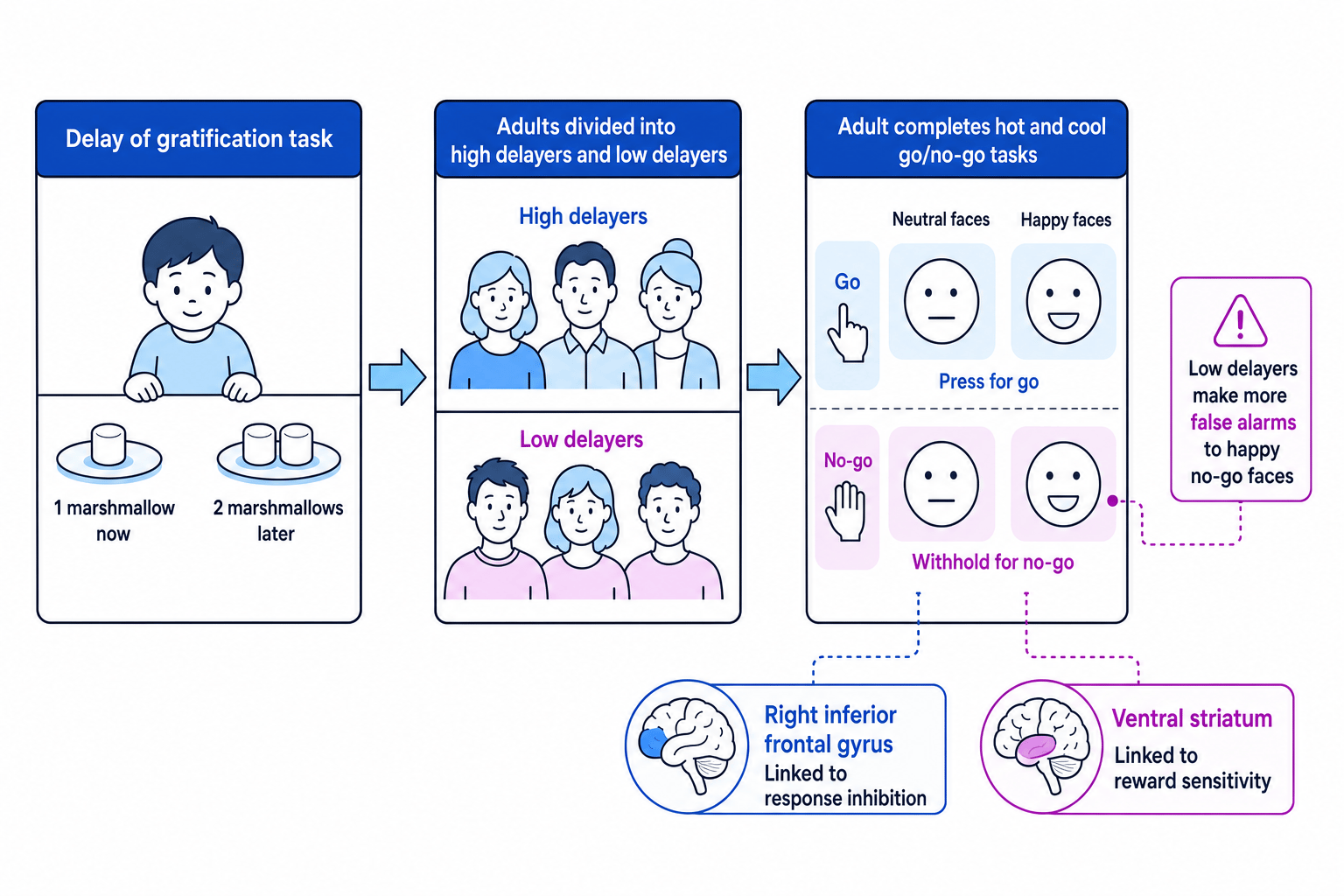
- What Casey et al. (2011) investigated and why it matters for the Biological area.
- How a childhood delay-of-gratification task was followed up around 40 years later.
- How the go/no-go task and fMRI were used to study impulse control.
- How to evaluate Casey et al. and compare it with Sperry (1968).
The big idea: self-control and the brain
Casey et al. (2011) is the contemporary core study for the key theme Regions of the brain in the Biological area. It asks whether differences in people’s ability to resist temptation are linked to activity in particular brain regions.
The study followed up people who had taken part in early delay-of-gratification research as children. Decades later, the researchers tested whether those who had been good or poor at delaying gratification still differed in adult self-control — and whether their brains responded differently to tempting social cues.
Delay of gratification
Delay of gratification means resisting an immediate reward in order to gain a better or later reward. In the classic “marshmallow” style task, a child might choose between one treat now or two treats if they wait.
Neural correlate
A neural correlate is a pattern of brain activity that is associated with a particular behaviour, experience, or mental process. It does not automatically prove that the brain activity causes the behaviour.
Background: why Casey et al. followed people for decades
The study builds on work by Mischel and colleagues, who tested preschool children’s ability to delay gratification. Children who could wait longer tended, later in life, to show better outcomes such as stronger self-control and academic achievement.
Casey et al. wanted to go further. Instead of only asking whether childhood self-control predicts adult behaviour, they asked whether long-term differences in self-control are linked to activity in brain regions involved in:
- inhibition, meaning stopping yourself from making a response;
- reward processing, meaning responding to attractive or tempting stimuli.
The core biological claim
Casey et al. suggests that adult self-control involves a balance between brain systems for cognitive control and brain systems for reward sensitivity.
Key brain regions in the study
Inferior frontal gyrus
The inferior frontal gyrus is a region in the frontal lobe. It is associated with response inhibition — stopping an action that is inappropriate or impulsive.
In Casey et al., stronger activity in the right inferior frontal gyrus was linked to better impulse control during the task.
Ventral striatum
The ventral striatum is a subcortical brain region involved in reward, motivation, and sensitivity to tempting cues.
In Casey et al., low delayers showed greater ventral striatum activity when faced with “hot” tempting cues, suggesting stronger reward-related responding.
Do not say one brain region controls everything
Avoid writing that the inferior frontal gyrus “is self-control” or the ventral striatum “is temptation”. Brain regions work in networks. Casey et al. found associations between activity in these regions and task performance.
Method: tell the story
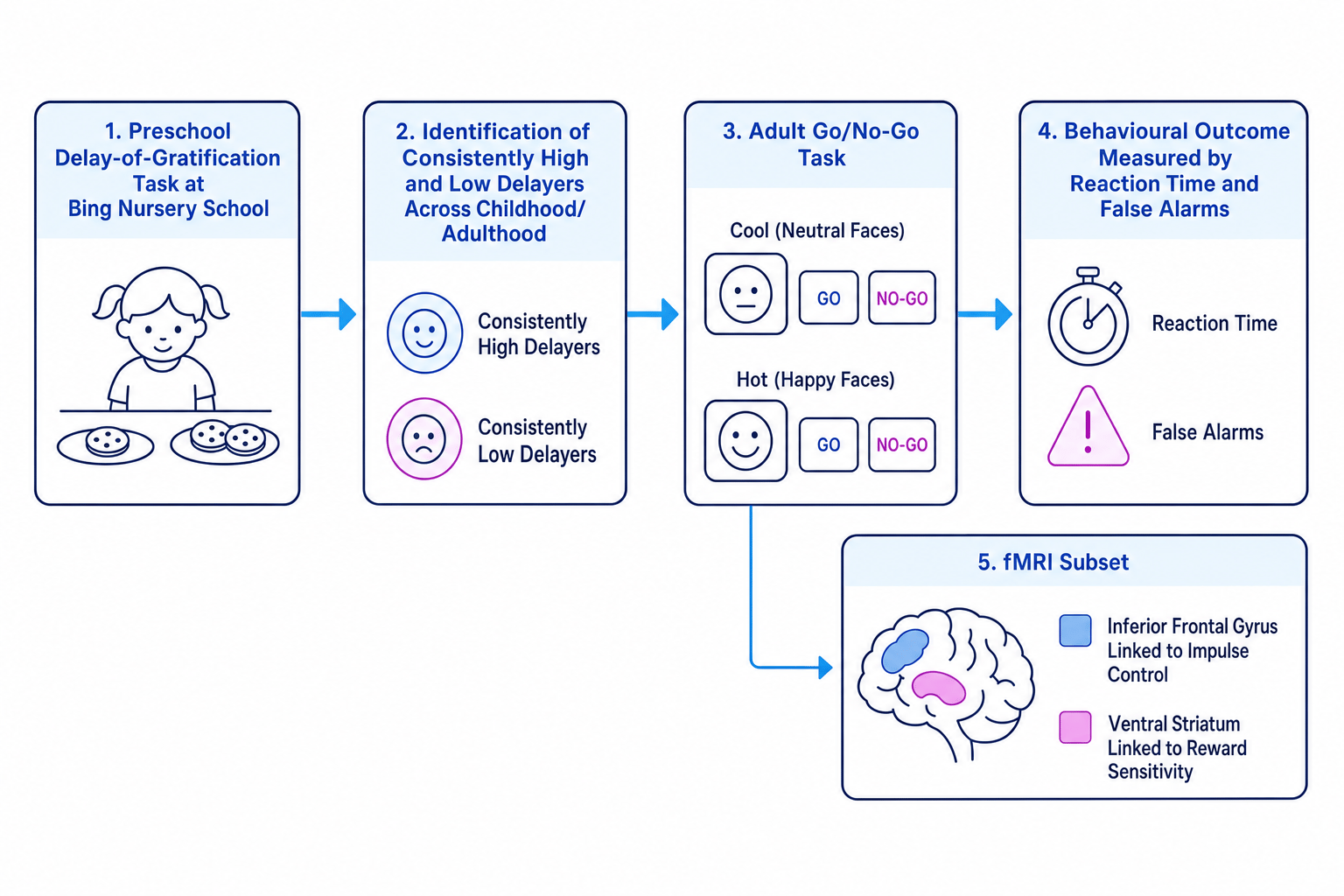
Casey et al. used a longitudinal study, meaning participants were studied across a long period of time. The original participants had taken part in delay-of-gratification research as preschool children at Stanford University’s Bing Nursery School.
Longitudinal study
A longitudinal study follows the same people over time, allowing researchers to investigate stability and change across development.
The researchers identified participants who had been consistently classified as either:
- high delayers: people who were better at delaying gratification;
- low delayers: people who found it harder to delay gratification.
As adults, participants completed a go/no-go task, and a subset also completed the task while undergoing functional magnetic resonance imaging, usually shortened to fMRI.
Design
This was a quasi-experiment because the researchers compared naturally occurring groups: high delayers and low delayers. Participants could not be randomly allocated to these groups because their delay ability already existed.
It was also highly controlled because all participants completed standardised computer-based tasks.
Sample
The sample came from the original delay-of-gratification participants, first studied as children. In adulthood, a smaller group returned for the follow-up, and an even smaller subset took part in the fMRI stage.
This is important for evaluation: the sample is unusual because it is based on people who remained available and willing to participate across many years.
Materials and apparatus
The main adult task was a go/no-go task.
Go/no-go task
A go/no-go task measures response inhibition. Participants must press a button for “go” stimuli and withhold the button press for “no-go” stimuli.
Casey et al. used two main types of task:
- a cool version using neutral stimuli;
- a hot version using emotionally rewarding stimuli, especially happy faces.
The fMRI scanner measured brain activity while participants performed the task.
fMRI
Functional magnetic resonance imaging, or fMRI, is a brain-scanning technique that measures changes in blood oxygenation. It gives an indirect measure of brain activity because active brain areas need more oxygenated blood.
Procedure
Participants were shown facial stimuli and had to respond or inhibit their response depending on the task instruction.
The key behavioural measures were:
- reaction time, meaning how quickly participants responded on go trials;
- false alarms, meaning times when participants incorrectly responded on no-go trials.
False alarm
A false alarm occurs when a participant makes a response when they should have withheld it. In Casey et al., more false alarms suggest poorer inhibitory control.
Interpreting a hot go/no-go result
Imagine an adult participant performs normally with neutral faces but makes many false alarms when happy faces are the no-go stimuli.
-
Compare the two conditions: performance is not generally poor, because the participant manages the neutral condition well.
-
Identify what changes in the hot condition: happy faces are more emotionally rewarding, so the task requires inhibition in the presence of a tempting cue.
-
Link the pattern to Casey et al.: this resembles the low-delayer pattern, where difficulty appears especially when suppressing responses to hot, rewarding stimuli.
-
Apply the brain explanation: you could predict relatively stronger reward-related activity in the ventral striatum and weaker or less effective inhibition-related activity in the inferior frontal gyrus.
Results
The main behavioural finding was that high and low delayers did not simply differ on every task. Their key difference appeared when the task involved “hot” tempting cues.
Low delayers made more false alarms than high delayers when they had to inhibit responses to happy faces. This suggests that low delayers particularly struggled when self-control had to be used against rewarding emotional stimuli.
In the fMRI part of the study:
- the right inferior frontal gyrus was linked with successful inhibition;
- the ventral striatum showed greater activation in low delayers when responding to happy, tempting cues.
Conclusions
Casey et al. concluded that the ability to delay gratification can remain relatively stable from childhood into adulthood.
The findings support the idea that self-control depends partly on interactions between brain regions involved in inhibition and reward. People who are more sensitive to rewarding cues may find it harder to suppress impulsive responses, especially in emotionally “hot” situations.
Best one-sentence summary
Casey et al. found that adults who were poor delayers as children were especially likely to struggle with inhibition when faced with rewarding cues, and this was linked to activity in reward and control regions of the brain.
Evaluation: strengths and weaknesses
Scientific control and objectivity
A major strength is that the adult task was standardised. Everyone completed the same basic go/no-go procedure, which improves reliability because the study could be repeated in a similar way.
The use of fMRI also gives objective biological data rather than relying only on self-report. This supports the Biological area’s aim of using scientific methods to investigate behaviour.
However, fMRI is still an indirect measure of neural activity. It measures blood oxygenation, not thoughts or self-control directly.
Validity
The study has strong internal control because the researchers carefully measured false alarms and brain activity in controlled conditions.
However, the go/no-go task is artificial. Pressing or not pressing a button in response to faces is not the same as resisting real-life temptations such as spending money, eating unhealthy food, or checking your phone.
Use the hot/cool distinction in evaluation
A strong AO3 point is that the task is artificial, but the hot condition improves validity because it uses emotionally rewarding stimuli rather than only neutral laboratory stimuli.
Longitudinal strength
A key strength is the longitudinal design. Very few studies can link preschool behaviour with adult brain activity around 40 years later. This makes the study valuable for understanding development over time.
The weakness is attrition, meaning participants dropping out over time. Those who stayed in the study may differ from those who did not, reducing generalisability.
Sampling bias and ethnocentrism
The original participants came from a specific setting: Stanford University’s Bing Nursery School. This may over-represent relatively advantaged American families.
This creates possible sampling bias, because the findings may not apply equally to people from different cultures, social classes, or educational backgrounds.
It may also be ethnocentric if conclusions about self-control are treated as universal when they are based mainly on one cultural context.
Cause and effect
Because the study compared naturally occurring high and low delayers, it cannot prove that brain differences caused self-control differences.
Other factors could matter, such as parenting style, early environment, stress, trust in adults, education, or socioeconomic status.
Correlation is not causation
Do not write that Casey et al. proved the ventral striatum causes poor self-control. The study shows an association between brain activity and delay-related behaviour.
Ethics
The study was relatively ethical because adult participants could give informed consent, fMRI is non-invasive, and the task was not highly distressing.
However, there are still ethical issues. The research involves sensitive information about self-control, so confidentiality is important. Researchers also need to avoid labelling people negatively as “low delayers”.
Under the BPS Code of Human Research Ethics, the main principles to mention are:
- valid consent;
- right to withdraw;
- confidentiality;
- protection from harm;
- careful handling of socially sensitive findings.
Debates and wider issues
Nature and nurture
Casey et al. supports the role of biological factors because self-control was linked to brain activity. However, it does not show that self-control is purely inherited or fixed.
The original delay task may also reflect nurture, such as children’s experiences of whether adults keep promises. So the best answer is interactionist: biology and environment likely work together.
Free will and determinism
The study leans towards biological determinism because it suggests brain systems influence impulse control. But it is not fully deterministic. People can learn strategies, change environments, and develop self-control skills.
Reductionism
The study is biologically reductionist because it explains a complex behaviour — self-control — through brain regions and neural activity.
This is useful because it allows precise measurement, but it may oversimplify social and cognitive factors such as motivation, trust, culture, and learning.
Usefulness
The findings are useful because they may help explain why some people find temptation harder to resist. This could inform interventions for addiction, overeating, impulsive spending, or adolescent risk-taking.
However, applications must be cautious because the study does not prove that scanning someone’s brain can predict their future behaviour perfectly.
Comparison with Sperry (1968)
Sperry (1968) is the classic paired study for the same key theme, Regions of the brain.
Sperry studied people whose corpus callosum had been surgically cut to treat severe epilepsy. He showed that the two hemispheres of the brain have different abilities, such as language being mainly associated with the left hemisphere in most people.
Casey et al. also links brain regions to behaviour, but the focus is different: it investigates reward, inhibition, and self-control.
| Point of comparison | Sperry (1968) | Casey et al. (2011) |
|---|---|---|
| Key theme | Regions of the brain | Regions of the brain |
| Area | Biological | Biological |
| Main behaviour studied | Hemispheric lateralisation | Delay of gratification and impulse control |
| Sample | Split-brain patients | Adults followed up from childhood delay studies |
| Method | Lab-based visual and tactile tasks | Longitudinal follow-up, go/no-go task, fMRI |
| Key brain focus | Corpus callosum and hemispheres | Inferior frontal gyrus and ventral striatum |
| Main issue | Very unusual sample | Attrition and culturally narrow sample |
Comparing Casey with Sperry
Suppose an essay asks you to compare the two studies in relation to the Biological area.
-
Choose a clear similarity: both studies investigate how brain structures are linked to behaviour, so both support the Biological area’s assumption that behaviour has a physical basis.
-
Add precise evidence from each study: Sperry linked split-brain patients’ performance to separated hemispheres, while Casey linked self-control differences to the inferior frontal gyrus and ventral striatum.
-
Choose a meaningful difference: Sperry studied rare patients after surgery, whereas Casey studied a longitudinal sample from childhood into adulthood.
-
Turn the difference into evaluation: Sperry’s sample limits generalisability because split-brain patients are unusual, while Casey’s sample also limits generalisability because of attrition and its specific American nursery-school origin.
AO1, AO2, AO3 exam focus
For AO1, describe the background, aim, sample, go/no-go task, fMRI, results, and conclusions.
For AO2, apply Casey et al. to new examples of self-control. For example, if someone can resist temptation in calm situations but not when cues are emotionally rewarding, you can link this to the hot condition and reward sensitivity.
For AO3, evaluate the study using methodological issues, ethics, validity, reliability, sampling bias, and comparison with Sperry.
In the exam
-
Use the phrase “hot rewarding cues” when explaining why low delayers struggled; this shows you understand the key result rather than just saying “they had less self-control”.
-
For evaluation, balance a strength with a limitation: for example, fMRI is objective and scientific, but it is indirect and the task may lack ecological validity.
-
When comparing with Sperry (1968), make the comparison explicit: write “both studies…” for similarities and “whereas…” for differences.
Check yourself
- Why did Casey et al. use a hot and a cool version of the go/no-go task?
- Which two brain regions are most important in this study, and what were they linked to?
- How is Casey et al. similar to and different from Sperry (1968)?