What you'll learn
- How antipsychotic drugs modify schizophrenia symptoms through brain chemistry.
- How cognitive behavioural therapy helps people reinterpret symptoms and reduce distress.
- How to evaluate both methods using AO1, AO2 and AO3.
- How treatment studies link to Component 2 research methods and inferential testing.
Starting point: what is being modified?
Schizophrenia is a severe mental health condition involving disruption to thinking, perception, emotion and behaviour. In this topic, “modifying the behaviour” means reducing the impact of schizophrenia symptoms and improving everyday functioning.
Positive and negative symptoms
Positive symptoms are experiences added to normal functioning, such as hallucinations and delusions. Negative symptoms are reductions in normal functioning, such as avolition, speech poverty and reduced emotional expression.
Modifying schizophrenia
In Eduqas Component 3, modifying schizophrenia means using interventions to reduce symptoms, distress, relapse and impairment. It does not necessarily mean “curing” schizophrenia.
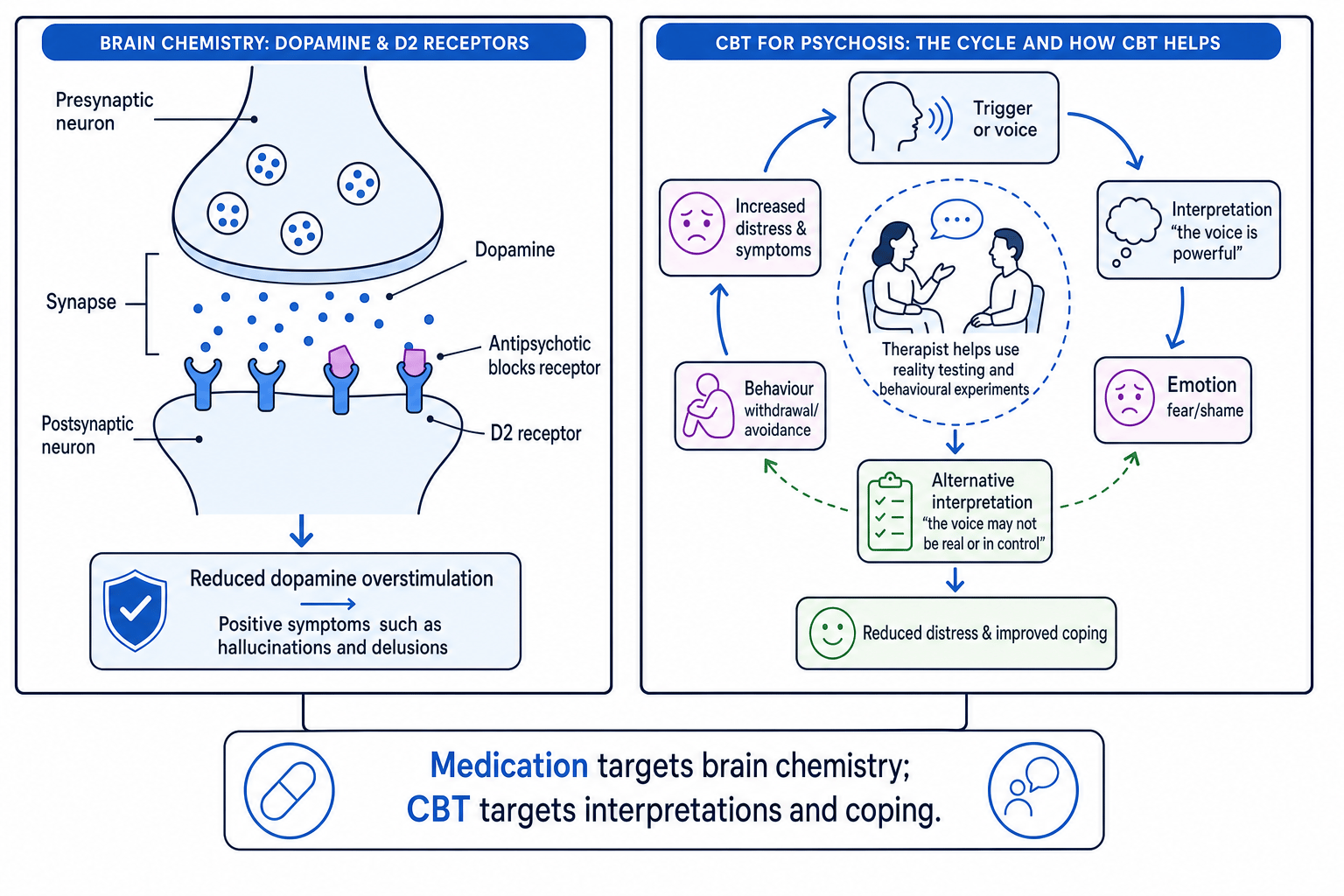
The two key methods you need are antipsychotic drugs and cognitive behavioural therapy, often called CBT. They work at different levels: drugs mainly target brain chemistry, while CBT targets beliefs, interpretations and coping behaviour.
Method 1: antipsychotic drugs
The basic idea
Antipsychotic drugs
Antipsychotic drugs are medications used to reduce psychotic symptoms, especially hallucinations and delusions. Many work by changing activity in dopamine systems in the brain.
A neurotransmitter is a chemical messenger that carries signals between nerve cells. Dopamine is one neurotransmitter involved in reward, motivation and perception. A synapse is the gap between two neurons where neurotransmitters are released.
Antipsychotic drugs are linked to the dopamine hypothesis, which suggests that some symptoms of schizophrenia are associated with excessive dopamine activity, especially in brain pathways involved in salience and perception.
Typical antipsychotics
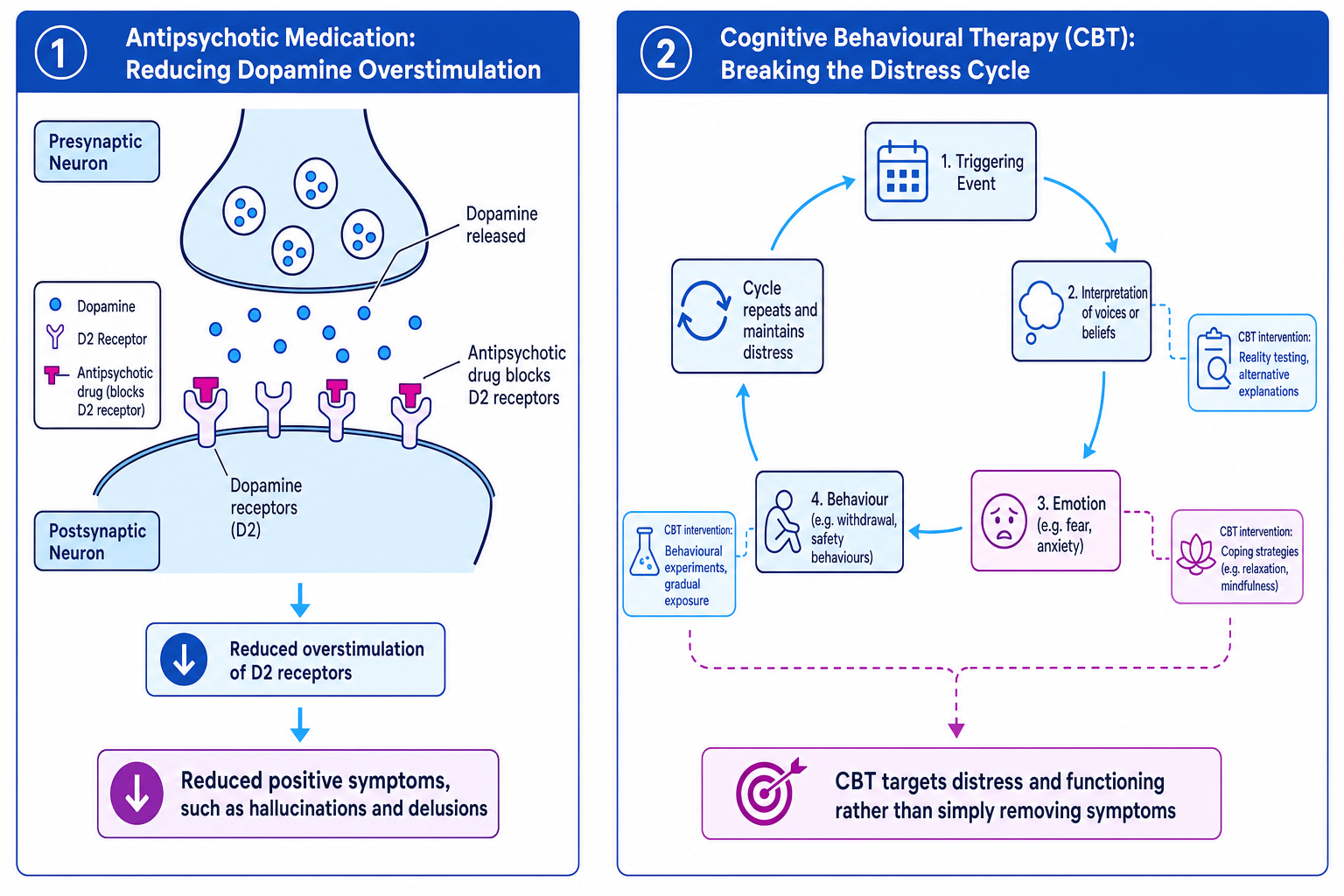
Typical antipsychotics, also called first-generation antipsychotics, include chlorpromazine and haloperidol. They mainly act as dopamine antagonists, meaning they block dopamine receptors, especially D2 receptors.
By blocking D2 receptors, they reduce dopamine overstimulation. This can reduce positive symptoms such as hallucinations and delusions.
However, dopamine is also involved in movement. Blocking dopamine in movement pathways can cause extrapyramidal side effects, meaning movement-related side effects such as stiffness, tremors or restlessness. Long-term use may lead to tardive dyskinesia, which involves involuntary movements and can sometimes be irreversible.
Atypical antipsychotics
Atypical antipsychotics, also called second-generation antipsychotics, include clozapine, risperidone and olanzapine. They still affect dopamine, but many also act on serotonin systems.
Clozapine is often used for treatment-resistant schizophrenia, meaning symptoms have not responded well to other medication. It can be effective, but it carries a risk of agranulocytosis, a dangerous reduction in white blood cells, so patients need regular blood monitoring.
Antipsychotics in one sentence
Antipsychotic drugs modify schizophrenia mainly by reducing biological processes linked to psychosis, especially dopamine activity, but their usefulness depends on balancing symptom reduction against side effects.
Applying antipsychotic treatment to a scenario
A patient is experiencing frightening voices and believes neighbours are spying on them.
-
The symptoms are mainly positive symptoms because they involve added experiences: auditory hallucinations and a persecutory delusion.
-
Antipsychotic medication is relevant because positive symptoms are the symptoms most strongly linked to dopamine activity, so D2 receptor blockade may reduce symptom intensity.
-
The treatment plan should also consider side effects and adherence, meaning whether the patient can keep taking medication as prescribed. If side effects are severe, the patient may stop taking the drug, increasing relapse risk.
-
A strong applied answer would say medication may reduce acute psychosis, but should usually be combined with psychological and social support.
Evaluating antipsychotic drugs
Strength: strong evidence for symptom reduction
There is substantial research support for antipsychotics. Thornley et al. (2003) reviewed evidence on chlorpromazine and found it was more effective than placebo for reducing symptoms and relapse, although side effects were common.
Leucht et al. (2012) also found that antipsychotics were effective in relapse prevention compared with placebo. This supports real-world use because relapse is a major issue in schizophrenia care.
Strength: useful in acute episodes
Antipsychotics can work faster than talking therapies for acute psychosis. If someone is very distressed, confused or at risk, medication may reduce intensity enough for them to engage with further support.
Weakness: side effects and adherence
Side effects can be serious. Typical antipsychotics are associated with movement problems, while atypical drugs can cause weight gain, diabetes risk and sedation. This creates an ethical and practical issue: a treatment can be effective but still difficult to tolerate.
Do not write “antipsychotics cure schizophrenia”
Antipsychotics usually manage symptoms and reduce relapse risk. They do not remove all symptoms for all patients, and they do not address every psychological or social factor involved in schizophrenia.
Weakness: reductionism
A purely biological treatment can be criticised as reductionist, meaning it explains a complex disorder too narrowly. Schizophrenia involves cognition, family stress, trauma, social support, poverty, stigma and culture, not just dopamine.
Ethical issues
The BPS Code of Ethics and Conduct highlights consent, protection from harm, confidentiality, right to withdraw, deception and debriefing. In drug treatment and drug trials, informed consent can be complicated if the person is acutely psychotic. Clinicians must monitor side effects carefully, protect patients from harm and ensure medication is not used simply as a form of social control.
Method 2: cognitive behavioural therapy
The basic idea
Cognitive behavioural therapy for psychosis
Cognitive behavioural therapy for psychosis, often called CBTp, is a talking therapy that helps the person examine interpretations of experiences, test beliefs, reduce distress and develop coping strategies.
CBT does not simply tell someone their hallucinations or delusions are “wrong”. Instead, it works collaboratively. The therapist and client build a formulation, meaning a shared explanation of how thoughts, feelings, symptoms and behaviours maintain distress.
How CBT modifies schizophrenia
CBT targets the cycle between:
- a trigger, such as stress or a voice;
- an interpretation, such as “the voice is all-powerful”;
- an emotion, such as fear or shame;
- a behaviour, such as withdrawal, checking or avoidance.
The therapist may use reality testing, where beliefs are gently examined against evidence, and behavioural experiments, where the person tests predictions in a safe, planned way.
CBT can also include coping strategies for voices, activity scheduling for negative symptoms, relapse planning and work on self-esteem.
Using the CBT cycle with voice-hearing
A person hears a voice saying they are worthless and starts avoiding friends.
-
The therapist identifies the interpretation maintaining distress: the person may believe the voice is powerful, truthful and uncontrollable.
-
The emotional and behavioural consequences are mapped: fear and shame lead to withdrawal, which reduces social support and may make the voice feel even more dominant.
-
CBT introduces an alternative explanation: the voice may be a symptom that becomes worse during stress rather than an external authority.
-
A behavioural experiment might involve meeting a trusted friend briefly and rating distress before and after, testing whether withdrawal is the only safe response.
Best wording for AO1
Say CBTp aims to reduce distress and impairment linked to symptoms. It may not eliminate voices or unusual beliefs, but it can change how threatening and controlling they feel.
Evaluating CBT
Strength: evidence for reducing distress and improving coping
Sensky et al. (2000) compared CBT with befriending in patients with persistent symptoms despite medication. Both groups improved at first, but CBT showed better maintenance of improvement at follow-up. This suggests CBT may have lasting benefits because it teaches skills the person can keep using.
Meta-analyses such as Wykes et al. (2008) suggest CBT has beneficial effects, although effect sizes vary. This supports CBT as part of a broader treatment package.
Strength: fewer biological side effects
CBT does not carry drug side effects such as movement disorders or metabolic problems. It can also increase autonomy because the person learns coping strategies and becomes more involved in their own treatment.
Weakness: effects may be modest
Jauhar et al. (2014) argued that when studies used stronger controls and reduced bias, CBT effects on core psychotic symptoms were smaller than sometimes claimed. This is important AO3: CBT may be helpful, but it should not be exaggerated as a complete replacement for medication.
Weakness: access and engagement
CBT requires trained therapists, regular attendance and the ability to reflect on thoughts and experiences. During acute psychosis, a person may be too distressed or suspicious to engage fully.
Ethical issues
CBT must avoid confrontation. Directly challenging a delusion too forcefully could increase distress or damage trust. Ethical therapy should be collaborative, respect confidentiality, gain informed consent and include safeguarding if there is risk of harm.
Comparing the two methods
Antipsychotics and CBT are not rivals in a simple “one is right, one is wrong” way. They modify schizophrenia differently.
Antipsychotics are often most useful for reducing acute positive symptoms and relapse risk. CBT is often most useful for helping people understand experiences, reduce distress, improve coping and support recovery.
NICE guidance in the UK generally recommends antipsychotic medication alongside psychological interventions such as CBTp and family intervention. This supports an interactionist approach, meaning biological and psychological factors are treated together.
Best overall conclusion
A balanced essay should argue that schizophrenia is usually best modified through a combined approach: medication can reduce symptom intensity, while CBT can reduce distress, improve coping and support long-term functioning.
Component 2 research methods link
Treatment evidence often comes from a randomised controlled trial, or RCT, where participants are randomly allocated to conditions such as drug versus placebo or CBT versus control therapy. A meta-analysis combines results from multiple studies.
If you are asked about statistics, choose the inferential test from the design and data type:
- Unrelated t-test: difference between two independent groups using interval data.
- Related t-test: difference in related or repeated-measures interval data.
- Mann-Whitney U: difference between two independent groups using ordinal or non-parametric data.
- Wilcoxon signed-ranks: difference between related conditions using ordinal or non-parametric data.
- Spearman’s rho: correlation between two variables using ordinal/ranked data.
- Chi-square: association or difference using nominal frequency data.
- Binomial sign test: direction of change in related nominal data.
Researchers usually test at p≤0.05p \leq 0.05p≤0.05. They compare an observed value with a critical value from a table. One-tailed tests are used for directional hypotheses, such as “CBT will reduce distress”; two-tailed tests are used for non-directional hypotheses, such as “CBT will affect distress”. A Type I error is a false positive, while a Type II error is a false negative.
Choosing a test for a CBT study
A researcher measures the same 18 patients’ symptom scores before and after CBT. The scores come from an ordinal rating scale.
-
The design is related because the same patients are measured twice.
-
The aim is to test a difference between before and after scores, not a correlation.
-
The data are ordinal, so a non-parametric related-difference test is needed.
-
The correct test is Wilcoxon signed-ranks. If the scores were treated as interval and met parametric assumptions, a related t-test could be considered instead.
In the exam
-
For AO1, describe the mechanism clearly: antipsychotics block dopamine activity; CBT changes interpretations, coping and behaviour.
-
For AO2, apply to the symptom type: medication is especially relevant to hallucinations and delusions, while CBT is useful for distress, coping, insight and functioning.
-
For AO3, evaluate with evidence, side effects, ethics, access, methodological issues and a balanced conclusion about combined treatment.
Check yourself
- Why are antipsychotics usually more effective for positive symptoms than negative symptoms?
- How does CBT reduce distress without necessarily removing hallucinations?
- What is one ethical issue in drug treatment and one ethical issue in CBT for schizophrenia?