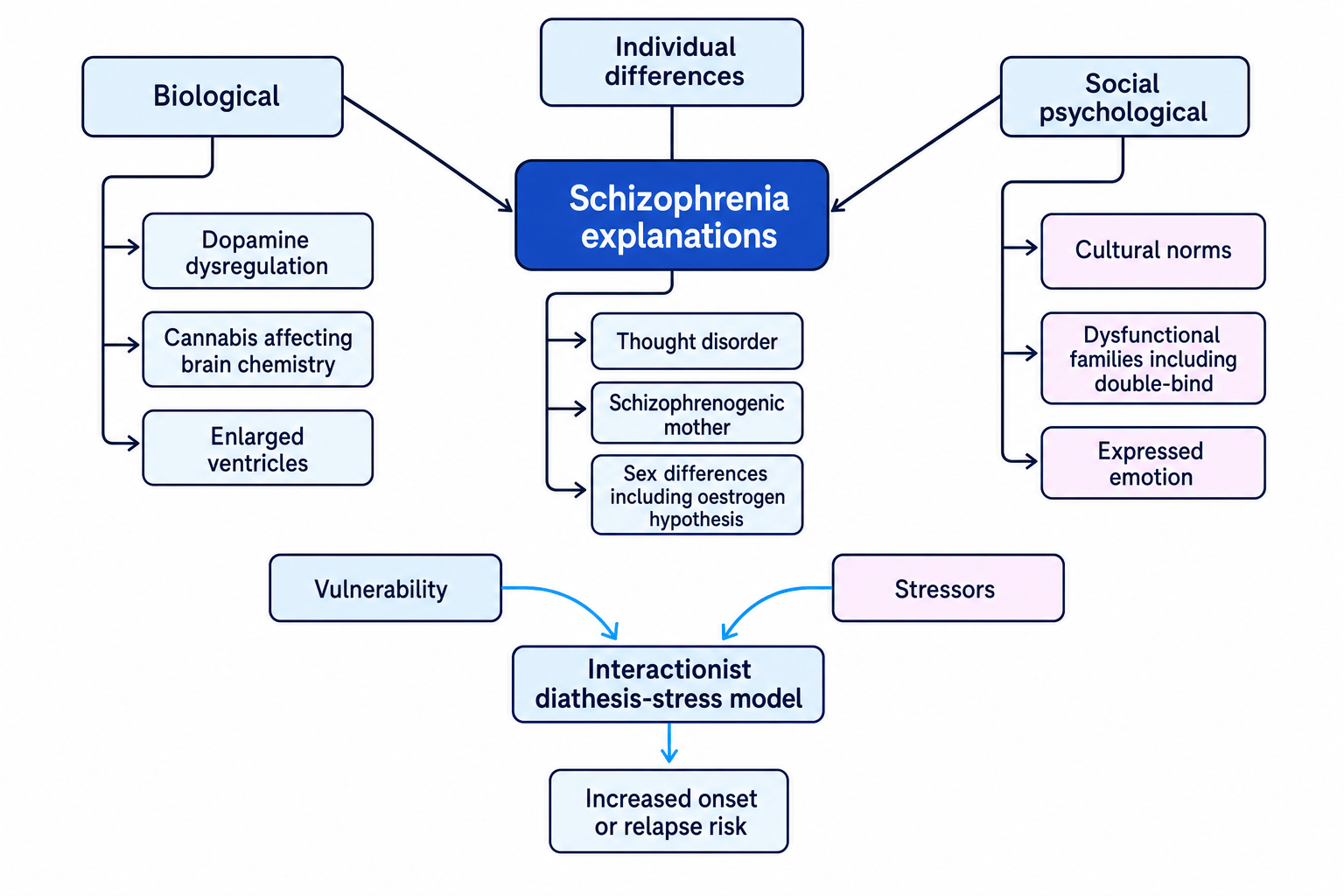
What you'll learn
- How biological explanations link schizophrenia to brain chemistry, cannabis and brain structure.
- How individual differences explanations focus on thinking patterns, family-related theories and sex differences.
- How social psychological explanations use culture, family functioning and expressed emotion.
- How to evaluate explanations using evidence, causality, ethics and AO2 application.
First: what counts as an explanation?
Schizophrenia is a severe mental disorder involving symptoms such as hallucinations, delusions, disorganised speech, reduced motivation and social withdrawal. Positive symptoms are experiences added to normal functioning, such as hallucinations. Negative symptoms are reductions or losses of normal functioning, such as avolition, meaning lack of motivation.
An explanation tries to account for why schizophrenia develops, why it is maintained, or why relapse happens after improvement.
Explanation
An explanation in psychology is a theory or model that identifies possible causes, risk factors or maintaining factors for a behaviour or mental disorder.
For Eduqas, organise schizophrenia explanations into three broad groups: biological, individual differences and social psychological.
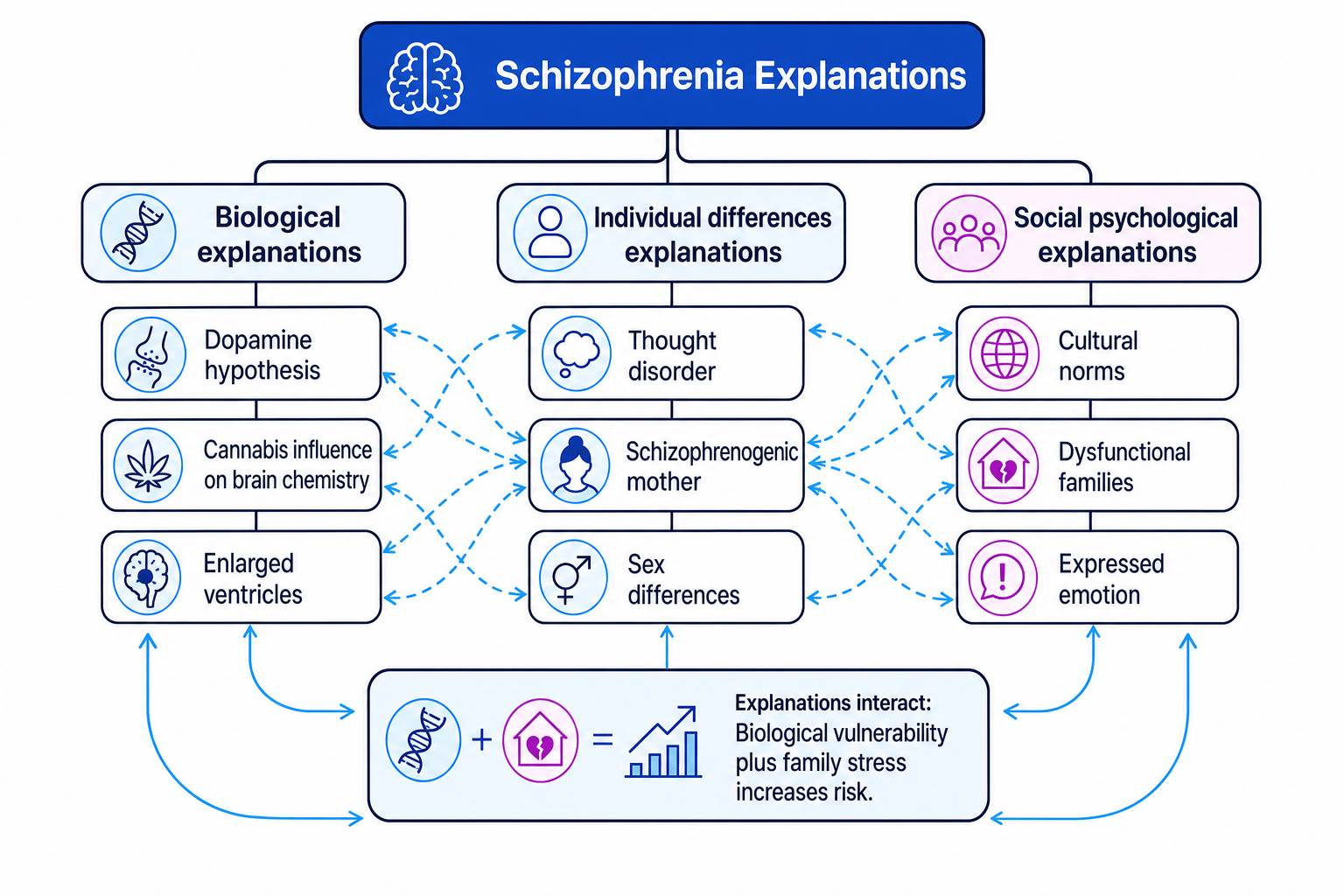
Interaction, not one cause
The safest A-Level answer is usually interactionist: schizophrenia is unlikely to have one single cause. Biological vulnerability may combine with psychological and social stressors.
Biological explanations
A biological explanation focuses on physical processes in the body and brain, such as neurotransmitters, genes, brain structures and drug effects.
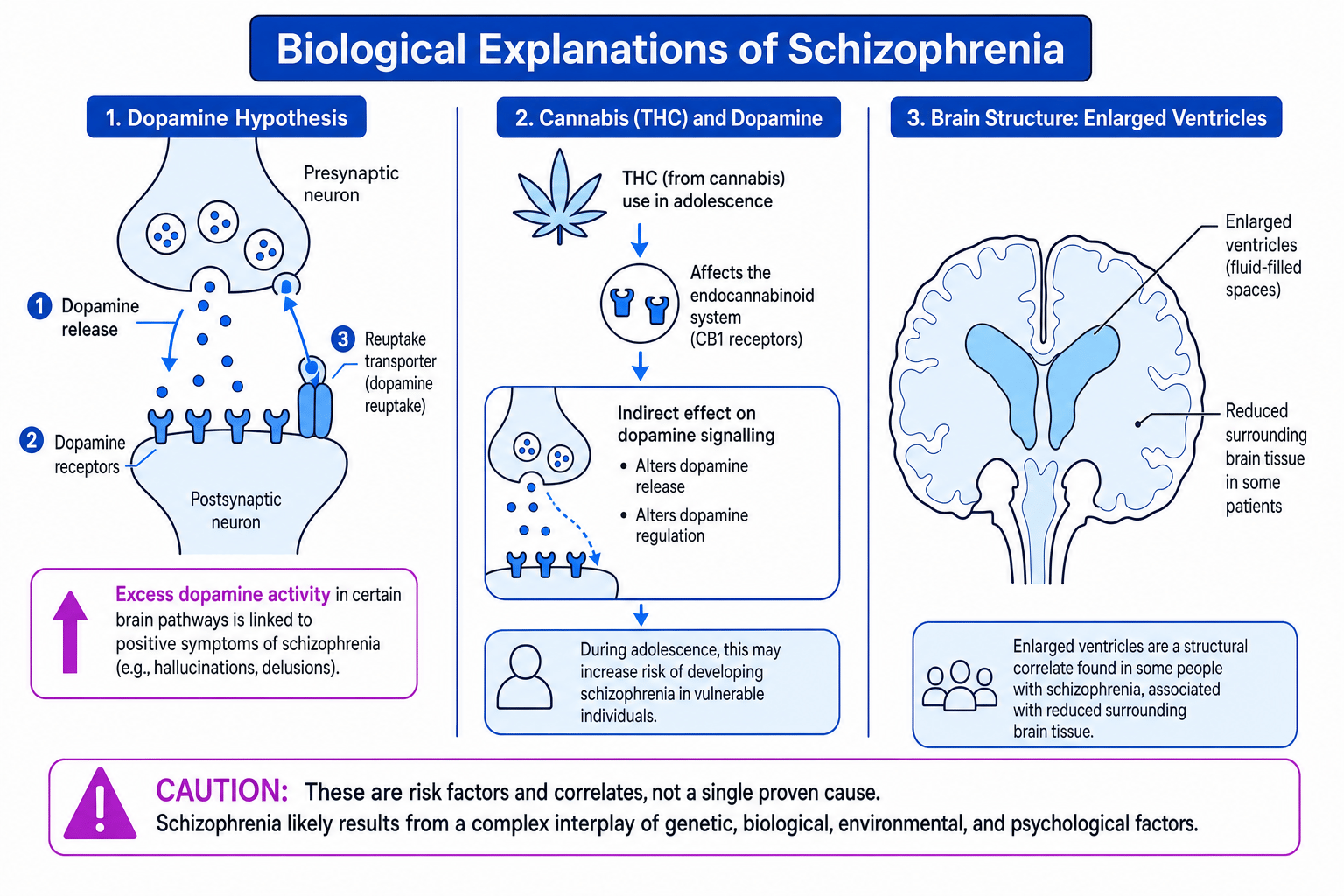
Dopamine hypothesis
A neurotransmitter is a chemical messenger that passes signals between neurons. Dopamine is a neurotransmitter involved in reward, motivation, movement and attention.
The dopamine hypothesis argues that schizophrenia is linked to abnormal dopamine activity. A traditional version suggests excess dopamine activity, especially in subcortical brain pathways, is associated with positive symptoms such as hallucinations and delusions. A more modern version is more complex: dopamine dysregulation may vary across brain areas, with possible underactivity in prefrontal areas linked to negative and cognitive symptoms.
AO1 evidence includes the fact that many antipsychotic drugs reduce dopamine activity, especially at D2 receptors. Davis et al. (1991) supported a revised dopamine account by arguing that dopamine abnormalities are involved but are not the whole story.
AO3 strength: this explanation has useful real-world application because it led to drug treatments. AO3 weakness: not everyone with schizophrenia responds to dopamine-blocking medication, and dopamine abnormalities may be a consequence rather than the original cause.
Cannabis influence on brain chemistry
Cannabis is a psychoactive drug, meaning it affects brain functioning and experience. Its main active chemical is THC, which acts on the brain’s endocannabinoid system, a signalling system involved in mood, memory and reward. THC can indirectly affect dopamine pathways.
Research such as Di Forti et al. (2015) found that high-potency cannabis use was associated with increased risk of psychosis, especially with frequent use. This supports the idea that cannabis may be an environmental trigger in biologically vulnerable individuals.
AO3 strength: this explanation helps explain why adolescence may be a sensitive period, because the brain is still developing. AO3 weakness: much cannabis research is correlational. People at risk of psychosis may be more likely to use cannabis, and other factors such as trauma, social deprivation or other drug use may confound the relationship.
Enlarged ventricles
Ventricles are fluid-filled spaces in the brain. Enlarged ventricles may suggest reduced volume in surrounding brain tissue.
Johnstone et al. (1976) used CT scans and found that some people with chronic schizophrenia had larger ventricles than controls. This supports a structural brain explanation: schizophrenia may be linked to neurodevelopmental differences or brain tissue loss.
AO3 strength: brain imaging provides relatively objective biological evidence. AO3 weakness: enlarged ventricles are not found in all patients and are not unique to schizophrenia, so they cannot diagnose the disorder by themselves.
Correlation is not causation
Do not write “enlarged ventricles cause schizophrenia” as a simple fact. A safer phrase is: enlarged ventricles are a biological correlate found in some people with schizophrenia.
Individual differences explanations
An individual differences explanation focuses on ways people vary from one another, such as thinking style, personality, family history, sex or developmental experiences.
Thought disorder
Thought disorder means disorganised thinking, often shown through disorganised speech. For example, a person may jump between unrelated ideas, give answers that are hard to follow, or use unusual associations.
Frith (1992) proposed a cognitive explanation in which schizophrenia involves problems monitoring thoughts and actions. If a person misattributes their own inner speech to an external source, this may help explain auditory hallucinations.
AO3 strength: this explanation links well to observable symptoms such as disorganised speech and hallucinations. AO3 weakness: thought disorder may be a symptom of schizophrenia rather than a root cause, so you need to be careful with causal language.
Schizophrenogenic mother
The schizophrenogenic mother theory, associated with Fromm-Reichmann (1948), claimed that schizophrenia could develop because of a cold, rejecting, controlling or overprotective mother. It is a psychodynamic-style explanation, meaning it focuses on early relationships and unconscious emotional conflict.
This theory is historically important, but it is now heavily criticised.
AO3 weaknesses are very strong here. The theory is difficult to test scientifically, relies on retrospective accounts and risks blaming mothers without good evidence. It is also sexist because it places responsibility mainly on women while ignoring fathers, wider family systems, biology and social context.
Sex differences
Sex differences refer to patterns linked to biological sex. In schizophrenia, researchers have found differences in average onset and course. Häfner et al. (1993) reported that males often show earlier onset and may have more negative symptoms, while females may show later onset and sometimes better social outcomes.
One explanation is the oestrogen hypothesis: oestrogen may have a protective effect on dopamine systems, delaying onset in some females. This may also help explain a later increase in risk after menopause, when oestrogen levels fall.
AO3 strength: sex differences can help explain variation in symptoms and prognosis. AO3 weakness: sex differences are averages, not rules. Diagnosis, help-seeking, social roles and cultural expectations may also affect the patterns researchers find.
Social psychological explanations
A social psychological explanation focuses on how behaviour and mental health are influenced by other people, social groups, culture and relationships.
Cultural norms
Cultural norms are shared expectations about what is considered normal or abnormal in a society. The same experience may be interpreted differently across cultures. For example, hearing the voice of an ancestor may be viewed as spiritual in one culture but as a symptom in another.
WHO research, including Jablensky et al. (1992), found that outcomes for schizophrenia varied between countries. Luhrmann et al. (2015) also reported cultural differences in how voice-hearing is experienced. This suggests culture can shape symptoms, interpretation and recovery.
AO3 strength: cultural explanations reduce ethnocentric bias, meaning bias from judging other cultures by one’s own cultural standards. AO3 weakness: culture alone cannot fully explain schizophrenia because biological symptoms and distress occur across cultures.
Dysfunctional families
A dysfunctional family explanation suggests that some family patterns may increase stress and contribute to onset or relapse. Bateson et al. (1956) proposed the double-bind theory, where a child receives contradictory messages, making communication confusing and stressful. Lidz et al. (1965) discussed family conflict and distorted family roles.
AO3 weakness: these theories are often based on small, retrospective or clinical samples. They can also unfairly blame families. However, they have contributed to family therapy approaches that aim to reduce stress and improve communication.
Expressed emotion
Expressed emotion
Expressed emotion, often shortened to EE, refers to the level of criticism, hostility and emotional over-involvement shown by relatives towards a person with schizophrenia.
Brown et al. (1972) and Vaughn and Leff (1976) found that people returning to high-EE family environments were more likely to relapse. This does not mean families “cause” schizophrenia; it suggests family emotional climate can influence relapse risk.
AO3 strength: EE research has strong practical application because family interventions can reduce criticism, improve communication and lower relapse risk. AO3 weakness: high EE may be partly a reaction to severe symptoms, so cause and effect are difficult to separate.
Putting the explanations together
The diathesis-stress model combines explanations. A diathesis is a vulnerability, such as genetic risk, dopamine dysregulation or brain structural differences. A stressor is an environmental pressure, such as cannabis use, high expressed emotion, discrimination or family conflict.
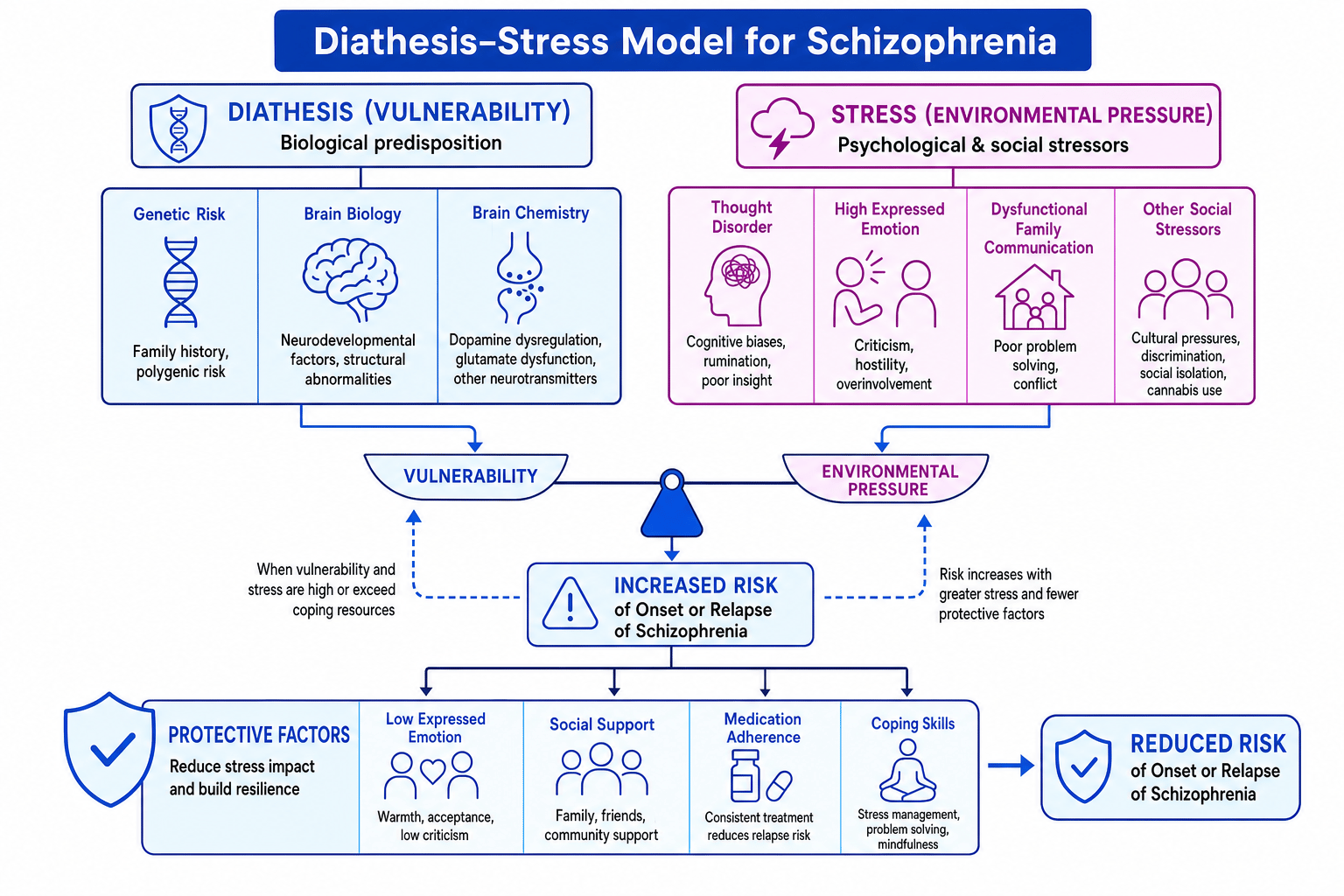
Applying the diathesis-stress model
A student is asked to explain why Sam developed psychotic symptoms after using high-potency cannabis and experiencing intense criticism at home.
- Identify Sam’s possible diathesis: if Sam has a family history of schizophrenia or unusual dopamine sensitivity, this would count as an underlying vulnerability.
- Identify the biological stressor: high-potency cannabis could affect THC and dopamine-related brain systems, increasing risk in a vulnerable person.
- Identify the social stressor: intense criticism at home could be high expressed emotion, which research links to relapse and symptom worsening.
- Combine the factors: Sam’s symptoms are best explained by an interaction between vulnerability and stress, rather than by cannabis or family criticism alone.
AO3 evaluation: what examiners want
Strong evaluation should compare explanations rather than listing them separately.
Biological explanations are scientific and have treatment applications, but they can be reductionist, meaning they reduce a complex disorder to brain chemistry or structure. Individual differences explanations can explain variation between people, but some, especially the schizophrenogenic mother theory, are ethically problematic. Social explanations are useful for relapse and recovery, but they often struggle to prove causation.
Ethics matter when studies involve people with mental health difficulties. Under the BPS Code of Ethics and Conduct, researchers must consider informed consent, deception, right to withdraw, protection from harm, confidentiality and debriefing. Extra care is needed around capacity to consent, privacy of diagnosis, distress during family interviews and confidentiality around drug use.
Research methods link
For AO3, mention method quality briefly: brain scans may give interval data suitable for means and standard deviations; symptom ratings may be ordinal; diagnosis categories are nominal. Group comparisons may use unrelated t-tests or Mann-Whitney U, related designs may use related t-tests or Wilcoxon signed-ranks, relationships may use Spearman’s rho, and categories may use chi-square or the binomial sign test. Researchers usually compare observed and critical values at p≤0.05p \le 0.05p≤0.05; stricter significance lowers Type I error risk but can increase Type II error risk.
In the exam
- For AO1, name the explanation, define the key term, and explain the mechanism linking it to schizophrenia.
- For AO2, classify scenario details into biological, individual differences and social factors, then combine them using diathesis-stress.
- For AO3, avoid simple “cause” claims: evaluate evidence, causality, ethics, reductionism and real-world applications.
Check yourself
- How does the dopamine hypothesis differ from the enlarged ventricles explanation?
- Why is the schizophrenogenic mother theory ethically and scientifically controversial?
- How could high expressed emotion increase relapse risk without proving that families cause schizophrenia?