What you'll learn
- How anger management modifies criminal behaviour using cognitive-behavioural techniques.
- How restorative justice modifies offending through accountability, victim involvement and reparation.
- How to apply each method to offender scenarios for AO2.
- How to evaluate effectiveness, ethics and research evidence for AO3.
The starting point: what does “modifying criminal behaviour” mean?
In this topic, you are not just describing why people offend. You are looking at ways to reduce offending or reoffending once criminal behaviour has occurred.
Recidivism
Recidivism means reoffending after a person has already been punished, cautioned, convicted or treated for an offence.
A method of modifying criminal behaviour should therefore aim to change something that maintains offending, such as:
- impulsive responses to anger
- hostile thoughts about other people
- lack of empathy for victims
- poor problem-solving skills
- weak sense of responsibility for harm caused
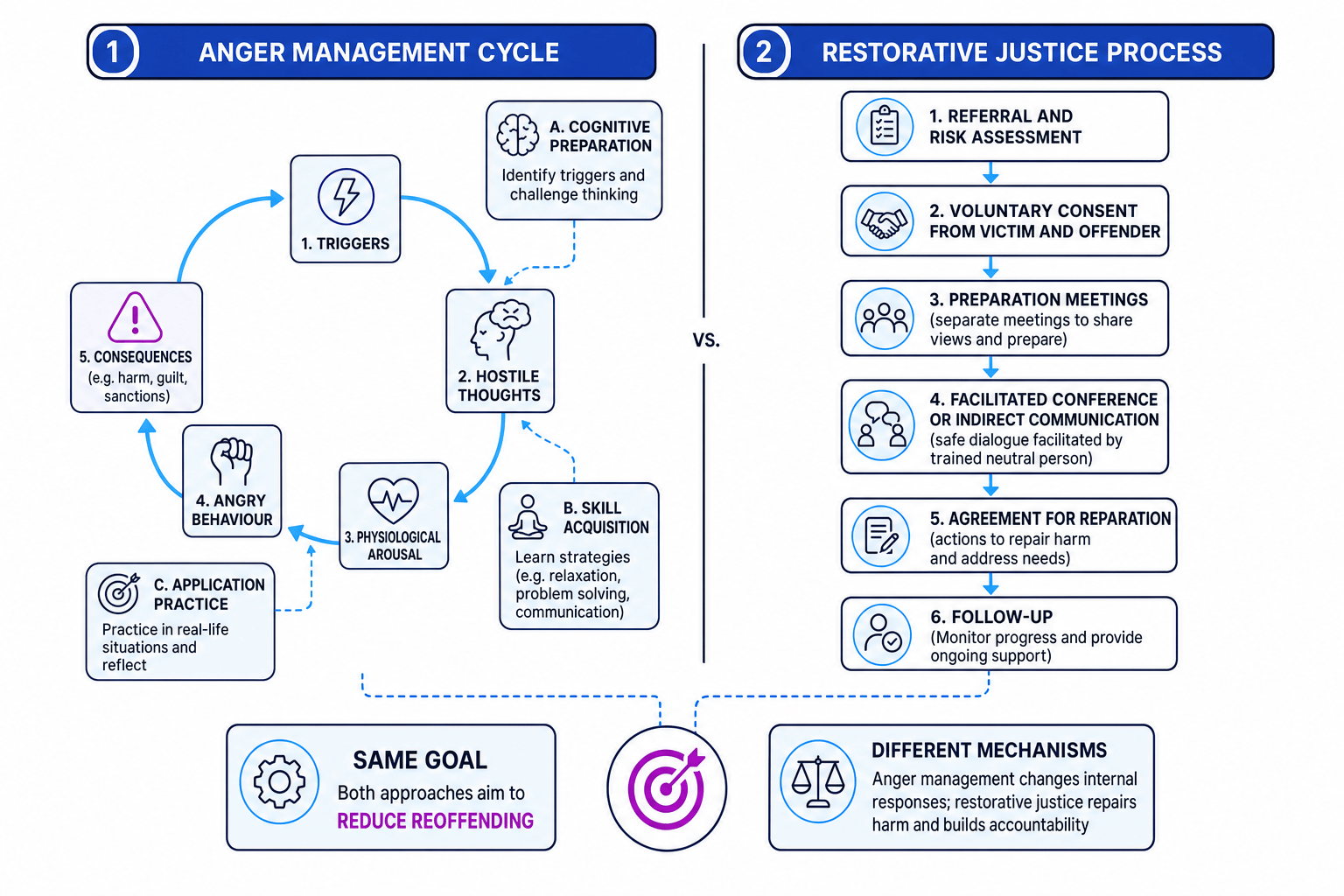
Anger management and restorative justice both aim to reduce reoffending, but they work in very different ways.
Two different routes to change
Anger management focuses mainly on changing the offender’s internal responses. Restorative justice focuses mainly on repairing harm between offender, victim and community.
Method 1: anger management
AO1: what is anger management?
Anger management
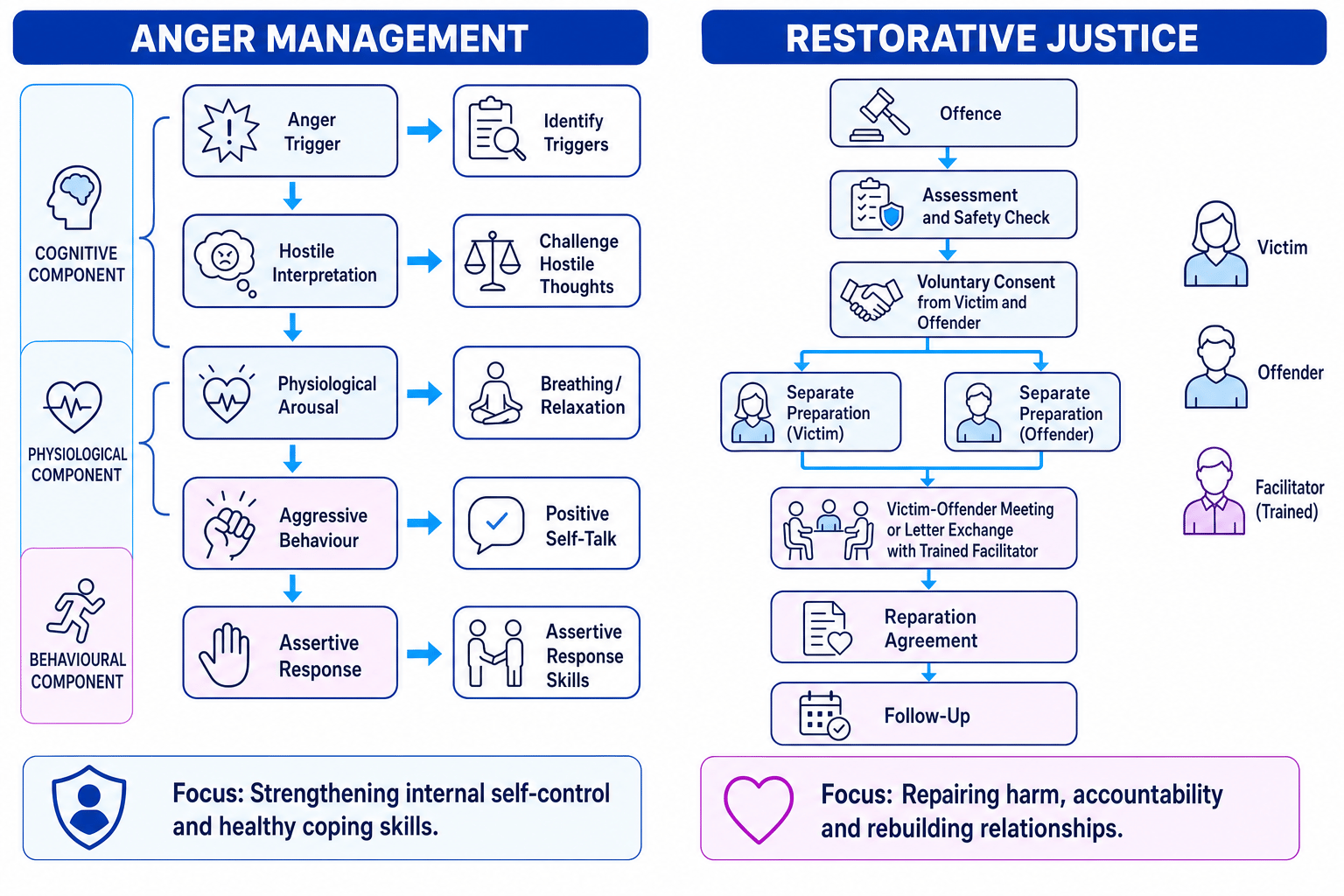
Anger management is a psychological intervention that teaches offenders to recognise anger triggers, control physiological arousal, challenge hostile thoughts and use non-aggressive behaviour.
It is usually based on cognitive behavioural therapy, often shortened to CBT.
Cognitive behavioural therapy
CBT is a therapy based on the idea that thoughts, feelings and behaviours are linked, so changing unhelpful thinking can change emotional responses and behaviour.
For criminal behaviour, anger management is especially relevant when offences involve:
- assault
- threatening behaviour
- domestic violence
- violent reactions to provocation
- conflict in prison or young offender institutions
A key assumption is that some offenders do not simply “lose control”. Instead, they may interpret situations in a biased way, become physiologically aroused, and then respond aggressively.
Hostile attribution bias
Hostile attribution bias is the tendency to interpret ambiguous behaviour from others as deliberately hostile or threatening.
For example, an offender may assume “he bumped into me on purpose” rather than “it was an accident”.
Novaco’s anger management model
Raymond Novaco developed influential cognitive-behavioural approaches to anger management in the 1970s, including work often linked to stress inoculation training. In offender programmes, anger is usually treated as having three connected parts:
- Cognitive component — thoughts and interpretations, such as “they are disrespecting me”.
- Physiological component — bodily arousal, such as increased heart rate or muscle tension.
- Behavioural component — outward actions, such as shouting, threatening or attacking.
Anger management programmes often use three stages.
Stage 1: cognitive preparation
The offender learns to identify:
- situations that trigger anger
- thoughts that escalate anger
- signs that anger is building
- consequences of aggressive behaviour
The aim is not to say anger is always “wrong”. Instead, the offender learns that anger can be managed before it turns into violence.
Stage 2: skill acquisition
The offender learns specific skills, such as:
- relaxation and breathing techniques
- positive self-talk
- assertive communication
- problem-solving
- perspective-taking
- recognising early warning signs
Stage 3: application practice
The offender practises these skills through role-play, group discussion and real-life homework tasks. This is important because it helps transfer skills from the therapy room to everyday situations.
Applying anger management to a prison incident
An offender punches another prisoner after being laughed at during lunch. How could anger management be applied?
- Identify the cognitive trigger: the offender interpreted the laughter as deliberate humiliation, so the programme would challenge thoughts such as “everyone is disrespecting me”.
- Link thought to arousal: the offender would learn to notice physical warning signs, such as tension or a racing heartbeat, before aggression occurs.
- Choose replacement skills: the offender could use controlled breathing, self-talk such as “walk away before this gets worse”, or assertive communication.
- Practise the new response: role-play could recreate the lunchroom situation so the offender rehearses leaving, speaking calmly or asking staff for support.
AO3: evaluating anger management
Strengths
One strength is that anger management targets several parts of aggressive behaviour. It does not only punish the offender after violence. It teaches practical strategies for recognising triggers, controlling arousal and changing behaviour.
Research evidence can support its usefulness. Ireland (2000) evaluated an anger management programme with young male offenders and found improvements compared with a waiting-list control group. This suggests anger management can reduce anger-related problems in institutional settings.
It also has positive real-world applications. In prisons, anger management may reduce conflict, improve safety and support rehabilitation rather than simply increasing punishment.
Weaknesses
A limitation is that anger management is not suitable for all offending. Some crimes are planned, financially motivated or linked to peer pressure rather than uncontrolled anger. For those offenders, anger management may not target the main cause of behaviour.
There are also methodological issues. Studies may rely on self-report anger questionnaires or staff ratings, which can be affected by social desirability or observer bias. Short-term improvement in anger scores does not always prove long-term reduction in recidivism.
Howells et al. (2005) found that anger management outcomes can depend on motivation and readiness to change. This matters because offenders may be required to attend programmes but not genuinely engage with them.
Assuming anger management means suppressing anger
Anger management does not mean “never feel angry”. It means recognising anger early and responding in a controlled, non-criminal way.
Ethical issues
Because anger management often takes place in prisons, consent can be complicated. Offenders may feel pressured to attend if it affects parole, privileges or sentence progression.
Ethical practice should follow the BPS Code of Ethics and Conduct, including:
- informed consent where possible
- right to withdraw without unfair penalty
- confidentiality, especially in group sessions
- protection from psychological harm
- debriefing and support after difficult discussions
- avoiding deception about the programme’s aims
Method 2: restorative justice
AO1: what is restorative justice?
Restorative justice
Restorative justice is a process where offenders are encouraged to take responsibility for harm caused, often through communication with the victim and an agreement to repair the harm.
It is not simply a therapy and it is not the same as forgiving the offender. It is a structured process, usually led by a trained facilitator.
Restorative justice may involve:
- a face-to-face conference
- indirect communication through letters
- victim-offender mediation
- family or community conferencing
- an agreement for reparation
Reparation
Reparation means making amends for harm caused, for example through apology, compensation, community work or practical actions agreed with the victim.
A key theoretical link is Braithwaite’s reintegrative shaming theory (1989).
Reintegrative shaming
Reintegrative shaming means condemning the criminal act while still allowing the offender to be accepted back into the community if they take responsibility.
The message is: “What you did was wrong and harmful, but you can repair the harm and change.”
The restorative justice process
A typical restorative justice process includes:
- Assessment — professionals decide whether the case is suitable and safe.
- Voluntary consent — both victim and offender must agree.
- Preparation — each person is prepared separately before contact.
- Communication — the victim explains the impact; the offender responds and accepts responsibility.
- Agreement — actions are agreed to repair harm.
- Follow-up — progress is monitored.
Planning restorative justice after burglary
A young offender burgles a house and the victim wants answers about why their home was targeted. How could restorative justice be used?
- Check suitability: the facilitator would assess risk, making sure the offender accepts responsibility and the victim is not likely to be retraumatised.
- Prepare both sides: the victim could plan questions and boundaries, while the offender prepares to explain their actions without excusing them.
- Facilitate communication: in a meeting or letter exchange, the victim describes the emotional impact, and the offender hears the consequences directly.
- Agree reparation: the offender might write an apology, repay damage where possible, or complete community work linked to the offence.
AO3: evaluating restorative justice
Strengths
Restorative justice gives victims a voice. Traditional court processes can leave victims feeling ignored, whereas restorative justice allows them to ask questions and explain the impact of the offence.
Research evidence is encouraging. Sherman and Strang (2007) reviewed restorative justice evidence and found benefits for some offenders and victims, including reduced repeat offending in some cases and higher victim satisfaction. Shapland et al. (2008) also reported that restorative justice conferences in the UK were associated with reduced reoffending and could be cost-effective.
It may also encourage empathy. Hearing directly from the victim can make the consequences of crime more personal than a court sentence alone.
Weaknesses
Restorative justice is not suitable for every case. It may be inappropriate where there is a serious risk of intimidation, coercive control, denial of responsibility or further harm to the victim.
There is also a selection bias problem. Offenders who agree to restorative justice may already be more remorseful and less likely to reoffend, so it can be difficult to prove that restorative justice caused the improvement.
Victims may also feel pressured to participate, especially if restorative justice is presented as something they “should” do. A poorly managed conference could increase distress rather than reduce it.
Victim safety comes first
Restorative justice should only happen when it is voluntary, carefully prepared and risk-assessed. It is not automatically appropriate just because an offender says they are sorry.
Ethical issues
Restorative justice has important ethical strengths because it can empower victims and promote offender accountability. However, ethical safeguards are essential.
Under the BPS principles, practitioners should protect participants from harm, maintain confidentiality, avoid deception, gain informed consent, respect the right to withdraw and provide debriefing or follow-up support.
Comparing the two methods
| Feature | Anger management | Restorative justice |
|---|---|---|
| Main focus | Offender’s thoughts, arousal and behaviour | Harm caused to victim and community |
| Best suited to | Anger-related or impulsive violence | Offences where offender accepts responsibility and victim wants involvement |
| Mechanism of change | Self-control, cognitive restructuring, coping skills | Accountability, empathy, reparation, reintegration |
| Key risk | May not work if offence is not anger-based | May distress victims if poorly prepared |
| Evidence issue | Short-term anger scores may not predict reoffending | Volunteers may already be more remorseful |
Essay comparison shortcut
Use the phrase “different mechanisms, same aim”: anger management changes internal self-regulation, while restorative justice changes accountability and social repair. Both aim to reduce recidivism.
Research methods link: how would we test effectiveness?
In Component 3 essays, you can gain AO3 credit by thinking like a researcher.
Possible outcome measures include:
- number of disciplinary incidents
- anger questionnaire scores
- victim satisfaction ratings
- whether the offender is reconvicted
- time taken before any reoffending
The design matters. A study could compare an intervention group with a control group, or measure the same offenders before and after treatment. However, withholding a potentially helpful programme raises ethical issues.
For statistics, the test depends on design and data type:
- Chi-square could test whether reoffending yes/no differs between programme and control groups.
- Wilcoxon signed-ranks could test related before-and-after anger scores if the data are ordinal or non-normal.
- Mann-Whitney U could compare two unrelated groups on ranked anger scores.
- Related or unrelated t-tests could be used for interval data if assumptions are met.
- Spearman’s rho could test whether more sessions are associated with lower anger scores.
- Binomial sign test could test the direction of change for related nominal outcomes.
Psychology usually uses a significance level of p≤0.05p \leq 0.05p≤0.05. Researchers compare the observed value with a critical value from a table, using the correct one-tailed or two-tailed decision.
Only reporting that a programme 'worked'
For AO3, say how effectiveness was measured. Reduced anger scores, fewer prison incidents and lower reconviction rates are related, but they are not identical outcomes.
Building an essay answer
For a strong response, aim for:
AO1: describe clearly
Name the method, outline the process, and use key terms accurately.
AO2: apply to the scenario
If the item describes an impulsive assault after provocation, anger management may fit well. If it describes a victim wanting answers and an offender accepting responsibility, restorative justice may fit well.
AO3: evaluate with balance
Use evidence, ethics, methodology and real-world application. Avoid claiming either method is a guaranteed cure.
In the exam
- Separate AO1 from AO3: first explain the method step by step, then evaluate evidence, ethics and limitations.
- Use named evidence: for example, Ireland (2000) for anger management, and Sherman and Strang (2007) or Shapland et al. (2008) for restorative justice.
- Apply precisely: link the method to the type of offence, the offender’s motivation and the victim’s needs rather than saying it works for all criminals.
Check yourself
- How does anger management try to change the cognitive, physiological and behavioural parts of anger?
- Why might restorative justice reduce reoffending for some offenders but be unsuitable for others?
- What methodological problems make it difficult to prove that a behaviour modification programme caused lower recidivism?