What you'll learn
- How psychodynamic therapy tries to make unconscious conflicts conscious.
- The AO1 steps in dream analysis and psychodrama.
- How to apply each therapy to a scenario using AO2.
- How to evaluate these therapies using AO3: evidence, ethics, usefulness and limitations.
The starting point: why therapy is needed
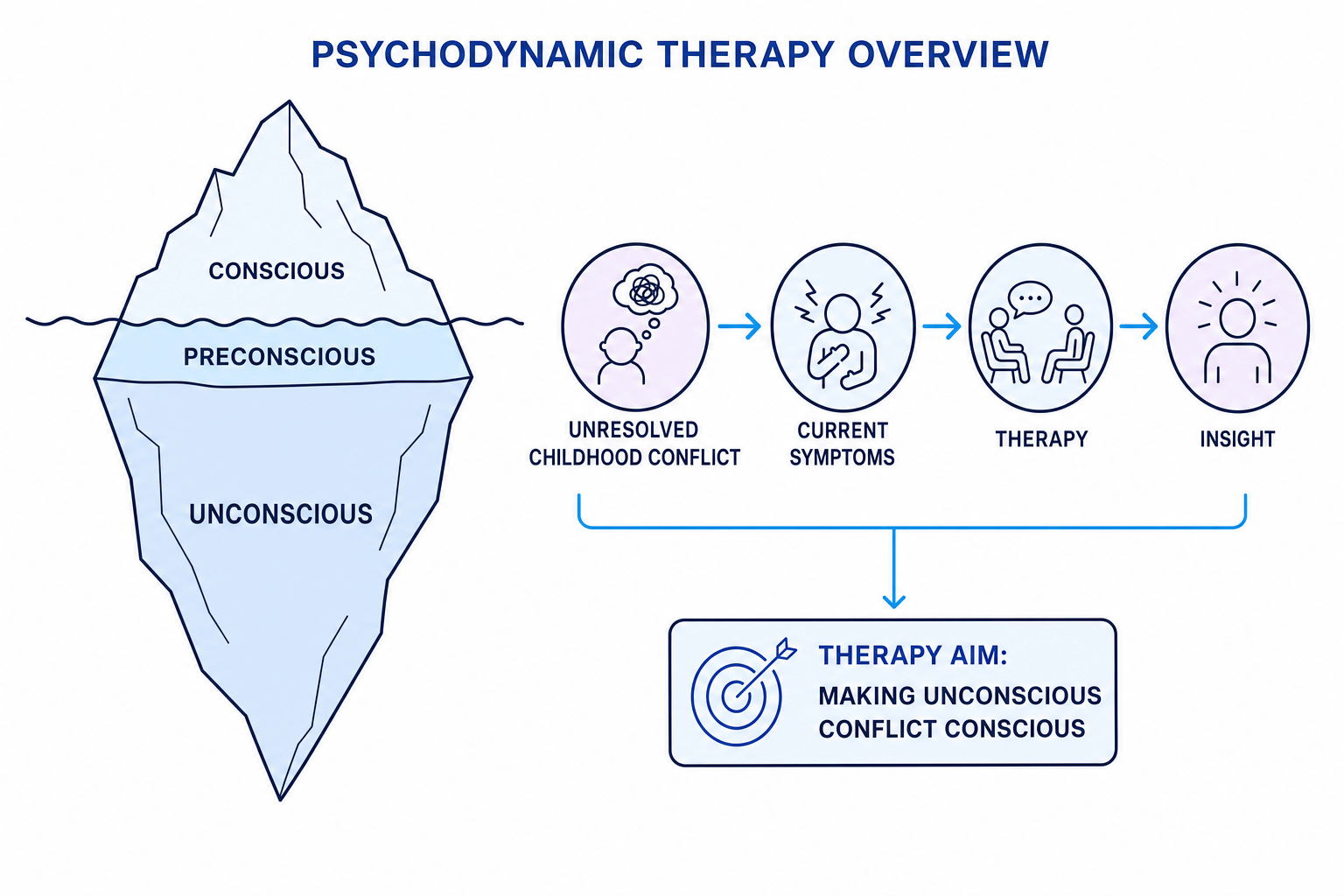
Psychodynamic therapy is based on the idea that behaviour can be influenced by the unconscious mind, meaning thoughts, wishes, fears and memories outside conscious awareness. Freud argued that unresolved conflicts, especially from childhood, may create anxiety and psychological symptoms later in life.
Psychodynamic therapy
Psychodynamic therapy is a treatment based on the assumption that unconscious conflicts influence current behaviour and distress; the aim is to bring these conflicts into conscious awareness so the person can gain insight and change.
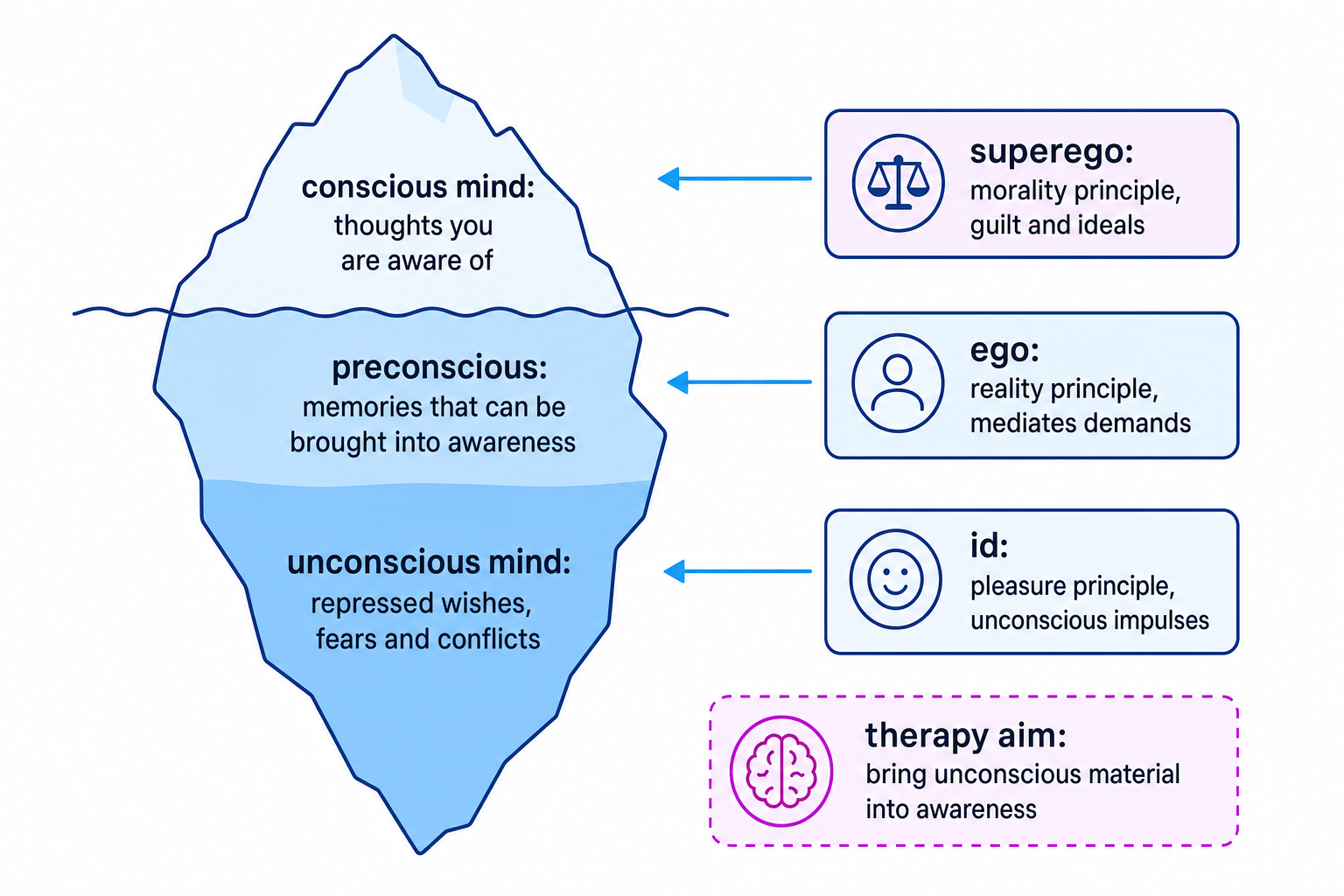
Freud’s model is often shown as an iceberg: only a small part of the mind is conscious, while deeper unconscious material may still affect behaviour.
Core psychodynamic ideas you need first
The id is the instinctive part of personality that seeks immediate pleasure. The ego is the realistic part that mediates between the id, the external world and morality. The superego is the moral part, linked to guilt and ideals.
A defence mechanism is an unconscious strategy the ego uses to reduce anxiety, such as repression, where threatening thoughts are pushed out of conscious awareness.
The therapy aim
Psychodynamic therapy does not just aim to remove symptoms quickly. It aims to uncover the hidden emotional cause of symptoms, so the client develops insight: a deeper understanding of their own motives, fears and conflicts.
Eduqas therapy choice: dream analysis OR psychodrama
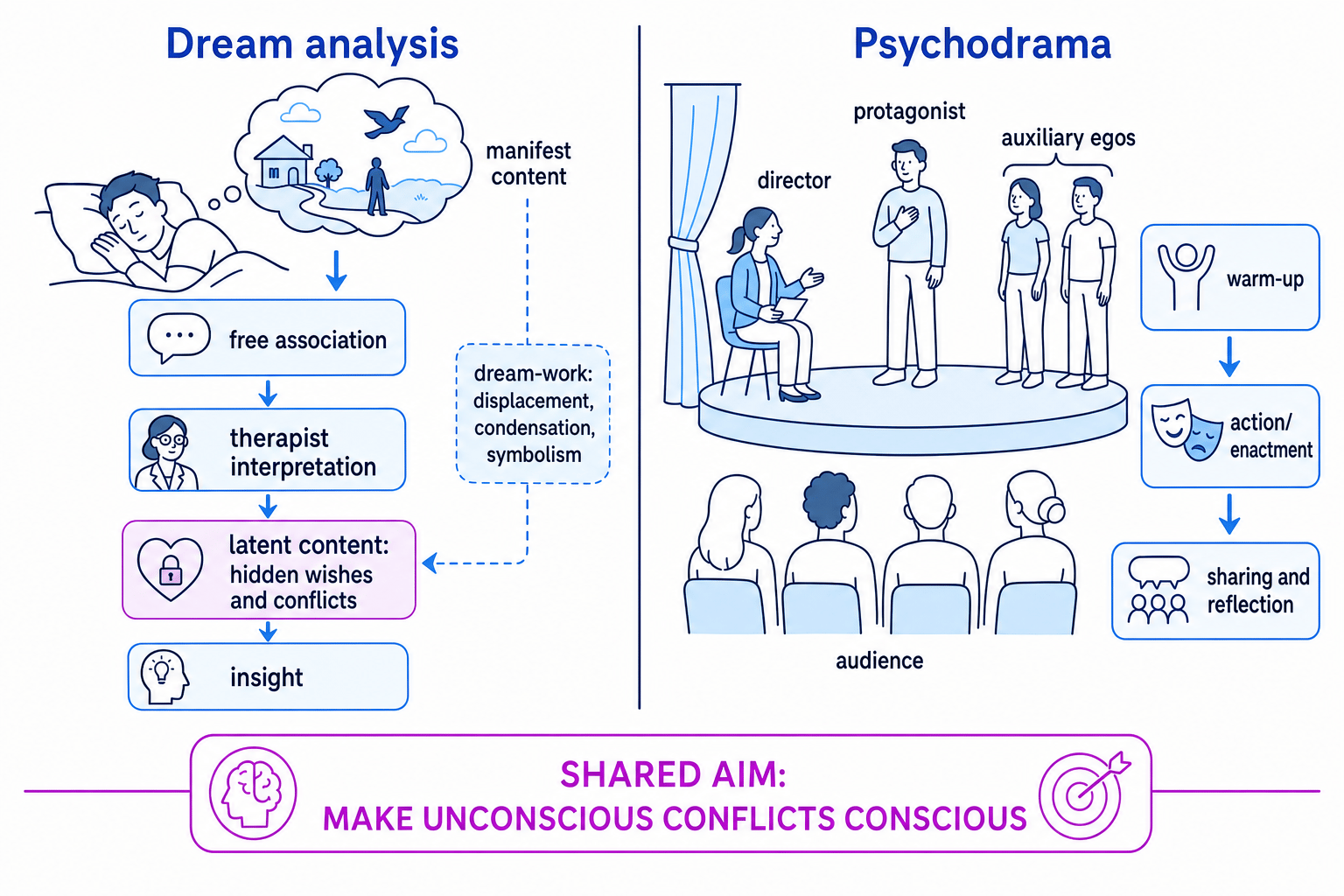
For Eduqas Component 1, the psychodynamic therapy is dream analysis OR psychodrama. Your teacher may focus on one, but it is useful to understand both because they share the same psychodynamic aim: making unconscious conflict conscious.
Dream analysis
Dream analysis
Dream analysis is a psychodynamic therapy technique in which the therapist helps the client interpret dreams as disguised expressions of unconscious wishes, fears or conflicts.
Freud developed dream analysis in The Interpretation of Dreams (1900). He called dreams the “royal road to the unconscious” because he believed dreams give clues about hidden material that the waking mind normally censors.
Manifest and latent content
The manifest content of a dream is the dream as the client remembers and reports it: the storyline, images and events.
The latent content is the hidden psychological meaning underneath the dream. Freud believed the latent content often involves unacceptable wishes or conflicts that have been disguised.
Dream-work
Dream-work is the process by which unconscious thoughts are transformed into the disguised images of a dream. It may involve condensation where several ideas are combined, displacement where emotion is shifted onto a safer object, and symbolism where one thing represents another.
Free association
Free association is when the client says whatever comes into their mind without censoring it. In dream analysis, the client may freely associate to dream images, such as a locked door, a journey, an animal or a family member.
The therapist listens for patterns, emotional themes and possible links to childhood experiences, relationships or conflicts.
The basic process
- The client describes the manifest content of the dream.
- The therapist asks the client to free associate to key images or events.
- The therapist looks for possible symbols, displacement or repeated themes.
- The therapist suggests an interpretation of the latent content.
- The client reflects on the interpretation and may gain insight.
Interpreting manifest and latent content
A client dreams they are locked outside their childhood home while their parents are inside ignoring them.
- Identify the manifest content: the remembered dream involves being locked out, a childhood home and unavailable parents.
- Use free association: if the client links the house to childhood safety and the locked door to rejection, those associations become more important than a dictionary-style symbol.
- Infer a possible latent content: the dream may express unconscious fear of emotional exclusion or unresolved childhood anger towards caregivers.
- Link to therapy aim: discussing the dream may help the client recognise how early feelings of rejection influence current relationships.
Do not treat symbols as fixed meanings
Avoid saying “a door always means X” or “water always means Y”. In psychodynamic therapy, the client’s own associations matter. The same dream image could mean different things for different people.
Psychodrama
Psychodrama
Psychodrama is an active psychodynamic therapy, developed by Jacob Moreno, in which clients act out experiences, conflicts or relationships to explore hidden feelings and gain insight.
Psychodrama is usually done in a group setting. Instead of only talking about a conflict, the client physically enacts it. This can make emotions more vivid and help unconscious feelings become conscious.
Key roles in psychodrama
The protagonist is the main client whose issue is being explored. The director is the therapist who guides the session. Auxiliary egos are group members who play important people or parts of the client’s inner world. The audience is the rest of the group, who observe and may later share responses.
Key techniques
Role reversal is when the protagonist swaps roles with another person in the scene, such as a parent, partner or teacher. This may help them see the relationship from another perspective.
Doubling is when another group member stands near the protagonist and voices feelings the protagonist may be struggling to express.
Mirroring is when the protagonist watches someone else act out their behaviour, helping them see it more clearly.
A typical session has a warm-up, where the issue is chosen; an action phase, where the scene is enacted; and a sharing phase, where the group reflects on feelings raised.
Using role reversal to explore conflict
A client feels intense anxiety whenever they disagree with their manager.
- Choose the scene: the director asks the client to recreate a recent disagreement at work, with an auxiliary ego playing the manager.
- Apply role reversal: the client plays the manager and hears another person speak as “the client”, which may reveal expectations such as “I must never upset authority figures”.
- Connect the reaction to earlier conflict: the client may realise the manager triggers feelings linked to a strict parent.
- Build insight: the anxiety is understood as a current response shaped by earlier unconscious conflict, not simply as “being bad at work”.
AO3 evaluation
Strengths
A major strength is that psychodynamic therapies can be holistic, meaning they consider the whole person: childhood, relationships, emotions and unconscious motives. This can be useful for complex problems that may not respond to purely symptom-focused approaches.
Dream analysis may help clients discuss painful material indirectly, which can feel safer than confronting it directly. Psychodrama may be especially helpful for clients who find ordinary talking therapy too abstract, because it uses action, emotion and role-play.
Freud’s classic case study of Little Hans (Freud, 1909) supports the psychodynamic style of interpretation because Freud explained Hans’ phobia through unconscious conflict. However, this is stronger as an illustration of the approach than as conclusive scientific proof.
Weaknesses
A key weakness is subjectivity. Different therapists might interpret the same dream or psychodrama scene differently, so reliability can be low. Many psychodynamic interpretations are also difficult to falsify, meaning it can be hard to prove them wrong scientifically.
Dream analysis is challenged by biological explanations of dreaming, such as Hobson and McCarley’s activation-synthesis theory (1977), which argues that dreams may result from the brain trying to make sense of random neural activity. This weakens Freud’s claim that dreams necessarily reveal hidden wishes.
Psychodynamic therapies can also be time-consuming and expensive. They may not be suitable for clients who want short-term, practical strategies for immediate symptom management.
Good AO3 balance
A strong evaluation does not just say “there is no evidence”. Say what kind of evidence is limited: small case studies, subjective interpretation, lack of control groups, difficulty testing unconscious processes, or weak reliability between therapists.
Ethics
Because these therapies explore sensitive memories and relationships, ethical safeguards are essential. Under the BPS Code of Ethics and Conduct, therapists should protect confidentiality, gain informed consent, respect the right to withdraw, reduce risk of psychological harm, and provide appropriate debriefing or support.
Psychodrama has extra ethical issues because it often happens in groups. Group members may hear very personal information, so confidentiality must be agreed clearly. The action phase could also create distress if painful memories are re-enacted too intensely.
Therapy can uncover distressing material
Psychodynamic therapy should be carried out by trained professionals. Bringing unconscious material into awareness may be helpful, but it can also temporarily increase anxiety or emotional distress.
Using it in essays
For AO1, describe the therapy clearly: aim, assumptions, key terms and procedure. For AO2, apply those terms to a scenario: identify the client’s manifest dream content, possible latent content, role reversal, repression or insight. For AO3, evaluate using evidence, ethics, scientific status and practical usefulness.
If you discuss therapy research, remember that modern outcome studies may use control groups, random allocation and statistical significance, often using a default of p≤0.05p \le 0.05p≤0.05. But do not pretend Freud’s case studies used modern inferential testing; they were mainly qualitative case-study evidence.
In the exam
- If the question names dream analysis or psychodrama, focus only on that therapy rather than writing generally about Freud.
- Use precise AO1 terms: for dream analysis, include manifest content, latent content and free association; for psychodrama, include protagonist, director and role reversal.
- In AO3, balance usefulness with scientific criticisms: insight and rich detail are strengths, but subjectivity and limited testability are weaknesses.
- Add one ethical point if the question involves therapy practice, especially confidentiality and protection from harm.
Check yourself
- What is the difference between manifest content and latent content in dream analysis?
- How could role reversal in psychodrama help a client gain insight?
- Why might psychodynamic therapy be criticised as difficult to test scientifically?