What you'll learn
- What Bowlby (1944) investigated in Forty-four juvenile thieves: Their characters and home-life.
- How the study links to psychodynamic ideas about early childhood and later behaviour.
- The key aim, method, findings and conclusions you need for AO1.
- How to evaluate the study for AO3, including methodology, ethics and real-world applications.
Where this fits in the psychodynamic approach
The psychodynamic approach explains behaviour by looking at early experiences, emotional development and unconscious processes. Bowlby’s study is not a Freudian case study in the narrow sense, but it fits the approach because it argues that early relationships can shape later personality and behaviour.
Psychodynamic approach
The psychodynamic approach explains behaviour through unconscious mental processes and the long-term effects of early childhood experiences, especially emotional relationships with caregivers.
For Eduqas, Bowlby (1944) is the classic research for the psychodynamic approach. “Classic” means an older, influential study that helped shape later theory and research.
The core idea: early attachment matters
Bowlby was interested in whether disrupted early relationships could be linked to later emotional and behavioural problems. The key relationship was the child’s bond with the mother or mother figure.
Attachment and maternal deprivation
- Attachment is a close emotional bond between a child and a caregiver.
- Maternal deprivation means the loss or serious disruption of emotional care from the mother or mother figure during early childhood.
Bowlby argued that prolonged early separation could make it harder for a child to develop guilt, empathy and warm emotional relationships. This was then linked to juvenile delinquency, which means antisocial or criminal behaviour by a young person.
Affectionless psychopathy
In Bowlby’s study, affectionless psychopathy meant a pattern of cold, unemotional behaviour: little affection for others, little guilt or shame, and a weak sense of responsibility. It is a historical label, not a term you should use casually today.
The main psychodynamic link
Bowlby’s explanation is that early emotional disruption may affect later personality development, making delinquent behaviour more likely in some children.
Bowlby (1944): Forty-four juvenile thieves
Aim
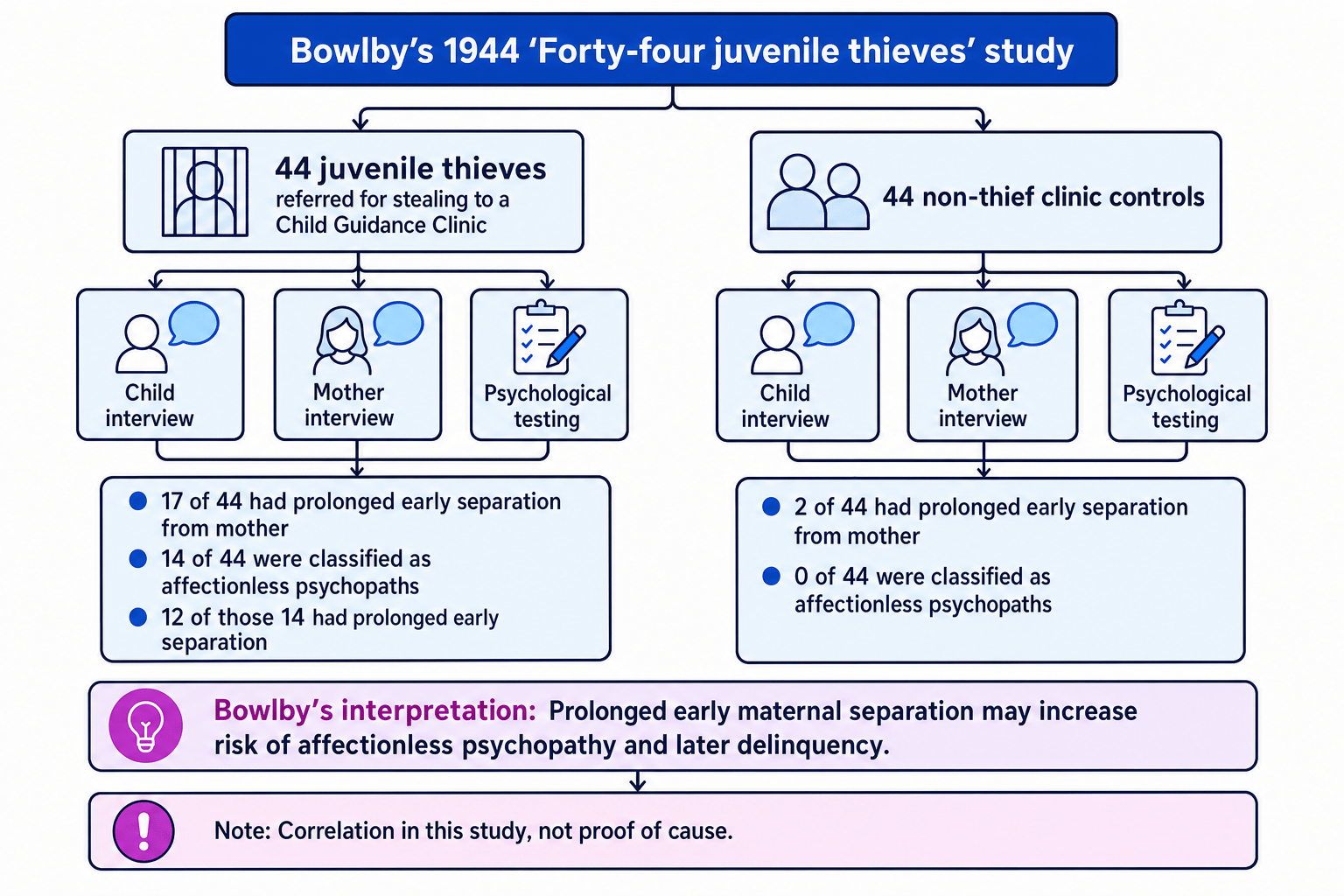
Bowlby aimed to investigate whether children who stole had experienced more early separation from their mothers than children who did not steal. He was especially interested in whether early separation was linked to affectionless psychopathy.
Participants
The study used two groups from a Child Guidance Clinic:
- 44 juvenile thieves who had been referred because of stealing.
- 44 non-thief controls who had been referred for emotional difficulties but not for stealing.
A control group is a comparison group. It helps researchers judge whether a pattern found in the target group is unusual.
Method and procedure
This was a retrospective clinical comparison study. Retrospective means it looked backwards at past experiences, such as early childhood separations.
Bowlby and colleagues collected information using interviews and psychological testing. The children were interviewed, their mothers or caregivers were interviewed, and psychological assessments were used. The researchers then recorded whether the children had experienced prolonged separation from their mother or mother figure, especially in the first five years of life.
The basic design is easiest to remember as two clinic groups being compared on early separation and emotional characteristics.
Findings
Bowlby reported several important findings:
- 14 of the 44 thieves were classified as affectionless psychopaths.
- 12 of these 14 affectionless thieves had experienced prolonged early separation from their mothers.
- 17 of the 44 thieves had experienced prolonged early separation.
- Only 2 of the 44 non-thief controls had experienced prolonged early separation.
- None of the controls were classified as affectionless psychopaths.
Conclusion
Bowlby concluded that prolonged early maternal separation was linked to affectionless psychopathy and delinquency. He argued that early emotional care is important for later social and emotional development.
Turning correlation into cause
Do not write “Bowlby proved maternal deprivation causes crime.” A safer AO3 phrase is: Bowlby found an association between early separation, affectionless psychopathy and stealing, but the study cannot prove cause and effect.
Applying Bowlby to a scenario
In AO2, you may be given a short scenario and asked to apply the psychodynamic approach or Bowlby’s research. Focus on early relationships, emotional development and later behaviour.
Applying Bowlby to a child’s behaviour
A child spent a long period away from their mother before age five. As a teenager, they repeatedly steal and appear unconcerned when others are upset.
- Identify the early experience: the long separation before age five fits Bowlby’s idea of early maternal deprivation.
- Match the behaviour to Bowlby’s concepts: repeated stealing links to juvenile delinquency, while lack of concern for others may resemble Bowlby’s description of affectionless psychopathy.
- Explain the possible link: Bowlby would argue that disrupted early attachment may have affected the child’s emotional development, especially guilt and empathy.
- Add caution: other factors, such as poverty, family conflict, trauma, peer influence or genetics, could also explain the behaviour.
Research methods link
Bowlby’s study is useful for Component 2 thinking because it involves comparison groups, interview data and categorical findings.
The data about separation can be treated as nominal data, because children are placed into categories such as “experienced prolonged separation” or “did not experience prolonged separation”. For this kind of frequency data, the most suitable Eduqas inferential test would usually be chi-square.
Choosing the right test
Use chi-square when you are looking for an association between categories. You would use Spearman’s rho for a correlation between ranked or ordinal variables, Mann-Whitney U for differences between two unrelated groups using ordinal data, Wilcoxon for related ordinal data, and related or unrelated t-tests for interval data when parametric assumptions are met.
Testing the separation difference
Using the simplified data that 17 of 44 thieves and 2 of 44 controls experienced prolonged early separation:
- Classify the variables: group membership, thief or control, and separation history, yes or no, are both nominal categories.
- Choose the test: because the data are frequencies in categories, chi-square is more appropriate than a t-test or correlation.
- Calculate expected frequencies under the null hypothesis: for separated children in each group, E=44×1988=9.5E = \frac{44 \times 19}{88} = 9.5E=8844×19=9.5; for non-separated children in each group, E=44×6988=34.5E = \frac{44 \times 69}{88} = 34.5E=8844×69=34.5.
- Substitute into the chi-square formula: χ2=∑(O−E)2E≈15.10\chi^2 = \sum \frac{(O - E)^2}{E} \approx 15.10χ2=∑E(O−E)2≈15.10.
- Compare observed and critical values: with df=(2−1)(2−1)=1df = (2 - 1)(2 - 1) = 1df=(2−1)(2−1)=1, the critical value at p≤0.05p \le 0.05p≤0.05 is about 3.84, so 15.10≥3.8415.10 \ge 3.8415.10≥3.84.
- Interpret carefully: the association is statistically significant, but it still does not prove that early separation caused stealing.
A Type I error would mean concluding there is a real association when there is not one. A Type II error would mean failing to detect a real association. In exam answers, remember that the decision depends on the test, the critical-value table, the significance level, usually p≤0.05p \le 0.05p≤0.05, and whether the hypothesis is one-tailed or two-tailed.
AO3 evaluation
Strengths
One strength is that Bowlby used a control group. The thieves were compared with children from the same clinic who had emotional problems but did not steal. This makes the comparison more meaningful than simply studying thieves alone.
A second strength is the use of multiple sources of data. Interviews with children, interviews with mothers or caregivers, and psychological testing allowed some triangulation, which means using more than one source of evidence to build a fuller picture.
A further strength is real-world relevance. The study influenced thinking about childcare, hospital visiting, fostering, adoption and support for children who experience family disruption.
Weaknesses
A major weakness is that the study was not an experiment. Bowlby did not manipulate early separation, so cause and effect cannot be established. Children who experienced separation may also have experienced other difficulties, such as poverty, parental illness, bereavement, conflict or poor institutional care.
The study also relied on retrospective information. Parents and children may not have remembered early events accurately, so recall bias could reduce validity.
There may also have been researcher bias. Bowlby believed early separation was important, and the classification of children as affectionless psychopaths involved judgement. This could affect objectivity and reliability.
The sample was limited. The children were from a clinic population, so the findings may not generalise to all children, all cultures or modern family structures.
Contradictory evidence
Later researchers questioned Bowlby’s conclusions. Rutter argued that researchers should distinguish between deprivation, which means losing an attachment after it has formed, and privation, which means never forming a strong attachment in the first place. Rutter also suggested that poor outcomes may depend on the quality of later care, not simply on separation itself.
Research such as Hodges and Tizard’s work on institutionalised children also suggests that some children can recover and form attachments later, especially if they receive stable, sensitive care. This challenges a fully deterministic interpretation of Bowlby.
Ethics and social sensitivity
Bowlby’s study was carried out before today’s BPS Code of Ethics and Conduct. A modern study would need informed consent from parents or guardians, assent from children where possible, the right to withdraw, confidentiality, protection from harm and debriefing.
The topic is also socially sensitive. Labelling children as “thieves” or “affectionless psychopaths” could be stigmatising. The study may also encourage “mother-blaming” if findings are oversimplified. A balanced answer should recognise that children’s outcomes are affected by many factors, including fathers, wider family, substitute caregivers, social conditions and later support.
Real-world applications
Bowlby’s research helped change attitudes towards children’s emotional needs. For example, hospitals became more likely to allow parents to visit or stay with young children. Childcare services also became more aware of the importance of stable caregivers, early intervention and sensitive support after separation.
However, the application should be cautious. The study does not mean that every child who experiences separation will become delinquent, or that separation always causes permanent damage.
In the exam
- For AO1, include the researcher and year, aim, sample, method, findings and conclusion.
- For AO3, balance strengths, such as the control group and real-world value, with weaknesses, such as retrospective data, bias and lack of causality.
- Use cautious wording: write “linked to” or “associated with”, not “proved to cause”.
- Always include an ethics point if evaluating the study, especially protection from harm, confidentiality and socially sensitive labelling.
Check yourself
- What did Bowlby mean by affectionless psychopathy?
- Why does the study not prove that maternal deprivation causes delinquency?
- Which ethical issues would a modern version of this study need to address?
