What you'll learn
- What the psychodynamic approach assumes about behaviour and personality.
- How the unconscious mind can influence thoughts, feelings and actions.
- Why Freud argued that childhood experiences are especially important.
- How to use the tripartite personality — id, ego and superego — in AO1, AO2 and AO3 answers.
The starting point: what is an “assumption”?
An assumption is a basic belief that an approach uses to explain behaviour. In Eduqas essays, assumptions are mainly AO1: you describe what the approach believes. You then use AO2 to apply those ideas to a scenario, and AO3 to evaluate how convincing they are.
Psychodynamic approach
The psychodynamic approach is a view of human behaviour, mainly associated with Sigmund Freud, which argues that behaviour is driven by unconscious mental forces, inner conflict and early childhood experiences.
Freud’s approach is called psychodynamic because it sees the mind as active and full of “dynamic” forces pushing against each other. A person might appear calm on the outside, but Freud would argue that hidden wishes, fears and conflicts may be shaping their behaviour.
Assumption 1: the unconscious mind
Freud argued that not all mental activity is available to conscious awareness. In other words, you may not fully know why you think, feel or behave in certain ways.
Conscious, preconscious and unconscious
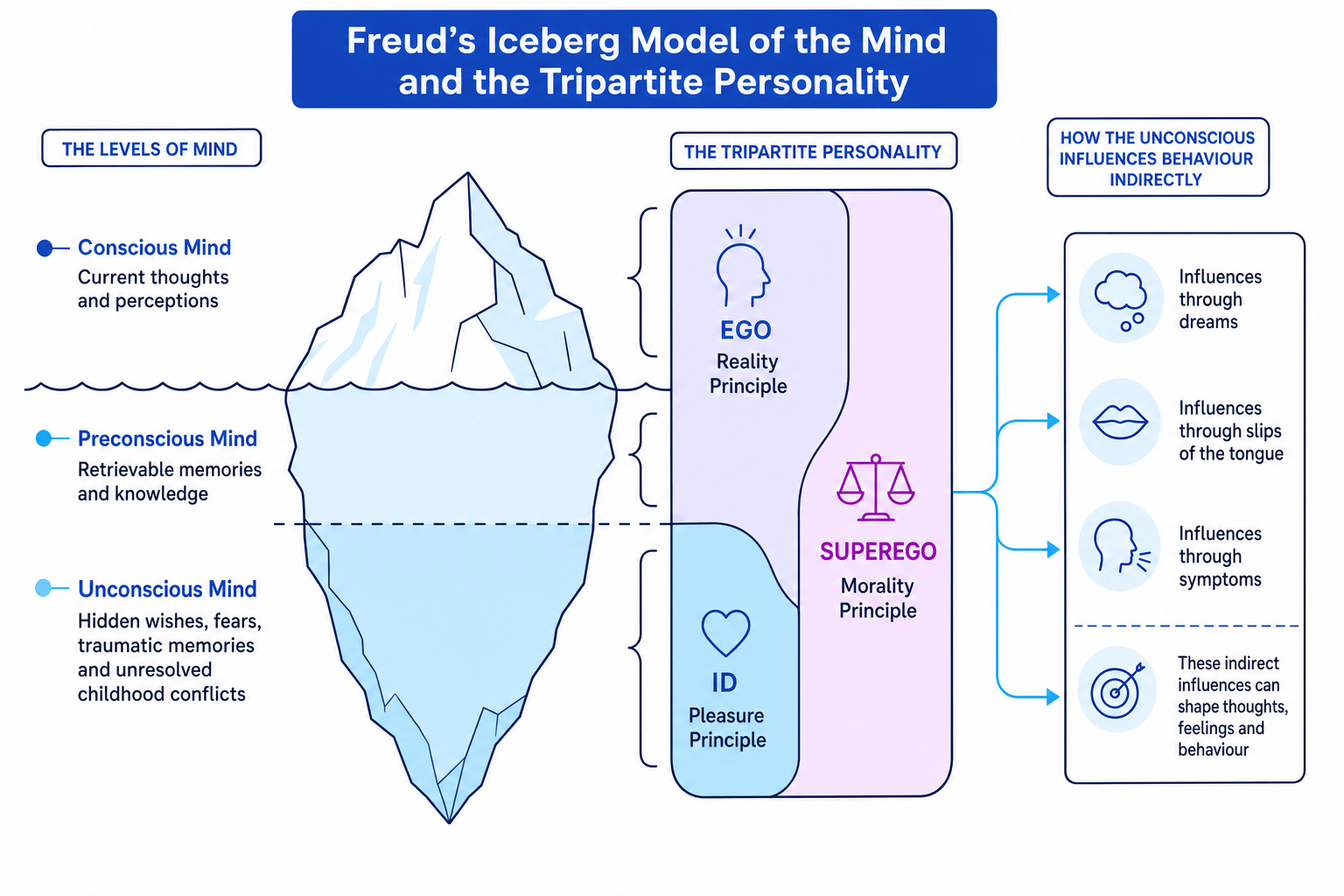
The conscious mind contains thoughts and feelings you are aware of right now. For example, you may be aware that you are reading these notes.
The preconscious mind contains information you are not thinking about right now but could bring into awareness quite easily, such as what you had for breakfast.
The unconscious mind contains hidden wishes, fears, traumatic memories and conflicts. Freud believed these unconscious forces can influence behaviour indirectly.
The iceberg model is a useful way to visualise this: only a small part of the mind is visible above the surface, while the largest part is hidden underneath.
The hidden mind
For Freud, behaviour is not random: even slips of the tongue, dreams and symptoms may reveal unconscious conflicts.
This idea is linked to psychic determinism, which means the belief that behaviour has a psychological cause, even when the person is unaware of it.
Freud also believed the mind protects itself from distress through defence mechanisms. A defence mechanism is an unconscious strategy used by the ego to reduce anxiety. For example, repression means pushing threatening thoughts or memories into the unconscious.
Explaining repeated forgetting
- A person repeatedly “forgets” to attend counselling sessions after a painful family argument, even though they normally have a good memory.
- A psychodynamic explanation would apply psychic determinism: the repeated forgetting may have a psychological cause rather than being pure accident.
- The painful argument could be linked to unconscious anxiety, so the mind may use repression or avoidance to keep distressing material out of awareness.
- The behaviour can then be interpreted as an indirect expression of conflict: the person consciously says they forgot, but unconsciously they may be avoiding emotional pain.
- A balanced answer would add that this is only one interpretation; cognitive explanations such as poor attention or stress affecting memory could also explain the behaviour.
Unconscious does not mean asleep
In psychology, the unconscious mind means mental processes outside awareness. It does not simply mean being physically unconscious or asleep.
Assumption 2: childhood experiences shape adult personality
Freud believed that early childhood experiences are crucial in shaping adult personality. He argued that problems in adulthood may come from unresolved conflicts in childhood.
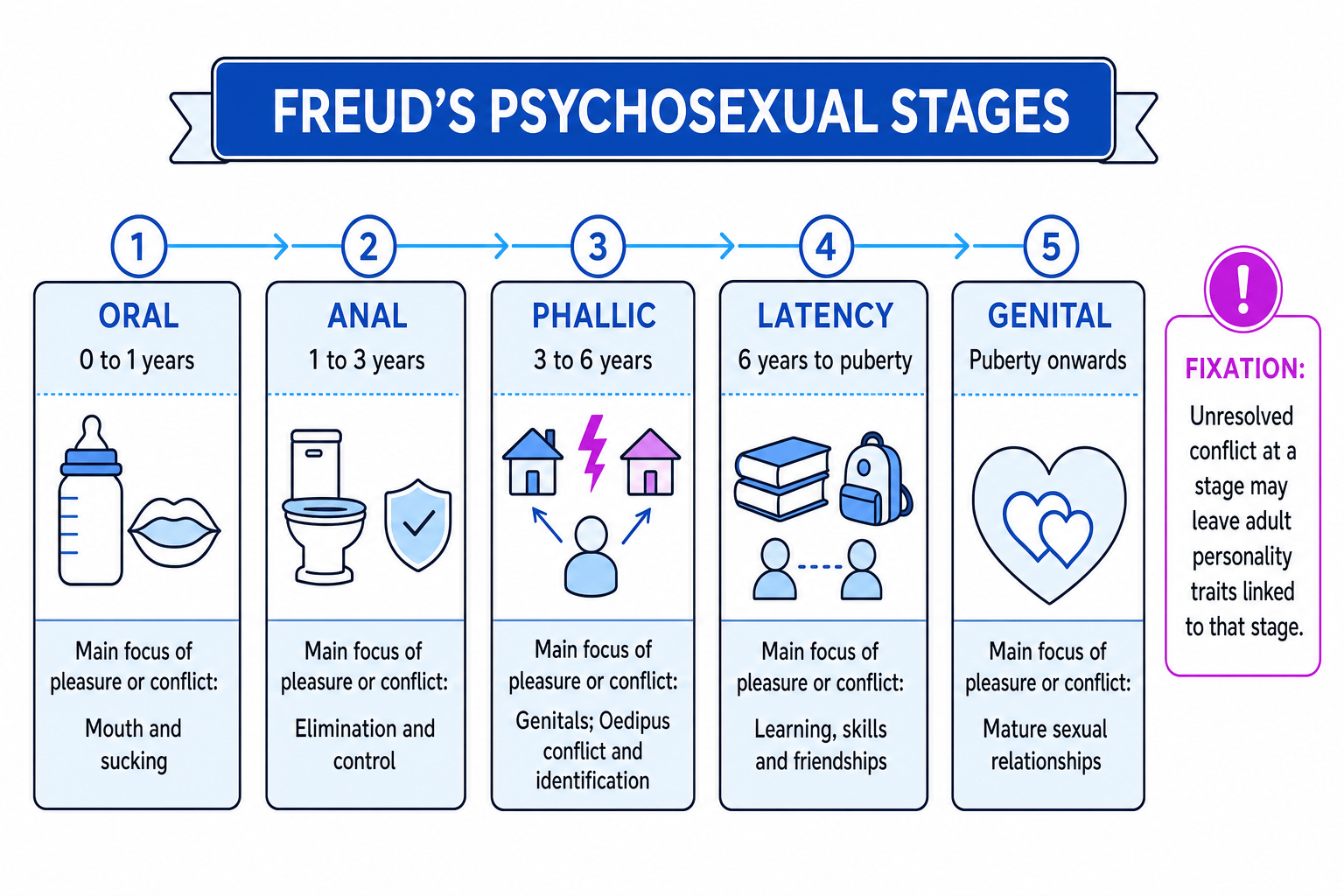
A key part of this is Freud’s theory of psychosexual stages. These are stages of development where the child’s pleasure and conflict are focused on different parts of the body or different developmental issues.
Psychosexual stages and fixation
Freud proposed five stages:
- Oral stage: from birth to about 1 year, focused on the mouth, sucking and feeding.
- Anal stage: around 1 to 3 years, focused on toilet training, control and independence.
- Phallic stage: around 3 to 6 years, involving family relationships, identification and the Oedipus conflict.
- Latency stage: around 6 years to puberty, where sexual impulses are quieter and energy is directed into learning and friendships.
- Genital stage: from puberty onwards, focused on mature adult relationships.
Fixation
A fixation is when unresolved conflict at one psychosexual stage affects later personality or behaviour.
For example, Freud suggested that an overly strict or overly relaxed approach to toilet training could lead to later “anal” personality traits, such as excessive orderliness or messiness. You do not need to accept this as fact — in AO3, you can criticise how difficult it is to test scientifically.
Linking early experience to adult behaviour
- Imagine an adult who is extremely rigid about neatness, control and routines, and becomes anxious when things are out of place.
- A Freudian explanation might link this pattern to the anal stage, where the child experiences conflict around toilet training and control.
- If that conflict was unresolved, Freud would say the person may become fixated at that stage, so adult behaviour reflects earlier anxiety about control.
- To evaluate the explanation, compare it with alternatives: the behaviour might also be explained by learning, family modelling, personality traits or anxiety disorders.
Assumption 3: tripartite personality
Freud proposed that personality has three parts. This is called the tripartite personality, meaning a personality made up of three interacting structures.
Tripartite personality
The tripartite personality is Freud’s model of personality containing the id, ego and superego, which are in constant interaction and sometimes conflict.
The id
The id is present from birth and operates according to the pleasure principle. This means it seeks immediate satisfaction of basic instincts and desires. It is impulsive and does not consider rules, consequences or other people’s needs.
The ego
The ego develops to deal with reality. It operates according to the reality principle, meaning it tries to satisfy the id’s desires in a realistic and socially acceptable way.
The superego
The superego develops through internalising moral rules, often from parents and society. It operates according to the morality principle. It rewards the person with pride when they behave well and punishes them with guilt when they do wrong.
Personality as conflict
Freud saw personality as a conflict between desire, reality and morality: the id wants, the superego judges, and the ego negotiates.
Applying the id, ego and superego
- A student has not revised for a test and sees the answers on the teacher’s desk.
- The id pushes for immediate gratification: “Take the answers and avoid feeling stressed.”
- The superego creates moral pressure: “Cheating is wrong, and you should feel guilty if you do it.”
- The ego weighs up reality: “If I cheat, I might be caught; a better compromise is to revise quickly, answer what I can and accept the outcome.”
- If the conflict creates anxiety, the ego may use a defence mechanism, such as rationalisation: “Everyone else probably cheats anyway,” to reduce guilt.
Id bad, superego good
Do not describe the id as simply “evil” and the superego as simply “good”. The id represents instinctive desire, while the superego represents internalised moral standards. Both can create problems if too strong.
How the assumptions fit together
The three assumptions work best as a chain:
- Early childhood experiences create important emotional conflicts.
- Some conflicts become unconscious because they are too threatening.
- The id, ego and superego continue to interact, creating anxiety or symptoms.
- Behaviour can reveal unconscious conflict indirectly, through dreams, slips of the tongue, phobias or defence mechanisms.
This is why Freud’s therapy focused on making the unconscious conscious. In the wider psychodynamic topic, dream analysis is the named therapy/application: dreams are interpreted as symbolic expressions of unconscious wishes and conflicts.
Research anchors for Eduqas essays
Freud (1909): Little Hans
Freud’s classic study, Freud (1909), is known as the case study of Little Hans, a five-year-old boy with a phobia of horses. Freud did not treat Hans directly; much of the evidence came from letters and reports written by Hans’s father.
Freud interpreted Hans’s horse phobia as a displacement of unconscious fear linked to the Oedipus conflict. In AO1, this supports the assumptions because it involves childhood experience, unconscious conflict and the interaction of desire, fear and morality.
In AO3, the study gives rich qualitative detail, but it is only one case study, so it has low generalisability. Freud’s interpretation may also be biased because the evidence was filtered through Hans’s father and Freud’s own theory. A behaviourist might offer an alternative explanation: Hans may have learned fear after seeing a horse collapse.
Ethically, by modern BPS Code of Ethics and Conduct standards, there are concerns about consent, protection from harm and confidentiality. Hans was a child, so his ability to give informed consent was limited, and discussing his fears and family relationships could have caused distress.
Bowlby (1944): Forty-Four Juvenile Thieves
The later psychodynamic study often linked with this approach is Bowlby (1944), which compared 44 young thieves with a control group of 44 non-thieves. Bowlby found that many of the “affectionless” thieves had experienced early separation from their mothers.
This supports the psychodynamic assumption that childhood experiences can influence later behaviour and emotional development. However, the study is correlational, so it cannot prove that early separation caused delinquency. Other factors, such as poverty, family stress or school experiences, may have contributed.
Ethically, the study involved vulnerable young people, so modern researchers would need careful consent procedures, confidentiality, protection from psychological harm and sensitive debriefing. The label “affectionless” may also be considered stigmatising.
Evaluation of the assumptions
Strengths
One strength is that the psychodynamic approach takes emotions, childhood and inner conflict seriously. This gives it explanatory depth, especially for behaviours that seem irrational, such as phobias, dreams or repeated relationship patterns.
A second strength is real-world influence. Psychodynamic ideas contributed to talking therapies and encouraged society to take early childhood experiences seriously. Bowlby’s work, for example, influenced thinking about childcare, attachment and emotional development.
Weaknesses
A major weakness is scientific status. Many psychodynamic ideas are hard to test objectively because unconscious motives cannot be directly observed. This makes the approach difficult to falsify, meaning it can be hard to prove wrong.
Another weakness is methodological. Freud relied heavily on case studies, which are detailed but subjective. They often use small samples, retrospective reports and interpretation rather than controlled measurement.
A further criticism is determinism. The approach can imply that adult behaviour is strongly determined by early childhood, leaving less room for free will, change and later life experiences.
There are also issues of cultural and gender bias. Some Freudian concepts were developed in a particular historical context and may reflect sexist assumptions about gender roles and family life.
Essay shortcut
For a strong Eduqas paragraph, link one assumption to one research example and one evaluation point: for example, childhood experiences → Bowlby (1944) → useful support but correlational and ethically sensitive.
In the exam
- For AO1, use the exact terms: unconscious mind, childhood experiences, tripartite personality, id, ego and superego.
- For AO2, map the scenario onto the theory: ask what hidden conflict, early experience or personality structure could explain the behaviour.
- For AO3, avoid vague criticism. Use precise points such as low generalisability, subjective interpretation, unfalsifiability, determinism, ethical concerns or alternative explanations.
- Include researcher names and years where relevant: Freud (1909) for Little Hans and Bowlby (1944) for early separation and juvenile thieves.
Check yourself
- What is the difference between the conscious, preconscious and unconscious mind?
- In a conflict between wanting to cheat and feeling guilty, what would the id, ego and superego each do?
- Why is Freud’s Little Hans study useful for the psychodynamic approach but weak as scientific evidence?
