What you'll learn
- What psychologists mean by “the mother as primary care-giver”.
- How this debate links to the psychodynamic approach, especially Freud and Bowlby.
- Evidence that supports and challenges the idea that the mother is uniquely important.
- How to build AO1, AO2 and AO3 points for Eduqas essay answers.
The debate in one sentence
This debate asks whether an infant’s healthy emotional development depends especially on the mother being the main care-giver, or whether other sensitive, consistent adults can provide equally secure care.
Primary care-giver
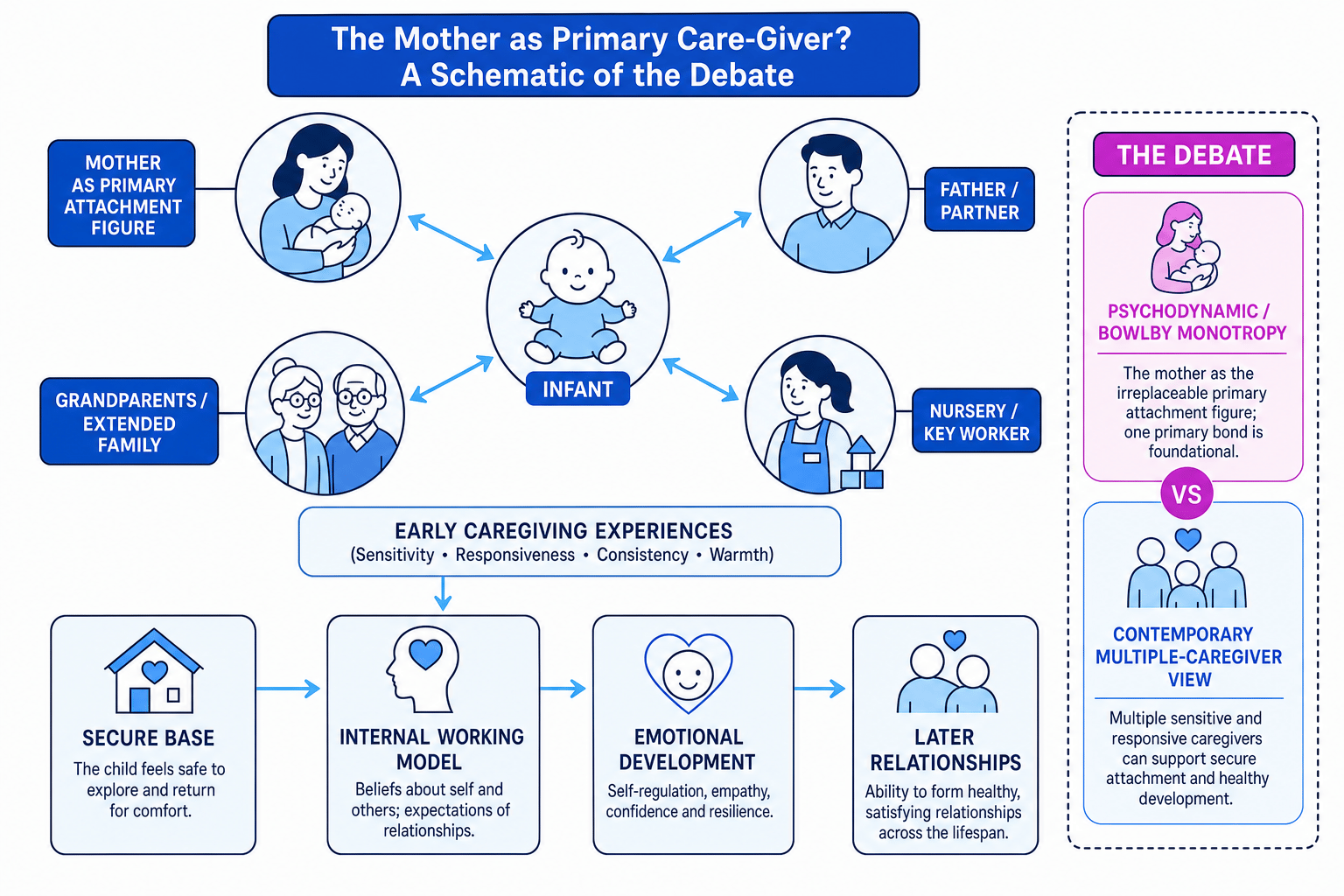
A primary care-giver is the person who takes the main responsibility for an infant’s day-to-day physical and emotional care. Traditionally this has meant the mother, but it can also be a father, grandparent, adoptive parent, foster carer or another stable adult.
Attachment
Attachment is a close emotional bond between an infant and a care-giver, shown through behaviours such as seeking comfort, distress at separation and using the care-giver as a secure base for exploration.
Why this belongs in the psychodynamic approach
The psychodynamic approach argues that early childhood experiences shape later personality, emotions and relationships, often through processes outside conscious awareness.
For this debate, the key idea is that the infant’s earliest relationship may become a template for later emotional life. If early care is warm, reliable and responsive, the child may develop trust and emotional security. If early care is disrupted or neglectful, later relationships may be affected.
The core psychodynamic link
The mother-as-primary-care-giver debate matters because psychodynamic psychologists see early relationships as powerful foundations for later personality and emotional development.
Bowlby’s view: the mother or mother-substitute matters
John Bowlby developed attachment theory, which combines psychodynamic ideas with evolutionary thinking. He argued that infants have an innate tendency to form attachments because staying close to a care-giver increases survival.
Monotropy
Monotropy
Monotropy is Bowlby’s idea that infants have one special, central attachment figure who is more important than all others. Bowlby often identified this figure as the mother, or a permanent mother-substitute.
Bowlby did not simply mean “biological mother at all costs”. His claim was that the infant needs continuous, loving care from one main figure. However, because mothers were usually the main carers in mid-twentieth-century Britain, his theory became strongly associated with the idea that mothers should be primary care-givers.
Maternal deprivation
Maternal deprivation
Maternal deprivation means the loss of, or prolonged separation from, the mother or main attachment figure after an attachment has formed. Bowlby argued this could damage emotional and social development, especially if it happened early and no good substitute care was provided.
Bowlby proposed a sensitive period, meaning a time in early life when forming an attachment is especially important. He believed serious disruption during this period could contribute to later difficulties such as delinquency, low empathy or problems forming relationships.
Internal working model
Internal working model
An internal working model is a mental template of relationships. It includes beliefs about the self, other people and what to expect from close relationships.
For example, a securely attached infant may develop the expectation: “I am worthy of care, and other people can be trusted.” An insecurely attached infant may be more likely to expect rejection, inconsistency or emotional distance.
Applying Bowlby to a childcare scenario
A 14-month-old infant’s mother returns to full-time work. The father and a nursery key worker provide regular, warm care.
- Identify the issue: the question is not just “Is the mother absent?” but whether the infant experiences emotional deprivation or has reliable substitute care.
- Apply Bowlby’s view: Bowlby would be concerned if the infant lost continuous contact with the main attachment figure and no stable substitute attachment was available.
- Apply the contemporary challenge: if the father and key worker are sensitive, consistent and emotionally available, they may also support secure attachment.
- Reach a balanced conclusion: the scenario does not automatically show harm; the quality and continuity of care are central.
Classic psychodynamic anchor: Freud (1909)
The classic psychodynamic study usually linked to this approach is Freud’s (1909) case study of Little Hans. Hans was a young boy with a phobia of horses. Freud interpreted the phobia as evidence for unconscious conflict linked to the Oedipus complex, where a young boy has unconscious desire for the mother and rivalry with the father.
This study is not directly about infant childcare, but it supports the broader psychodynamic assumption that early family relationships are psychologically significant.
AO3 evaluation of Freud’s link
Freud’s evidence was detailed and rich, which is a strength of the case study method. However, it was based on one child, much of the information came through Hans’s father, and Freud’s interpretations were difficult to test scientifically. Ethical issues also arise because Hans was a child and could not give fully informed consent in the modern BPS sense.
Overclaiming Freud
Do not write that Freud proved mothers must be primary care-givers. Freud supports the broader idea that early family relationships matter, but Bowlby is the more direct theorist for the mother-as-primary-care-giver debate.
Contemporary psychodynamic anchor: Bowlby (1944)
Bowlby’s 44 juvenile thieves study is central evidence for this debate.
Bowlby studied 44 children and adolescents who had been referred to a clinic for stealing, and compared them with a control group of 44 emotionally disturbed young people who had not stolen. He interviewed children and families and examined their early histories.
He found that some of the thieves were described as showing affectionless psychopathy, meaning they lacked guilt, empathy and emotional warmth. Many of these young people had experienced prolonged early separation from their mothers. Bowlby concluded that early maternal deprivation could be linked to later emotional and behavioural problems.
AO3 evaluation of Bowlby (1944)
A strength is that Bowlby used detailed clinical data and included a comparison group, making the evidence more systematic than a single case study.
However, the study was correlational, so it cannot prove that maternal separation caused later delinquency. Other factors, such as poverty, family conflict, trauma or institutional care, may have contributed. Bowlby also relied on retrospective information about childhood experiences, which may be incomplete or biased.
Ethically, modern researchers would need to consider the BPS principles of consent, confidentiality, protection from harm, debriefing and careful handling of sensitive labels such as “affectionless psychopath”.
Evidence that challenges “mother only”
Schaffer and Emerson (1964)
Schaffer and Emerson studied infants in Glasgow and found that many babies formed multiple attachments. The mother was often the first attachment figure, but fathers and other carers also became important. Crucially, attachment seemed to depend more on sensitive responsiveness than on who spent the most time with the infant.
Harlow (1958)
Harlow’s research with rhesus monkeys showed that infant monkeys preferred a soft “comfort” surrogate mother over a wire mother that provided food. This supports the importance of emotional comfort, not just feeding.
However, Harlow’s work raises serious animal ethics concerns. The monkeys experienced distress and social isolation. Today, animal research must be justified through likely benefits, minimising suffering, and applying principles such as replacement, reduction and refinement.
Rutter’s criticism
Michael Rutter argued that Bowlby sometimes confused deprivation with privation.
Deprivation and privation
Deprivation means losing an attachment after it has formed. Privation means never forming a strong attachment in the first place.
This matters because the long-term effects of never having stable care may be different from temporary separation from a loving parent. Rutter’s work with children who experienced institutional care suggests that recovery is possible, especially when children later receive high-quality, stable care.
So, should the mother be the primary care-giver?
A balanced Eduqas answer should avoid an extreme position.
The strongest modern conclusion is that infants need sensitive, consistent, emotionally available care. In many families this may come mainly from the mother. But psychological evidence does not prove that only mothers can provide it.
Fathers, grandparents, adoptive parents, foster carers and professional key workers can all support secure development if they provide stable and responsive care.
Best balanced conclusion
The mother can be a crucial care-giver, but the evidence points more strongly to the importance of consistent, sensitive attachment relationships than to the biological mother being uniquely necessary.
Wider implications and controversies
Gender roles and sexism
A major criticism of Bowlby’s theory is that it has sometimes been used to blame mothers for children’s difficulties or to argue that mothers should not work outside the home. This can be seen as socially conservative and potentially sexist.
A stronger contemporary view is that society should support infants by supporting families: parental leave, affordable childcare, mental health support, and encouragement for fathers and other carers to be actively involved.
Cultural bias
The idea of one mother as the central care-giver reflects a Western nuclear-family model. In many cultures, infants are raised through alloparenting, where several adults share childcare. This challenges the assumption that one mother-child bond is the only healthy arrangement.
Real-world applications
Bowlby’s work had positive effects too. It influenced hospital policies, encouraging parents to visit or stay with young children rather than leaving them separated for long periods. It also highlighted the emotional needs of infants, not just their physical care.
Component 2 methods link
If you were investigating attitudes to the mother as primary care-giver, your method choices would matter.
For example, a questionnaire could produce ordinal data if participants rate agreement on a scale. A comparison between two separate groups, such as mothers and fathers, might use Mann-Whitney U if the data are ordinal. A relationship between two ranked variables might use Spearman’s rho. Nominal category data may require chi-square, while interval data may allow related or unrelated t-tests.
For Eduqas, remember the usual significance level is p≤0.05p \leq 0.05p≤0.05. You compare the observed value with the critical value from a table, using a one-tailed test for a directional hypothesis and a two-tailed test for a non-directional hypothesis. Type I errors mean falsely accepting a difference or relationship; Type II errors mean missing a real one.
Choosing a test for caregiver attitude data
A researcher compares agreement ratings from mothers and fathers on the statement “The mother should be the main care-giver.” Ratings are on a 1-to-5 scale.
- Decide the aim: the researcher is testing for a difference between two groups, not a correlation.
- Identify the design: mothers and fathers are separate participants, so this is an independent groups design.
- Identify the level of measurement: 1-to-5 ratings are usually treated as ordinal data.
- Choose the test: the appropriate Eduqas test is Mann-Whitney U, using the correct critical-value table and significance level.
In the exam
- Start by defining the debate: is the mother uniquely necessary, or is sensitive caregiving from any stable adult enough?
- Use named evidence: Freud (1909) for early family relationships and Bowlby (1944) for maternal deprivation, then challenge with Schaffer and Emerson, Rutter or Harlow.
- Keep AO3 balanced: include methodology, ethics, gender bias, cultural bias and real-world applications.
- For AO2 scenarios, focus on care quality, consistency and attachment security rather than simply whether the mother is present.
Check yourself
- What is the difference between monotropy and multiple attachments?
- Why does Bowlby’s 44 thieves study not prove that maternal deprivation causes delinquency?
- How could the mother-as-primary-care-giver debate be criticised as culturally biased or sexist?
