What you'll learn
- What behaviourists mean by the blank slate.
- How behaviour is learnt through classical conditioning and operant conditioning.
- Why behaviourists use findings from non-human animal research to explain human behaviour.
- How to turn this into AO1 description, AO2 application, and AO3 evaluation.
The big behaviourist idea
An assumption is a starting belief that an approach uses to explain behaviour. The behaviourist approach begins with a simple, bold idea: psychology should study behaviour that can be observed and measured, rather than hidden thoughts, dreams, or unconscious conflicts.
Behaviourist approach
The behaviourist approach explains behaviour as something learnt from the environment through experience, especially through conditioning.
Behaviourists focus on the link between a stimulus and a response. A stimulus is something in the environment that affects behaviour, such as a sound, object, reward, or punishment. A response is the behaviour that follows.
The behaviourist starting point
Behaviourists argue that much of human behaviour is shaped by the environment: what happens to us, what we associate together, and what consequences follow our actions.
Assumption 1: the blank slate
Blank slate
The blank slate, or tabula rasa, is the idea that people are born without fixed behavioural patterns, and that experience “writes” behaviour onto them through learning.
This does not mean behaviourists think biology is irrelevant. Instead, they deliberately put most attention on nurture: the influence of the environment. For example, a behaviourist would be more interested in how a phobia was learnt than in whether someone has a “fearful personality”.
Applying the blank slate assumption
A child is not afraid of dogs. One day, a dog bites them. After this, the child cries whenever they see a dog.
- Identify the behavioural change: the child has moved from no fear response to a fear response when seeing dogs.
- Link the change to an environmental experience: the dog bite was a strong event that changed how the child reacts to dogs.
- Apply the blank slate idea: the fear is explained as learnt through experience, rather than being present from birth.
Blank slate is not “no biology”
Do not write that behaviourists believe humans have no biology. A better answer is that behaviourists explain behaviour mainly through environmental learning, rather than genes, brain structures, or unconscious motives.
Assumption 2: behaviour is learnt through conditioning
Conditioning
Conditioning is a learning process where behaviour changes because of associations or consequences in the environment.
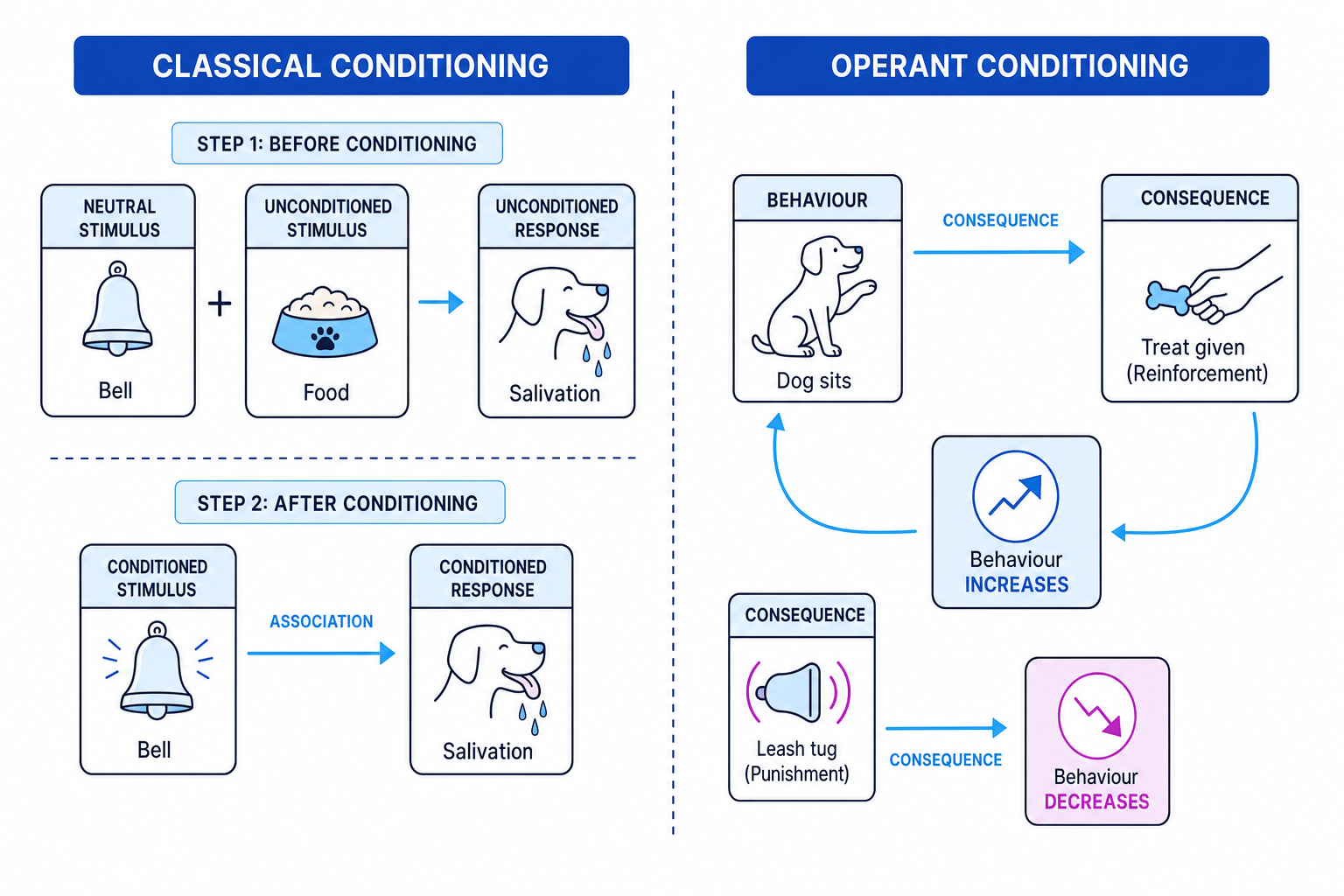
There are two key forms: classical conditioning, which is learning by association, and operant conditioning, which is learning through consequences.
Classical conditioning: learning by association
Classical conditioning happens when a person or animal learns to associate two stimuli together. Eventually, a stimulus that was once neutral can trigger a response by itself.
Key terms:
- A neutral stimulus is something that does not naturally produce the response at first.
- An unconditioned stimulus naturally produces a response without learning.
- An unconditioned response is the natural response to the unconditioned stimulus.
- A conditioned stimulus is the once-neutral stimulus after learning has taken place.
- A conditioned response is the learnt response to the conditioned stimulus.
The classic Eduqas behaviourist study is Watson and Rayner (1920), often known as the Little Albert study. They conditioned an infant to fear a white rat by pairing the rat with a loud noise.
Labelling Little Albert's conditioning
- Before conditioning, the white rat was a neutral stimulus because Albert did not originally fear it.
- The loud noise was an unconditioned stimulus because it naturally produced fear, and Albert’s crying was the unconditioned response.
- During conditioning, the rat and loud noise were paired, so Albert learnt an association between the rat and fear.
- After conditioning, the rat became a conditioned stimulus, and Albert crying at the rat became the conditioned response.
Watson and Rayner also reported stimulus generalisation, where Albert showed fear towards similar objects, such as a rabbit and fur coat. This supports the idea that learnt responses can spread to related stimuli.
Operant conditioning: learning through consequences
Operant conditioning explains behaviour as shaped by what happens after it. A consequence is something that follows a behaviour.
Reinforcement and punishment
Reinforcement increases the likelihood of a behaviour being repeated, while punishment decreases the likelihood of a behaviour being repeated.
There are two types of reinforcement:
- Positive reinforcement: something pleasant is added after a behaviour, such as praise.
- Negative reinforcement: something unpleasant is removed after a behaviour, such as anxiety reducing when someone avoids a feared situation.
Punishment is different because it makes a behaviour less likely.
Classifying consequences
A student keeps checking their phone during revision.
- If checking the phone leads to enjoyable messages, the behaviour is likely to increase because something pleasant is added: this is positive reinforcement.
- If checking the phone reduces the student’s anxiety about missing out, the behaviour is likely to increase because something unpleasant is removed: this is negative reinforcement.
- If the student loses phone privileges after checking it, the behaviour is likely to decrease because an unpleasant consequence follows: this is punishment.
Positive does not mean good
In operant conditioning, positive means “added” and negative means “removed”. Positive reinforcement and negative reinforcement both increase behaviour.
Assumption 3: humans and animals learn in similar ways
Behaviourists argue that the basic principles of learning apply across species. This is why research using non-human animals has been important in behaviourism. For example, Pavlov (1927) studied conditioning in dogs, and Skinner (1938) studied operant learning in rats and pigeons.
Extrapolation
Extrapolation means applying findings from one group, such as non-human animals, to another group, such as humans.
Behaviourists justify extrapolation by arguing that humans and animals can both learn associations and respond to reinforcement and punishment. This makes animal research useful for controlled studies of learning.
Using animal evidence carefully
A rat presses a lever more often when food follows the lever press.
- Identify the learning principle: food increases lever pressing, so the food acts as positive reinforcement.
- Apply the principle to humans cautiously: a human may also repeat a behaviour if it is followed by a reward, such as praise or money.
- Add the limitation: human behaviour may also involve language, beliefs, emotions, and culture, so animal findings cannot explain every human behaviour fully.
Ethics angle
Human research must follow the British Psychological Society Code of Ethics and Conduct, including consent, right to withdraw, protection from harm, confidentiality, and debrief. Animal research also needs strong justification, humane treatment, and the principles of replacement, reduction, and refinement.
Study anchors for Eduqas essays
Classic study: Watson and Rayner (1920)
For AO1, describe how Little Albert was conditioned to fear a white rat by pairing it with a loud noise. For AO3, evaluate it carefully: it supports classical conditioning because the fear response appeared after pairing, but it was a single case study with serious ethical issues. Albert could not give consent, his mother’s consent was limited, he was distressed, and he was not properly deconditioned.
Contemporary study: Becker et al. (2002)
The Eduqas behaviourist approach is also linked to Becker et al. (2002), who studied Fijian adolescent girls after the introduction of television. Exposure to Western media was associated with changes in eating attitudes and body image.
This supports the broader behaviourist idea that behaviour can be shaped by the environment. However, be precise: Becker et al. is not a pure conditioning study like Little Albert. It is better used as evidence that social and cultural environments can influence behaviour.
AO3 evaluation: strengths and weaknesses
Strengths
Behaviourism helped make psychology more scientific because it focused on observable behaviour and controlled research. This makes behaviour easier to record consistently than unconscious thoughts or private mental experiences.
It also has useful real-world applications. For example, systematic desensitisation treats phobias by gradually pairing the feared object with relaxation, using the principles of classical conditioning. Operant conditioning is also used in behaviour modification programmes, such as reward systems in schools or clinical settings.
Weaknesses
A major weakness is reductionism, which means explaining complex behaviour in an overly simple way. Behaviourism can reduce behaviour to stimulus-response links while ignoring thinking, emotion, biology, and culture.
It can also be criticised for environmental determinism, the idea that behaviour is controlled by the environment and that free choice has little role. This may be too extreme, because people can reflect on their behaviour and choose differently.
Animal research is useful but limited. Humans share basic learning processes with other species, but human behaviour is often influenced by language, expectations, moral rules, and social meanings.
Component 2 research methods link
If you design a behaviourist practical, you might observe a behaviour before and after a reward, punishment, or conditioning procedure. Make the behaviour operationalised, meaning clearly defined so it can be measured.
Choosing statistics for a learning study
Use the design and data level to choose a test: Mann-Whitney U for two independent groups with ordinal data, Wilcoxon signed-ranks for related ordinal data, unrelated t-test for independent interval data, related t-test for repeated or matched interval data, Spearman’s rho for correlations, chi-square for nominal category data, and the binomial sign test for related nominal change. The default significance level is usually p≤0.05p \leq 0.05p≤0.05; compare the observed value with the critical value and check whether the hypothesis is one-tailed or two-tailed.
A Type I error is when a researcher wrongly claims a significant effect. A Type II error is when a researcher misses a real effect. For descriptive statistics, you might use the mean, median, mode, range, standard deviation, bar charts, or scatterplots, depending on the data.
In the exam
- For AO1, cover all three assumptions: blank slate, conditioning, and similarity between human and animal learning.
- For AO2, translate scenarios into behaviourist language: stimulus, response, association, reinforcement, punishment, or generalisation.
- For AO3, balance scientific usefulness and applications against reductionism, determinism, ethical issues, and limits of animal extrapolation.
Check yourself
- What does the blank slate assumption mean, and what does it not mean?
- In Little Albert, can you identify the neutral stimulus, unconditioned stimulus, unconditioned response, conditioned stimulus, and conditioned response?
- Why is animal research useful for behaviourists, but limited when explaining human behaviour?
