What you'll learn
- What the ethics of neuroscience means in the biological approach.
- How brain-scanning and biological explanations raise issues around consent, harm, privacy and stigma.
- How to apply the debate to Raine, Buchsbaum and LaCasse (1997) and Casey et al. (2011).
- How to turn this debate into strong AO1, AO2 and AO3 essay points.
Start point: why this belongs in the biological approach
The biological approach explains behaviour by looking at physical processes in the body: the brain, nervous system, genes, hormones and neurochemicals. In modern psychology, this often involves studying the brain directly using scanning techniques.
That is why the contemporary debate is the ethics of neuroscience: as psychologists become better at measuring and influencing the brain, they must ask whether this knowledge is being used responsibly.
Neuroscience
Neuroscience is the scientific study of the nervous system, especially the brain, spinal cord and neurons. In psychology, it is used to investigate how biological processes relate to thoughts, emotions and behaviour.
The big debate
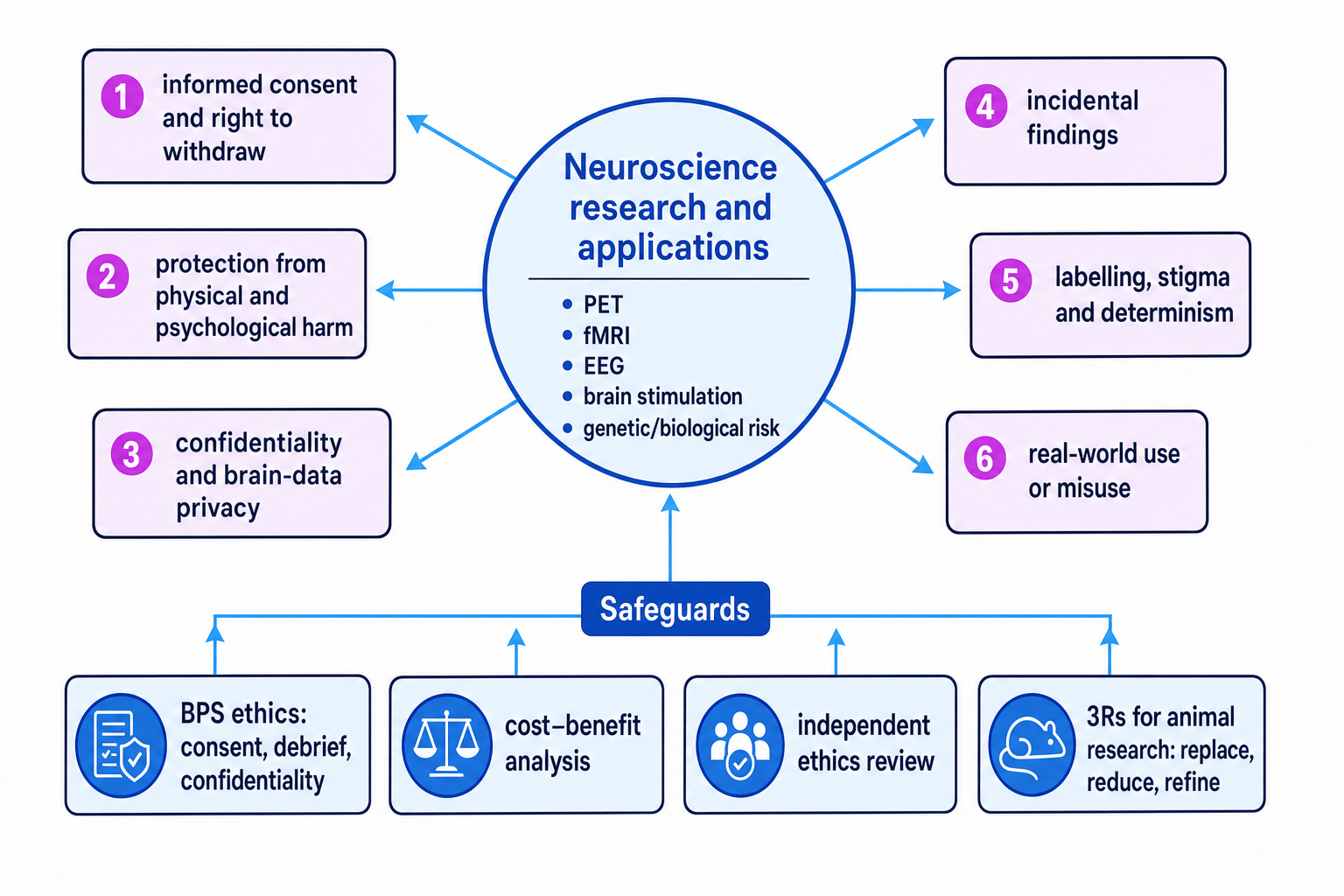
Neuroscience can help us understand and treat behaviour, but it also creates ethical risks because brain data is personal, powerful and easy to over-interpret.
The map below shows the main ethical issues that come up when psychologists use neuroscience methods or apply neuroscience findings.
What makes neuroscience ethically sensitive?
Brain data feels more “personal” than ordinary data
A questionnaire response tells us what a person says. A brain scan may appear to show something deeper: patterns linked to emotion, impulse control, memory, pain or risk of disorder.
This makes confidentiality especially important. If brain data were misused by employers, insurers, schools or courts, it could affect someone’s life chances.
Confidentiality
Confidentiality means keeping participants’ data private, usually by anonymising results and making sure individuals cannot be identified in published research.
Brain findings can be misunderstood
Brain scans can look very convincing, but they are not mind-reading devices. Most neuroscience findings are based on group averages, not perfect predictions about individuals.
Brain scan equals proof
Do not write as if a brain scan proves that someone will behave in a certain way. Brain activity is usually correlational, context-dependent and only one part of a much wider explanation.
Key neuroscience methods
PET scans
A PET scan, or positron emission tomography scan, measures brain activity by tracking a radioactive tracer injected into the body. Active brain areas use more glucose, so the scan can estimate patterns of brain metabolism.
This raises ethical issues because PET involves a medical procedure and exposure to radiation. Participants need clear informed consent, medical screening and protection from unnecessary risk.
fMRI scans
An fMRI scan, or functional magnetic resonance imaging scan, measures changes in blood oxygen levels in the brain. The idea is that active brain areas need more oxygenated blood.
fMRI does not use radiation, but it can still be stressful. Participants may feel claustrophobic, they must lie very still, and metal objects or implants can be dangerous.
EEG
An EEG, or electroencephalogram, records electrical activity from the brain using electrodes placed on the scalp. It is usually low risk, but it still involves privacy issues because it produces sensitive biological data.
The BPS ethical framework
In UK psychology, researchers are expected to follow the BPS Code of Ethics and Conduct. For this debate, the most useful issues are:
- Informed consent: participants should understand what the study involves.
- Right to withdraw: participants should be able to leave without pressure.
- Protection from harm: researchers should avoid physical and psychological harm.
- Confidentiality: data should be protected and anonymised.
- Deception: if deception is used, it must be justified and followed by debriefing.
- Debrief: participants should be told the true purpose and given support if needed.
Informed consent
Informed consent means participants freely agree to take part after being given enough information about the procedure, risks, purpose and use of their data.
Weighing ethical costs and benefits in a PET study
Imagine researchers want to use PET scans to compare brain activity in violent offenders and non-offenders.
-
Identify the main ethical cost: PET requires a radioactive tracer, so there is a physical risk that must be medically justified.
-
Check whether the participants can give valid consent: offenders may feel pressured if the research is connected to courts, hospitals or parole decisions, so researchers must make it clear that taking part is voluntary.
-
Consider the social benefit: if the study improves understanding of violence, assessment or rehabilitation, there may be a strong benefit — but only if the design is scientifically valid.
-
Add safeguards: use independent ethics review, medical screening, anonymised data, the right to withdraw and a clear debrief.
-
Reach a balanced judgement: the study may be ethical if the risk is low, consent is genuine and the findings are not used to label individuals as “born violent”.
Named study link: Raine, Buchsbaum and LaCasse (1997)
AO1: what the study did
The classic biological study for Eduqas is Raine, Buchsbaum and LaCasse (1997). They used PET scans to compare 41 murderers pleading not guilty by reason of insanity with 41 matched controls.
Participants completed a continuous performance task before scanning. The researchers found differences in brain activity, including reduced activity in areas such as the prefrontal cortex, which is linked to self-control and regulation of behaviour.
Ethical issues in Raine et al.
This study is a strong example for the ethics of neuroscience because it involved:
- Offender participants, who may be vulnerable because of legal or psychiatric circumstances.
- PET scanning, which involves an invasive medical element.
- Highly sensitive data, because the findings relate to murder, brain abnormality and responsibility.
- Risk of stigma, because people may overinterpret the findings as meaning some individuals have a “criminal brain”.
Useful AO3 wording
A strong evaluation point is: Raine et al. may improve understanding of violent behaviour, but the findings must not be used deterministically because they are based on group differences and cannot predict individual guilt or future violence.
AO3: strengths and weaknesses
A strength is that Raine et al. used an objective biological measure rather than relying only on self-report. This supports the scientific status of the biological approach.
However, the study was a quasi-experiment, meaning the researchers did not manipulate whether someone was a murderer or not. This means cause and effect cannot be established. Brain differences may be linked to violence, but they could also be linked to injury, mental illness, substance use, trauma or other factors.
The ethical concern is therefore not just the scan itself, but how society uses the conclusion. If findings are treated too simplistically, they may reduce personal responsibility or increase prejudice against people with brain differences.
Named study link: Casey et al. (2011)
AO1: what the study did
The contemporary biological study for Eduqas is Casey et al. (2011). This was a follow-up of participants from a long-term delay-of-gratification study. Adults who had shown high or low self-control as children were tested using go/no-go tasks, and some completed fMRI scanning.
The study found that lower delayers had more difficulty suppressing responses to emotionally tempting stimuli, and this was linked to activity in areas such as the ventral striatum, which is involved in reward processing.
Ethical issues in Casey et al.
Casey et al. raises different ethical issues from Raine et al.:
- Participants were followed across a long period, so confidentiality of personal developmental data was important.
- fMRI scanning can produce incidental findings.
- Labelling people as “low self-control” could affect self-esteem if feedback is handled badly.
- The findings could be useful for education or intervention, but could also be misused to judge children too early.
Incidental finding
An incidental finding is an unexpected result discovered during research, such as a possible brain abnormality found during a scan when the study was not looking for medical problems.
Researchers should have a clear plan for incidental findings: who reviews the scan, whether the participant is told, and how they are referred for medical advice.
Wider ethical issues in neuroscience
Determinism and responsibility
Determinism is the idea that behaviour is caused by factors outside a person’s free choice. Biological explanations can sound deterministic because they focus on brain structures, genes and neurochemistry.
This matters in criminal justice. If someone has reduced prefrontal activity, does that reduce responsibility? Should it affect sentencing? Neuroscience may help explain behaviour, but explanation is not the same as excuse.
Reductionism
Reductionism means explaining complex behaviour in terms of one narrow level of explanation. Neuroscience can be reductionist if it explains aggression, addiction or self-control only through brain activity.
A more balanced view is interactionist: biological factors interact with upbringing, culture, learning, stress and personal experience.
Animal research
Some neuroscience uses non-human animals, especially when procedures would be too invasive for humans. This adds extra ethical concerns because animals cannot consent or withdraw.
Researchers should follow the 3Rs:
- Replace animals with non-animal methods where possible.
- Reduce the number of animals used.
- Refine procedures to minimise suffering.
Animal neuroscience may produce valuable knowledge about the brain, but it must be justified by clear benefits and strict welfare protections.
Building essay answers
For this debate, think in three layers.
AO1: describe the debate
Explain that neuroscience uses biological methods to study the brain and behaviour. Then outline the ethical issues: consent, harm, confidentiality, incidental findings, stigma, determinism and possible misuse.
AO2: apply to studies or scenarios
Link directly to examples. For Raine et al. (1997), discuss PET scans, offender vulnerability and criminal responsibility. For Casey et al. (2011), discuss fMRI, longitudinal data, self-control labels and incidental findings.
AO3: evaluate both sides
A balanced answer should not simply say “neuroscience is unethical”. The better argument is that neuroscience has major benefits, but needs careful safeguards.
Benefits include better diagnosis, treatment, rehabilitation and understanding of behaviour. Risks include overclaiming, labelling, privacy invasion and biological reductionism.
Only writing about consent
Consent is important, but it is not the whole debate. High-level answers also discuss harm, confidentiality, incidental findings, determinism, stigma and real-world misuse.
In the exam
-
Start with a clear definition of neuroscience and state why it creates ethical questions.
-
Use named evidence: Raine, Buchsbaum and LaCasse (1997) for PET/offenders, and Casey et al. (2011) for fMRI/self-control.
-
Evaluate in a balanced way: weigh benefits against risks, then mention safeguards such as informed consent, confidentiality, debriefing and ethics review.
Check yourself
-
Why might brain-scan evidence be more ethically sensitive than questionnaire data?
-
How could Raine et al. (1997) be useful, and how could its findings be misused?
-
What is an incidental finding, and why does it matter in fMRI research?
