What you'll learn
- What the debate means by the relevance of positive psychology in today’s society.
- How ideas such as flourishing, PERMA, gratitude and strengths-based interventions are applied.
- How to build AO1, AO2 and AO3 points for essay answers.
- How to evaluate the evidence, methods, ethics and real-world usefulness of positive psychology.
1. Quick recap: what is the positive approach?
The positive approach in psychology shifts attention away from only studying mental illness, abnormality and distress. Instead, it asks: What helps people live well? It focuses on strengths, happiness, resilience, meaning, relationships and personal growth.
Positive psychology
Positive psychology is the scientific study of human strengths, wellbeing and flourishing, with the aim of understanding what enables individuals and communities to thrive.
Eduqas links the positive approach to three core assumptions:
- Acknowledgement of free will: people are not only shaped by genes, unconscious forces or conditioning; they can make choices and pursue goals.
- Authenticity of goodness and excellence: qualities such as kindness, courage, creativity and resilience are treated as real psychological strengths, not just masks for selfish motives.
- Focus on the good life: psychology should study positive functioning, not just the causes and treatment of disorders.
Not just “cheer up”
Positive psychology is not the same as forced happiness. At A-Level, treat it as an evidence-based approach that studies wellbeing, strengths and flourishing — while still needing critical evaluation.
2. What is the contemporary debate?
A contemporary debate is a current issue psychologists disagree about or evaluate using evidence. Here, the debate is:
How relevant is positive psychology in today’s society?
That means asking whether positive psychology is genuinely useful for modern problems such as exam stress, loneliness, workplace burnout, social media comparison, mental health pressures and post-pandemic recovery.
Relevance can mean several things:
- Practical relevance: does it improve people’s lives?
- Scientific relevance: is it supported by reliable evidence?
- Ethical relevance: can it be used without blaming or harming people?
- Social relevance: does it work across cultures, social classes and real-world situations?
The debate in one sentence
The issue is not whether happiness is pleasant; it is whether positive psychology offers evidence-based, ethical and socially fair ways to improve wellbeing today.
3. PERMA: a useful model of wellbeing
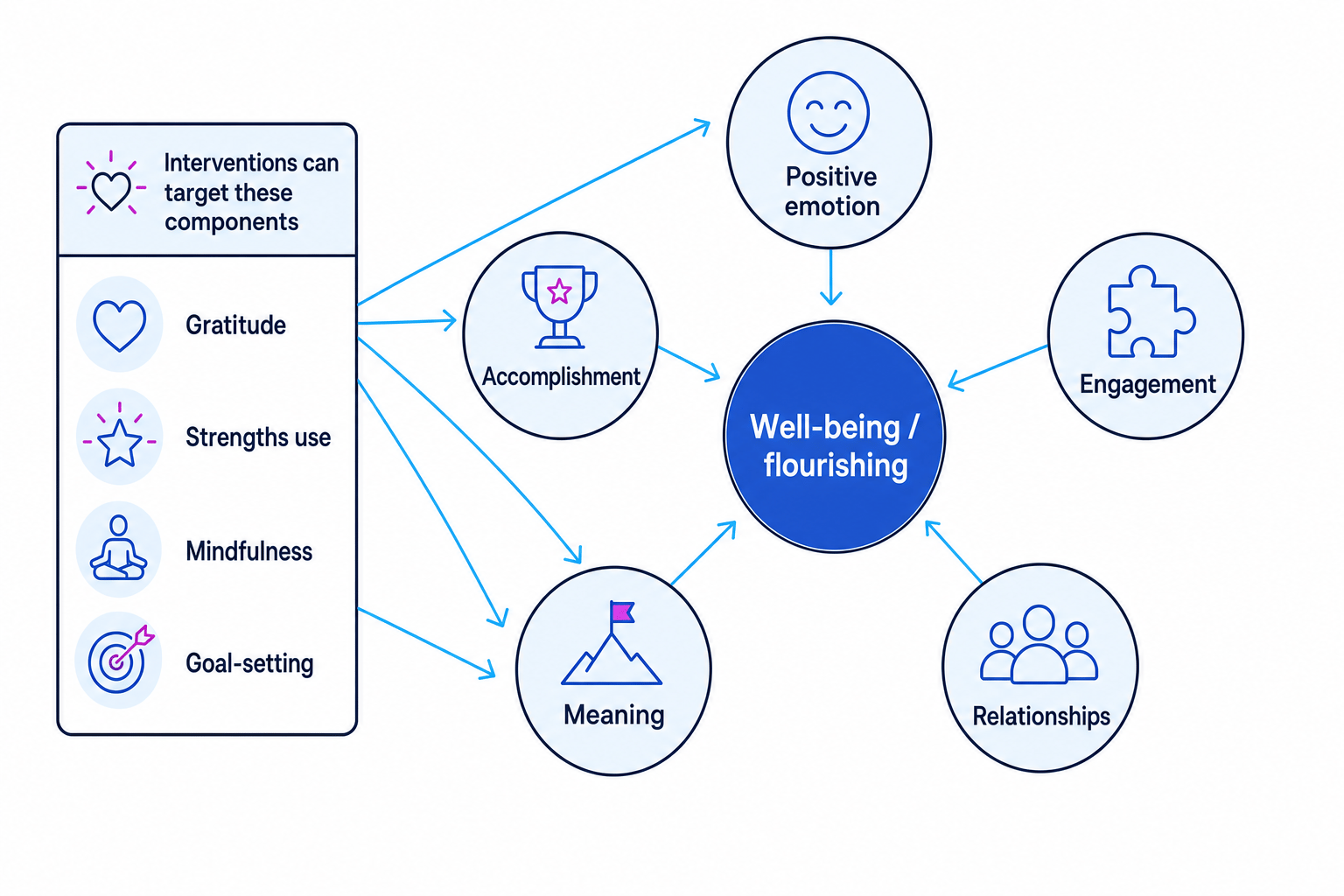
One way to explain positive psychology’s relevance is through Seligman’s PERMA model. This model says wellbeing is not just one feeling; it has several routes.
PERMA
PERMA is Seligman’s model of flourishing, made up of Positive emotion, Engagement, Relationships, Meaning and Accomplishment.
The five parts are:
- Positive emotion: feelings such as joy, gratitude, hope and contentment.
- Engagement: being absorbed in an activity, sometimes called “flow”.
- Relationships: supportive social connections.
- Meaning: feeling that life has purpose beyond the self.
- Accomplishment: achieving goals and feeling competent.
The diagram shows how positive psychology interventions, such as gratitude or strengths use, can target different parts of wellbeing.
4. Why positive psychology may be relevant today
Mental health and prevention
Modern society often focuses on treating problems after they appear. Positive psychology can be relevant because it aims to build protective factors before people reach crisis point.
For example, gratitude diaries, mindfulness, acts of kindness and strengths-based activities may increase wellbeing and resilience. These are usually low-cost and can be used in schools, workplaces or community settings.
However, positive psychology should not replace clinical treatment for serious mental health conditions. It is better seen as a possible addition to therapy, medication or social support.
Education
Schools increasingly teach wellbeing, resilience and emotional literacy. Positive psychology is relevant here because students face exam pressure, social comparison and uncertainty about the future.
A school might use:
- Gratitude exercises to increase positive emotion.
- Strengths questionnaires to improve confidence.
- Peer-support activities to strengthen relationships.
- Goal-setting tasks to build accomplishment.
Workplaces
In workplaces, positive psychology can be used to improve engagement, motivation and job satisfaction. Strengths-based management may help employees feel valued.
But this is also ethically sensitive. If employers use “wellbeing” programmes while ignoring workload, low pay or bullying, positive psychology may become a way of shifting responsibility onto employees.
Society and policy
Governments and organisations increasingly measure wellbeing, not just economic output. Positive psychology is relevant because it supports the idea that a successful society should consider life satisfaction, social connection and meaning.
5. Useful named evidence
Seligman et al. (2005)
A key positive-approach study is Seligman, Steen, Park and Peterson (2005). They tested positive psychology interventions online, including “three good things”, a gratitude visit and using signature strengths in a new way.
Participants completed measures of happiness and depressive symptoms. Some interventions, especially “three good things” and using signature strengths, were linked to increased happiness and reduced depressive symptoms over time.
This supports the relevance of positive psychology because it suggests small, practical activities can improve wellbeing.
AO3 points:
- Strength: the study used a more scientific approach than vague self-help advice, including comparison conditions and follow-up measures.
- Weakness: it relied on self-report questionnaires, so responses may have been affected by demand characteristics or social desirability.
- Sample issue: online volunteers may have been especially motivated, so findings may not generalise to everyone.
- Ethics: researchers still need informed consent, confidentiality, the right to withdraw, debriefing and support if mood questionnaires reveal distress.
Diener and Seligman (2002)
Diener and Seligman (2002) studied very happy people and found that strong social relationships were a key feature of high wellbeing. This supports the “Relationships” part of PERMA.
However, the finding is correlational. Strong relationships may increase happiness, but happier people may also find it easier to form and maintain relationships.
Bolier et al. (2013)
A useful contemporary evidence link is Bolier et al. (2013), a meta-analysis of positive psychology interventions. They found that such interventions can improve wellbeing and reduce depressive symptoms, but effects were often small to moderate.
This is helpful for a balanced debate: positive psychology can be relevant, but it is not a magic solution.
Applying the debate to a school wellbeing programme
-
Map the programme to the positive approach: gratitude diaries target positive emotion, strengths activities target engagement and accomplishment, and peer-support tasks target relationships.
-
Apply AO1: the school is not only trying to reduce anxiety; it is trying to build flourishing, which fits the positive approach’s focus on the good life.
-
Use evidence: Seligman et al. (2005) suggests that simple positive interventions can increase happiness and reduce depressive symptoms, so the programme has some empirical support.
-
Evaluate the context: exam stress may also be caused by workload, poverty, family pressure or lack of support, so a gratitude diary alone may be too limited.
-
Reach a balanced judgement: the programme is relevant if it is voluntary, evidence-based and supported by proper safeguarding, but it should not replace counselling or structural changes.
6. AO3 evaluation: strengths of positive psychology’s relevance
It is practical and accessible
Many positive psychology interventions are simple and low-cost. Activities such as recording “three good things” or identifying personal strengths can be used in everyday settings.
This makes the approach relevant to schools, workplaces and community mental health campaigns.
It balances psychology’s focus
Traditional psychology has often focused on illness, dysfunction and treatment. Positive psychology adds balance by asking what makes life worth living.
This is especially relevant today because many people are not clinically unwell but still struggle with stress, loneliness or lack of meaning.
It has real-world applications
Positive psychology has influenced coaching, education, occupational psychology, health psychology and public policy. This gives it strong practical value for society.
7. AO3 evaluation: limitations and criticisms
It may ignore social causes of distress
A major criticism is that positive psychology can become too individualistic. If someone is stressed because of poverty, discrimination, insecure housing or unsafe working conditions, telling them to practise gratitude may be inadequate or even insulting.
It can become “toxic positivity”
Positive psychology is sometimes misused to imply that people should always be happy. This can make people feel guilty for normal emotions such as sadness, anger or fear.
Writing a one-sided celebration
Do not present positive psychology as “everyone should just think positively”. A stronger essay explains that it can improve wellbeing for some people, but it must not blame individuals for distress caused by social or economic factors.
Measurement can be difficult
Wellbeing is subjective, meaning it depends on personal experience. Researchers often use questionnaires, but people may interpret rating scales differently across cultures or situations.
This raises questions about construct validity: are researchers really measuring flourishing, or just temporary mood?
Cultural bias
Positive psychology often reflects Western values, such as personal achievement, individual choice and self-improvement. In some cultures, wellbeing may be more closely linked to family duty, community harmony or spirituality.
So, its relevance may depend on whether interventions are adapted to cultural context.
8. Research methods link: testing whether it works
If you carried out a practical investigation into positive psychology, you might ask participants to complete a wellbeing questionnaire before and after a gratitude intervention.
You could use:
- Measures of central tendency: mean, median or mode wellbeing scores.
- Measures of dispersion: range or standard deviation to show variation.
- Graphs: bar charts for group means, line graphs for change over time, or scattergraphs for correlations between strengths use and wellbeing.
For inferential testing, the choice depends on design and level of measurement:
- Wilcoxon signed-ranks test: related design with ordinal data.
- Related t-test: related design with interval data.
- Mann-Whitney U test: unrelated design with ordinal data.
- Unrelated t-test: unrelated design with interval data.
- Spearman’s rho: correlation using ordinal data.
- Chi-square: association between nominal categories.
- Binomial sign test: direction of change in related nominal or simple sign data.
Use the usual significance level of p≤0.05p \leq 0.05p≤0.05 unless told otherwise. Decide whether the hypothesis is one-tailed or two-tailed, then compare the observed value with the critical value from the correct table. The table will tell you whether the observed value must be higher or lower than the critical value.
Choosing a test for a gratitude intervention
-
The same students complete a wellbeing questionnaire before and after a gratitude diary, so the design is related measures.
-
If the questionnaire gives ordinal ratings, such as Likert-scale scores, the safer test is Wilcoxon signed-ranks.
-
If the hypothesis predicts that wellbeing will increase after the diary, use a one-tailed test; if it only predicts a difference, use a two-tailed test.
-
Compare the observed value with the critical value at p≤0.05p \leq 0.05p≤0.05, following the rule given by the critical-value table.
Ethically, a wellbeing investigation must follow the BPS Code of Ethics and Conduct: informed consent, right to withdraw, protection from harm, confidentiality and debriefing. Extra care is needed if participants are students or employees, because they may feel pressured to take part.
Best judgement line
A strong conclusion is: positive psychology is relevant in today’s society when it is evidence-based, culturally sensitive and used alongside — not instead of — wider social and clinical support.
In the exam
-
Start by defining the debate: whether positive psychology is useful and appropriate for modern society.
-
Use clear AO1: refer to flourishing, free will, strengths, PERMA or positive interventions.
-
Add AO2 by applying it to a real context, such as schools, workplaces, social media stress or mental health prevention.
-
Build AO3 balance: include evidence support, methodological issues, ethics, cultural bias and the risk of blaming individuals.
-
End with a judgement: positive psychology is relevant, but only if used critically and not as a replacement for addressing serious mental health or social problems.
Check yourself
- How does PERMA explain more than just “feeling happy”?
- Why might positive psychology be useful in schools or workplaces?
- What are two criticisms of using positive psychology in today’s society?
