What you'll learn
- Why eyewitness testimony is a key contemporary debate in the cognitive approach.
- How memory can be distorted during encoding, storage and retrieval.
- How studies such as Loftus and Palmer (1974), Gabbert et al. (2003) and Yuille and Cutshall (1986) inform the debate.
- How to evaluate EWT research using AO1, AO2 and AO3 for Eduqas essay answers.
Why this debate belongs in the cognitive approach
The cognitive approach studies internal mental processes such as memory, attention, perception and thinking. Eyewitness testimony fits this approach because it asks: How does a person take in information, store it, and later recall it?
Eyewitness testimony
Eyewitness testimony (EWT) is an account given by a person who has witnessed an event, usually a crime or accident. It may include descriptions of people, actions, objects, locations, or identification of a suspect.
Reliability and accuracy
In strict psychology terms, reliability means consistency, while accuracy means closeness to the truth. In EWT debates, “reliability” is often used more broadly to mean whether eyewitness evidence can be trusted.
A confident eyewitness can be very persuasive in court, but cognitive psychologists argue that memory is not like a video recording. It is selective, reconstructive and vulnerable to distortion.
Memory is reconstructive
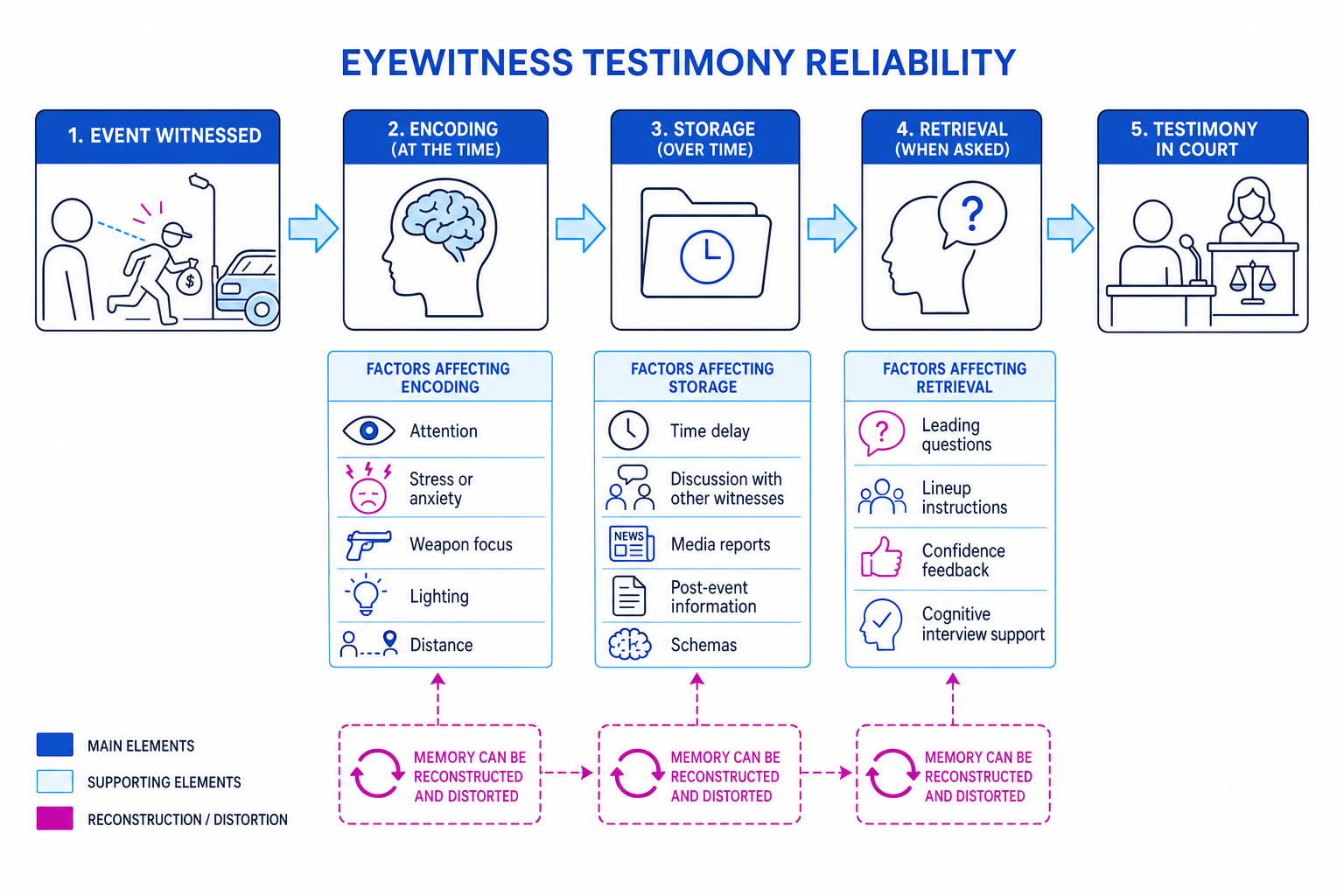
To understand EWT, you need three memory stages:
- Encoding: taking information in at the time of the event.
- Storage: keeping that information over time.
- Retrieval: accessing the information later when questioned.
A schema is a mental framework built from past experience. Schemas help you make sense of the world quickly, but they can also fill in gaps incorrectly. For example, if you see a masked person running from a shop, your “robbery” schema might make you assume there was a weapon even if you did not clearly see one.
The core cognitive argument
Eyewitness memory can be distorted at any stage: what the witness notices, what happens after the event, and how they are later questioned.
Factors that affect the reliability of EWT
Encoding: what the witness notices
At the time of the event, attention is limited. A witness may focus on one striking detail and miss other information.
Weapon focus is when attention is drawn to a weapon, reducing memory for other details such as the offender’s face or clothing. Anxiety may also affect encoding. The relationship is not simple: moderate arousal may improve attention, but very high stress can narrow attention and reduce accuracy for peripheral details.
Storage: what happens after the event
A retention interval is the time between witnessing the event and recalling it. Longer intervals often reduce detail.
Post-event information is information encountered after the event, such as media reports, conversations with other witnesses or police questions. This can change what the witness later believes they saw.
Memory conformity occurs when one witness’s memory becomes more similar to another person’s account after discussion. Gabbert et al. (2003) found that witnesses who discussed an event with another participant often reported details they had not personally seen.
Retrieval: how the witness is questioned
A leading question is phrased in a way that suggests a particular answer. For example, “How fast was the car going when it smashed into the other car?” suggests a more severe crash than “hit”.
Line-up procedures also matter. If witnesses think the suspect must be present, they may choose the person who looks most similar, even if the real culprit is absent. Confidence can also be altered by feedback such as “Good, you identified the suspect.”
Assessing a witness statement
A witness saw a robbery at night from across the road. The offender had a knife. The witness later discussed the event with a friend and was then asked, “Did you see the getaway car speeding away?”
-
Evaluate encoding: the poor lighting and distance reduce the chance of accurate visual detail, while weapon focus may mean the witness remembers the knife better than the offender’s face.
-
Evaluate storage: discussion with the friend may introduce post-event information, so some later details may reflect the conversation rather than the original event.
-
Evaluate retrieval: the question assumes there was a getaway car and that it was speeding, so it may lead the witness towards a distorted answer.
-
Reach a balanced judgement: the witness may be useful for central details, such as “there was a knife”, but their account of the car and speed should be treated cautiously and checked against other evidence.
Loftus and Palmer (1974): classic cognitive evidence
Loftus and Palmer’s study is central for this debate because it shows how questioning can affect memory.
In Study 1, 45 students watched film clips of car accidents. They were asked to estimate speed using different verbs: “smashed”, “collided”, “bumped”, “hit” or “contacted”. The mean estimate was highest for “smashed” and lowest for “contacted”. This suggests that the wording of a question can influence recall.
In Study 2, 150 students watched a car accident film. Some were asked how fast the cars were going when they “smashed” into each other, some heard “hit”, and a control group was not asked a speed question. One week later, participants were asked whether they saw broken glass. There was no broken glass, but more participants in the “smashed” condition falsely reported seeing it.
This supports the idea that leading questions can create a response bias — changing how people answer — and may also alter the memory itself through post-event information.
Overclaiming Loftus and Palmer
Do not say Study 1 proves memory was changed. It could show response bias. Study 2 is stronger evidence for memory distortion because participants later reported a false detail: broken glass.
AO3 evaluation of Loftus and Palmer
A major strength is high control. All participants saw similar film clips, and the verb in the question was systematically manipulated. This makes it easier to establish cause and effect.
However, the study has low ecological validity. Watching a film clip in a laboratory is not the same as witnessing a real accident or crime. Participants were mostly students, so the sample may not represent all witnesses.
There are also ethical issues. Under the BPS Code of Ethics and Conduct, researchers should consider informed consent, right to withdraw, protection from harm, confidentiality and debriefing. The study involved mild deception because participants were not fully told the aim, and accident films could cause some distress, though the risk was relatively low compared with real crime research.
Contemporary evidence: the debate is not one-sided
Research often shows that EWT can be unreliable, but it does not mean eyewitnesses are always wrong.
Gabbert et al. (2003) supports the unreliability argument because witnesses who discussed an event with another person often incorporated incorrect details into their own recall. This has strong real-world relevance because witnesses may talk to each other before giving formal statements.
Wells and Bradfield (1998) showed that confidence is not fixed. Participants who received confirming feedback after identifying a suspect became more confident and believed they had a better view of the event. This matters because juries may overvalue confident witnesses.
However, Yuille and Cutshall (1986) studied witnesses to a real shooting and found that many accounts remained accurate months later, and misleading questions had little effect. This challenges laboratory findings and suggests that real-life emotional events may sometimes be remembered well, especially for central details.
Balanced conclusion
The best answer is not “EWT is reliable” or “EWT is unreliable”. Reliability depends on the conditions of witnessing, delay, questioning, social influence and whether procedures protect the witness’s memory.
Improving EWT: the Cognitive Interview
The Cognitive Interview is a police interview technique developed from cognitive psychology, especially by Geiselman et al. (1985) and Fisher and Geiselman (1992). It aims to increase accurate recall without leading the witness.
The main techniques are:
- Report everything: even small details may trigger more memories.
- Mental reinstatement of context: the witness mentally returns to the scene, including sights, sounds and feelings.
- Recall in a different order: recalling backwards can reduce reliance on schemas.
- Recall from a different perspective: considering another viewpoint may cue extra details.
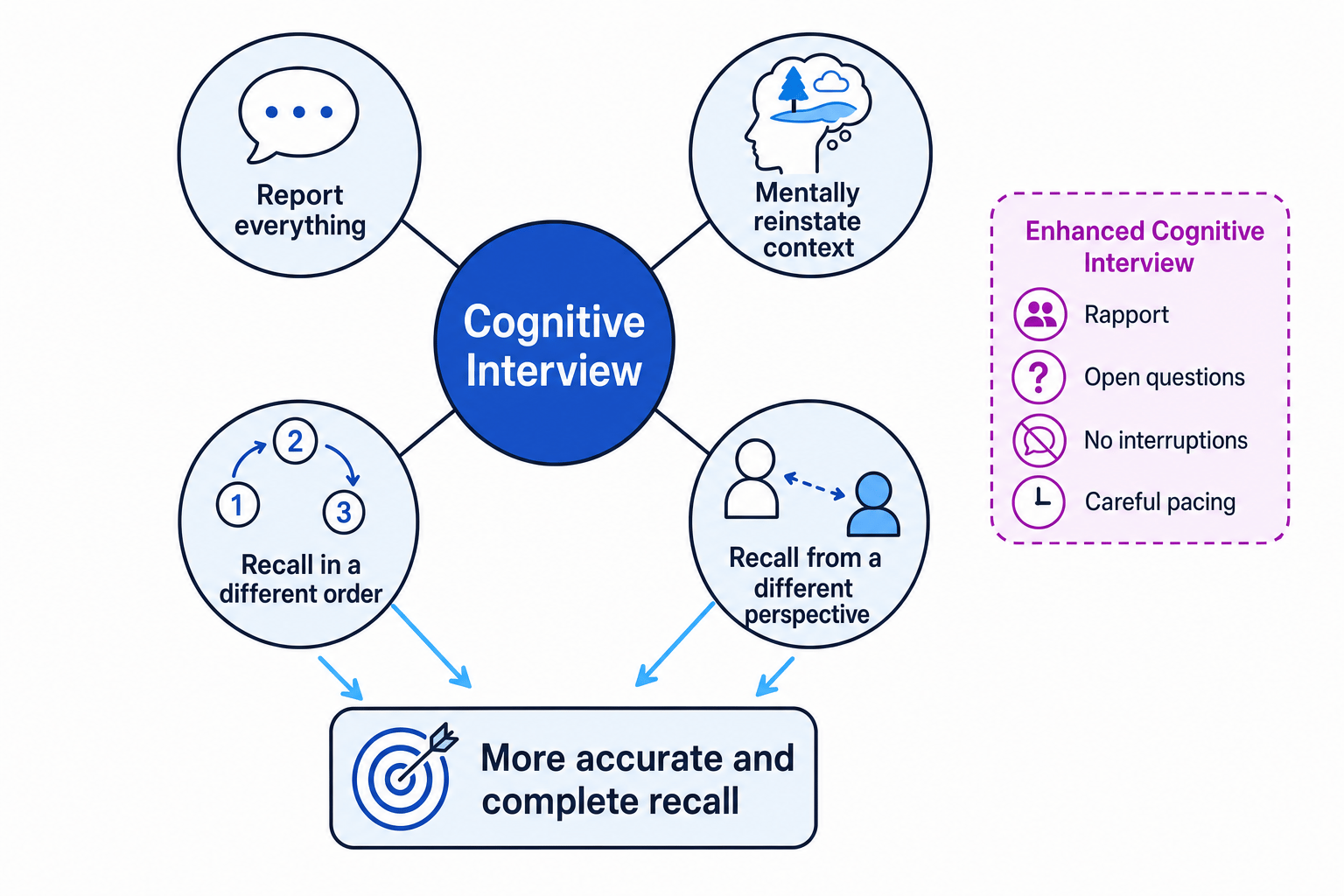
The Enhanced Cognitive Interview adds communication features such as rapport, open questions, no interruptions and careful pacing. Research reviews such as Köhnken et al. (1999) suggest the Cognitive Interview increases correct recall, although it can be time-consuming and may also increase some incorrect detail if not used carefully.
Essay link
The Cognitive Interview is a strong AO3 application point: even if EWT can be unreliable, cognitive psychology has produced practical ways to improve police interviewing.
AO2: linking this to a practical investigation
You could investigate EWT by showing participants the same event and manipulating the wording of a question. For example, one group could hear “smashed” and another could hear “contacted”. The independent variable would be the wording of the question, and the dependent variable could be the estimated speed or the number of accurate details recalled.
Ethically, you would need informed consent, the right to withdraw, protection from harm, confidentiality and debriefing. If deception is used — for example, not revealing that the real aim is to test leading questions — it must be justified and explained afterwards.
Choosing a test for an EWT practical
A researcher compares two independent groups. One group hears a leading question and one group hears a neutral question. The dependent variable is estimated speed.
-
Identify the design: different participants are in each condition, so the design is independent groups.
-
Identify the level of measurement: estimated speed is interval-level data because the numbers are measured on a meaningful scale.
-
Choose the test of difference: if the data are roughly normally distributed, an unrelated t-test is suitable because there are two unrelated groups and interval data.
-
Choose the non-parametric alternative if needed: if assumptions are not met, Mann-Whitney U would be more appropriate for two independent groups.
-
Apply significance conventions: use p≤0.05p \le 0.05p≤0.05 unless told otherwise, choose one-tailed or two-tailed based on the hypothesis, then compare the observed value with the critical value in the correct table.
Critical-value table direction
Check the rule for the specific test. For Mann-Whitney U, Wilcoxon signed-ranks and the binomial sign test, the observed value usually needs to be equal to or less than the critical value. For chi-square, t-tests and Spearman’s rho, it usually needs to be equal to or greater than the critical value.
How to shape an essay answer
For AO1, describe the cognitive explanation: memory is reconstructed through encoding, storage and retrieval, and EWT can be affected by leading questions, schemas, weapon focus, anxiety and post-event information.
For AO2, apply these ideas to scenarios. If a witness was stressed, questioned with leading wording, or discussed the event with others, explain exactly how that could affect their testimony.
For AO3, evaluate with evidence. Use Loftus and Palmer (1974) for leading questions, Gabbert et al. (2003) for memory conformity, Wells and Bradfield (1998) for confidence feedback, and Yuille and Cutshall (1986) as a challenge from real-world research.
In the exam
-
Make the debate balanced: argue that EWT can be unreliable under some conditions, but not automatically useless.
-
Use named evidence with detail: include researcher names, years, procedures and at least one key finding.
-
Evaluate methods and ethics: compare lab control with ecological validity, and mention BPS issues such as deception, protection from harm and debriefing.
-
Link back to real life: explain why this matters for police interviews, line-ups, court decisions and miscarriages of justice.
Check yourself
- How can a leading question affect both response bias and memory distortion?
- Why might Yuille and Cutshall’s real-life findings challenge Loftus and Palmer’s laboratory study?
- Which inferential test would you use for an EWT study with two independent groups and interval data?
