What you'll learn
- How to distinguish target populations, sampling frames and samples.
- The main participant sampling methods used in A-Level Psychology research.
- How to evaluate sampling methods using bias, representativeness, generalisability, practicality and ethics.
- How event sampling and time sampling work in observations.
Why participants matter
In psychology, researchers rarely study every person they are interested in. Instead, they study a smaller group and then judge how far the findings can apply more widely.
That makes participant selection very important. A study can have careful controls and accurate statistics, but if the sample is biased, the conclusions may not generalise well.
Core participant terms
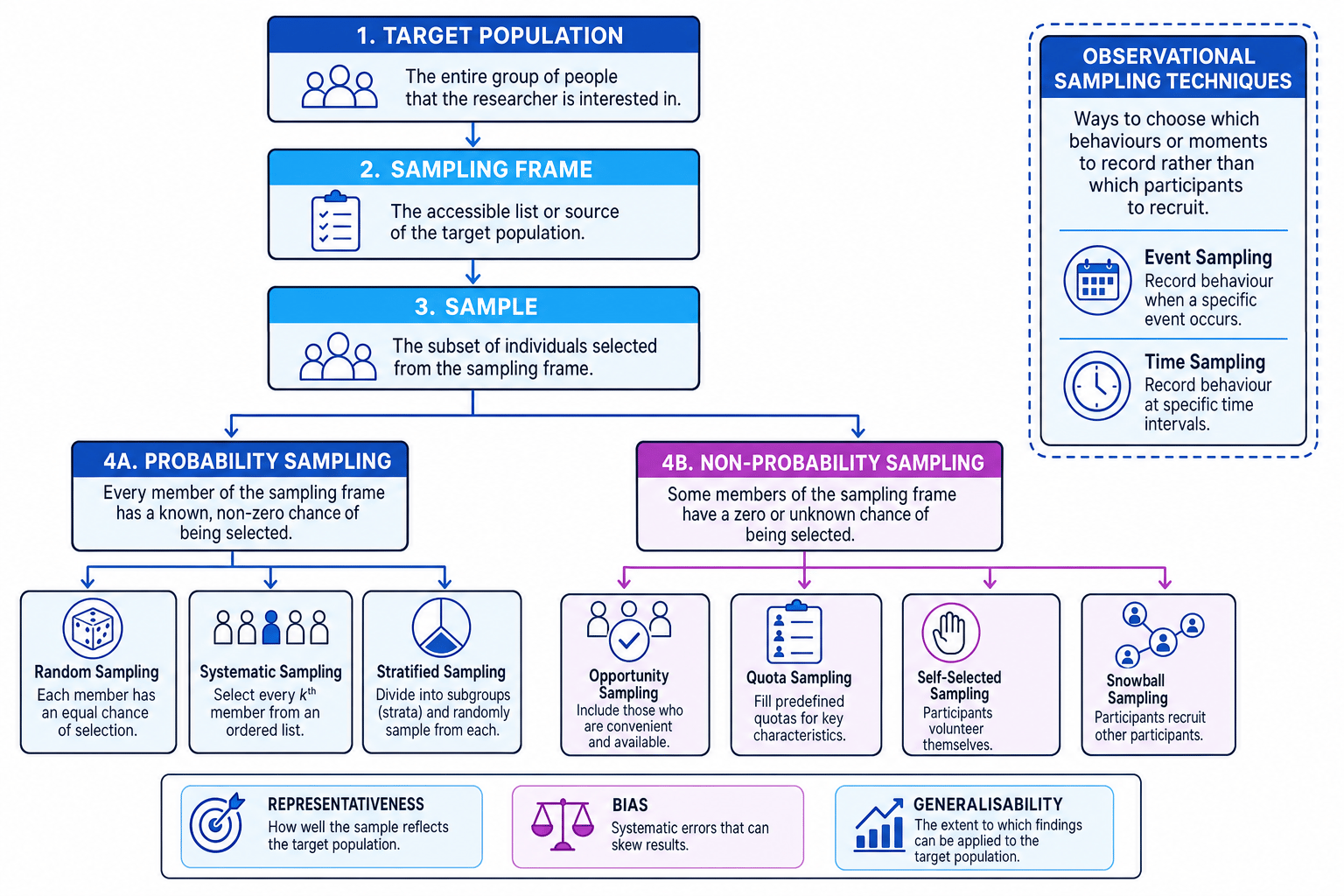
- Target population: the whole group of people the researcher wants to draw conclusions about.
- Sample: the smaller group of people who actually take part in the study.
- Sampling frame: the practical list or source from which the sample is chosen, such as a school register, GP list, online database or workplace staff list.
- Representativeness: how closely the sample reflects the target population.
- Generalisability: the extent to which findings from the sample can be applied to the wider target population.
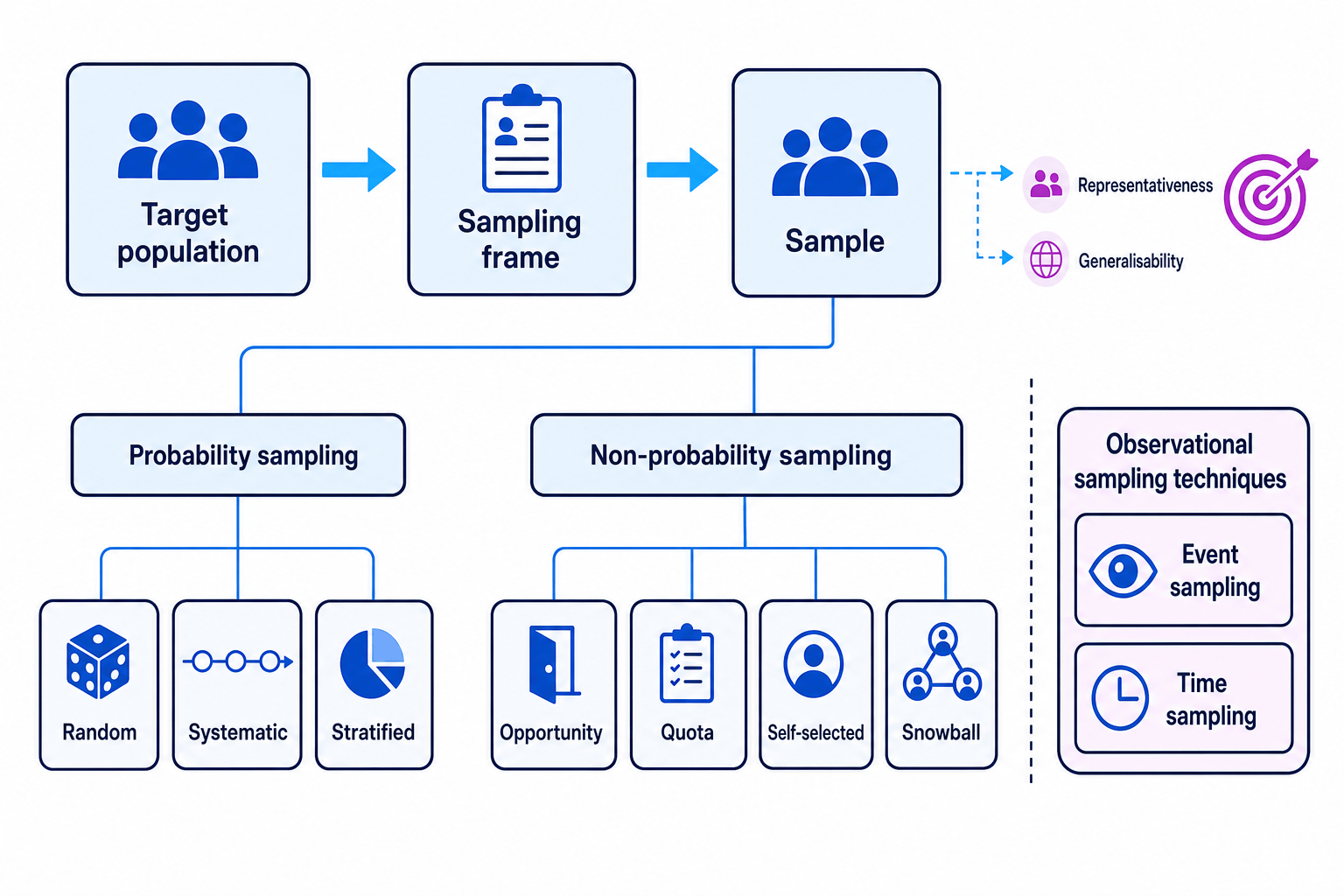
The process usually moves from a broad target population to a practical sampling frame, then to the final sample.
Identifying population, frame and sample
A researcher wants to study whether sixth-form students in Wales experience stress before exams. They use the register from one college and recruit 40 students from Year 12 and Year 13.
- Identify the target population: the researcher wants to generalise to “sixth-form students in Wales”, so that is the target population.
- Identify the sampling frame: the actual accessible list is one college register, so this is the sampling frame.
- Identify the sample: the 40 students who take part are the sample.
- Evaluate the match: one college may not represent all sixth-form students in Wales, so population validity may be limited.
Population is not the same as sample
Do not write that “the target population is the 40 students who took part”. The 40 students are the sample. The target population is the wider group the researcher wants the findings to apply to.
Sampling methods: the big divide
Sampling methods are often grouped into probability sampling and non-probability sampling.
Probability and non-probability sampling
- Probability sampling means each member of the sampling frame has a known chance of being selected.
- Non-probability sampling means some people have an unknown or unequal chance of selection.
Sampling affects external validity
More representative samples usually improve external validity, especially population validity, because findings are more likely to apply beyond the people studied.
Random sampling
Random sampling is a probability method where every person in the sampling frame has an equal chance of being selected. For example, a researcher could number every name on a school register and use a random number generator.
AO3: strengths and weaknesses
A strength is that random sampling reduces researcher bias because the researcher does not choose who looks useful or convenient. This can improve representativeness.
A weakness is that it requires a complete and accurate sampling frame. It can also be time-consuming, and selected people may refuse to take part, creating non-response bias.
Systematic sampling
Systematic sampling is a probability method where the researcher selects every nth person from an ordered sampling frame after choosing a starting point.
For example, if a researcher needs 20 people from a list of 200, they might select every 10th person.
Using systematic sampling
A researcher has a list of 200 students and wants a sample of 20.
- Calculate the sampling interval using k=Nnk = \frac{N}{n}k=nN, where NNN is the sampling frame size and nnn is the desired sample size: k=20020=10k = \frac{200}{20} = 10k=20200=10.
- Choose a random starting point between 1 and 10, such as 6.
- Apply the interval consistently: select person 6, 16, 26, 36, and continue until 20 students have been selected.
- Check for bias in the list order: if the register is ordered by tutor group and every 10th student comes from the same group, the sample may become biased.
AO3: strengths and weaknesses
Systematic sampling is quicker than pure random sampling and spreads participants across the sampling frame. However, it can be biased if the list has a hidden pattern. For example, choosing every 5th name from a seating plan could over-represent one part of the classroom.
Stratified sampling
Stratified sampling is a probability method where the target population is divided into important subgroups, called strata, and participants are randomly selected from each stratum in proportion to their presence in the target population.
Strata might include gender, age group, year group, ethnicity, diagnosis, or any variable relevant to the research question.
Calculating a stratified sample
A sixth form has 80 Year 12 students and 120 Year 13 students. A researcher wants a sample of 50.
- Calculate the total population size: 80+120=20080 + 120 = 20080+120=200 students.
- Work out each stratum’s proportion: Year 12 is 80÷200=0.4080 \div 200 = 0.4080÷200=0.40, and Year 13 is 120÷200=0.60120 \div 200 = 0.60120÷200=0.60.
- Apply the proportions to the sample size: Year 12 needs 0.40×50=200.40 \times 50 = 200.40×50=20 participants; Year 13 needs 0.60×50=300.60 \times 50 = 300.60×50=30 participants.
- Randomly select within each stratum: choose 20 Year 12 students and 30 Year 13 students using a random method.
AO3: strengths and weaknesses
Stratified sampling can be highly representative because key subgroups are included in the correct proportions. This is useful when a variable may affect the behaviour being studied.
However, it takes more planning than opportunity sampling and requires accurate information about the population. It also only controls for the strata chosen; other variables may still be unevenly represented.
Stratified vs quota
Both methods use subgroups. The key difference is that stratified sampling randomly selects within each subgroup, while quota sampling fills subgroup targets non-randomly.
Opportunity sampling
Opportunity sampling means selecting people who are available and willing at the time. For example, a student researcher might ask classmates in the common room to complete a questionnaire.
AO3: strengths and weaknesses
A strength is practicality. It is quick, cheap and useful for classroom practical investigations.
A weakness is sampling bias. People who happen to be available may share characteristics, such as being from the same school, age group or friendship network. This limits generalisability.
Ethically, the researcher must avoid pressuring people just because they are nearby. Participants still need informed consent, the right to withdraw, confidentiality and debriefing.
Quota sampling
Quota sampling is a non-probability method where the researcher sets targets for certain categories, then recruits people until each quota is filled.
For example, a researcher may decide to recruit 10 male and 10 female participants, then approach people in a town centre until both quotas are complete.
AO3: strengths and weaknesses
Quota sampling can improve representativeness compared with pure opportunity sampling because important categories are deliberately included.
However, it is still non-random. The researcher may select the easiest or most approachable people within each category, causing interviewer bias. It also only represents the variables used for the quotas.
Quota sampling is not random sampling
Quota sampling may look balanced, but it is not usually random. If the researcher chooses whoever is available until each category is full, selection bias can still occur.
Self-selected sampling
Self-selected sampling, also called volunteer sampling, occurs when participants put themselves forward. This might happen through an advert, email, online post or poster.
AO3: strengths and weaknesses
A strength is that volunteers are likely to be motivated and have given consent clearly.
A weakness is volunteer bias. People who choose to take part may be more confident, more interested in psychology, or more affected by the topic than those who ignore the advert.
This matters when evaluating studies. For example, if a stress study attracts only highly stressed students, the sample may exaggerate stress levels in the wider population.
Snowball sampling
Snowball sampling involves asking initial participants to recruit further participants from their social networks.
This is especially useful for hard-to-reach groups, such as people with rare experiences, hidden populations, or groups where trust is important.
AO3: strengths and weaknesses
A strength is access. Snowball sampling can reach participants who would be difficult to find through public advertising.
A weakness is network bias. Participants may recruit people similar to themselves, so the sample may be narrow. There are also ethical issues: confidentiality must be protected, and potential participants should not feel pressured by friends, family or group members to take part.
Applying sampling to studies
Sampling is useful for AO3 evaluation of named studies. For example, Freud’s study of Little Hans (1909) used one child, so the sample was extremely small and unrepresentative. This limits generalisability, although the detailed qualitative data may still be valuable.
In Loftus and Palmer’s eyewitness testimony research (1974), students were used as participants. This made the research practical and controlled, but student samples may not represent all real eyewitnesses.
In Raine, Buchsbaum and LaCasse (1997), murderers pleading not guilty by reason of insanity were compared with matched controls. Matching helped control participant variables, but the sample was highly specific, so findings should not be overgeneralised to all offenders.
Observational sampling techniques
Participant sampling is about who takes part. Observational sampling is about when or which behaviours are recorded during an observation.
Observational sampling techniques
- Event sampling: recording every time a specific behaviour or event occurs.
- Time sampling: recording behaviour at set time intervals.
Event sampling
In event sampling, the researcher defines a behaviour clearly and records each occurrence. For example, in a playground observation, a researcher might record every time a child pushes another child.
Event sampling is useful for behaviours that are clear, countable and not happening constantly.
A weakness is that it can miss context or duration. Two aggressive incidents may be counted equally even if one lasts one second and another lasts one minute.
Time sampling
In time sampling, the researcher records behaviour at specific time intervals, such as every 30 seconds or every two minutes.
This is useful when behaviour is frequent or continuous, such as time spent on-task in a classroom.
A weakness is that behaviour between intervals may be missed. If a child is off-task for 20 seconds but back on-task when the interval is recorded, the observation may underestimate off-task behaviour.
Choosing event or time sampling
A researcher wants to observe behaviour in a classroom.
- Match the method to the behaviour: if the behaviour is a clear action such as “raises hand without permission”, event sampling is suitable because each occurrence can be counted.
- Consider continuous behaviour: if the aim is to estimate how much time pupils spend “on-task”, time sampling is better because the behaviour lasts over time.
- Operationalise the behaviour: “on-task” might mean looking at the teacher, writing, reading the set text, or discussing the task.
- Evaluate likely accuracy: event sampling may over-focus on frequency, while time sampling may miss brief behaviours between intervals.
Event and time sampling do not recruit participants
Event sampling and time sampling are not ways of choosing people. They are ways of choosing what to record during an observation.
Ethics when recruiting participants
Sampling is not just a methodological issue. It is also ethical.
Researchers should follow the BPS Code of Ethics and Conduct, including informed consent, avoiding unnecessary deception, right to withdraw, protection from harm, confidentiality and debriefing.
Recruitment adverts should be honest about what participation involves. Researchers should avoid coercion, especially when recruiting students, employees, patients, children or vulnerable groups.
If non-human animals are used, researchers must consider additional safeguards such as the 3Rs: replacement, reduction and refinement. This means avoiding animal use where possible, using the fewest animals needed, and minimising suffering.
Best sampling method depends on the aim
There is no single “best” sampling method. Strong answers explain why a method suits the research aim, setting, time limits, target population and ethical constraints.
In the exam
- For AO1, define the sampling method precisely and use the correct terms: target population, sampling frame, sample, bias and representativeness.
- For AO2, apply your answer to the scenario: say exactly who the target population is, where the sampling frame comes from, and how participants would be selected.
- For AO3, evaluate both methodology and ethics: comment on generalisability, practicality, researcher bias, volunteer bias, consent, confidentiality and possible pressure to take part.
Check yourself
- Can you explain the difference between a target population, sampling frame and sample?
- Which sampling methods are probability methods, and which are non-probability methods?
- When would event sampling be better than time sampling in an observation?