What you'll learn
- How psychologists allocate participants to conditions in independent groups, repeated measures and matched pairs designs.
- How each design affects validity, participant variables, order effects and demand characteristics.
- How to choose a suitable design for your own practical investigation.
- How design links to inferential test choices in Component 2.
The starting point: what is an experiment?
An experiment tests whether one variable causes a change in another variable. The researcher manipulates the independent variable and measures the dependent variable.
Independent variable and dependent variable
The independent variable, or IV, is the factor the researcher changes. The dependent variable, or DV, is the behaviour or score the researcher measures to see whether the IV had an effect.
For example, if you investigate whether background music affects memory, the IV might be “music condition” with two levels: music and silence. The DV might be the number of words recalled from a list.
A condition is one version of the experiment. In the music example, “music” is one condition and “silence” is another.
Experimental design
An experimental design is the way participants are arranged across the different conditions of an experiment.
Design = who does what
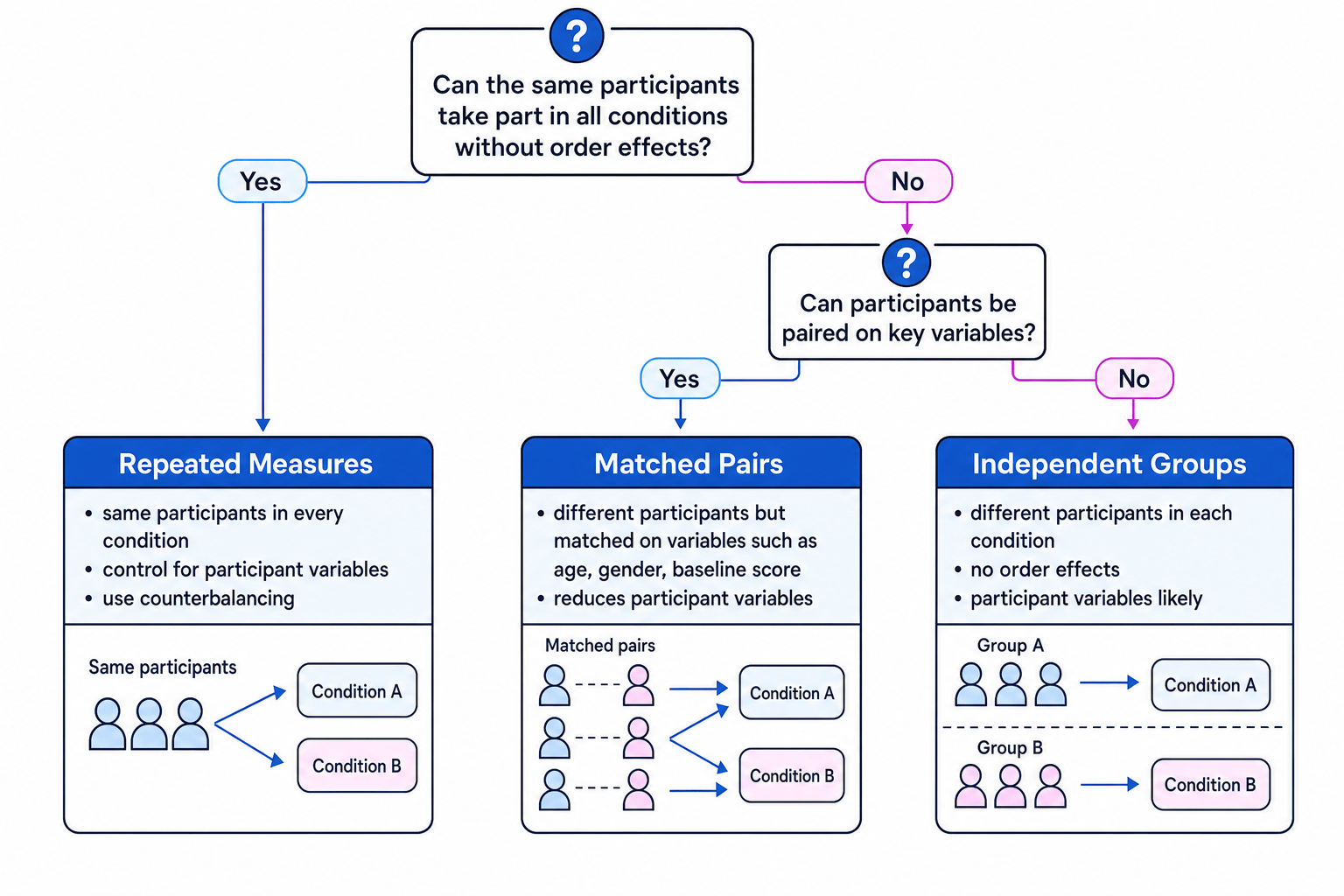
When identifying the design, focus on the participants: are the same people used in all conditions, different people used in each condition, or are different people matched before being split between conditions?
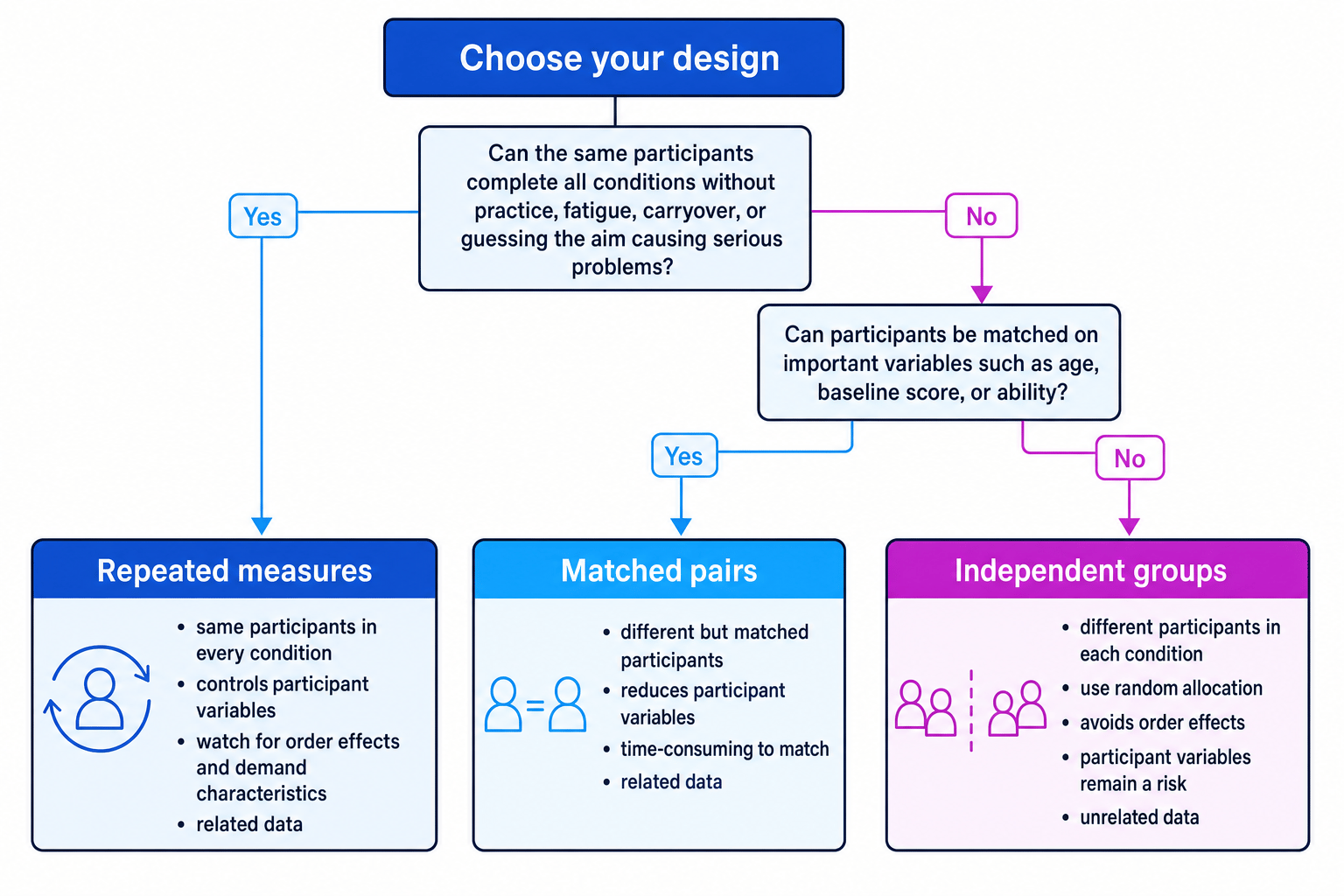
The quickest way to choose a design is to ask whether using the same participants would create problems such as practice, fatigue, or guessing the aim.
Key threats you are trying to control
Participant variables
Participant variables
Participant variables are individual differences between participants, such as memory ability, intelligence, motivation, mood, age, gender, personality, eyesight, or prior experience.
Participant variables matter because they can become confounding variables: uncontrolled factors that vary systematically with the IV and may affect the DV.
For example, if the music group happens to contain stronger readers than the silence group, better recall might be due to reading ability rather than music.
Order effects
Order effects
Order effects happen when taking part in one condition affects performance in another condition because of practice, fatigue, boredom, learning, or carryover effects.
Order effects are mainly a problem in repeated measures designs because the same participants do more than one condition.
Demand characteristics
Demand characteristics
Demand characteristics are clues in the study that make participants guess the aim and change their behaviour, either deliberately or unconsciously.
If a participant does both the “music” and “silence” conditions, they may realise the study is about music and memory, then try harder in one condition.
Confusing the IV with the design
The IV is what is being changed. The design is how participants are used across conditions. “Music versus silence” is the IV; “same participants do both” is repeated measures.
Independent groups design
AO1: What it is
In an independent groups design, different participants are used in each condition of the experiment. Each participant usually takes part in only one condition.
For example, one group completes a memory test with music, while a separate group completes the same test in silence.
Random allocation
Random allocation means assigning participants to conditions by chance, such as using a random number generator. It helps reduce allocation bias and spreads participant variables more evenly across groups.
AO2: Applying it
Loftus and Palmer (1974), a classic study on leading questions and eyewitness memory, is a useful example: different participants were exposed to different verb conditions such as “hit” or “smashed”. This allowed the researchers to compare groups without participants experiencing all wording conditions.
Grant et al. (1998), a context-dependent memory study, also used separate groups across study and test contexts, showing how independent groups can be useful when exposure to one condition might influence later performance.
Using independent groups for a therapy comparison
A researcher wants to test whether a stress-management app reduces exam anxiety compared with no app.
- The IV has two conditions: using the stress-management app and not using the app.
- Participants are randomly allocated so each person is placed in only one condition, reducing researcher bias in who receives the app.
- Anxiety scores are compared between the two groups after the intervention, so any difference in the DV can be linked cautiously to the IV.
- The researcher still needs to consider participant variables, because one group might contain more naturally anxious students before the study begins.
AO3: Strengths and weaknesses
A strength is that independent groups avoid order effects. Participants cannot become practised, tired, or influenced by doing a previous condition because they only complete one condition.
Another strength is that demand characteristics may be reduced because participants are less likely to compare conditions and guess the aim.
A weakness is that participant variables are more likely. If groups differ before the experiment starts, differences in the DV may not be caused by the IV. Random allocation helps, but it does not guarantee perfectly equal groups, especially with small samples.
Independent groups also usually require more participants than repeated measures, because each condition needs its own separate group.
Repeated measures design
AO1: What it is
In a repeated measures design, the same participants take part in every condition of the experiment.
For example, the same students complete a memory test once with music and once in silence.
AO2: Applying it
Repeated measures are useful when individual differences would strongly affect the DV. In a memory experiment, people naturally differ in memory ability, so comparing each participant with themselves can be very powerful.
Counterbalancing
Counterbalancing is a control technique where participants complete conditions in different orders, so order effects are spread across conditions rather than favouring one condition.
Counterbalancing two conditions
A researcher tests recall in silence and recall with background music using 20 participants.
- The researcher labels the two orders as silence then music, and music then silence.
- Ten participants are allocated to silence then music, while ten are allocated to music then silence.
- If practice improves the second attempt, that advantage is shared across both conditions rather than only helping music or only helping silence.
- The researcher can then compare recall scores with more confidence that the order of tasks has been partly controlled.
AO3: Strengths and weaknesses
A major strength is control of participant variables. Because the same people complete every condition, differences in memory ability, motivation, or personality are held constant across conditions.
Repeated measures can also be more economical because fewer participants are needed.
A weakness is order effects. Participants may improve through practice, get tired, or carry information from one condition into another. Counterbalancing reduces this problem, but it may not remove it completely.
Repeated measures may also increase demand characteristics because participants are more likely to spot the aim when they experience every condition.
When repeated measures is unsuitable
Avoid repeated measures when one condition permanently changes the participant or makes the next condition invalid, such as learning a skill, receiving therapy, or being exposed to distressing material that cannot be “undone”.
Matched pairs design
AO1: What it is
In a matched pairs design, different participants are used in each condition, but they are paired on important characteristics before allocation. One member of each pair goes into one condition, and the other member goes into the other condition.
Matching variables should be relevant to the DV. For a memory study, useful matching variables might include age, reading ability, baseline memory score, or sleep quality.
AO2: Applying it
Bandura, Ross and Ross (1961) is a useful illustration of matching logic because children were pre-rated for aggression before allocation to conditions. Raine et al. (1997) also used matching logic in a quasi-experimental comparison by matching murderers pleading not guilty by reason of insanity with controls on variables such as age and sex.
Matching participants for a sleep experiment
A researcher tests whether sleep deprivation affects reaction time.
- Before the experiment, all participants complete a baseline reaction-time task, because natural reaction speed is likely to affect the DV.
- Participants with similar baseline reaction times are paired together, and the researcher also checks key variables such as age and caffeine use.
- One person from each pair is allocated to the sleep-deprivation condition and the other to the normal-sleep condition.
- This reduces participant-variable differences while still avoiding order effects because nobody completes both sleep conditions.
AO3: Strengths and weaknesses
A strength is that matched pairs reduce participant variables more than independent groups. The groups should be more similar before the IV is introduced.
Another strength is that matched pairs avoid order effects, because each participant still takes part in only one condition.
However, matching is time-consuming and often difficult. You can never match participants on every relevant variable. Even identical twins may differ in motivation, mood, recent sleep, or life experience.
Matched pairs can also create practical problems: if one participant withdraws, their matched partner may become less useful because the pair is incomplete.
Thinking matched pairs means the same person twice
Matched pairs uses two different people who are made as similar as possible. Repeated measures uses the same person in more than one condition.
Choosing between the three designs
| Design | Who takes part? | Main strength | Main weakness |
|---|---|---|---|
| Independent groups | Different participants in each condition | No order effects | Participant variables |
| Repeated measures | Same participants in all conditions | Controls participant variables | Order effects and demand characteristics |
| Matched pairs | Different but matched participants | Reduces participant variables and avoids order effects | Difficult and time-consuming to match |
Quick decision rule
If the same participants can safely do all conditions without guessing the aim or being affected by practice, consider repeated measures. If not, ask whether matching is realistic. If matching is not practical, independent groups may be best.
How design links to statistics
Your experimental design affects which inferential test is appropriate.
First, decide whether your data are related or unrelated. Repeated measures and matched pairs produce related data. Independent groups produce unrelated data.
Then consider the level of measurement:
- Nominal data are categories or frequencies, such as “improved” or “did not improve”.
- Ordinal data can be ranked, but gaps between scores are not necessarily equal.
- Interval data use numerical scores where the intervals are treated as equal, such as many test scores or rating-scale totals.
For Eduqas Component 2, useful links include:
- Independent groups with ordinal data: Mann-Whitney U test.
- Independent groups with interval data and parametric assumptions met: unrelated t-test.
- Repeated measures or matched pairs with ordinal data: Wilcoxon signed-ranks test.
- Repeated measures or matched pairs with interval data and parametric assumptions met: related t-test.
- Related data where only direction of change is used: binomial sign test.
- Association between two co-variables, rather than an experiment: Spearman’s rho.
- Frequencies in categories: chi-square test.
The usual significance convention is p≤0.05p \le 0.05p≤0.05. After calculating an observed value, you compare it with a critical value from a table. Always check the table rule: some tests are significant when the observed value is equal to or smaller than the critical value, while others are significant when it is equal to or larger.
Choosing a test from the design
A researcher measures the same 15 students’ anxiety scores before and after a mindfulness task. The scores are numerical and treated as interval data.
- The same students are measured twice, so the data are related rather than unrelated.
- The DV is a numerical anxiety score, so if parametric assumptions are met, interval-level analysis is appropriate.
- Because the design is repeated measures and the data are interval, the suitable test is a related t-test.
- If the data were ranked or clearly non-parametric, the safer choice would be Wilcoxon signed-ranks instead.
Ethics in experimental design
Design choices affect ethics. In human research, you must follow the BPS Code of Ethics and Conduct: informed consent, protection from harm, right to withdraw, confidentiality, debriefing, and careful management of deception.
Repeated measures may increase fatigue or distress because participants complete multiple tasks. Independent groups may raise fairness issues if one group receives a beneficial treatment and another does not. Matched pairs may require collecting sensitive personal information, so confidentiality matters.
If non-human animals are used, researchers must also consider the 3Rs: Replacement, Reduction and Refinement, as well as housing, suffering, species-appropriate care and legal controls.
Reporting your practical investigation
When writing up your own investigation, describe the design clearly and justify it. You should also explain controls, such as random allocation, counterbalancing, standardised instructions, and matching criteria.
For descriptive statistics, report suitable measures of central tendency and dispersion, such as the mean or median, plus range or standard deviation. For graphs, experimental comparisons often use bar charts showing condition averages, with a clear title and labelled axes.
In the exam
- Identify the design by tracking the participants: same people, different people, or matched people.
- Evaluate using the correct trade-off: independent groups risk participant variables; repeated measures risk order effects; matched pairs are hard to match properly.
- Link design to method decisions, such as random allocation, counterbalancing, matching variables, ethics, and the correct inferential test.
Check yourself
- Why might repeated measures be a poor choice for a study where participants learn a new skill?
- In what way does matched pairs improve on independent groups, and what problem does it still have?
- Which design produces unrelated data, and which designs produce related data?