What you'll learn
- How to distinguish laboratory, field and online research locations.
- Why location affects control, ecological validity, ethics and data quality.
- How to apply location choices to your own practical investigation and unseen scenarios.
- How to evaluate location in AO3 terms: strengths, weaknesses, methodology and ethics.
Why location matters
In Component 2, location of research means the setting in which data is collected. It is not the same as the method. For example, a questionnaire can be carried out in a classroom, in a shopping centre, or online.
Location of research
The location of research is the physical or digital setting where participants are studied or where data is collected, such as a laboratory, real-world field setting, or online platform.
The location you choose affects how much control the researcher has. Control means reducing or managing factors that might affect the results apart from the variable being studied. These unwanted factors are called extraneous variables.
It also affects ecological validity, which means how well the research setting and task reflect real-life behaviour.
Ecological validity
Ecological validity is the extent to which findings from a study can be generalised to real-life settings and everyday behaviour.
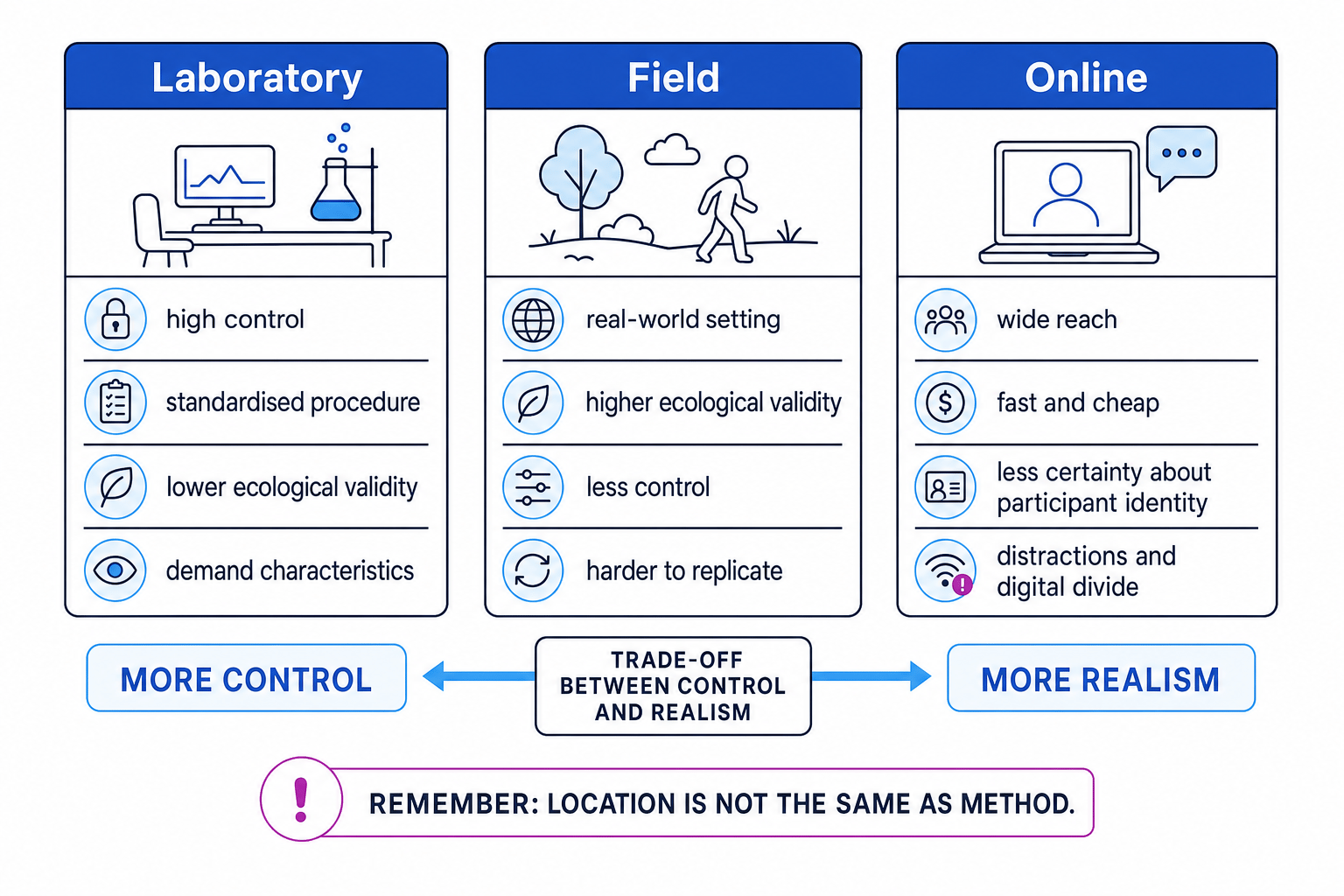
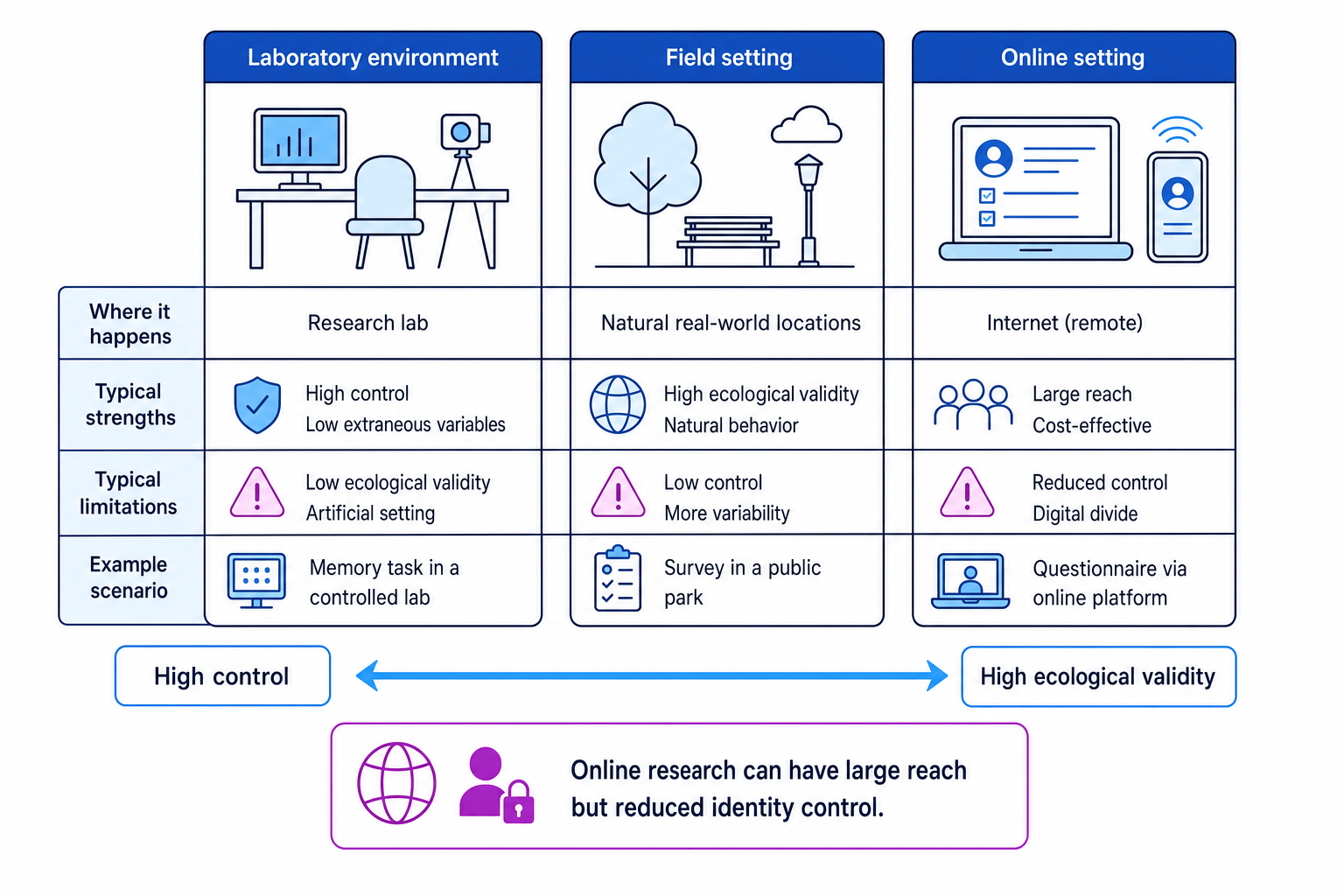
A useful way to remember the topic is as a trade-off: laboratory research usually gives more control, field research usually gives more realism, and online research often gives wider reach but less certainty about who is taking part.
The big trade-off
No location is automatically “best”. A strong answer explains which location best suits the aim, variables, participants, ethics and practical limits of the study.
Confusing location with method
Do not write “it was a laboratory study” when the question asks for the method. A laboratory is a location; the method might be an experiment, observation, interview, questionnaire, or case study.
Choosing a research location
A researcher wants to test whether background music affects memory for a word list.
- Identify the aim: the researcher wants to see whether one variable, background music, causes a change in another variable, memory score.
- Consider control: volume, song type, word list difficulty, timing and instructions need to be standardised, so a laboratory or controlled classroom would help.
- Consider ecological validity: if the researcher wants to know about revision in real life, a field setting such as a study room might be more realistic.
- Make the justified choice: for a cause-and-effect test, a laboratory location is stronger; for real-world revision behaviour, a field location is stronger.
Conducting research in a laboratory environment
A laboratory environment is a controlled setting arranged by the researcher. It does not have to be a science lab with white coats; it could be a quiet room, testing booth, university room, clinic, or classroom used under controlled conditions.
Laboratory research
Laboratory research is research carried out in an artificial or highly controlled environment where the researcher can standardise procedures and reduce extraneous variables.
Laboratory research is common in experiments because the researcher can carefully manipulate the independent variable. The independent variable, or IV, is the factor deliberately changed by the researcher. The dependent variable, or DV, is the measured outcome.
For example, Loftus and Palmer (1974) used a controlled laboratory-style procedure to investigate how leading questions affected eyewitness memory. Raine et al. (1997) also used a highly controlled clinical/laboratory setting when comparing brain activity using PET scans.
Strengths of laboratory research
Laboratory research often has high internal validity. This means the researcher can be more confident that changes in the DV were caused by the IV rather than by uncontrolled factors.
It is also easier to replicate, meaning repeat the study using the same procedure to check whether the findings are reliable. Standardised instructions, timings and materials help make this possible.
Weaknesses of laboratory research
The main weakness is lower ecological validity. Participants may behave differently because the setting feels artificial. This can create demand characteristics, which are clues that lead participants to guess the aim and change their behaviour.
Laboratory samples can also be unrepresentative if they rely heavily on students, volunteers, or people confident enough to attend a research setting.
Ethics in laboratory research
The BPS Code of Ethics and Conduct applies in any location. In laboratory research, you should consider informed consent, deception, right to withdraw, protection from harm, confidentiality and debriefing.
If non-human animals are used in controlled research, there are additional responsibilities: researchers must justify the use of animals, minimise pain and distress, use suitable housing, and follow the principles of replacement, reduction and refinement.
Evaluating a laboratory memory study
A researcher shows participants a video of a car accident in a lab and then asks either “How fast were the cars going when they hit?” or “How fast were the cars going when they smashed?”
- Link the location to control: the lab allows the same video, timings and instructions for all participants, reducing extraneous variables.
- Link control to validity: because the procedure is standardised, any difference in speed estimates is more likely to be due to the wording of the question.
- Add a limitation: watching a video in a lab is less realistic than witnessing an accident, so ecological validity may be limited.
- Add ethics: if the real aim is hidden to prevent bias, participants must be debriefed afterwards and reminded of their right to withdraw their data.
Conducting research in the field
A field setting is a real-world location where the behaviour being studied naturally occurs. This could be a school, workplace, hospital, street, sports club, shop, public transport setting, or home environment.
Field research
Field research is research conducted in a natural real-world setting rather than in an artificial environment created by the researcher.
A field experiment is a specific type of field research where the researcher manipulates an IV in a natural setting and measures a DV. Field research can also involve observations, interviews or questionnaires.
Strengths of field research
Field research often has stronger ecological validity because participants are in a more natural setting. Behaviour may be more spontaneous and realistic.
Participants may also be less affected by demand characteristics if they are unaware that research is taking place, although this creates ethical issues.
Weaknesses of field research
The main weakness is reduced control. Real-world settings contain many extraneous variables, such as noise, weather, social context, time of day, or other people nearby. This can make cause-and-effect conclusions less secure.
Field research can also be harder to replicate because real-world environments change.
Ethics in field research
Ethical issues can be more complicated in the field. If participants are observed in public, researchers must consider privacy, consent and whether the behaviour is genuinely public. If deception or lack of prior consent is used, it needs a strong justification and a clear debrief where possible.
Identifying a field experiment
A psychologist investigates whether a sign saying “Most people here recycle” increases recycling in a school canteen.
- Identify the setting: the canteen is a natural environment where recycling behaviour normally occurs.
- Identify manipulation: the researcher changes the presence or absence of the sign, so there is an IV.
- Identify measurement: the researcher measures the amount of recycling, which is the DV.
- Classify the location and method: because the IV is manipulated in a real-world setting, this is a field experiment.
- Evaluate briefly: the behaviour is realistic, but other factors such as lunch menu, crowding or teacher presence may affect recycling.
Conducting research online
Online research is carried out using the internet. This could involve online questionnaires, video-call interviews, computer-based experiments, social media content analysis, smartphone apps, or participant platforms.
Online research
Online research is research where participants provide data remotely through digital tools such as websites, apps, video calls, email, or online survey platforms.
Online research has become especially important in psychology because it can reach large and varied samples quickly. It is useful for topics where participants may feel more comfortable responding privately, such as stress, wellbeing, addiction, or attitudes.
Strengths of online research
Online research can be fast, cheap and convenient. It can reach participants from different geographical areas, increasing the chance of a more diverse sample.
Digital tools can also automatically randomise conditions, time responses, prevent missing answers, and store data in a structured format for analysis.
Weaknesses of online research
The researcher has less control over the environment. Participants may be distracted, multitasking, using different devices, or completing the study in very different conditions.
There may also be problems with identity control. A participant might complete the study more than once, misunderstand instructions, or not belong to the target population.
The digital divide is another issue. This means unequal access to technology and the internet, which can bias the sample towards people with reliable devices, internet access and digital confidence.
Ethics in online research
Online consent must be clear. Participants should know the aim, what they will do, how their data will be used, whether responses are anonymous, and how to withdraw.
Confidentiality is especially important because online data can be copied, stored or shared. Researchers should avoid collecting unnecessary personal information and should store data securely.
Public posts are not automatically free to use
Even if social media posts are publicly visible, researchers should still consider privacy, potential harm, anonymisation and whether users could reasonably expect their posts to be analysed for research.
Improving an online questionnaire
A student wants to run an online questionnaire about stress and sleep quality.
- Check the sampling issue: online recruitment may miss people without regular internet access, so the student should describe the sample carefully and avoid overgeneralising.
- Improve control: standardised written instructions and the same question order help all participants understand the task in the same way.
- Reduce careless responses: attention-check items or minimum completion times can help identify data that may be unreliable.
- Strengthen ethics: the first page should include consent information, confidentiality, right to withdraw and contact details for support if stress questions cause discomfort.
- Plan debriefing: the final page should thank participants, explain the aim, and state when withdrawal of anonymous data is no longer possible.
Linking location to analysis
Location affects how data is collected, but it does not directly decide the statistical test. The test depends on your research design, level of measurement and whether you are testing a difference, association, or correlation.
Levels of measurement
Nominal data are categories, ordinal data are ranked or ordered scores, and interval data are numerical scores with equal intervals between values.
For descriptive statistics, you may use measures of central tendency such as mean, median and mode, and measures of dispersion such as range and standard deviation. You may also use tables, bar charts, histograms or scattergraphs depending on the data.
For inferential statistics, remember the Eduqas decision rules: Mann-Whitney U for differences between unrelated groups using ordinal data, Wilcoxon signed-ranks for related ordinal data, Spearman’s rho for correlations, chi-square for associations between nominal categories, the binomial sign test for related nominal/directional change data, and related or unrelated t-tests for interval data where the assumptions are appropriate.
The usual significance level is p≤0.05p \leq 0.05p≤0.05. You compare an observed value from your data with a critical value from a table, using the correct one-tailed or two-tailed decision.
Location is not the stats rule
Do not choose a test because a study is “online” or “in a lab”. Choose it because of the design, the data level, and whether the hypothesis predicts a difference, association or correlation.
AO1, AO2 and AO3 for location answers
For AO1, define the location accurately and describe what happens there.
For AO2, apply the location to the scenario. Mention the actual setting, task, participants and variables. Avoid generic statements like “it has high validity” without linking them to the study.
For AO3, evaluate the consequences of that location. Strong answers usually discuss control, ecological validity, demand characteristics, sampling, reliability, ethics and practical issues.
In the exam
- State the location clearly: laboratory, field, or online.
- Link one strength and one weakness directly to the scenario, not just to the location in general.
- Use key terms precisely: control, extraneous variables, ecological validity, demand characteristics, reliability and ethics.
- Remember the BPS issues: consent, deception, right to withdraw, protection from harm, confidentiality and debrief.
- If statistics are involved, choose the test from design and data type, not from the research location.
Check yourself
- Why might a laboratory study have high internal validity but low ecological validity?
- What ethical problem is especially likely in field research where participants are unaware they are being observed?
- Why can online research have a large sample but still be biased?