What you'll learn
- How biological, individual differences, and social psychological explanations account for criminal behaviours.
- The key theories named in the Eduqas specification, including Eysenck, differential association, gender socialisation, and the amygdala.
- How to build AO1 description, AO2 application, and AO3 evaluation into essay-style answers.
- How to use research evidence carefully without becoming biologically or socially deterministic.
Starting point: what counts as “criminal behaviour”?
Criminal behaviour
Criminal behaviour means an action, or sometimes a failure to act, that breaks the law and can be punished by the legal system. It is not fixed forever: laws vary across cultures and historical periods, so “crime” is partly a legal and social category as well as a psychological behaviour.
Psychologists try to explain criminal behaviours at different levels of explanation. A level of explanation is the “type” of cause being considered, such as brain functioning, personality, or peer-group learning.
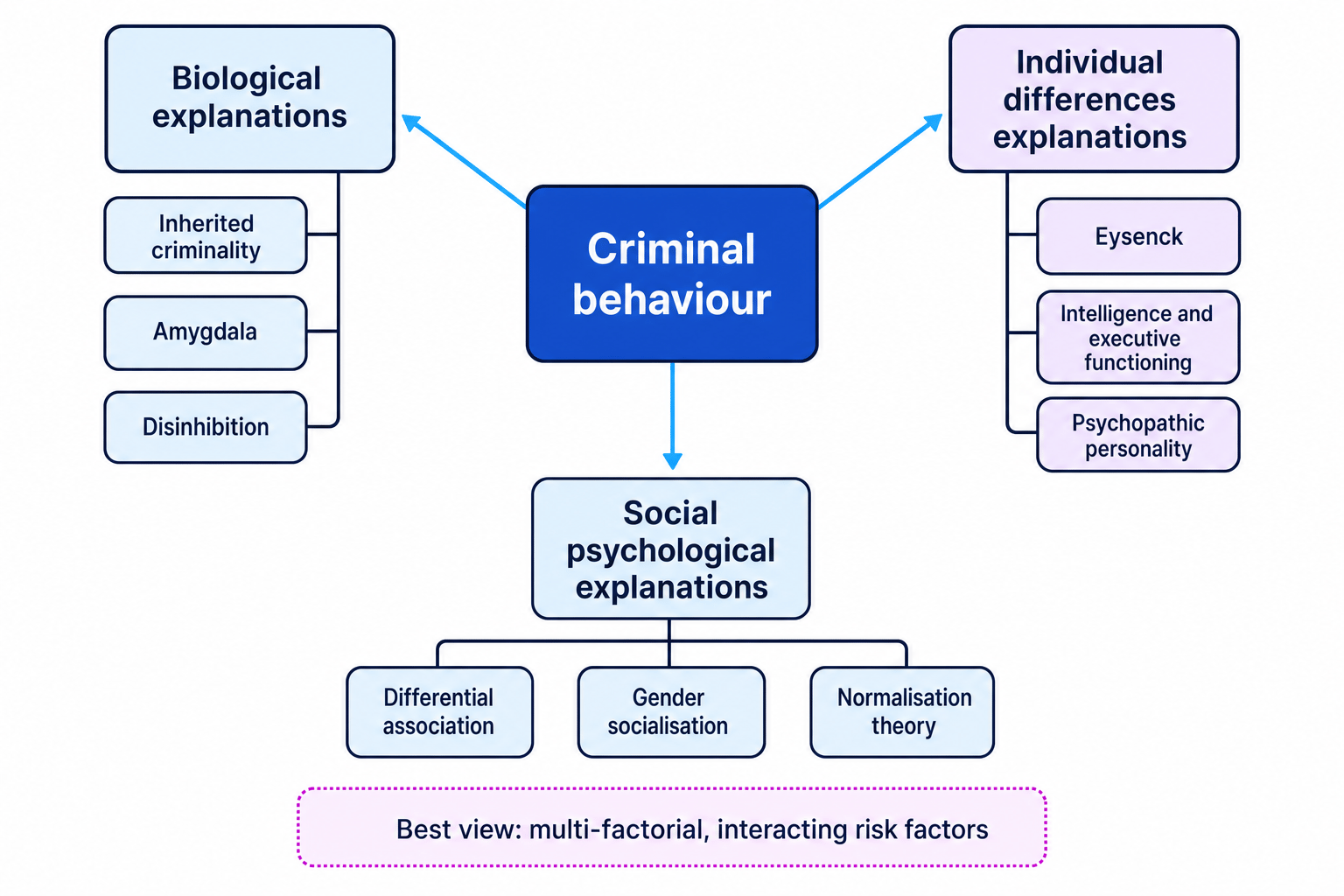
This overview shows how the three main types of explanation fit together. In a strong essay, you can discuss them separately but should remember that they may interact in real life.
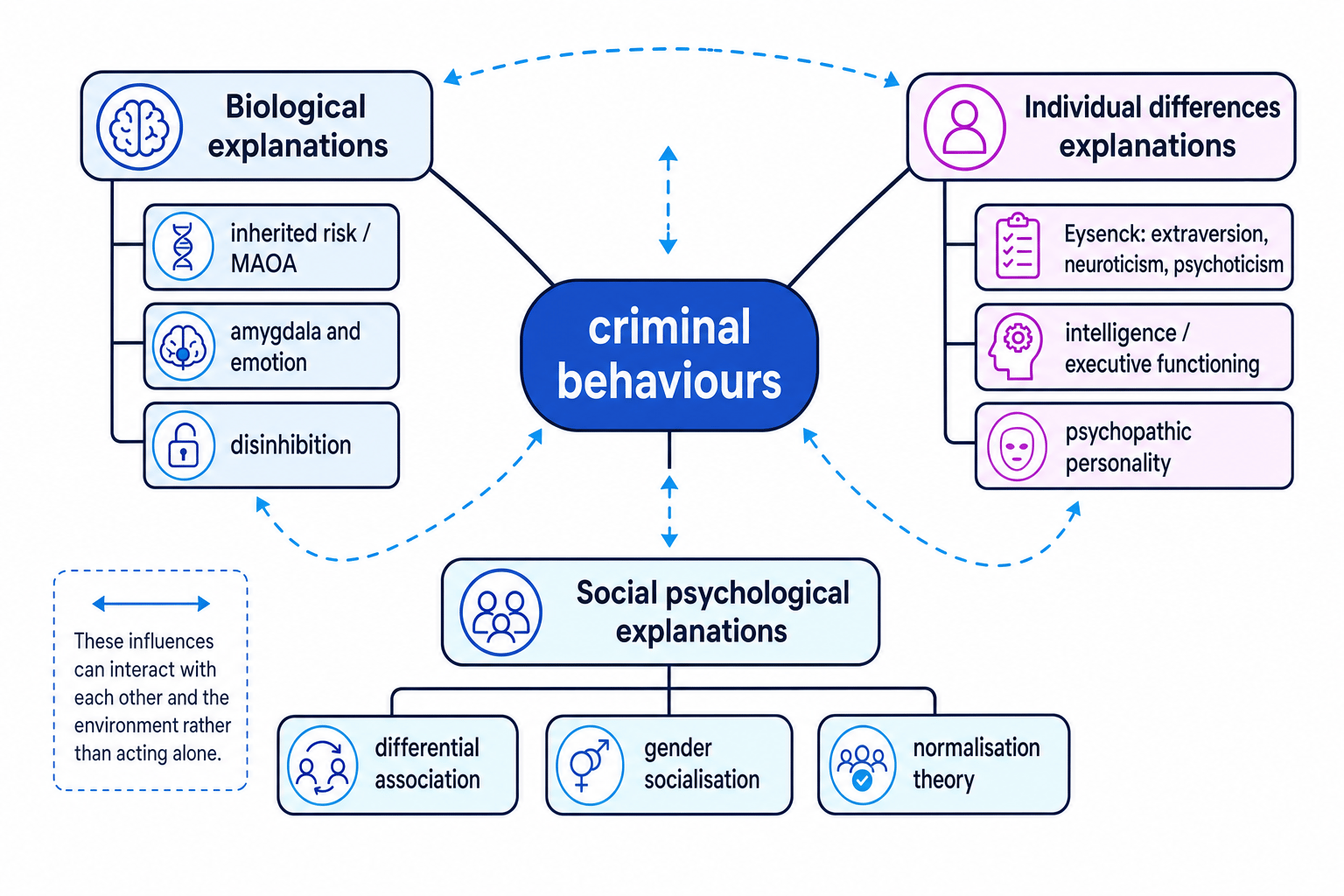
The big takeaway
Criminal behaviour is best understood as multi-factorial: biological risk factors, personal characteristics, and social environments can all increase or decrease the likelihood of offending.
Biological explanations
Biological explanations focus on physical factors, such as genes, brain structures, hormones, or neurochemistry. They often look for risk factors that make offending more likely, not guaranteed.
Inherited criminality
Inherited criminality
Inherited criminality is the idea that a tendency towards offending may be partly passed on genetically. A gene is a section of DNA that influences characteristics; heritability means the proportion of variation in a trait that can be linked to genetic differences within a population.
Twin and adoption studies are commonly used here. If identical twins, who share all their genes, show higher similarity in offending than non-identical twins, this suggests a possible genetic influence. Christiansen (1977), using Danish twin records, found higher concordance for criminal convictions in monozygotic twins than dizygotic twins. Mednick et al. (1984) also found that adopted children were more likely to have criminal convictions if their biological parents had convictions.
A more specific biological line involves the MAOA gene. Brunner et al. (1993) studied a Dutch family in which several males showed impulsive aggression and criminal behaviours; they were found to have a rare mutation affecting MAOA, an enzyme involved in breaking down neurotransmitters. Caspi et al. (2002) added an important interactionist point: low MAOA activity predicted later antisocial behaviour mainly among males who had also experienced childhood maltreatment.
AO3: this evidence is useful because twin, adoption, and gene-environment studies allow researchers to separate genetic and environmental influences more than ordinary correlations can. However, they still do not prove a “crime gene”. Shared environments, selective placement in adoption, and social reactions to children can all affect outcomes. There are also serious ethical issues: genetic explanations can create stigma, fatalism, and discrimination.
The role of the amygdala
Amygdala
The amygdala is a brain structure in the limbic system involved in emotional processing, especially fear, threat detection, and emotional learning.
A poorly functioning amygdala may make it harder for someone to learn from fear or recognise distress in others. This could reduce empathy and increase aggressive or risky behaviour. Raine et al. (1997) used PET scans with murderers pleading not guilty by reason of insanity and found reduced activity in areas including the prefrontal cortex, alongside abnormal patterns in limbic areas. Blair (1995) also linked psychopathic traits with poorer recognition of fearful and sad facial expressions.
AO3: brain-imaging research gives objective biological data, which strengthens scientific credibility. However, much of this evidence is correlational: brain differences may contribute to offending, result from trauma, drug use, or injury, or be linked to a third variable. Samples of serious offenders are also not representative of all criminal behaviour, such as minor theft or fraud.
Disinhibition hypothesis
Disinhibition
Disinhibition means a reduction in normal self-control or restraint, so impulses are more likely to be acted on.
The disinhibition hypothesis suggests that offending can occur when usual controls over behaviour are weakened. This may happen through alcohol, drugs, brain injury, or poor functioning of the prefrontal cortex, which is involved in planning, impulse control, and considering consequences.
For example, alcohol can reduce anxiety about punishment, narrow attention to immediate cues, and increase impulsive reactions. This helps explain some violent offences committed in nightlife settings, where provocation and intoxication combine.
Biology does not mean inevitability
Avoid writing as if a person with a particular gene, brain pattern, or low impulse control must become criminal. Biological explanations are usually about increased risk, not destiny.
Individual differences explanations
Individual differences explanations focus on how people vary in personality, intelligence, emotional processing, and thinking style.
Eysenck’s criminal personality
Eysenck argued that personality has a biological basis and can influence how easily someone learns social rules.
Eysenck’s personality dimensions
Eysenck proposed three main personality dimensions: extraversion means being sensation-seeking and sociable; neuroticism means emotional instability and anxiety; psychoticism means being tough-minded, aggressive, and lacking empathy.
According to Eysenck, people high in extraversion may seek stimulation and be harder to condition because they have lower cortical arousal. People high in neuroticism may react strongly and emotionally. People high in psychoticism may be more aggressive and less socially sensitive. A “criminal personality” is therefore often described as high in extraversion, neuroticism, and psychoticism.
AO3: this theory is useful because it links biology and learning: conscience develops through conditioning, but some personalities may condition less easily. However, evidence is mixed, and many studies rely on self-report questionnaires, which can be affected by lying, poor insight, or social desirability. The theory may also be culturally biased if personality tests are standardised mainly on particular populations.
Intelligence factors
Some explanations link offending to lower measured intelligence or weaker executive functioning, meaning mental skills such as planning, inhibition, working memory, and problem-solving.
The argument is not simply “low intelligence causes crime”. A more careful version is that poor school success, difficulty thinking through consequences, and weak problem-solving may increase vulnerability to antisocial peer groups or impulsive offences. Moffitt (1993) argued that life-course-persistent antisocial behaviour is linked to early neuropsychological difficulties interacting with disadvantaged environments.
AO3: this explanation can help explain why early educational support may reduce offending risk. But it is easy to overstate. IQ tests can be culturally biased, and criminal convictions are also affected by policing, poverty, school exclusion, and opportunity. Some crimes, such as fraud or cybercrime, may require high planning and technical ability.
Psychopathic personality
Psychopathic personality
A psychopathic personality involves traits such as superficial charm, lack of remorse, shallow emotion, manipulation, impulsivity, and low empathy. Hare’s Psychopathy Checklist-Revised, or PCL-R, is a common assessment tool.
Psychopathy is relevant because it may explain persistent, callous offending, especially where the offender appears emotionally detached from victims. Hare (1991) developed the PCL-R to assess psychopathic traits in forensic settings. Research by Blair and others suggests links between psychopathic traits, amygdala functioning, and reduced sensitivity to others’ distress.
AO3: psychopathy research has real-world application in risk assessment and offender management. However, the label is ethically sensitive because it can stigmatise individuals and influence sentencing or parole decisions. Also, not all offenders are psychopathic, and not all people with psychopathic traits commit crimes.
Applying an individual differences explanation
A young offender repeatedly steals cars, shows little guilt, and says the victims “can afford it anyway”.
- The lack of guilt and emotional detachment fit a psychopathic personality explanation more directly than a simple intelligence explanation.
- The repeated offending suggests this may not be a one-off disinhibited act; it could reflect stable traits such as low empathy and impulsivity.
- A balanced answer would still avoid certainty: peer-group rewards, poverty, substance use, or previous trauma might also help explain the behaviour.
Social psychological explanations
Social psychological explanations focus on how behaviour is shaped by other people, groups, culture, and social norms.
Differential association theory
Differential association theory
Differential association theory, proposed by Sutherland (1939), argues that criminal behaviour is learned through interaction with others, especially close and frequent social groups.
Sutherland argued that people learn both the techniques of crime and the attitudes that justify it. Crime becomes more likely when a person is exposed to more definitions favourable to law-breaking than definitions unfavourable to it.
For example, a young person may learn how to shoplift, how to avoid detection, and how to excuse it by saying “big shops don’t really lose anything”. The theory can also explain white-collar crime because criminal attitudes may be learned in workplaces, not just gangs.
AO3: differential association is strong because it explains why crime clusters in families, peer groups, and subcultures. It also leads to useful interventions, such as mentoring and changing peer networks. However, it is difficult to measure precisely how many “pro-crime definitions” a person has learned, and it underplays individual choice and biological differences.
Gender socialisation
Gender socialisation means the process by which people learn cultural expectations about masculinity and femininity. Boys may be rewarded more for dominance, toughness, risk-taking, and aggression, while girls may be more strongly socialised towards care, conformity, or fear of danger.
This can help explain why official statistics usually show higher male offending, especially for violent and risk-taking crimes. Messerschmidt (1993) argued that some crime can be understood as a way of “doing masculinity”, especially when legitimate status is blocked.
AO3: gender socialisation is useful because it links crime to wider culture and power. It also avoids assuming that male offending is purely biological. However, it can become stereotyped if written too generally. Many men do not offend, female offending exists, and gender norms vary across cultures and historical periods.
Normalisation theory
Normalisation theory
Normalisation theory suggests that some behaviours previously seen as deviant can become viewed as ordinary or acceptable within a group or culture.
Parker, Aldridge and Measham (1998) applied this to recreational drug use among young people. If a behaviour becomes common, openly discussed, and seen as low-risk, individuals may be less likely to define it as “criminal” even if it remains illegal.
This can also apply to online piracy, underage drinking, or carrying weapons in a peer culture where “everyone does it”. The focus is on changing norms rather than abnormal individuals.
AO3: normalisation theory is valuable for explaining widespread, lower-level offending where social approval matters. But it is less convincing for rare, serious crimes such as murder. It may also describe a pattern without fully explaining why some people resist normalised deviance.
Applying differential association and normalisation
A student starts vaping cannabis because most of their friendship group does it at parties and they say, “It’s not proper crime — everyone does it.”
- Differential association explains the learning element: the student is exposed to peers who model the behaviour and provide justifications for it.
- Normalisation theory explains the attitude shift: because the behaviour is common in the group, it feels ordinary rather than deviant.
- A stronger application combines them: the peer group teaches both the technique and the belief that the behaviour is acceptable.
Evaluation themes for essays
Methodological issues
Many studies on criminal behaviour use offender samples, official convictions, interviews, questionnaires, or brain scans. Each has limits. Official convictions miss undetected crime. Self-reports may be affected by dishonesty. Brain scans can show associations but not simple causation.
If you are linking this topic to Component 2 research methods, remember that the choice of inferential test depends on design and data type. Unrelated offender/control comparisons may use an unrelated t-test for interval data or Mann-Whitney U for ordinal data. Before-and-after intervention designs may use a related t-test or Wilcoxon signed-ranks. Associations may use Spearman’s rho, and nominal category data may use chi-square. The usual convention is significance at p≤0.05p \le 0.05p≤0.05, using observed and critical values from tables, with one-tailed or two-tailed decisions depending on the hypothesis.
Ethical issues
Research with offenders must follow the BPS Code of Ethics and Conduct: informed consent where possible, protection from harm, confidentiality, right to withdraw, and debriefing. Extra care is needed because prisoners or forensic patients may feel pressured to participate. Deception must be justified and minimised.
Biological research raises additional ethical concerns because findings about genes or brains can affect how society views responsibility, punishment, and rehabilitation.
Best essay balance
A high-level answer usually says: “This explanation accounts for some criminal behaviours in some contexts, but it is incomplete on its own.” Then compare it with another level of explanation.
In the exam
- Start each paragraph with a clear AO1 claim: biological, individual differences, or social psychological.
- Add named evidence with researcher and year, then explain exactly how it supports or challenges the theory.
- Evaluate using causation, determinism, methodology, ethics, and real-world application rather than making vague points like “it is useful”.
Check yourself
- How does differential association theory explain both criminal techniques and criminal attitudes?
- Why is it risky to describe MAOA or the amygdala as “causing crime”?
- Which explanation best accounts for gender differences in offending, and what is one limitation of it?