What you'll learn
- How CAPSLE modifies bullying by changing the bully–victim–bystander system.
- How the Olweus Bullying Prevention Programme uses school, classroom and individual strategies.
- How to apply these methods to a school scenario using AO2.
- How to evaluate them using evidence, methodology, ethics and real-world practicality.
Start point: what is being modified?
An intervention is an organised attempt to change behaviour. In this topic, the behaviour being modified is bullying: not just one aggressive act, but a repeated pattern involving power, fear and social reinforcement.
Bullying behaviour
Bullying is intentional, repeated aggressive behaviour where there is a power imbalance between the person bullying and the person being targeted. The power imbalance may be physical, social, psychological, online or based on group status.
Bullying can be direct — such as hitting, threats or insults — or indirect — such as exclusion, rumours or cyberbullying. A key idea for A-Level answers is that bullying is often a group process. The bystanders, peer audience and adult response can accidentally maintain the behaviour.
Why whole-school methods are used
A whole-school approach is an intervention that involves the entire school community: pupils, teachers, senior leaders, parents and sometimes the wider community. This matters because bullying is not usually solved by only punishing one individual pupil.
If bystanders laugh, adults respond inconsistently, and school rules are unclear, bullying may be reinforced. Reinforcement means a consequence that makes a behaviour more likely to happen again. For example, if a bully gains status from humiliating someone, the peer attention can reinforce the bullying.
The logic of whole-school interventions
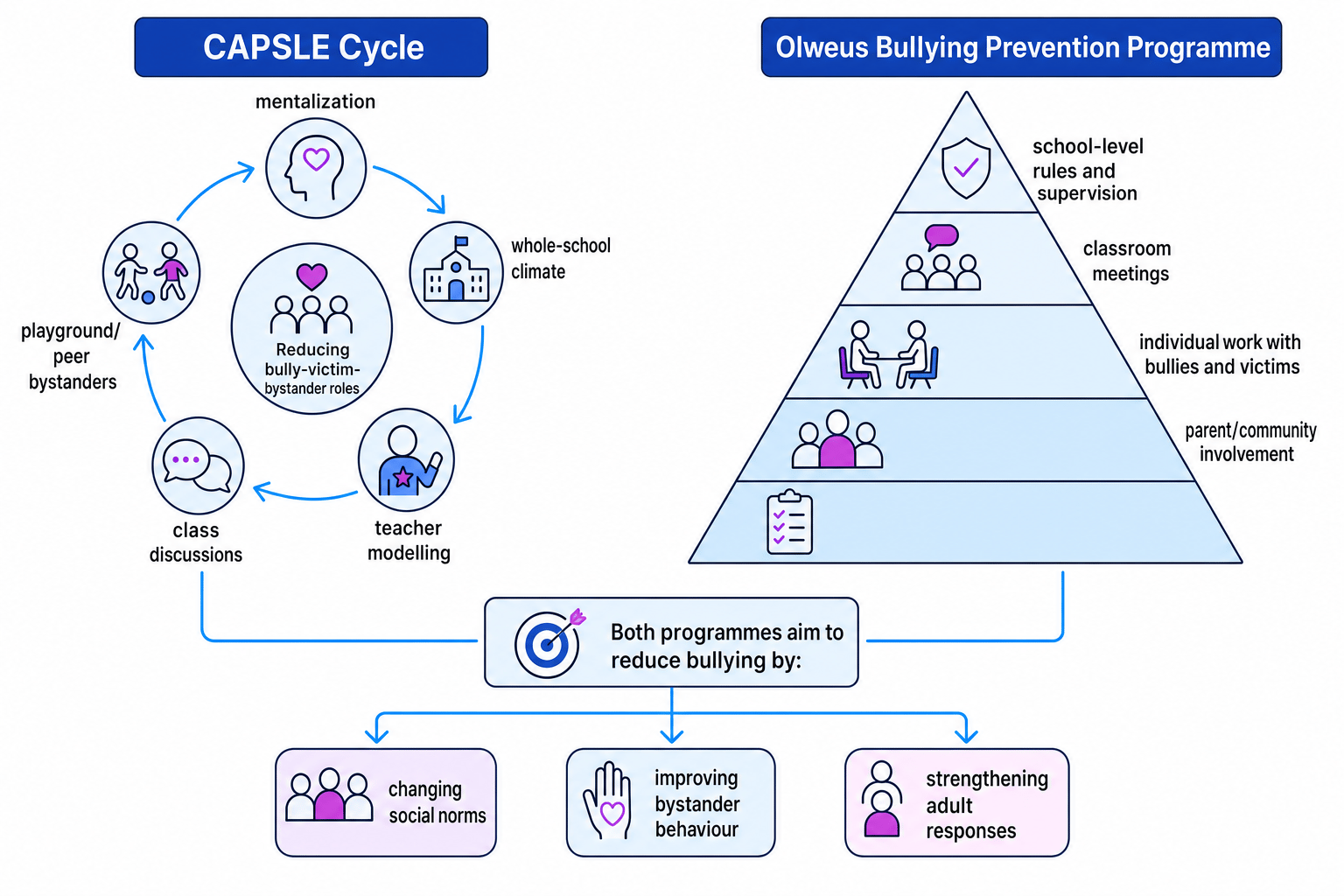
Both CAPSLE and Olweus assume bullying is maintained by the social environment, so they aim to change the school climate, bystander behaviour and adult responses — not just the individual bully.
The two named interventions are both whole-school approaches, but they emphasise slightly different mechanisms: CAPSLE focuses strongly on mentalisation and relationships, while Olweus focuses on clear rules, supervision and structured responses.
Method 1: Creating A Peaceful School Learning Environment
AO1: What is CAPSLE?
CAPSLE stands for Creating A Peaceful School Learning Environment. It is associated with researchers such as Twemlow, Fonagy and Sacco, and evidence includes a school-based trial by Fonagy et al. (2009).
CAPSLE is a mentalisation-based whole-school intervention. It tries to reduce bullying by helping pupils and adults understand the feelings, thoughts and intentions behind behaviour.
Mentalisation
Mentalisation is the ability to understand your own behaviour and other people’s behaviour in terms of mental states, such as feelings, beliefs, intentions and desires.
In bullying, poor mentalisation may mean a pupil sees another person only as “weak”, “annoying” or “deserving it”, rather than as someone with feelings. CAPSLE aims to interrupt this by encouraging reflection: What was the person feeling? What did the bystanders do? What could the adult have done differently?
How CAPSLE modifies bullying
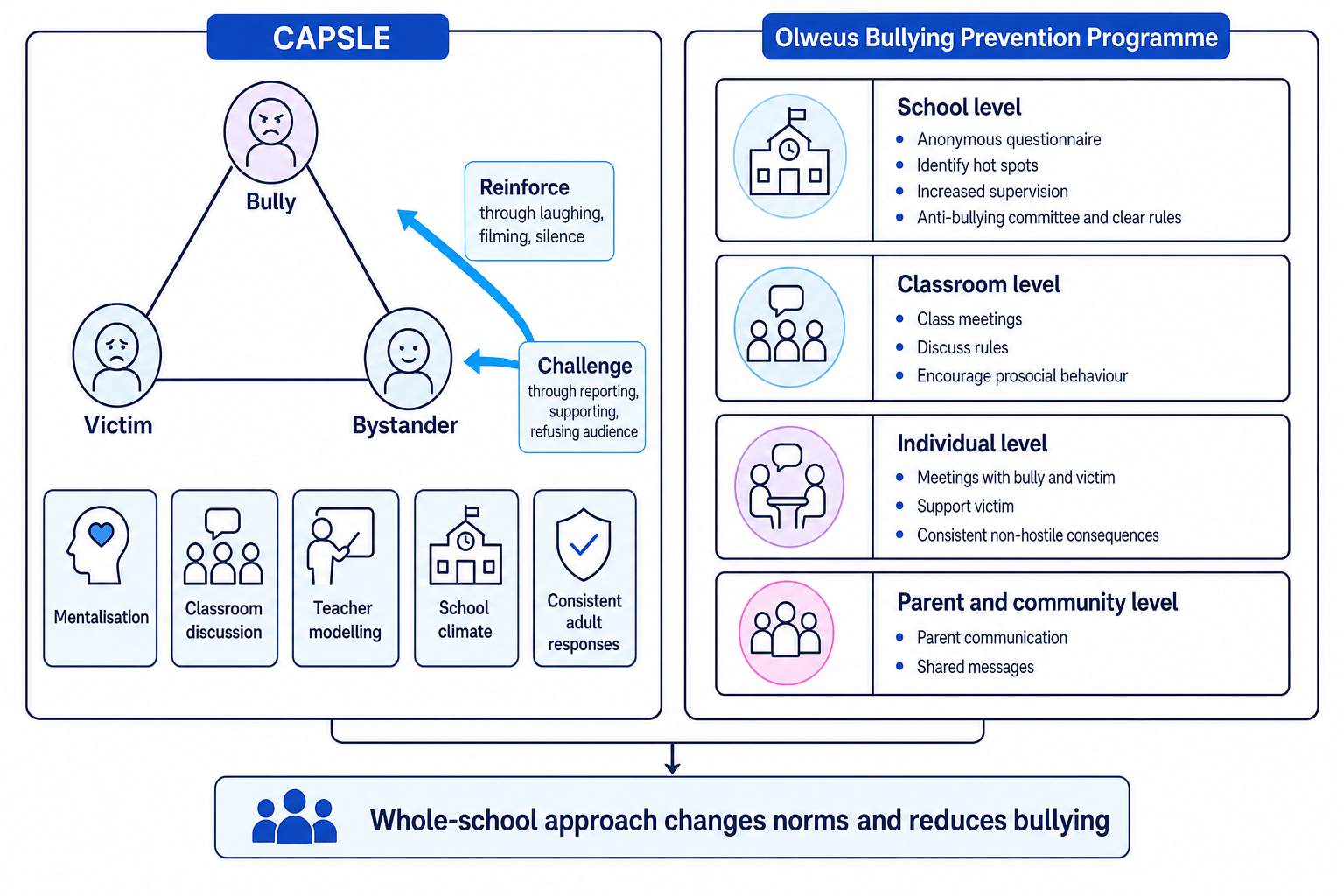
CAPSLE treats bullying as a relationship pattern involving three roles:
- the bully, who uses power aggressively
- the victim, who is targeted
- the bystander, who witnesses and may reinforce, ignore or challenge the bullying
The programme aims to stop pupils becoming fixed in these roles. It encourages pupils to recognise that bystanders are not neutral: laughing, filming or staying silent can strengthen the bullying.
Key CAPSLE features include:
- teacher training so adults model calm, reflective and non-humiliating responses
- classroom discussions about feelings, responsibility and peaceful problem-solving
- focus on bystanders, encouraging pupils to seek help or refuse to reward bullying
- consistent adult responses to bullying incidents
- school climate change, meaning a safer set of shared norms and relationships across the school
A school climate is the overall emotional and social atmosphere of a school, including whether pupils feel safe, respected and fairly treated.
AO2: Applying CAPSLE
If a school has a problem with corridor intimidation, CAPSLE would not only identify the pupils doing the bullying. It would also examine what the audience is doing, whether staff are responding consistently, and whether pupils can understand the emotional impact on the victim.
Applying CAPSLE to a bystander problem
A Year 9 pupil is mocked every lunchtime. Several pupils watch and laugh, but no one reports it.
- Identify the maintaining process: the bullying is being reinforced by the peer audience, because laughter gives the bully attention and status.
- Apply the CAPSLE role model: the pupils watching are bystanders, so the intervention should target their behaviour as well as the bully’s behaviour.
- Choose a CAPSLE strategy: classroom discussions and role-play could develop mentalisation by asking pupils to consider the victim’s feelings, the bully’s motives and the bystander’s responsibility.
- Link the strategy to behaviour change: if bystanders stop rewarding the bullying and instead seek adult help, the bully loses social reinforcement and the victim gains support.
AO3: Evaluating CAPSLE
A major strength of CAPSLE is that it fits the social nature of bullying. Instead of assuming bullying is caused only by “bad” individuals, it recognises that peer approval, teacher reactions and school norms matter.
There is also research support. Fonagy et al. (2009) carried out a cluster randomised controlled trial, where whole schools rather than individual pupils were allocated to different conditions. A randomised controlled trial is a study where participants, or groups of participants, are allocated to conditions to compare outcomes. CAPSLE was linked with reductions in aggression and victimisation compared with comparison conditions. This supports the claim that changing the school system can reduce bullying.
However, CAPSLE can be difficult to implement. It needs staff training, time and commitment. This is an issue of programme fidelity, which means how closely a programme is delivered as intended. If teachers do not use the reflective approach consistently, CAPSLE may become just another anti-bullying slogan.
A methodological weakness is that bullying is often measured using self-report questionnaires, where pupils report their own experiences. Self-report can be affected by social desirability, meaning pupils may give answers that make them look better. Victims may also underreport bullying because they fear retaliation.
Ethically, research and interventions in schools involve children, so protection from harm is crucial. Under the BPS Code of Ethics and Conduct, researchers should consider consent, right to withdraw, confidentiality, debriefing and protection from harm. In bullying research, confidentiality has limits: if a pupil discloses serious risk, staff may need to act for safeguarding.
Method 2: Olweus Bullying Prevention Programme
AO1: What is the Olweus programme?
The Olweus Bullying Prevention Programme, often shortened to OBPP, was developed by Dan Olweus in Norway. Olweus’s work is often treated as classic research in bullying, with his major programme described in Olweus (1993).
OBPP is based on a social-ecological approach. This means behaviour is influenced by several layers of the environment, including the individual, peer group, classroom, school, family and community.
Social-ecological approach
A social-ecological approach explains behaviour by looking at the different social systems around a person, rather than focusing only on individual personality or biology.
OBPP aims to create a school environment where bullying is clearly unacceptable, adults supervise effectively, and victims receive support.
How Olweus modifies bullying
Olweus set out several core principles:
- adults should show warmth and positive involvement
- the school should set firm limits on unacceptable behaviour
- consequences should be consistent and non-hostile
- adults should act as positive role models
The programme works at several levels.
At the school level, staff may carry out anonymous bullying questionnaires, identify bullying “hot spots”, increase supervision, form an anti-bullying committee and agree clear school rules.
At the classroom level, teachers hold class meetings, discuss rules and encourage prosocial behaviour. Prosocial behaviour means behaviour intended to help or benefit others.
At the individual level, staff meet with pupils who bully, pupils who are victimised and parents where appropriate. The aim is to stop bullying while supporting the victim and preventing retaliation.
At the community or parent level, the programme encourages communication between school and families, because bullying is harder to reduce if parents and school staff give conflicting messages.
AO2: Applying Olweus
If a school finds that bullying happens mainly near the toilets and on the playground, OBPP would focus on supervision and clear rules. Staff could use questionnaires to identify where bullying happens, increase adult presence in those areas, and follow up incidents through structured meetings.
The key difference from CAPSLE is emphasis. Olweus is more clearly organised around rules, supervision and consistent consequences. CAPSLE is more clearly organised around mentalisation and the bully–victim–bystander relationship.
Comparing the two methods
| Feature | CAPSLE | Olweus Bullying Prevention Programme |
|---|---|---|
| Main focus | Mentalisation, relationships and bystander roles | Clear rules, supervision and whole-school structure |
| View of bullying | A bully–victim–bystander system | A behaviour shaped by individual, peer, school and family systems |
| Typical strategies | Reflection, classroom discussion, teacher modelling, changing roles | Questionnaires, anti-bullying rules, supervision, class meetings, individual meetings |
| Strength | Tackles emotional and relational processes | Clear, structured and widely researched |
| Limitation | Requires strong staff training and fidelity | Effects vary across schools and cultures |
Only describing punishment
Do not write as if these methods simply “punish the bully”. Both programmes try to change the wider conditions that allow bullying to continue, especially bystander behaviour, adult responses and school norms.
AO3: Evaluating the Olweus programme
A major strength of OBPP is the amount of evidence behind it. In the original Norwegian evaluation reported by Olweus (1993), schools showed large reductions in self-reported bullying and victimisation. Later reviews, such as Ttofi and Farrington (2011), also found that school-based anti-bullying programmes can reduce bullying and victimisation overall, especially when they include parent meetings, playground supervision and firm disciplinary methods.
Another strength is practical clarity. OBPP gives schools concrete steps: survey pupils, identify hot spots, increase supervision, set rules and follow up incidents. This makes it easier to train staff than a vague “be kind” campaign.
However, findings are not always equally strong. Reviews such as Smith, Schneider, Smith and Ananiadou (2004) suggest that anti-bullying programmes can have mixed effects. Some schools show strong improvements, while others show small or no reductions. This may be due to differences in culture, staff commitment, age group, existing school climate or fidelity.
A further limitation is that OBPP was developed in Norway, so there may be cultural bias if it is assumed to work identically in every country or school. For example, expectations about teacher authority, pupil independence and parent involvement vary between cultures.
Ethically, OBPP must protect pupils from harm. If victims are identified publicly, bullying could worsen. Questionnaires should be confidential, data should be stored securely, and pupils should be debriefed about the purpose of the programme. Schools must also balance confidentiality with safeguarding duties.
Simple AO3 structure
For each method, aim for: one evidence point, one methodological issue, one practical issue, and one ethical issue. That gives you balanced evaluation rather than just description.
Using these methods in an essay
For AO1, describe what the programme is and how it works. Use named terms: mentalisation, bystanders, whole-school approach, social-ecological approach, supervision, class meetings and consistent consequences.
For AO2, link the method to the scenario. If the scenario mentions bystanders filming bullying, CAPSLE is easy to apply. If it mentions poor supervision in certain areas, Olweus is easy to apply.
For AO3, avoid saying “it works” without evidence. Name a study or review, then explain a strength or weakness. You could use Fonagy et al. (2009) for CAPSLE, Olweus (1993) for OBPP, and Ttofi and Farrington (2011) for wider support.
In the exam
- Start by defining bullying as repeated, intentional aggression involving a power imbalance.
- For each method, describe the mechanism: CAPSLE changes mentalisation and bystander roles; Olweus changes rules, supervision and school systems.
- Apply the method directly to the scenario rather than giving a generic list of features.
- Evaluate with evidence, then add a methodological, practical or ethical limitation.
- If comparing the methods, avoid claiming one is always better; explain which is more suitable for the specific school problem.
Check yourself
- How does CAPSLE use the bully–victim–bystander relationship to reduce bullying?
- What are three levels of the Olweus Bullying Prevention Programme?
- What is one ethical issue when researching or implementing anti-bullying programmes in schools?