What you’ll learn
- What “ethical costs” means in psychological research.
- How benefits to society and the economy can be weighed against risks to participants.
- Why research can have negative consequences beyond the study itself.
- How psychologists manage risk using the BPS ethical guidelines.
The basic controversy
Psychology often investigates sensitive areas: obedience, aggression, mental health, memory, addiction, stress, criminal behaviour and development. To understand these topics properly, researchers sometimes need to place people in unusual, stressful or deceptive situations.
The controversy is this: when, if ever, is it acceptable to expose participants to ethical costs in order to gain useful knowledge?
Ethical cost
An ethical cost is a possible harm, risk, loss of rights, or negative consequence created by conducting research. This can affect individual participants or wider society.
Psychologists do not simply ask, “Is this study interesting?” They ask whether the knowledge gained is important enough to justify the risks involved.
Cost-benefit analysis
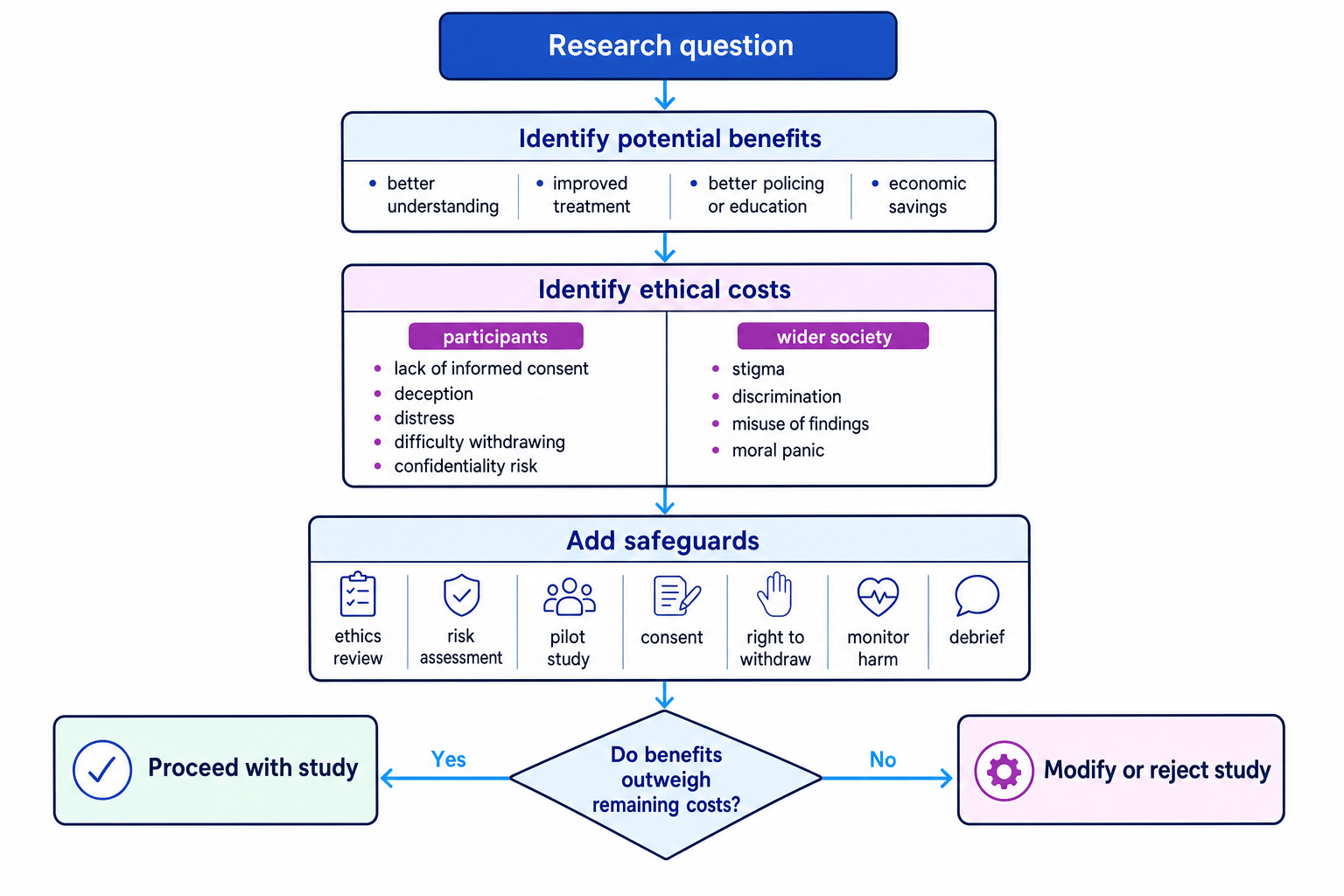
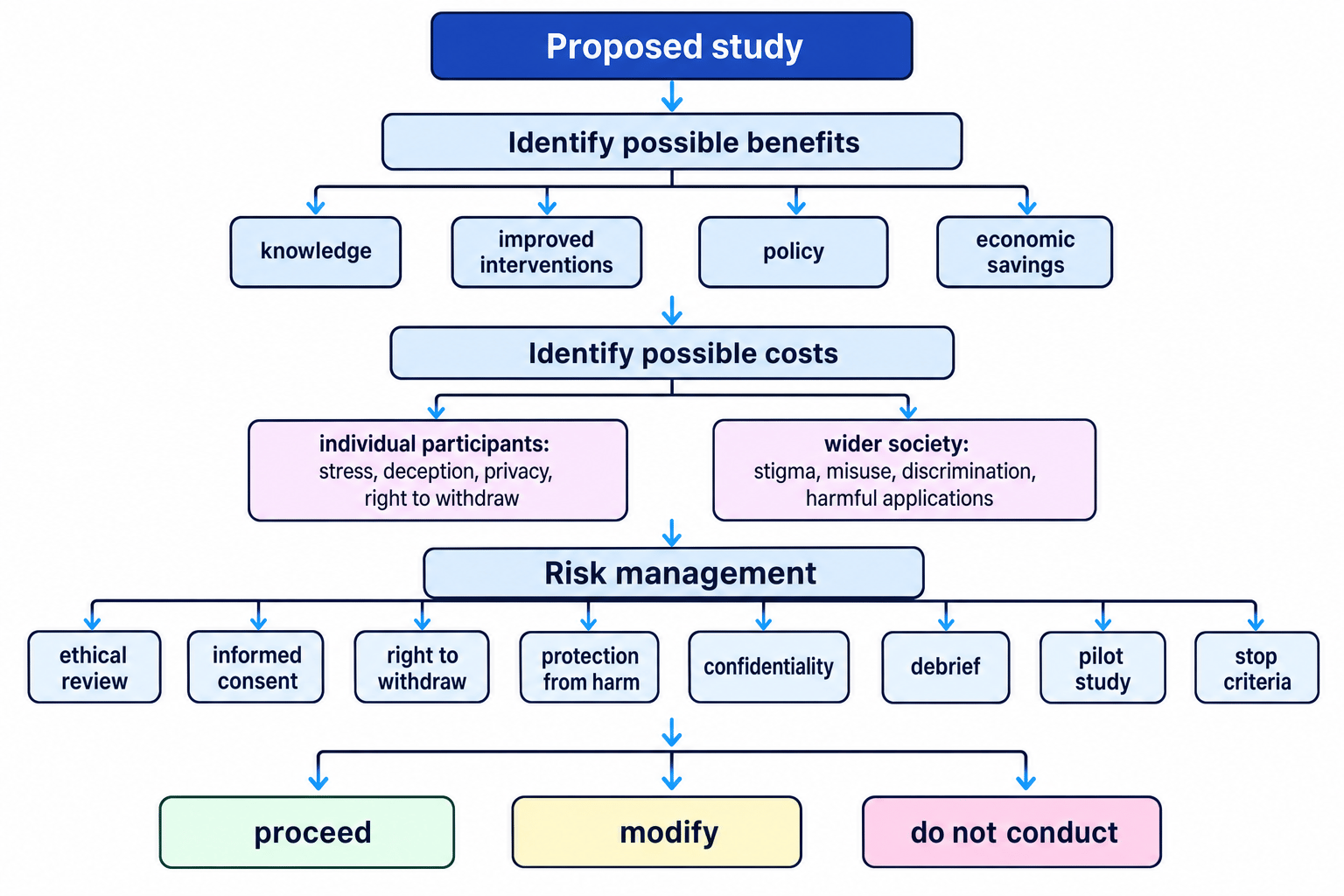
A cost-benefit analysis is the process of weighing the potential benefits of research against the possible ethical costs. If the costs are too high, the study should be changed or not conducted.
The key decision process is shown below.
The core issue
Ethical controversy is not usually about whether research is “good” or “bad”. It is about whether the benefits are strong enough and the risks are well-managed enough to justify doing it.
Benefits to society and the economy
Psychological research can create major benefits. These are often the strongest arguments for allowing research that involves some ethical risk.
Benefits to society
Research can help society by improving understanding of behaviour. For example:
- Research into eyewitness testimony, such as Loftus and Palmer (1974), showed that misleading questions can distort memory. This can improve police interviewing and reduce wrongful convictions.
- Research into obedience, such as Milgram (1963), helped explain how ordinary people may obey harmful authority figures.
- Research into brain differences and criminal behaviour, such as Raine et al. (1997), may support early intervention and more informed approaches to offending.
- Research into mental health can improve diagnosis, therapies and support services.
Benefits to the economy
Research may also reduce economic costs. For example, effective interventions for addiction, stress or schizophrenia can reduce:
- NHS spending
- workplace absence
- crime-related costs
- long-term care costs
- costs to families and support services
This matters in Component 3 because many studied behaviours have real-world implications. If research leads to better prevention or treatment, it may benefit both individuals and society.
Weighing benefits in eyewitness research
Imagine a study uses a video of a car accident and then asks participants misleading questions about what they saw.
- Identify the likely benefit: the study could show whether wording changes memory, which is useful for police interviews and court evidence.
- Identify the likely cost: participants may be deceived about the purpose of the study, but the task is low-risk and does not involve serious distress.
- Consider risk management: the researcher can gain consent, allow withdrawal, avoid graphic material, keep data confidential and fully debrief participants.
- Make a judgement: because the risk is mild and manageable, the social benefit may justify the ethical cost.
Ethical costs to individual participants
The most obvious ethical costs are those faced by the people who take part in the research.
Participant
A participant is a person who takes part in a psychological study and provides data, such as questionnaire answers, interview responses, behavioural observations or biological measures.
The British Psychological Society, or BPS, gives guidance on ethical research. The key ideas are often summarised through rights such as consent, protection, withdrawal, confidentiality and debriefing.
Informed consent
Informed consent
Informed consent means participants agree to take part after being given enough information about the study to make a genuine choice.
If participants are not properly informed, they cannot freely choose whether to take part. However, full information can sometimes ruin a study. For example, if participants know a memory study is testing misleading questions, they may change their behaviour.
This creates a genuine ethical tension: too much information may reduce validity, but too little information may reduce autonomy.
Deception
Deception
Deception means misleading participants or withholding important information about the true purpose or procedure of a study.
Deception was a major issue in Milgram’s obedience study (1963). Participants were told they were taking part in research on learning and memory, but the real aim was to investigate obedience to authority.
Deception can be justified only when there is a strong reason and when participants are debriefed afterwards.
Right to withdraw
The right to withdraw means participants should be able to leave a study at any point, and usually should also be able to withdraw their data afterwards.
In Milgram’s study, participants were technically allowed to leave, but the verbal prompts such as “You have no other choice, you must go on” made withdrawal feel difficult. This is why the study is often criticised.
Protection from harm
Protection from harm
Protection from harm means researchers should avoid exposing participants to physical or psychological risk beyond what they would normally experience in everyday life.
Harm can include stress, anxiety, embarrassment, lowered self-esteem, fear, guilt or lasting distress. Classic examples include:
- Watson and Rayner’s Little Albert study (1920), where a child was conditioned to fear a white rat.
- Zimbardo et al.’s Stanford prison study (1973), where participants experienced distress and the study was stopped early.
- Milgram’s obedience study (1963), where some participants showed signs of extreme tension.
Ethical issue is not the same as methodological weakness
Do not write “the study was unethical so the results are invalid” as if this automatically follows. A study can be ethically problematic but still produce useful data. You need to explain the link if you want to make a methodological criticism.
Applying ethical issues to Milgram’s obedience study
- Start with consent: participants agreed to take part, but they did not give fully informed consent because they were misled about the real aim.
- Consider deception: the learner’s shocks were fake, but participants believed they might be causing serious harm, so the deception was substantial.
- Assess protection from harm: many participants showed distress, such as sweating, trembling or nervous laughter, suggesting psychological risk.
- Weigh the benefit: the findings helped explain obedience to destructive authority, which has important social relevance.
- Reach a balanced judgement: the study had high ethical costs, but defenders argue that its contribution to understanding obedience was unusually significant.
Potentially negative consequences for society
Ethical costs do not stop with individual participants. Research can also create harmful effects for society.
Stigma and labelling
Research findings may lead to groups being labelled negatively. For example, if brain abnormalities are linked with criminal behaviour, some people may wrongly assume that individuals with similar brain patterns are “born criminals”.
This is a risk when discussing studies such as Raine et al. (1997). The research may be useful, but it could also encourage biological determinism.
Biological determinism
Biological determinism is the view that behaviour is mainly or entirely caused by biological factors, such as genes, brain structures or hormones.
The danger is that society may overinterpret research and treat people as if their future behaviour is fixed.
Discrimination and social control
Research can be misused by governments, employers, schools, advertisers or legal systems. For example:
- personality testing could be used unfairly in employment
- brain or genetic research could be used to label people as risky
- research into persuasion could be used for manipulation
- culturally biased research could reinforce stereotypes
This means psychologists must think carefully about how findings might be reported, interpreted and applied.
Moral panic and misunderstanding
Sometimes psychological findings are simplified in the media. A cautious research conclusion can become an exaggerated headline. For example, a correlational study showing an association between two variables may be reported as if one definitely causes the other.
Group findings do not diagnose individuals
Psychological research usually identifies patterns across groups. It should not be used to make absolute claims about one person’s character, risk or future behaviour.
Risk management techniques used by psychologists
Psychologists manage ethical risk before, during and after research. This is essential AO1 knowledge and very useful AO3 evaluation.
Before the study
Ethical review
Most research must be approved by an ethics committee. This committee checks whether the study is justified, whether risks are reasonable, and whether safeguards are in place.
Risk assessment
A risk assessment identifies possible harms and plans how to reduce them. For example, if a study asks about stressful life events, the researcher may include support information and stop the procedure if a participant becomes distressed.
Pilot study
A pilot study is a small trial version of the research. It can reveal unexpected ethical issues before the full study is conducted.
During the study
Psychologists should:
- gain informed consent where possible
- avoid unnecessary deception
- remind participants of their right to withdraw
- monitor distress
- protect confidentiality
- keep data secure
- stop the study if harm becomes too likely
Use the BPS checklist
For exam answers, a simple ethics checklist is: consent, deception, withdrawal, harm, confidentiality, debrief. Then add a judgement about whether the safeguards were enough.
After the study
Debrief
Debrief
A debrief is an explanation given after the study. It should reveal the true aim, explain any deception, check the participant’s wellbeing and remind them of their right to withdraw data.
Debriefing is especially important when deception has been used. However, it does not automatically remove all ethical costs. A participant may still feel embarrassed, guilty or distressed.
Confidentiality and anonymity
Confidentiality means personal information is protected and not shared in an identifiable way. Anonymity means the researcher cannot link the data to a named participant.
Confidentiality is particularly important in sensitive topics such as addiction, criminal behaviour, mental health or bullying.
Risk managing a student practical on stress
Suppose you are designing a questionnaire study on stress in sixth-form students.
- Identify the main risk: questions about stress could make some participants uncomfortable or reveal sensitive information.
- Reduce the risk before collecting data: use non-invasive questions, avoid asking for names, and make participation voluntary.
- Protect participants during the study: tell them they can skip questions or withdraw without giving a reason.
- Manage risk afterwards: provide a debrief and signpost support, such as a tutor, safeguarding lead or wellbeing service.
- Judge the design: the study is more ethically acceptable because the topic is sensitive but the procedure is low-risk and safeguards are clear.
Extra note: non-human animal research
Some psychological research uses non-human animals. This raises additional ethical concerns because animals cannot give informed consent or verbally withdraw.
Researchers should consider the 3Rs:
- Replacement: use non-animal alternatives where possible.
- Reduction: use the smallest number of animals needed.
- Refinement: reduce suffering and improve welfare.
Animal research may be defended if it produces important knowledge that cannot ethically be gained from humans. However, it remains controversial because the animals bear costs for benefits that mainly help humans.
AO3: evaluating the controversy
Ethical guidelines are a strength
Modern ethical guidelines protect participants and increase public trust in psychology. If people believe psychologists behave responsibly, they may be more willing to take part in research.
This also improves the reputation of psychology as a science with real-world value.
But guidelines can restrict useful research
Some researchers argue that strict ethical rules make it harder to study important behaviours realistically. For example, obedience, prejudice or aggression may not appear naturally if participants know the full aim of the study.
This can reduce ecological validity, which is the extent to which findings reflect real-life behaviour.
Deception can improve validity but reduce autonomy
Deception may prevent demand characteristics, where participants guess the aim and change their behaviour. However, deception undermines informed consent and may damage trust.
The strongest answer is balanced: deception is not automatically wrong, but it must be justified, minimised and followed by a proper debrief.
Benefits are hard to predict
One difficulty with cost-benefit analysis is that benefits may only become clear years later. Milgram’s study is now seen as highly influential, but an ethics committee before the study could not know exactly how important it would become.
This makes ethical decision-making partly subjective.
Social consequences depend on interpretation
A study’s findings may be carefully written by researchers but misused by others. This makes it difficult to hold psychologists fully responsible for every later misuse, but they do have a duty to communicate findings cautiously.
Best evaluation judgement
Ethical costs can sometimes be justified, but only when the research has clear value, the risks are proportionate, and psychologists use strong safeguards before, during and after the study.
In the exam
- Separate your answer into benefits, costs to participants, costs to society, and risk management.
- Use named studies such as Milgram (1963), Watson and Rayner (1920), Zimbardo et al. (1973), Loftus and Palmer (1974), or Raine et al. (1997) to support your points.
- Make evaluative judgements: do not just list ethical issues; explain whether the benefits justify the costs and whether safeguards were sufficient.
Check yourself
- What is the difference between an ethical cost to an individual participant and a negative consequence for society?
- Why might deception sometimes increase validity but reduce informed consent?
- How could a psychologist reduce risk in a study on a sensitive topic such as stress, addiction or criminal behaviour?