What you'll learn
- How classical conditioning and operant conditioning can be used to influence children’s behaviour.
- Why this is a contemporary debate: useful behaviour support or unethical social control?
- How to build AO1, AO2 and AO3 points for Eduqas essays.
- How to use named behaviourist evidence, especially Watson and Rayner (1920) and Becker et al. (2002), without overclaiming.
The debate: what are we arguing about?
A contemporary debate is a current issue where psychologists disagree about how psychological knowledge should be used in real life.
For this topic, the issue is: should adults use conditioning techniques to control the behaviour of children?
Here, control does not mean “mind control”. It means changing the environment so that some behaviours become more likely and others become less likely. This might happen at home, in schools, in therapy, or in behaviour-support programmes.
AO1 means accurate description, AO2 means applying ideas to a scenario or practical investigation, and AO3 means evaluating strengths, weaknesses, ethics and applications.
Conditioning techniques
Conditioning techniques are ways of changing behaviour through learned associations or consequences. In behaviourism, learning is mainly explained through classical conditioning and operant conditioning.
Behaviourist foundations
Behaviourism is the approach that focuses on observable behaviour rather than hidden mental processes. Behaviourists argue that much behaviour is learned from the environment.
The debate follows directly from that assumption: if behaviour is learned, then adults may be able to shape children’s behaviour by carefully controlling what happens before and after it.
The core logic
If children learn through associations and consequences, then changing those associations and consequences can change behaviour — but that creates an ethical question about power, consent and harm.
Classical conditioning: learning by association
Classical conditioning is learning through association. It was developed from work such as Pavlov’s research with dogs, where a neutral stimulus became associated with food and eventually produced salivation.
The key terms are:
- A neutral stimulus does not naturally produce the response.
- An unconditioned stimulus naturally produces a response.
- An unconditioned response is the natural response.
- A conditioned stimulus is the formerly neutral stimulus after learning.
- A conditioned response is the learned response.
In children, classical conditioning can create emotional reactions. For example, if a child is repeatedly embarrassed in maths lessons, the classroom or subject may become associated with anxiety.
Explaining a conditioned school anxiety response
-
Identify the natural trigger: being shouted at or humiliated is the unconditioned stimulus because it naturally produces anxiety.
-
Identify the originally neutral stimulus: the maths classroom starts as a neutral stimulus because it does not automatically cause fear.
-
Explain the association: if humiliation repeatedly happens in maths lessons, the classroom becomes a conditioned stimulus.
-
Predict the learned response: the child may feel anxious before maths even when nobody is currently shouting, because anxiety has become a conditioned response.
The classic Eduqas behaviourist study is Watson and Rayner (1920). They conditioned “Little Albert” to fear a white rat by pairing the rat with a loud noise. This shows that emotional responses can be learned, but it also highlights serious ethical issues.
Operant conditioning: learning through consequences
Operant conditioning is learning through the consequences of behaviour. It is associated with Skinner, who studied how animals’ behaviour changed when rewards or punishments followed responses.
In child behaviour management, operant conditioning is usually more relevant than classical conditioning because adults often use consequences: praise, stickers, tokens, loss of privileges, time-out, or ignoring unwanted behaviour.
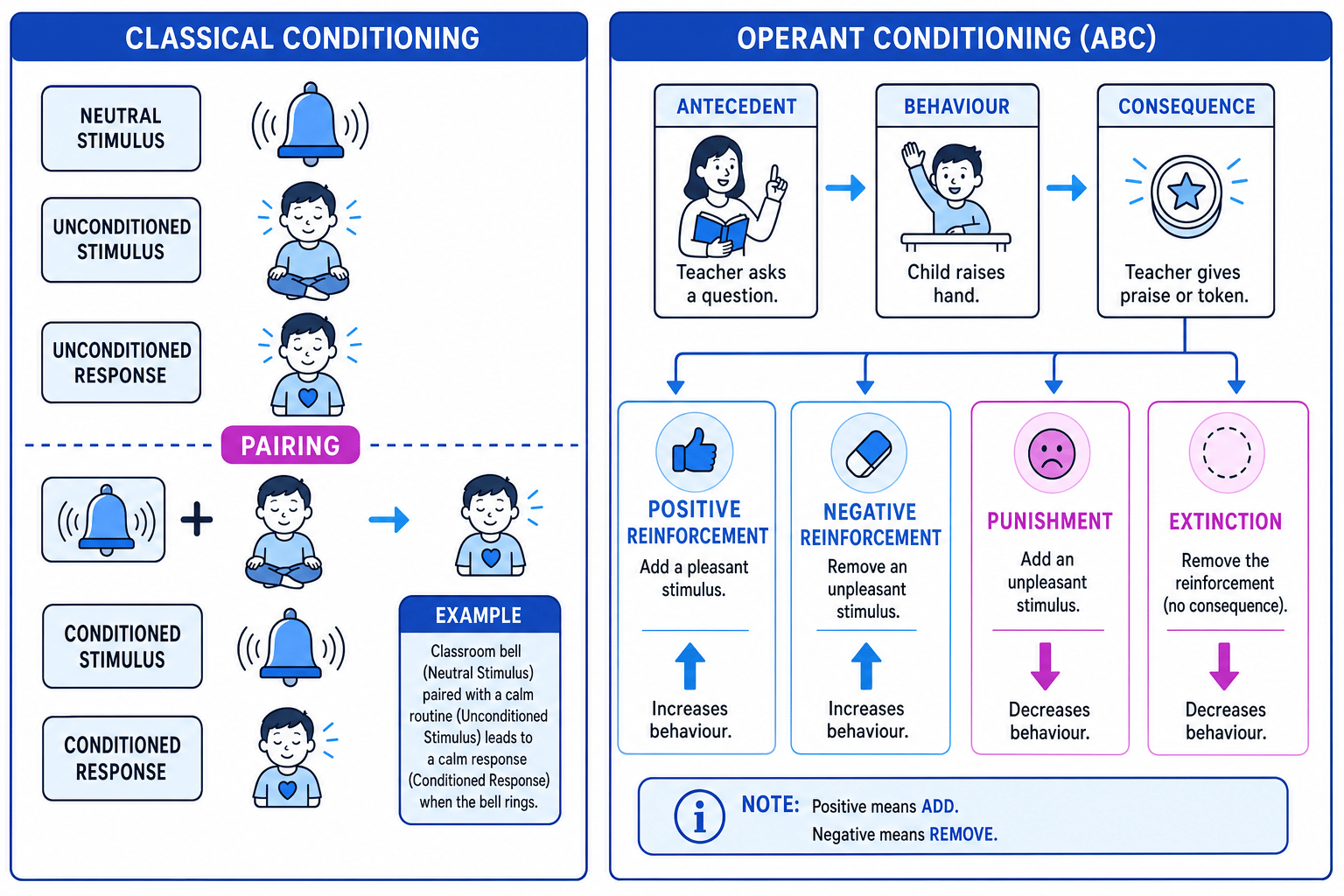
Important terms:
- Reinforcement increases the likelihood of a behaviour happening again.
- Punishment decreases the likelihood of a behaviour happening again.
- Positive means something is added.
- Negative means something is removed.
- Extinction means a behaviour decreases because it is no longer reinforced.
- Shaping means rewarding small steps towards a final desired behaviour.
- A token economy is a system where children earn tokens, points or stickers that can later be exchanged for rewards.
Positive and negative
In operant conditioning, positive does not mean “nice” and negative does not mean “nasty”. Positive means add something; negative means remove something.
Designing an operant plan for calling out
-
Operationalise the target behaviour: define “calling out” as speaking without putting a hand up while the teacher is addressing the class, so it can be counted consistently.
-
Choose the replacement behaviour: the desired behaviour is raising a hand and waiting to be chosen.
-
Apply reinforcement: give immediate praise or a token when the child raises their hand, so the desired behaviour is more likely to happen again.
-
Avoid accidental reinforcement: if calling out gains attention, even annoyed attention, it may continue. The teacher could briefly ignore minor calling out while still responding warmly to hand-raising.
-
Fade the reward: once hand-raising is established, reduce tokens gradually so the child does not depend completely on external rewards.
Arguments in favour of using conditioning with children
It can be effective and practical
Conditioning techniques can be clear, quick and measurable. In a classroom, a teacher can record how often a behaviour occurs before and after a reward system. This fits the behaviourist aim of studying observable behaviour scientifically.
Positive reinforcement can also be kinder than harsh punishment. For example, praising cooperation may build good habits without humiliating the child.
It can support learning and safety
Some behaviours need to change because they interfere with learning or safety: aggression, running out of class, refusal to follow safety rules, or severe disruption. Conditioning techniques can give children predictable boundaries.
Behaviourist methods can also be used in structured support programmes for children with additional needs. However, these must be individualised and respectful, not just focused on making a child appear “normal” for adult convenience.
Arguments against using conditioning with children
It can become manipulation
Children have less power than adults, so “behaviour control” can become ethically uncomfortable. A child may not fully understand the system, may not be able to opt out, and may be pressured into compliance.
Using behaviourist techniques on children therefore raises issues from the British Psychological Society Code of Ethics and Conduct, including consent, right to withdraw, protection from harm, confidentiality, deception and debriefing. With children, psychologists should seek parental consent and the child’s own age-appropriate assent.
It may ignore thoughts, emotions and reasons
Behaviourism can be criticised as reductionist, meaning it simplifies behaviour too much. A child who refuses schoolwork may not just need rewards; they may be anxious, tired, bullied, confused, or seeking connection.
There is also the overjustification effect, where external rewards may reduce intrinsic motivation. For example, if a child only reads to earn tokens, they may be less likely to read for enjoyment later.
Punishment is risky
Punishment may suppress behaviour in the short term, but it can also produce fear, resentment, secrecy or aggression. In essays, avoid writing as if punishment is automatically effective or ethical.
Evidence you can use in essays
Watson and Rayner (1920): classic evidence
Watson and Rayner conditioned Little Albert to fear a white rat by pairing it with a loud noise. This supports the behaviourist claim that emotional responses can be learned through association.
AO3 evaluation is essential. The study involved one child, so generalisability is limited. It was also ethically unacceptable by modern standards because Albert was distressed, could not consent, had no meaningful right to withdraw, and was not properly deconditioned afterwards.
Becker et al. (2002): contemporary evidence
The Eduqas behaviourist approach is also linked with Becker et al. (2002), who studied Fijian adolescent girls after prolonged exposure to television. The study found changes in eating attitudes and behaviours, with some girls referring to TV characters as models.
This supports the broader behaviourist idea that young people are influenced by the environment, although it is more about social learning than direct conditioning. Do not claim Becker et al. directly tested token economies or punishment.
Animal research: Pavlov and Skinner
Pavlov and Skinner’s animal studies gave behaviourism scientific control, but animal research raises ethical and validity issues. Non-human animals cannot consent, and UK research must consider welfare, minimising suffering, and whether the knowledge gained justifies the cost. There is also a generalisation problem: children’s behaviour is more complex than rats pressing levers.
Component 2 link: investigating a behaviour programme
If you designed a practical investigation, you could measure behaviour before and after a conditioning programme.
You might use event sampling, which means recording every occurrence of a target behaviour during a set period. A baseline is the measurement taken before the intervention. You could then compare the baseline with behaviour after reinforcement is introduced.
Descriptive statistics could include the mean number of incidents, the range, and the standard deviation. A bar chart or line graph could show changes over time.
For inferential testing, choose the test based on design and data level:
- Nominal data means categories, such as improved/not improved.
- Ordinal data means ordered scores or ranks.
- Interval data means numerical scores with equal intervals.
Choosing a test for before-and-after behaviour data
-
Identify the design: the same children are measured before and after a token system, so this is a related or repeated-measures design.
-
Identify the data: if the data are frequency counts treated as interval data and assumptions are suitable, a related t-test may be used. If the data are ordinal or assumptions are not met, Wilcoxon signed-ranks is safer.
-
Set the prediction: if you predict that calling out will decrease, use a one-tailed test. If you only predict that behaviour will change, use a two-tailed test.
-
Make the decision: use the usual significance level of p≤0.05p \le 0.05p≤0.05 and compare the observed value with the critical value table, remembering that different tests have different decision rules.
Type I errors happen when a researcher claims a real effect when there is not one. Type II errors happen when a researcher misses a real effect. In this debate, both matter: a weak reward system might be accepted too easily, or a helpful intervention might be rejected too quickly.
In the exam
-
Start with precise AO1: define the conditioning technique you are discussing, such as positive reinforcement, punishment, extinction or token economy.
-
Apply it to children specifically: mention power imbalance, parental consent, child assent, protection from harm, and the difference between support and control.
-
Evaluate both sides: balance practical benefits with ethical concerns, and use Watson and Rayner (1920) and Becker et al. (2002) carefully as evidence.
Check yourself
- Why is a sticker chart usually an example of positive reinforcement rather than negative reinforcement?
- What ethical issues arise when adults use conditioning techniques with children?
- How could you use Watson and Rayner (1920) in this debate without ignoring its weaknesses?
