What you'll learn
- How psychologists explain bullying using biological, individual differences and social psychological explanations.
- Why no single explanation is enough on its own.
- How to apply explanations to a scenario and evaluate them using AO1, AO2 and AO3.
- How research into bullying can be investigated ethically and statistically.
Starting point: what counts as bullying?
Bullying is not just “being mean”. Psychologists usually define it more tightly so they can study it reliably.
Bullying
Bullying is intentional aggressive behaviour that is repeated over time and involves a real or perceived power imbalance between the person bullying and the victim.
Bullying can be physical (hitting), verbal (insults), relational (spreading rumours or excluding someone), or cyberbullying (using online platforms to threaten, humiliate or exclude).
A good essay should not treat bullying as one simple behaviour. A pupil who uses physical intimidation may have different motives from a pupil who uses rumours to control social status.
Three levels of explanation
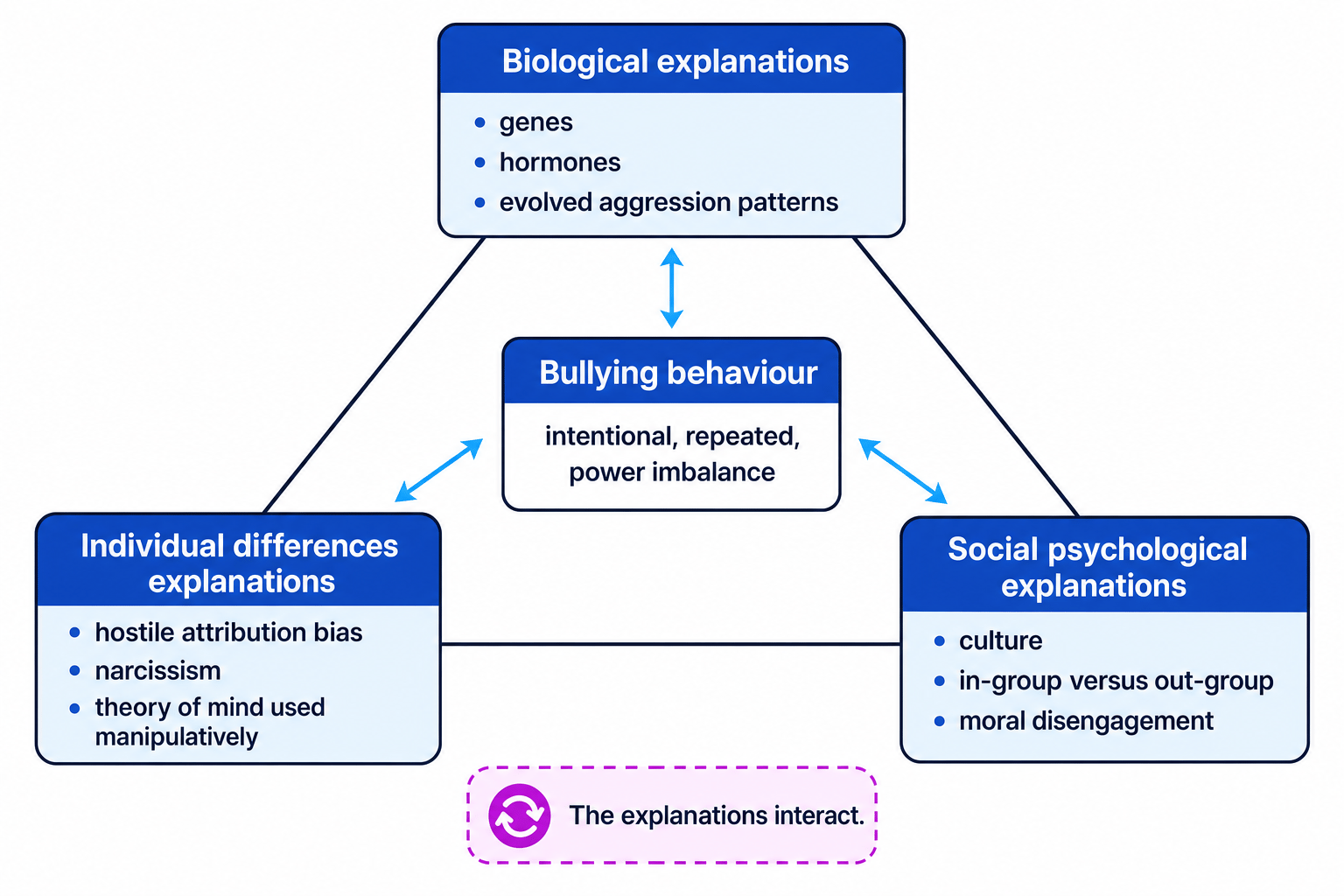
The Eduqas specification asks you to understand explanations from three broad levels:
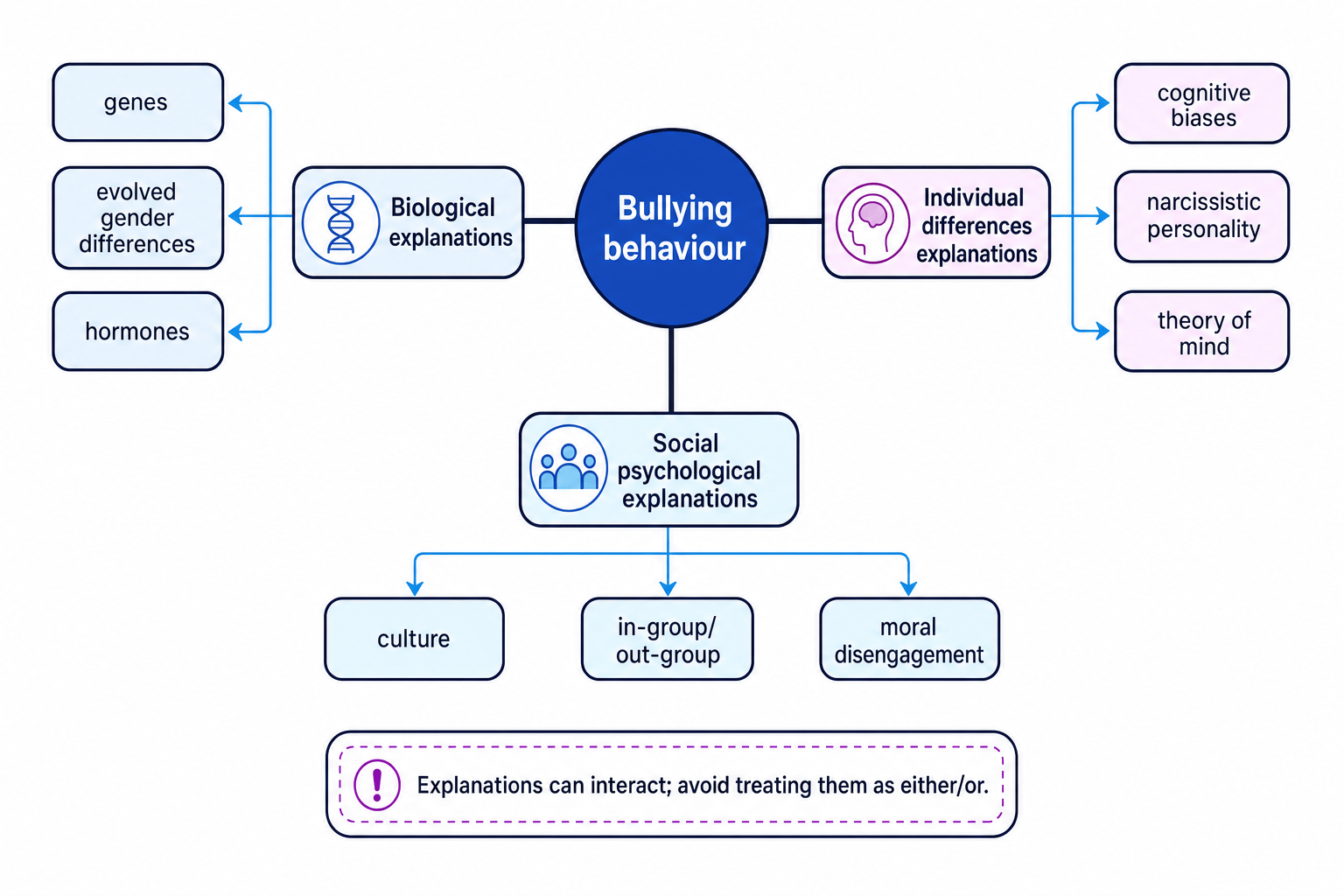
- Biological explanations: how genes, evolution and hormones may influence bullying.
- Individual differences explanations: how personality and thinking styles may make bullying more likely.
- Social psychological explanations: how culture, group identity and moral reasoning shape bullying.
These explanations are best seen as interacting rather than competing.
Interaction, not either/or
A strong answer says that bullying may result from several interacting factors: a biological predisposition, a hostile thinking style, and a peer group that rewards dominance can all combine.
Biological explanations
Bullying genes
A genetic explanation suggests that inherited biological differences may make some people more likely to show aggressive, dominant or impulsive behaviour.
Heritability
Heritability is the extent to which differences between people in a behaviour are associated with genetic differences within a particular population.
This does not mean there is a single “bullying gene”. Instead, genes may influence traits linked to bullying, such as impulsivity, low emotional regulation, dominance-seeking or aggression.
A useful study is Ball et al. (2008), who used twin data to examine genetic and environmental influences on bullying roles. Twin studies compare identical twins, who share all their genes, with non-identical twins, who share about half. If identical twins are more similar in bullying behaviour than non-identical twins, this suggests a genetic influence.
AO3 evaluation: twin studies are valuable because they separate genetic and environmental influences more clearly than ordinary correlations. However, they rely on assumptions, such as the equal environments assumption: identical and non-identical twins must be treated equally similarly for the comparison to be fair. Genetic explanations can also become reductionist if they ignore school culture, family life and peer reinforcement.
Evolved gender differences
An evolutionary explanation argues that some behavioural tendencies developed because they helped ancestors survive or reproduce.
Applied to bullying, this explanation suggests that males and females may be more likely to use different forms of aggression because of different evolutionary pressures. For example, direct physical aggression may historically have helped males compete for status, while indirect relational aggression may have allowed females to damage rivals’ social reputation while avoiding physical danger.
Björkqvist, Lagerspetz and Kaukiainen (1992) found that girls were more likely to use indirect forms of aggression, such as exclusion and rumour-spreading, while boys were more likely to use direct physical aggression.
AO3 evaluation: this explanation helps explain why bullying can take different forms. However, it risks stereotyping gender. Boys can use relational bullying and girls can use physical bullying. Cultural norms and school rules also affect which behaviours are rewarded or punished, so evolution is not a complete explanation.
Hormones
Hormones
Hormones are chemical messengers released by glands that travel in the bloodstream and influence bodily processes and behaviour.
The hormone most often linked to aggression is testosterone, which is associated with dominance and status-seeking. Higher testosterone may increase sensitivity to threats to status, making bullying more likely in competitive peer contexts.
Research such as Olweus et al. (1988) found links between testosterone and aggressive behaviour in adolescent males. However, hormone research is usually correlational, so it cannot prove that hormones directly cause bullying.
Another relevant hormone is cortisol, which is involved in stress responses. Some research suggests that low cortisol reactivity may be linked with fearlessness or reduced sensitivity to punishment, which could make persistent bullying more likely.
Biological determinism
Do not write as if biology “makes” someone a bully. Biological factors may increase risk, but behaviour is still shaped by learning, choices, peer norms and school responses.
Individual differences explanations
Cognitive biases
Cognitive bias
A cognitive bias is a systematic error in thinking that affects how a person interprets events.
One important bias is hostile attribution bias. This means interpreting ambiguous behaviour as deliberately hostile. For example, if someone bumps into a pupil in the corridor, the pupil assumes it was intentional and retaliates.
Dodge (1980) and the later Crick and Dodge (1994) social information-processing model suggest that aggressive children may process social situations differently: they notice threat cues, interpret others as hostile, and choose aggressive responses.
AO3 evaluation: this explanation is useful for reactive bullying, where the bully claims they were provoked. But it may not explain calculated bullying done for popularity or power. It also relies heavily on self-report or hypothetical scenarios, which may lack ecological validity.
Narcissistic personality
Narcissism
Narcissism is a personality pattern involving an inflated sense of self-importance, a need for admiration and sensitivity to criticism.
A narcissistic pupil may bully when their status is threatened. This links to the threatened egotism explanation: aggression is most likely when someone with a grand view of themselves feels insulted or disrespected.
Bushman and Baumeister (1998) found that narcissistic individuals were especially aggressive after receiving an ego threat. In bullying, this could mean humiliating someone who challenges the bully’s popularity or competence.
AO3 evaluation: narcissism can explain status-based bullying, but it does not explain every case. Some bullies may have low self-esteem, social anxiety or be imitating peers. Personality explanations can also wrongly label the individual while ignoring the group environment.
Theory of mind
Theory of mind
Theory of mind is the ability to understand that other people have their own thoughts, feelings, beliefs and intentions.
A simple assumption would be that bullies lack theory of mind because they do not understand victims’ feelings. However, the evidence is more complex.
Sutton, Smith and Swettenham (1999) found that some ringleader bullies had good social understanding. They could read others’ emotions and intentions, but used this skill manipulatively.
This is an important contradictory finding. Bullying may not always come from social ignorance. Some bullying may involve skilled social manipulation, especially relational bullying.
Social psychological explanations
Cultural differences
A cultural explanation focuses on shared norms, values and expectations within a society or community.
Bullying may be more common where dominance, toughness or strict social hierarchy are valued. It may also be reported differently across cultures because words for “bullying” do not always translate neatly.
Smith et al. (2002) studied definitions of bullying across countries and found variation in how children understood bullying-related terms. This matters because cross-cultural research may measure slightly different behaviours in different places.
AO3 evaluation: cultural explanations are useful because they move beyond blaming individuals. However, they can overgeneralise whole cultures and may ignore variation between schools within the same country.
In-group and out-group processes
In-group and out-group
An in-group is a group a person sees themselves as belonging to. An out-group is a group they see as different or separate from them.
Tajfel et al. (1971) showed that people can favour their in-group even when groups are created for trivial reasons. Tajfel and Turner’s (1979) social identity theory argues that people gain self-esteem from group membership.
In bullying, a group may strengthen its identity by excluding or humiliating an out-group member. For example, pupils may target someone seen as “weird”, “new” or “not one of us”. Bullying then becomes a way to signal loyalty to the in-group.
Moral disengagement
Moral disengagement
Moral disengagement is when people switch off normal moral standards so they can harm others without feeling guilt.
Bandura (1991, 1999) described mechanisms such as:
- Moral justification: “We’re teaching them a lesson.”
- Euphemistic labelling: “It’s just banter.”
- Diffusion of responsibility: “Everyone joined in.”
- Dehumanisation: treating the victim as less worthy of respect.
Research by Hymel, Rocke-Henderson and Bonanno (2005) and the meta-analysis by Gini, Pozzoli and Hymel (2014) supports a link between moral disengagement and bullying.
Applying explanations to a bullying scenario
A popular pupil repeatedly posts edited images mocking a new student. Their friends like and share the posts. When challenged, the pupil says, “It’s only banter — they need to toughen up.”
- Identify whether it is bullying: the behaviour is repeated, intentional, public and involves a power imbalance because the popular pupil has social influence.
- Apply a social explanation: the likes and shares reward the behaviour, and the in-group gains status by humiliating the out-group member.
- Apply moral disengagement: “It’s only banter” is euphemistic labelling, reducing guilt by making harm sound harmless.
- Apply individual differences cautiously: if the bully says the victim “deserved it”, this could suggest hostile attribution bias or narcissistic sensitivity to status threat.
- Avoid overclaiming biology: you cannot infer genes or hormones from the scenario unless biological evidence is provided.
AO3: comparing the explanations
A strong essay balances explanations rather than listing them.
Biological explanations are scientific and can use objective measures, such as hormone levels or twin comparisons. However, they can be reductionist and often rely on correlations.
Individual differences explanations are useful for understanding why one pupil bullies while another in the same school does not. But they may ignore peer reinforcement, school ethos and bystander behaviour.
Social psychological explanations are strong for real-world application because anti-bullying programmes can target group norms, bystander responsibility and moral disengagement. However, they may underplay individual personality and biological risk factors.
Evaluation shortcut
For each explanation, ask: What does it explain well? What does it ignore? What research supports it? What method limits the evidence?
Investigating bullying explanations
Bullying research often uses questionnaires, interviews, peer nominations, teacher reports or observations. Each method has strengths and weaknesses. Self-reports access private experiences but may be affected by social desirability. Peer nominations may identify bullying roles clearly but can risk labelling pupils.
Ethically, bullying research usually involves children or young people, so researchers must follow the BPS Code of Ethics and Conduct carefully: informed consent from parents or guardians, assent from pupils, right to withdraw, confidentiality, protection from harm, careful debriefing and safeguarding if serious harm is disclosed. Deception should be avoided unless strongly justified.
If you designed a practical investigation, descriptive statistics might include the mean, median, mode, range and standard deviation. Graph choices should fit the data: bar charts for categories, scattergraphs for correlations and line graphs for change over time.
For inferential tests, use the design and level of measurement. Spearman’s rho is used for correlations with ordinal data. Chi-square is used for associations between nominal categories. Mann-Whitney U compares two unrelated groups with ordinal data. Wilcoxon signed-ranks compares two related conditions with ordinal data. Unrelated and related t-tests are used with interval data where assumptions are met. The binomial sign test is used for simple related differences shown as signs.
Researchers usually use a significance level of p≤0.05p \leq 0.05p≤0.05. They compare the observed value with a critical value from a table. For Spearman’s rho, chi-square and t-tests, the observed value usually needs to be equal to or greater than the critical value. For Mann-Whitney U, Wilcoxon and the sign test, it usually needs to be equal to or less than the critical value. A one-tailed test is used for a directional hypothesis; a two-tailed test is used for a non-directional hypothesis.
Choosing a statistical test for a bullying investigation
A researcher measures pupils’ moral disengagement scores and their self-reported bullying frequency, predicting that higher moral disengagement will be linked with more bullying.
- Identify the aim: the researcher is testing a relationship between two co-variables, not comparing groups.
- Identify the level of measurement: questionnaire scores and bullying frequency are at least ordinal because they can be ranked.
- Choose the test: Spearman’s rho is appropriate because it tests a correlation using ranked data.
- Choose the tail: the hypothesis is directional, so a one-tailed test is suitable.
- Make the decision: compare the observed rho with the critical value at p≤0.05p \leq 0.05p≤0.05; if the observed value is large enough, reject the null hypothesis.
In the exam
- Start by defining bullying using intent, repetition and power imbalance.
- For each explanation, give AO1 description, one named study with researcher and year, then AO3 evaluation.
- Avoid single-cause answers: explain how biology, individual differences and social context can interact.
- Include ethics when discussing research, especially consent, confidentiality, protection from harm and debriefing.
Check yourself
- Why is it too simplistic to say there is a “bullying gene”?
- How can moral disengagement allow a pupil to bully without feeling guilty?
- Which explanation best accounts for bullying that is used to gain popularity within a peer group?