What you'll learn
- What “modifying autistic spectrum behaviours” should mean in a respectful, exam-ready way.
- How the Picture Exchange Communication System (PECS) aims to improve functional communication.
- How Relationship Development Intervention (RDI) aims to develop reciprocal social interaction.
- How to evaluate both methods using evidence, methodology, ethics and real-world application.
Starting point: what are we trying to modify?
Autistic spectrum behaviours are not a single behaviour. Autism is a spectrum, meaning autistic people vary widely in strengths, needs and experiences. Behaviours may include differences in social communication, social interaction, flexibility, sensory processing and repetitive or restricted patterns of behaviour.
Autistic spectrum behaviours
Autistic spectrum behaviours are behaviours associated with autism spectrum conditions, such as differences in communication, social reciprocity, routines, interests and sensory responses. In psychology, these behaviours should be described specifically rather than treated as one general “problem”.
In this topic, a method of modifying behaviour means an intervention designed to change a specific behaviour or skill. For example, an intervention might increase a child’s ability to request food, share attention with a parent, tolerate small changes in routine, or take turns in play.
Modification should support the person
The aim should not be to “cure” autism or make an autistic person appear non-autistic. A good intervention supports communication, wellbeing, independence and quality of life.
Before choosing a method, practitioners should identify the target behaviour, meaning the specific behaviour to change or develop. They may also take a baseline, which is a measurement of the behaviour before the intervention begins, so that progress can be judged more objectively.
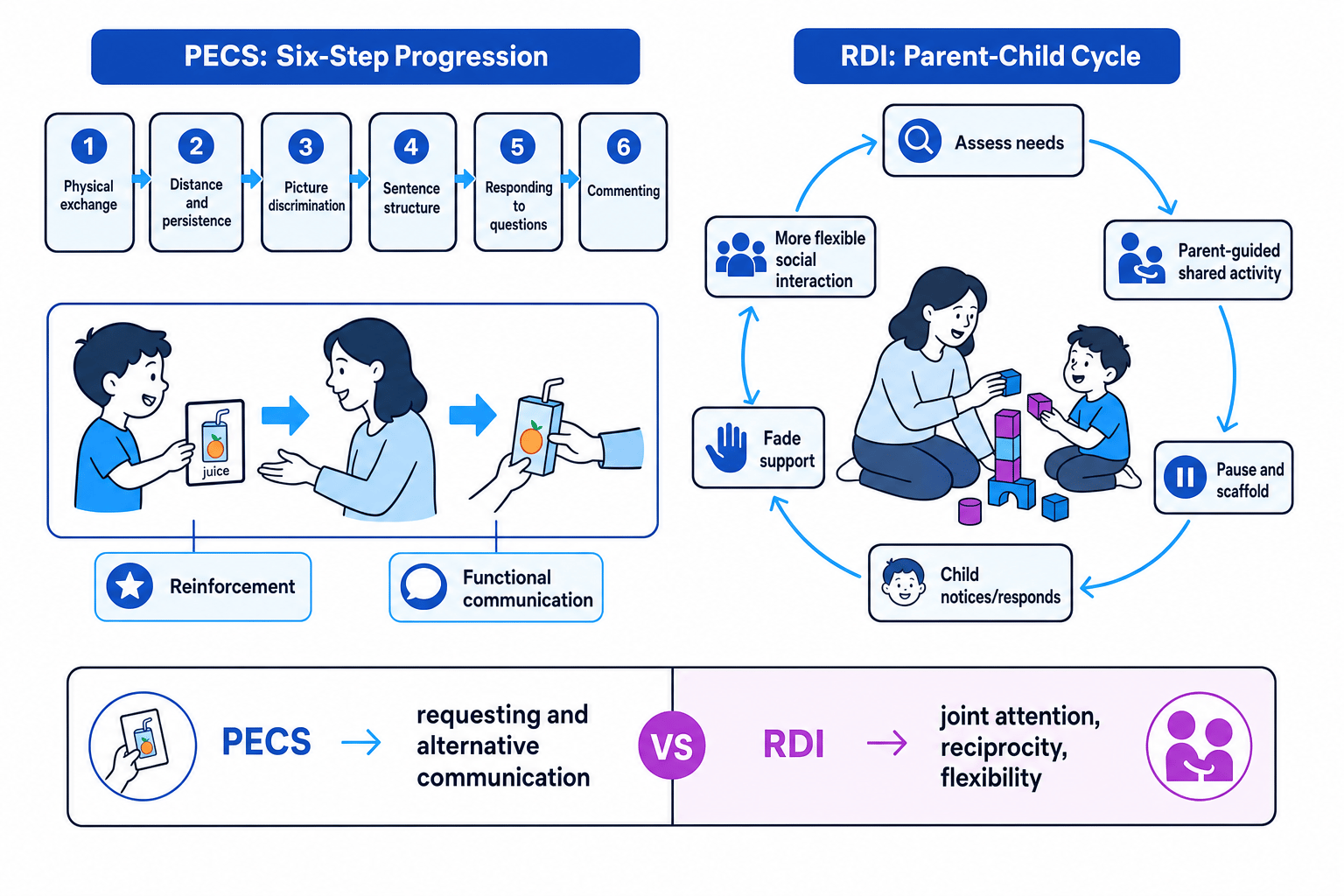
PECS and RDI both modify social-communication behaviour, but they work in different ways: PECS uses structured picture exchanges and reinforcement, while RDI uses caregiver-guided shared experiences and gradual support.
Method 1: Picture Exchange Communication System (PECS)
What is PECS?
Picture Exchange Communication System (PECS)
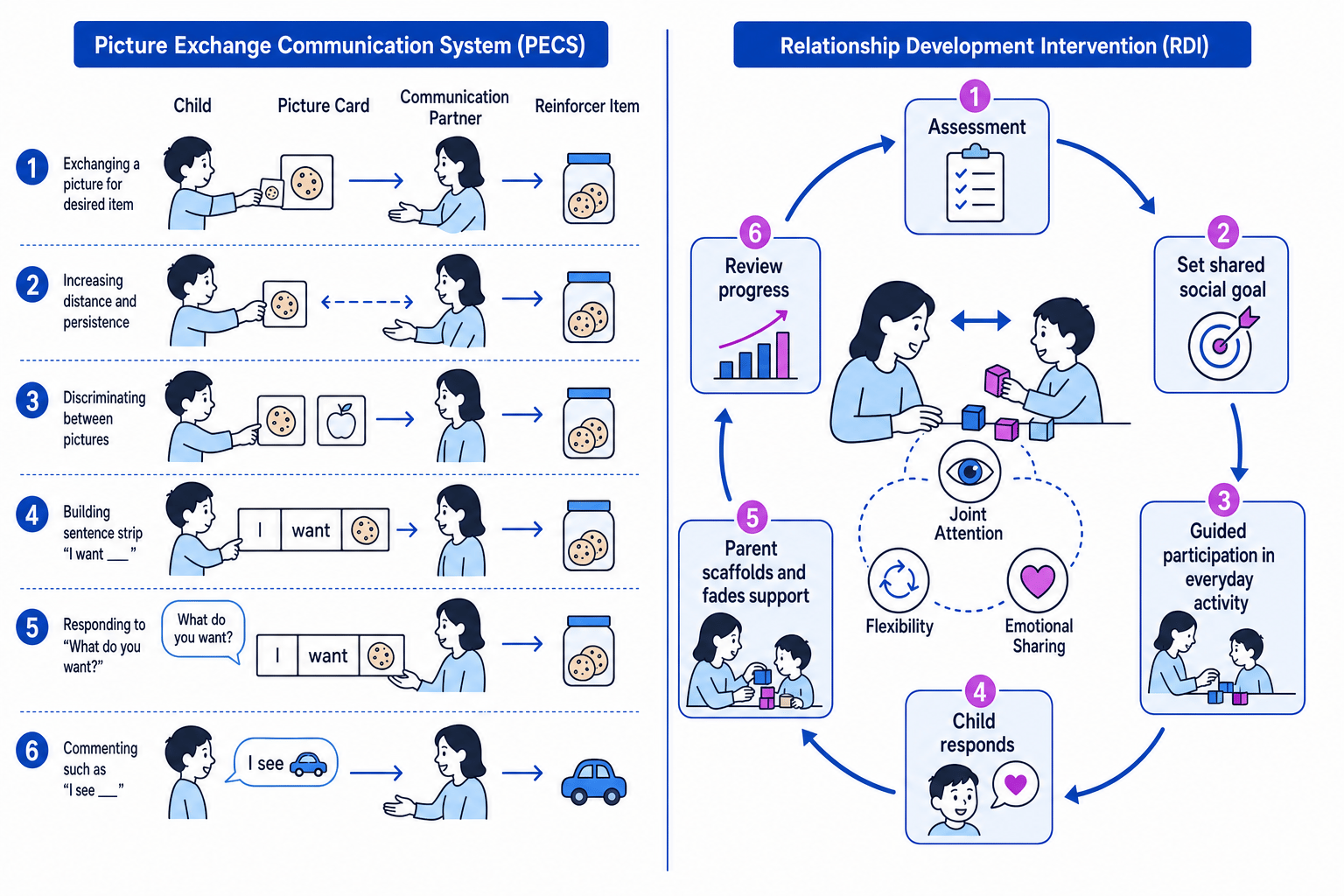
PECS is a structured communication intervention in which a learner gives a picture or symbol to a communication partner in exchange for a desired item, activity or social response.
PECS was developed by Bondy and Frost (1994). It is often linked to operant conditioning, which is learning through consequences. In PECS, successful communication is followed by reinforcement, meaning a consequence that increases the likelihood of the behaviour happening again. For example, if a child gives a picture of juice and then receives juice, the picture exchange is reinforced.
PECS is designed especially for people who have limited spoken language or who need an alternative way to communicate. It does not require the learner to speak first. This is important because it can reduce frustration by giving the person a functional way to express needs.
The six PECS phases
PECS is usually taught in stages.
- Physical exchange: the learner gives a picture to a communication partner and receives the item.
- Distance and persistence: the learner travels further or works harder to give the picture.
- Picture discrimination: the learner chooses between different pictures.
- Sentence structure: the learner uses a sentence strip, such as “I want biscuit”.
- Responding to questions: the learner responds to prompts such as “What do you want?”
- Commenting: the learner uses pictures to make comments, such as “I see car”.
A prompt is help given to encourage the correct response, such as guiding the learner’s hand or pointing to a picture. Prompt fading means gradually reducing that help so the learner becomes more independent.
How PECS modifies behaviour
PECS mainly modifies communication behaviour. It can increase spontaneous requesting, reduce reliance on crying or grabbing, and sometimes support spoken language. It may also reduce behaviours that are challenging if those behaviours previously happened because the person could not communicate a need.
Choosing the next PECS target
A child gives a single picture of a biscuit to an adult when the picture is placed directly in front of them. However, when shown a biscuit picture and a toy picture, the child chooses randomly.
- The child has already learned the basic exchange, because they can hand over one picture to obtain the biscuit.
- The child is not yet discriminating accurately between pictures, because they choose randomly when two options are present.
- The next target should be Phase 3: picture discrimination. The adult should practise choices between preferred and less preferred items, reinforce correct choices, and fade prompts so the child learns the meaning of each picture.
Evaluating PECS
Strengths
A major strength of PECS is that it is practical and concrete. Many autistic learners are strong visual processors, so pictures may be easier to use than spoken language alone. PECS can also be used across home, school and community settings, supporting generalisation, which means transferring a skill to new people, places or situations.
There is also research support. Charlop-Christy et al. (2002) found that PECS training was associated with increases in communication and some increases in speech and social-communicative behaviours. This supports the idea that PECS can have effects beyond simply handing over pictures.
A stronger piece of evidence is Howlin et al. (2007), who conducted a randomised controlled trial of PECS training in schools. They found improvements in communication initiations and PECS use during the intervention. However, the effects on broader language and social communication were more limited, which gives a more balanced picture.
Weaknesses
One limitation is that PECS may focus heavily on requesting rather than deeper reciprocal interaction. A learner might become good at asking for objects but still struggle with shared attention, emotional understanding or flexible conversation.
Another issue is that PECS requires consistent training. If teachers, parents and support workers use the system differently, progress may be slower and generalisation may be weaker.
Methodologically, some PECS research uses small samples or short follow-up periods. This makes it harder to know whether improvements are long-lasting or whether they apply to all autistic people.
Ethics
PECS should follow the BPS Code of Ethics and Conduct. Parents or carers should give informed consent, and the learner’s assent should be respected where possible. Practitioners should avoid causing frustration by withholding communication opportunities for too long. Confidentiality is also important if progress data, videos or school reports are used.
Method 2: Relationship Development Intervention (RDI)
What is RDI?
Relationship Development Intervention (RDI)
RDI is a parent-mediated intervention that aims to develop reciprocal social interaction, emotional sharing, flexibility and relationship skills through guided everyday activities.
RDI is associated with Gutstein and Sheely (2002). Unlike PECS, it is not mainly about exchanging symbols for objects. Instead, it focuses on the quality of social interaction between the child and caregiver.
Important RDI ideas include:
- Joint attention: sharing focus on the same object or event with another person.
- Social reciprocity: back-and-forth social responding, such as turn-taking or shared enjoyment.
- Scaffolding: temporary support from an adult that is gradually reduced.
- Dynamic intelligence: flexible thinking and problem-solving in changing social situations.
How RDI works
RDI usually begins with assessment of the child’s needs and the family context. Parents or caregivers are coached to create structured but natural opportunities for interaction. Activities might involve cooking, sorting objects, going for a walk, building a tower, or tidying together.
The adult does not simply instruct the child. Instead, they slow the activity down, create small moments of uncertainty, encourage the child to notice the adult’s face, actions or emotions, and then support the child’s response. Over time, the adult fades support so the child becomes more flexible and socially engaged.
How RDI modifies behaviour
RDI aims to modify behaviours linked to social reciprocity and flexibility. For example, it may increase turn-taking, shared attention, emotional referencing and tolerance of change. It may reduce distress in social situations by making interaction more predictable and meaningful.
Designing an RDI activity
A parent says their child becomes distressed if play routines change and rarely checks what the parent is doing during play.
- The target is not mainly requesting an object, so RDI is more suitable than PECS for this scenario.
- The parent could choose a simple shared activity, such as building a tower together, and introduce one small variation, such as changing the order of blocks.
- The parent would scaffold the interaction by pausing, using facial expression and waiting for the child to notice or respond, then gradually reduce support as the child tolerates more variation.
Evaluating RDI
Strengths
A strength of RDI is its ecological validity, meaning it takes place in realistic everyday contexts. Because parents use RDI during normal routines, skills may generalise better than skills taught only in a clinic.
RDI also focuses on relationships rather than just compliance. This can be positive because it aims to develop shared enjoyment, flexibility and emotional connection, which are important for wellbeing.
There is some supportive evidence. Gutstein, Burgess and Montfort (2007) reported improvements in social functioning for children involved in RDI. This suggests RDI may help some autistic children develop more flexible social interaction.
Weaknesses
However, the evidence base for RDI is generally less robust than for more widely researched behavioural interventions. Some studies are small, non-randomised or linked to the developers of the programme. This raises concerns about researcher bias, where researchers’ expectations or investment in the intervention may influence interpretation.
RDI can also be time-consuming and expensive. It depends heavily on parent availability, confidence and training. This may create inequality because families with more time, money or support may be better able to access it.
There is also a possible cultural issue. RDI values particular forms of social interaction, such as emotional sharing and joint attention. These are important, but expectations about eye contact, independence and parent-child interaction can vary across cultures and families.
Ethics
RDI may involve video recording parent-child interactions, so informed consent and confidentiality are essential. The child should not be pressured into uncomfortable social behaviour, and adults should be alert to sensory overload, anxiety or fatigue. Debriefing parents is also important so they understand progress realistically and do not feel blamed if change is slow.
PECS and RDI compared
| Feature | PECS | RDI |
|---|---|---|
| Main target | Functional communication, especially requesting | Social reciprocity, flexibility and relationships |
| Main method | Picture exchange followed by reinforcement | Parent-guided shared activities |
| Theoretical link | Behaviourist principles, especially operant conditioning | Developmental and relationship-based approaches |
| Best suited to | A learner who needs a clear communication system | A learner who needs support with shared interaction and flexibility |
| Key limitation | May not develop deeper social understanding | Evidence base is less strong and it can be demanding for families |
Calling interventions cures
Avoid writing that PECS or RDI “cures autism”. They modify specific behaviours or skills, such as communication or social reciprocity, and should be evaluated in terms of support and quality of life.
Applying this in AO2 scenarios
If the scenario describes a child who screams or grabs because they cannot ask for what they want, PECS is likely to be relevant because it provides an alternative communication response.
If the scenario describes a child who struggles with turn-taking, shared enjoyment, coping with change or reading a caregiver’s responses, RDI is likely to be more relevant.
For practical-style application, you could suggest measuring outcomes before and after the intervention. Suitable measures might include frequency of spontaneous picture exchanges, number of reciprocal turns in play, duration of shared attention, or parent/teacher ratings. A stronger investigation would include a baseline, clear operational definitions, inter-rater reliability and follow-up.
In the exam
- Start by defining the aim carefully: these methods support communication and social functioning; they do not “remove” autism.
- For PECS AO1, describe the picture exchange process, reinforcement and at least a few of the six phases.
- For RDI AO1, describe parent-mediated guided participation, joint attention, scaffolding and flexibility.
- For AO3, use named evidence such as Bondy and Frost (1994), Charlop-Christy et al. (2002), Howlin et al. (2007), and Gutstein, Burgess and Montfort (2007), then evaluate methodology and ethics.
Check yourself
- Which method would be more suitable for a child who cannot request preferred items, and why?
- How does scaffolding work in RDI?
- Give one strength and one weakness of the evidence base for PECS or RDI.