What you'll learn
- How drug therapy treats psychological disorders by changing brain chemistry.
- How psychosurgery treats severe disorders by altering brain tissue or circuits.
- How to evaluate biological therapies using AO1, AO2 and AO3.
- How to link therapy to Eduqas biological studies such as Raine et al. (1997) and Brendgen et al. (2005).
Starting point: the biological approach
The biological approach assumes that thoughts, emotions and behaviour are strongly influenced by physical processes in the body and brain. These include genes, brain structures, neurotransmitters, hormones and nervous-system activity.
Biological therapy
A biological therapy is a treatment that aims to reduce psychological symptoms by changing physical processes in the body or brain, such as neurotransmitter activity or brain-circuit functioning.
For Eduqas, the biological therapy is listed as drug therapy OR psychosurgery. Your class may focus on one in depth, but it is useful to understand both so you can compare them and choose the strongest material for essays.
Core assumption
If a psychological disorder has a biological basis, then changing the relevant biological process may reduce the symptoms.
The biological approach is supported by Eduqas studies. Raine, Buchsbaum and LaCasse (1997) used PET scans and found differences in brain activity in murderers pleading not guilty by reason of insanity, including reduced activity in areas such as the prefrontal cortex. Brendgen et al. (2005) used twin data to investigate genetic and environmental influences on social aggression. These are not therapy studies, but they support the wider idea that behaviour can be linked to brain and genetic factors.
Study link mistake
Do not write that Raine et al. (1997) or Brendgen et al. (2005) “proved” a therapy works. They support biological assumptions, but they are not direct tests of drug therapy or psychosurgery.
Option 1: drug therapy
Drug therapy uses medication to alter biological processes linked to psychological symptoms. In psychology, these drugs are often called psychotropic drugs, meaning drugs that affect mood, thinking or behaviour.
Neurotransmitters and synapses
A neurotransmitter is a chemical messenger that passes signals between nerve cells. A synapse is the tiny gap between two neurons. A receptor site is a specialised area on the receiving neuron where a neurotransmitter can bind.
Drugs can increase or decrease communication at the synapse. This matters because many psychological disorders are associated with unusual neurotransmitter activity.
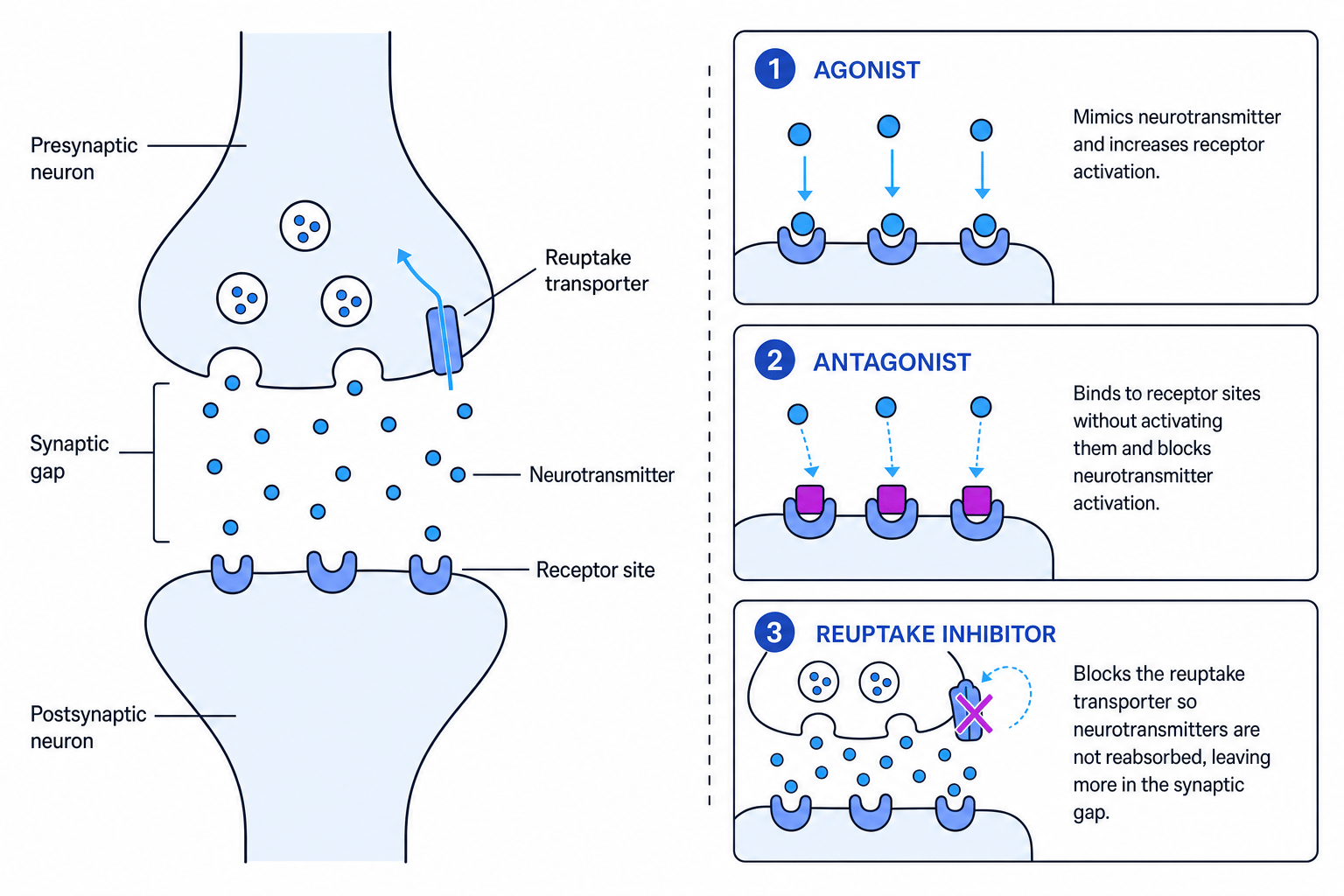
Three common drug actions
- An agonist increases the activity of a neurotransmitter system.
- An antagonist blocks or reduces the activity of a neurotransmitter system.
- A reuptake inhibitor prevents neurotransmitters being reabsorbed too quickly, so more remains available in the synapse.
Examples of drug therapy
One common example is an SSRI, a selective serotonin reuptake inhibitor. SSRIs are often used for depression and obsessive-compulsive disorder. They block the reuptake of serotonin, so serotonin remains active in the synapse for longer.
Another example is an antipsychotic, often used for schizophrenia. Traditional antipsychotics reduce dopamine activity by blocking dopamine receptors. Newer atypical antipsychotics may affect dopamine and serotonin systems.
A third example is a benzodiazepine, sometimes used for anxiety. These increase the effect of GABA, a neurotransmitter that reduces nervous-system activity, producing a calming effect.
Applying drug action to a scenario
A patient has depression and is prescribed an SSRI.
- Identify the symptom target: depression often involves low mood, reduced motivation and negative thinking, which may be linked to serotonin activity.
- Apply the mechanism: an SSRI blocks serotonin reuptake, so serotonin remains available in the synapse for longer.
- Link mechanism to outcome: increased serotonin signalling may reduce depressive symptoms, making it easier for the patient to function and engage with psychological therapy.
AO3 evaluation of drug therapy
A major strength is that drug therapy can be effective and practical. Medication can reduce severe symptoms relatively quickly, especially when someone is too distressed to engage with talking therapy. This gives drug therapy strong real-world application.
Drug therapy is also easier to test scientifically than many therapies. Researchers can use randomised controlled trials, where participants are randomly allocated to a drug group or placebo group. A placebo is an inactive treatment used for comparison. Trials may be double-blind, meaning neither participants nor researchers know who receives the real drug, reducing expectation bias.
However, drug therapy can have side effects. SSRIs may cause nausea, sleep problems or emotional blunting. Antipsychotics can cause movement problems, weight gain or sedation. Benzodiazepines can lead to tolerance or dependence if used for too long.
Drug therapy may also be criticised as reductionist. This means it explains complex psychological problems mainly in terms of biology, possibly ignoring trauma, relationships, culture, learning and thinking patterns.
Balanced evaluation phrase
A strong AO3 point is: “Drug therapy may reduce symptoms, but it may not address the psychological or social causes that helped maintain the disorder.”
Ethically, patients should give informed consent, understand likely benefits and side effects, have confidentiality protected, and be monitored for harm. If drug research uses non-human animals before human trials, researchers must justify the use of animals, minimise suffering and consider whether animal findings apply to humans.
Option 2: psychosurgery
Psychosurgery is brain surgery carried out to reduce severe psychological symptoms. It involves altering or destroying small areas of brain tissue believed to be involved in the disorder.
Psychosurgery
Psychosurgery is a biological therapy that changes brain tissue or brain circuits in order to treat a psychological disorder.
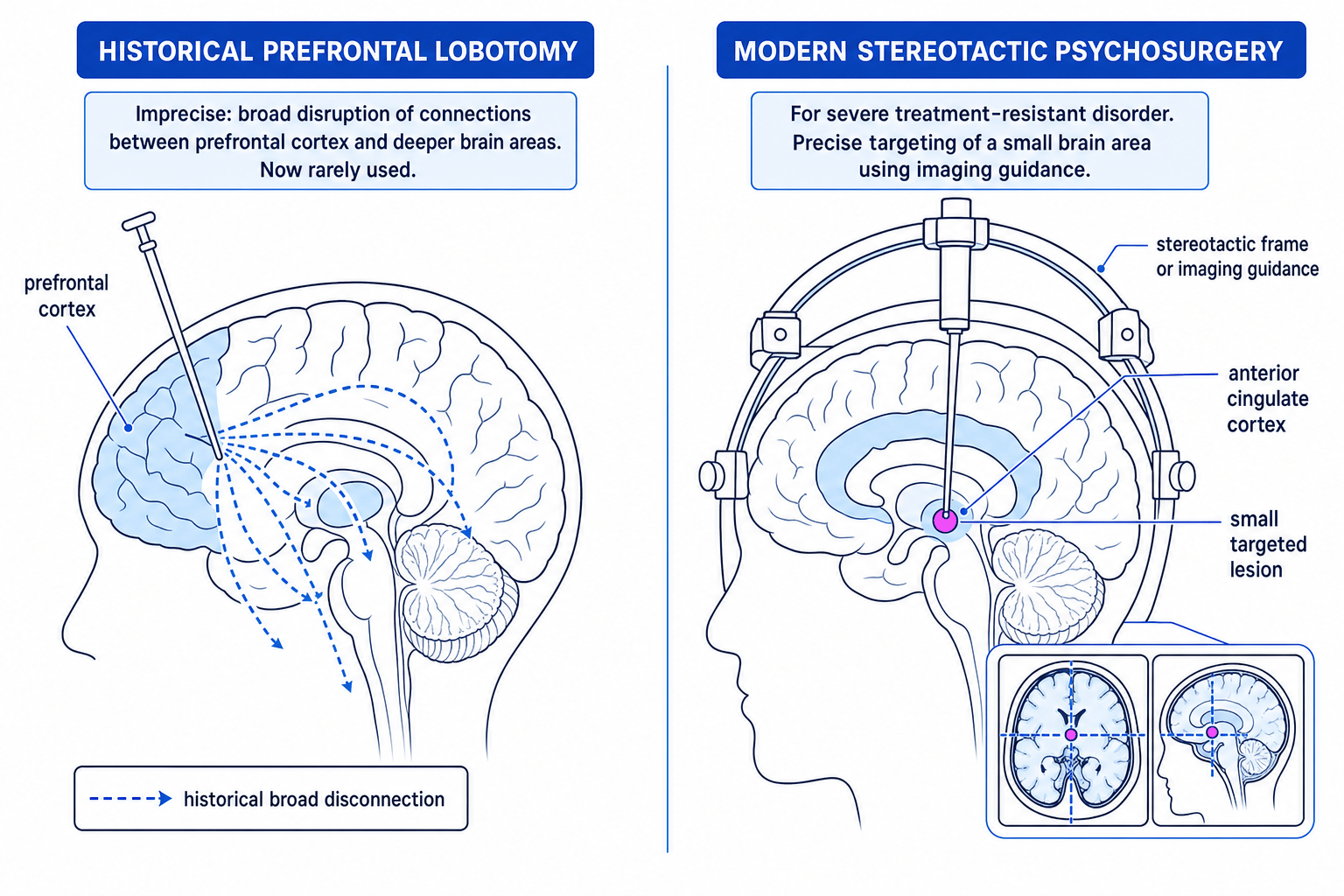
Historically, psychosurgery included procedures such as the prefrontal lobotomy, where connections involving the prefrontal cortex were disrupted. These early procedures were imprecise and could cause serious personality, emotional and cognitive changes.
Modern psychosurgery is much more controlled. Stereotactic surgery uses brain imaging and precise coordinates to target a small area, such as the anterior cingulate cortex, sometimes in severe treatment-resistant obsessive-compulsive disorder or depression.
When might psychosurgery be considered?
Psychosurgery is not a first-line treatment. It may only be considered when a person has a severe, long-lasting disorder and has not responded to other treatments such as medication and psychological therapy.
Deciding whether psychosurgery is appropriate
A person has severe OCD and has not responded to several medications or CBT.
- Assess severity: the symptoms are severe and long-lasting, so the potential benefit of intervention may be high.
- Check treatment resistance: because medication and CBT have not worked, more extreme biological treatment might be considered.
- Weigh risks and ethics: psychosurgery is invasive and may be irreversible, so informed consent, protection from harm and specialist review are essential before proceeding.
AO3 evaluation of psychosurgery
A strength of modern psychosurgery is that it can help some people with extremely severe symptoms when other treatments have failed. This gives it important real-world value for a small group of patients.
Another strength is that modern techniques are more precise than historical lobotomies. Brain imaging allows surgeons to target smaller areas, reducing some risks compared with earlier methods.
However, psychosurgery has serious weaknesses. It is invasive, may be irreversible, and can produce unwanted changes in emotion, motivation, memory or personality. Because it is rare and ethically difficult to study, evidence often comes from small samples rather than large controlled trials.
There are also major ethical issues. Patients must give valid consent, understand the risks, and have the right to withdraw before treatment. Clinicians must protect patients from harm and avoid using surgery simply because a patient is difficult to manage. The history of lobotomy is a warning about what can happen when biological treatments are used without strong ethical safeguards.
Irreversibility
Unlike many drug treatments, psychosurgery may permanently alter brain tissue. This makes the risk-benefit decision much stricter.
Drug therapy vs psychosurgery
Drug therapy is generally less invasive, easier to stop or adjust, and more widely used. It is suitable for a larger number of disorders and can be tested using stronger experimental designs.
Psychosurgery is much rarer and more extreme. It may be valuable for severe treatment-resistant cases, but its risks and ethical issues are greater.
Comparison
Drug therapy changes brain chemistry temporarily or semi-temporarily; psychosurgery changes brain circuits more directly and may be permanent.
Research-methods links for evaluation
When evaluating evidence for biological therapies, think like a Component 2 psychologist.
Drug trials often compare symptom scores before and after treatment or between treatment and placebo groups. Depending on the design and data, researchers might use related or unrelated t-tests, Wilcoxon signed-ranks, Mann-Whitney U, chi-square or the binomial sign test. Results are usually judged significant if p≤0.05p \leq 0.05p≤0.05.
But significance is not the same as importance. A drug may produce a statistically significant improvement but still have unpleasant side effects or only a small real-life benefit.
For psychosurgery, small samples make it harder to generalise findings. Placebo controls are also ethically and practically difficult because sham surgery would expose patients to risk without clear benefit.
AO1, AO2 and AO3 in essays
For AO1, describe the therapy clearly: what it is, how it works, and which symptoms or disorders it may treat.
For AO2, apply the therapy to a person or scenario. For example, if someone has depression, explain how an SSRI affects serotonin and why this might reduce symptoms.
For AO3, evaluate using evidence, ethics, side effects, reductionism, real-world usefulness, and methodological issues.
In the exam
- If the question asks for “one biological therapy”, focus on either drug therapy or psychosurgery rather than giving a shallow description of both.
- Link every evaluation point back to effectiveness, ethics or scientific evidence.
- Use named studies carefully: Raine et al. (1997) and Brendgen et al. (2005) support biological assumptions, but they are not direct therapy evidence.
Check yourself
- How does an SSRI affect neurotransmission at the synapse?
- Why is psychosurgery usually considered only after other treatments have failed?
- What is one strength and one weakness of using biological therapies for psychological disorders?
