What you'll learn
- How the biological approach explains behaviour through the body, brain and nervous system.
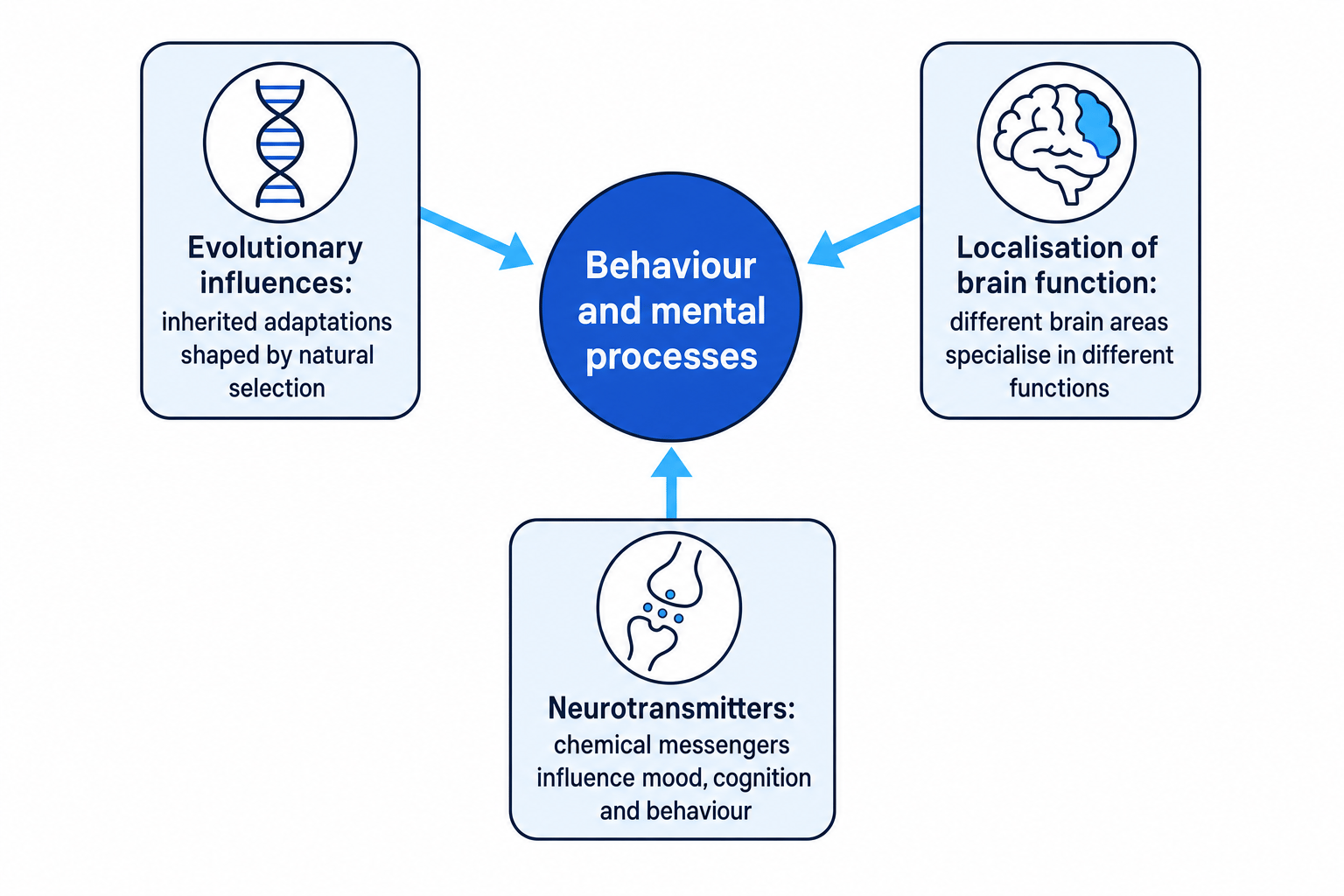
- The three key assumptions for Eduqas: evolutionary influences, localisation of brain function and neurotransmitters.
- How to link the assumptions to named research, especially Raine, Buchsbaum and LaCasse (1997) and Casey et al. (2011).
- How to evaluate the approach using AO3 points such as reductionism, determinism, scientific evidence and ethics.
The big idea: behaviour has biological causes
The biological approach argues that behaviour, thoughts and emotions are strongly influenced by physical processes in the body. These include brain structures, brain chemistry, genes, hormones and evolutionary pressures.
Biological approach
The biological approach is a perspective in psychology that explains behaviour in terms of biological processes, such as brain activity, neurotransmitters, hormones, genes and evolution.
This approach is often linked with scientific methods, such as brain scans, laboratory experiments and drug trials. It tends to look for measurable, physical evidence rather than relying only on what people say about their experiences.
Core takeaway
For essays, remember that the biological approach explains behaviour as being influenced by evolution, brain structures and brain chemistry.
Assumption 1: evolutionary influences
Evolution and natural selection
Evolution means that species change over many generations. In psychology, evolutionary explanations suggest that some behaviours exist because they helped our ancestors survive or reproduce.
Natural selection
Natural selection is the process where characteristics that improve survival or reproductive success are more likely to be passed on to future generations.
A behaviour can be described as adaptive if it increases the chance of survival or reproduction. For example, fear of dangerous animals may have helped ancestors avoid injury, while attachment behaviours may have helped infants stay close to caregivers.
This does not mean every modern behaviour is useful. Some behaviours may be a mismatch: they may have been adaptive in ancestral environments but less helpful today.
Explaining a fear using evolution
- Start with the behaviour: a person has a strong fear of snakes, even though they have never been bitten.
- Apply the survival problem: in ancestral environments, snakes could be dangerous, so avoiding them could reduce the risk of death or injury.
- Apply natural selection: individuals who quickly noticed and avoided snakes may have been more likely to survive and pass on genes linked to rapid fear responses.
- Link to modern behaviour: the fear may still appear today, even in situations where the actual danger is very low.
Genes are not destiny
A gene is a section of DNA that contributes to inherited characteristics. Biological psychologists may investigate whether behaviours have a genetic component, but this does not mean behaviour is completely fixed.
Most behaviours are influenced by both nature and nurture. Nature refers to inherited biological factors; nurture refers to environmental influences such as upbringing, culture, learning and relationships.
Writing as if biology is everything
Avoid saying “this behaviour is caused by genes” as if the environment does not matter. Stronger phrasing is: “biological factors may increase vulnerability, but environmental factors can also influence whether the behaviour develops.”
Assumption 2: localisation of brain function
Different brain areas do different jobs
Localisation of brain function means that different areas of the brain are specialised for different tasks.
Localisation of brain function
Localisation of brain function is the idea that specific areas of the brain are associated with specific psychological or behavioural functions.
For example, the visual cortex is involved in vision, the motor cortex is involved in voluntary movement, and the prefrontal cortex is involved in planning, decision-making and impulse control. The amygdala is often linked with emotion and threat detection, while the hippocampus is important for memory.
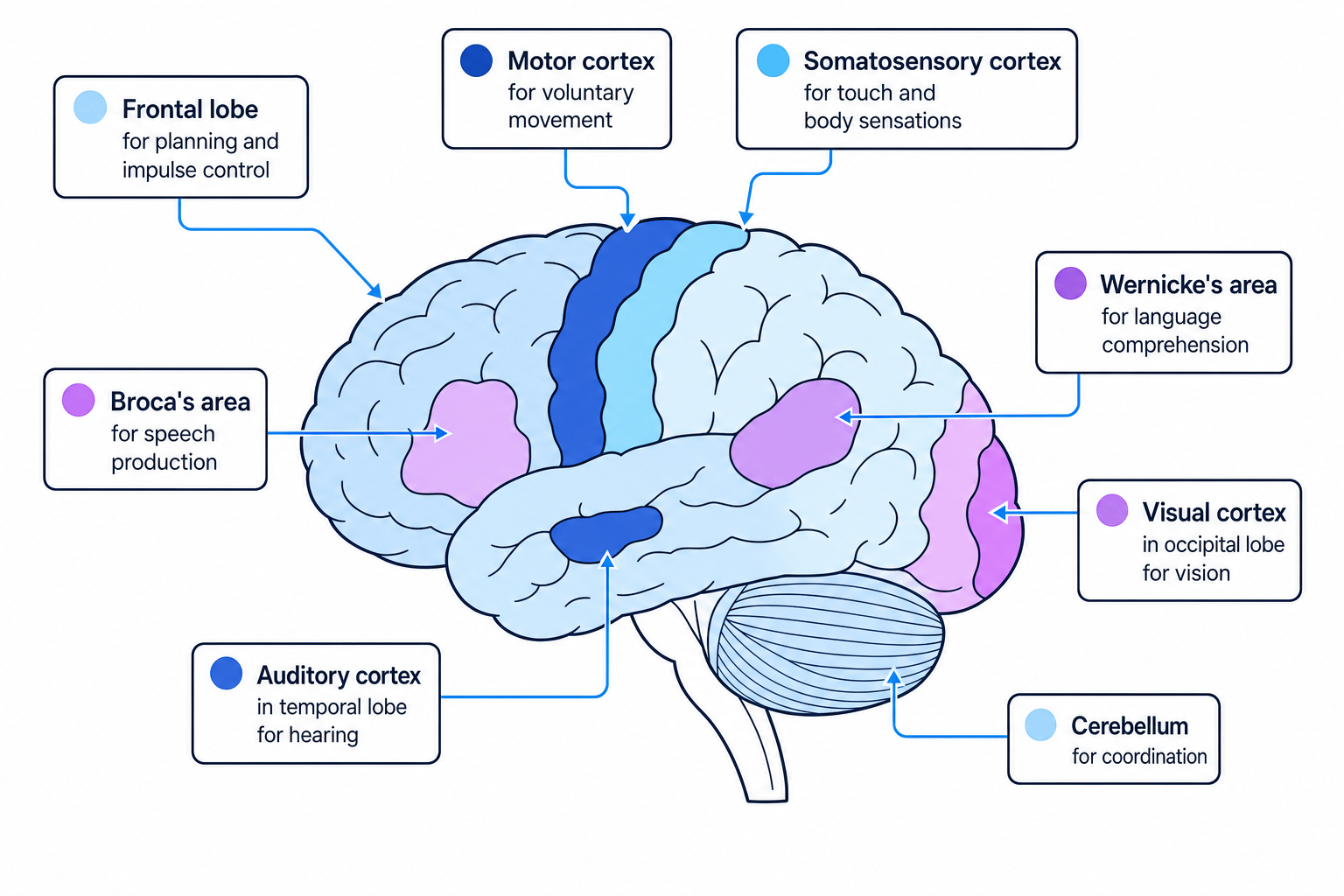
Localisation is important because damage or unusual activity in a brain area may be linked to changes in behaviour. For example, damage to frontal areas may affect impulse control, while damage to language areas may affect speech or comprehension.
Named study link: Raine, Buchsbaum and LaCasse (1997)
The classic biological study for this approach is Raine, Buchsbaum and LaCasse (1997). They used PET scans, which measure brain activity, to compare 41 murderers pleading not guilty by reason of insanity with 41 matched controls.
They found differences in brain activity, including reduced activity in areas such as the prefrontal cortex, which is linked with impulse control and decision-making. This supports the biological assumption that brain functioning can be linked to behaviour.
However, the study does not prove that brain differences caused the murders. It may be that other factors, such as trauma, substance use, mental illness or social background, also played a role.
Good AO3 wording
Use careful phrases such as “is associated with”, “is linked to” or “may contribute to”. Avoid claiming that a brain scan “proves” a behaviour was biologically caused.
Assumption 3: neurotransmitters
How neurons communicate
A neuron is a nerve cell. Neurons communicate using electrical signals within the cell and chemical messages between cells.
A neurotransmitter is a chemical messenger released by one neuron to influence another neuron. The tiny gap between neurons is called a synapse.
Neurotransmitter
A neurotransmitter is a chemical messenger that carries signals across a synapse from one neuron to another.
When a signal reaches the end of a neuron, neurotransmitters are released into the synapse. They bind to receptors on the next neuron. Afterwards, neurotransmitters may be broken down by enzymes or taken back into the original neuron through reuptake.
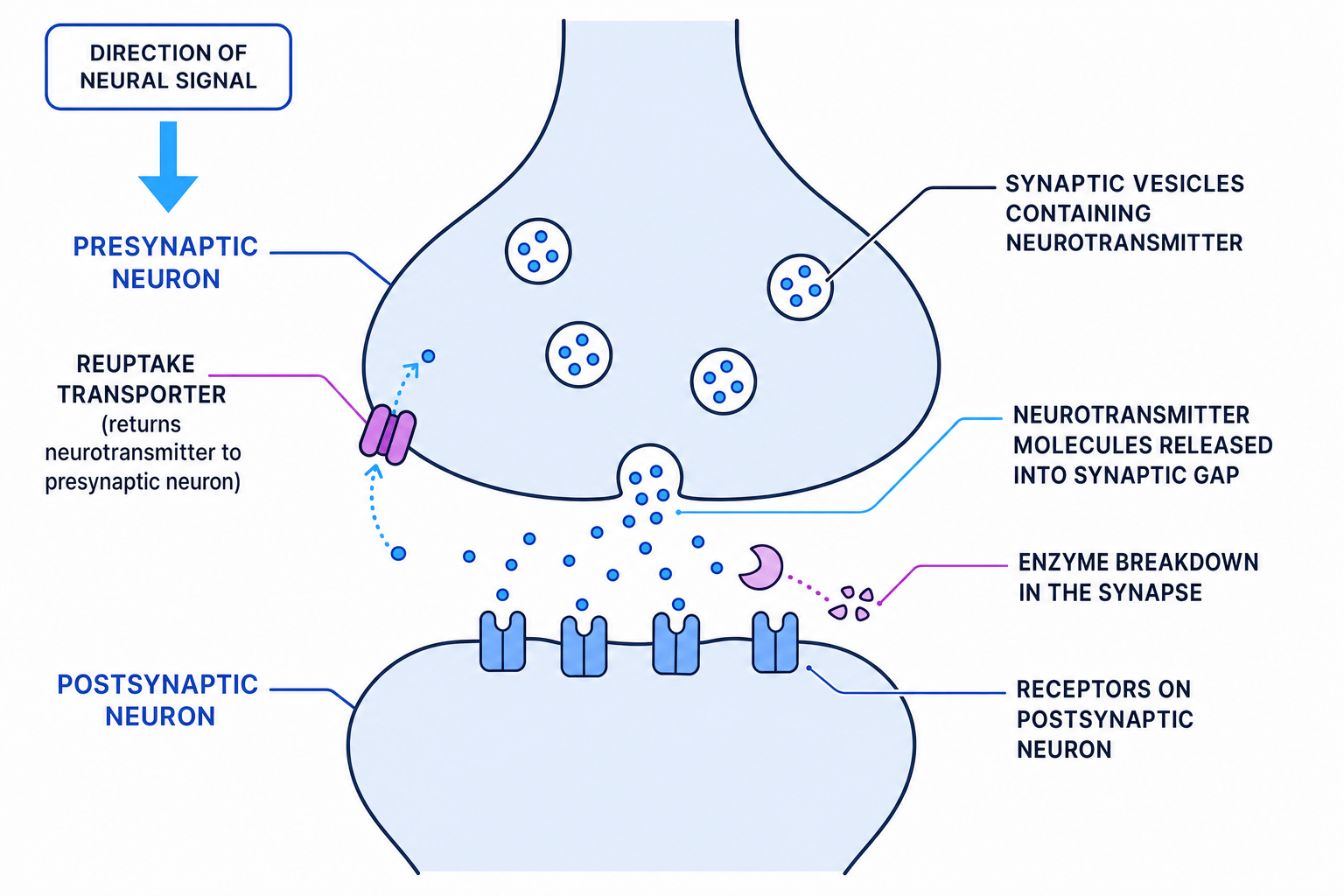
Different neurotransmitters are linked with different functions. For example, dopamine is associated with reward and motivation, while serotonin is associated with mood and impulse control. These links are not simple one-to-one explanations, but they are useful in understanding behaviour and treatment.
Explaining how an SSRI affects neurotransmission
- Link the behaviour to brain chemistry: depression has been associated with low serotonin activity in some explanations.
- Apply the mechanism: an SSRI blocks the reuptake of serotonin, so more serotonin remains available in the synapse.
- Explain the effect on communication: increased serotonin availability may strengthen signalling between neurons involved in mood regulation.
- Add caution: improvement after taking an SSRI supports a role for neurotransmitters, but it does not prove serotonin is the only cause of depression.
Oversimplifying neurotransmitters
Do not write that dopamine “causes addiction” or serotonin “causes happiness”. Neurotransmitters influence patterns of brain activity, but behaviour usually has multiple biological, cognitive and environmental influences.
How the assumptions work together
The three assumptions are often strongest when combined. For example, aggressive behaviour could be explained through:
- Evolutionary influences: aggression may once have helped with competition for resources or protection.
- Brain localisation: reduced prefrontal cortex activity may affect impulse control.
- Neurotransmitters: low serotonin activity has been linked with impulsive aggression.
This kind of answer is more sophisticated than treating each assumption as completely separate.
Contemporary study link: Casey et al. (2011)
A useful contemporary biological study is Casey et al. (2011), which followed up participants from a delay-of-gratification study. The researchers used tasks involving “go” and “no-go” responses, and some participants also had fMRI scans, which measure changes in brain activity.
The study found that people who had been low delayers as children showed more difficulty resisting tempting cues as adults. Brain activity differences were found in areas linked to impulse control and reward, such as the inferior frontal gyrus and ventral striatum.
This supports the biological approach because it links self-control to brain systems. It also shows how biological research can connect brain activity with real-world behaviours such as resisting temptation.
Evaluation: strengths and weaknesses
Strength: scientific and objective
The biological approach often uses objective methods such as PET scans, fMRI scans and controlled drug studies. This can make findings more reliable than relying only on self-report.
Raine et al. (1997), for example, used matched controls and brain scanning, which gives the study a scientific basis.
Strength: useful real-world applications
Biological explanations have led to treatments such as drug therapy. For example, antidepressants and antipsychotics are based on the idea that changing neurotransmitter activity can reduce symptoms.
The approach also helps with understanding brain injury, neurological conditions and mental health difficulties.
Weakness: reductionism
Reductionism means explaining something complex by reducing it to one level of explanation. The biological approach can be criticised for reducing complex behaviours to brain activity or chemicals.
For example, criminal behaviour cannot be fully understood by looking only at the brain. Social learning, poverty, trauma, culture and personal choice may also be relevant.
Weakness: biological determinism
Determinism is the idea that behaviour is controlled by factors outside a person’s free will. Biological explanations can sound deterministic because they emphasise genes, brain structures and chemistry.
This can be problematic if it makes behaviour seem unavoidable. It may also raise ethical concerns, such as labelling people as “dangerous” because of brain differences.
Ethics
Human biological research must follow the BPS Code of Ethics and Conduct, including informed consent, protection from harm, confidentiality, right to withdraw and debriefing. Brain-scan studies also need to consider privacy and the risk of stigma if biological differences are linked to behaviours such as violence.
Animal research may sometimes be used to study brain mechanisms or drug effects. This raises additional ethical issues: researchers must justify harm, minimise suffering and consider whether the benefits outweigh the costs.
In the exam
- For AO1, clearly describe all three assumptions: evolutionary influences, localisation of brain function and neurotransmitters.
- For AO2, apply the correct biological idea to the scenario: brain area, chemical messenger, inherited tendency or adaptive behaviour.
- For AO3, balance scientific strengths with limitations such as reductionism, determinism, causality issues and ethical concerns.
Check yourself
- How would you explain a behaviour using natural selection?
- What does localisation of brain function mean, and how does Raine et al. (1997) support it?
- Why is it too simplistic to say that one neurotransmitter “causes” a whole behaviour?
