What you'll learn
- What Raine, Buchsbaum and LaCasse (1997) investigated in their classic PET study.
- How the study used brain-imaging evidence to compare murderers with controls.
- The main findings about the prefrontal cortex, limbic system and corpus callosum.
- How to evaluate the study for AO3: methodology, ethics, applications and limitations.
Why this study is biological
The biological approach explains behaviour by looking at physical processes in the body and brain. In this topic, the key idea is that violent behaviour may be associated with differences in brain functioning.
Biological approach
The biological approach explains behaviour through biological factors such as brain structures, brain activity, genes, hormones, neurotransmitters and the nervous system.
Raine, Buchsbaum and LaCasse (1997) is the classic Eduqas study for the biological approach because it used brain scanning to investigate whether people charged with murder and pleading not guilty by reason of insanity showed abnormal patterns of brain activity.
Not guilty by reason of insanity
A person pleading not guilty by reason of insanity claims that, because of a severe mental disorder or abnormal mental state, they should not be held fully legally responsible for the crime.
The key brain areas
Before learning the study, you need a few brain-region basics.
Prefrontal cortex
The prefrontal cortex is the front part of the brain’s outer layer. It is involved in planning, decision-making, self-control and regulating impulses.
In Raine et al., this area matters because reduced prefrontal activity could be linked with poorer control over aggressive impulses.
Limbic system
The limbic system is a group of brain structures involved in emotion, motivation and threat responses. Raine et al. focused especially on the amygdala, hippocampus and thalamus.
- The amygdala is involved in fear, aggression and emotional learning.
- The hippocampus is involved in memory and emotional context.
- The thalamus helps relay sensory information and is involved in arousal and attention.
Corpus callosum
The corpus callosum is a bundle of nerve fibres connecting the left and right hemispheres of the brain. Lower activity here could suggest poorer communication between hemispheres.
Biological link to aggression
Raine et al. suggested that violent behaviour may be associated with reduced activity in brain areas responsible for self-control and abnormal activity in areas linked to emotion.
The scanning technique: PET
Raine et al. used positron emission tomography, usually shortened to PET.
PET scan
A PET scan is a brain-imaging technique that measures activity in different brain areas by detecting how much radioactive glucose tracer is being used. More glucose use suggests higher brain activity.
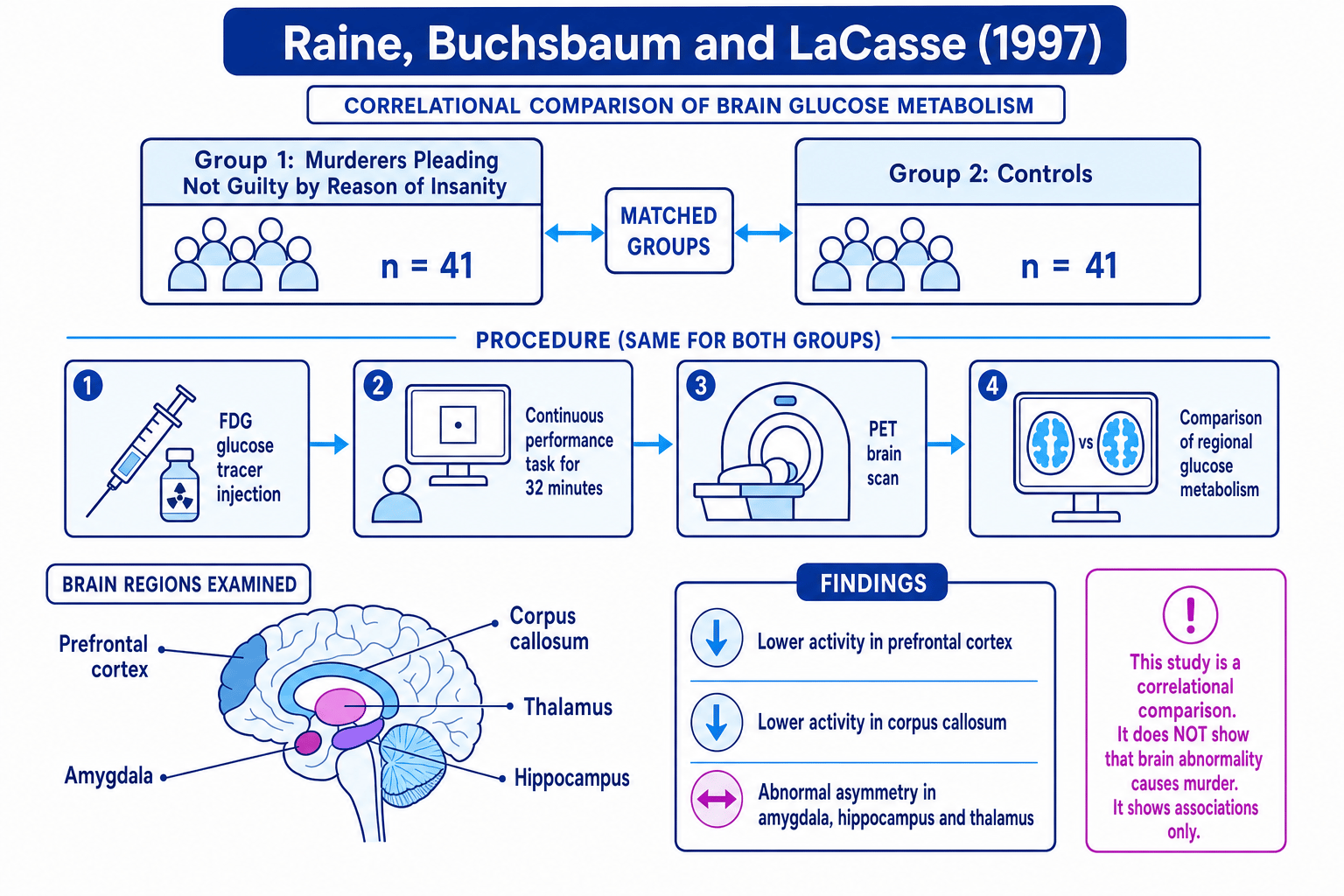
Participants were injected with FDG, a radioactive glucose tracer. Glucose is a sugar used by active brain cells for energy. While the tracer was being taken up by the brain, participants completed a continuous performance task, which is a simple attention task designed to keep brain activity reasonably standardised across participants.
The sequence below summarises how Raine et al. compared the two groups.
AO1: What Raine et al. (1997) did
Aim
The aim was to investigate whether murderers pleading not guilty by reason of insanity had different brain activity from non-murderer controls.
Sample
The study used:
- 41 people charged with or convicted of murder who were pleading not guilty by reason of insanity.
- 41 control participants matched for key characteristics such as age and sex.
Most of the murderer group were male. Some had diagnoses or histories including schizophrenia, head injury, substance abuse, affective disorder, epilepsy, learning difficulties or personality disorder.
Design
This was a quasi-experiment because the researchers compared naturally occurring groups. They did not randomly allocate people to be murderers or controls.
Quasi-experiment
A quasi-experiment compares groups that already exist naturally, rather than groups created by random allocation.
The study also used an independent groups design, because each participant belonged to only one group: murderer or control.
Procedure
All participants were tested using the same PET procedure. They were injected with FDG, then completed a continuous performance task for 32 minutes. After this, PET scans measured glucose metabolism in different brain regions.
The researchers then compared average brain activity between the murderer group and the control group.
Variables
The naturally occurring independent variable was participant group: murderer pleading not guilty by reason of insanity or control.
The dependent variable was brain activity, measured through glucose metabolism in different brain regions.
Main findings
Raine et al. found several differences between the murderer group and the control group.
The murderer group showed:
- Lower activity in the prefrontal cortex.
- Lower activity in the corpus callosum.
- Lower activity in some areas of the left hemisphere, including the left angular gyrus.
- Abnormal asymmetry in the amygdala, hippocampus and thalamus, with reduced activity on the left and increased activity on the right.
The headline conclusion
Raine et al. found an association between murderers pleading not guilty by reason of insanity and abnormal brain activity, especially in areas linked with self-control, emotion and communication between hemispheres.
The findings were interpreted as supporting a biological explanation of extreme violence. For example, lower prefrontal cortex activity could make it harder to regulate impulsive behaviour, while limbic abnormalities could affect emotional responses such as fear and aggression.
However, this does not mean the study proved that brain abnormalities cause murder.
Brain scan does not mean destiny
Do not write that Raine et al. proved people with abnormal brain activity will become murderers. The study found group differences and associations, not a certain biological fate.
Judging a causal claim
A journalist writes: “Raine et al. proved that low prefrontal activity causes murder.” A better psychological answer would be built like this:
- Identify the design: the study compared naturally occurring groups, so the researchers did not manipulate brain activity or randomly allocate people to conditions.
- Apply the causality rule: because it was a quasi-experiment, other factors could explain the difference, such as head injury, mental illness, substance abuse, childhood trauma or social background.
- Reach a cautious conclusion: Raine et al. showed that low prefrontal activity was associated with the murderer group, but the study cannot prove that it directly caused murder.
Research-methods link
Raine et al. is useful for Component 2 thinking because it shows how biological research often uses controlled, scientific measurement.
The study produced numerical brain-activity data, so researchers could test whether group differences were statistically significant. In psychology, the usual convention is that a result is significant if p≤0.05p \leq 0.05p≤0.05, meaning there is a 5% or lower probability that the result occurred by chance if the null hypothesis is true.
If you were designing a simpler practical inspired by this topic, the statistical test would depend on the design and level of measurement:
- Two unrelated groups with interval data: unrelated t-test.
- Two related conditions with interval data: related t-test.
- Two unrelated groups with ordinal data: Mann-Whitney U test.
- Two related conditions with ordinal data: Wilcoxon signed-ranks test.
- Association between two ranked variables: Spearman’s rho.
- Nominal category data: chi-square.
- Direction of change in paired signs only: binomial sign test.
Linking Component 1 and Component 2
When evaluating Raine et al., use research-methods language: matched controls, standardised procedure, objective measurement, quasi-experiment, independent groups, confounding variables and issues with causality.
AO2: Applying Raine et al.
If a scenario describes someone with impulsive aggression after frontal-lobe damage, you could apply Raine et al. by explaining that the prefrontal cortex is involved in self-control and impulse regulation.
If a scenario describes poor emotional regulation, lack of fear or inappropriate threat responses, you could link this to limbic structures such as the amygdala.
For a practical investigation, you would not ethically create aggression or scan violent offenders. Instead, you might investigate a safe proxy, such as the relationship between self-reported impulsivity and self-reported aggression in volunteers. You would need informed consent, the right to withdraw, confidentiality, protection from harm and a full debrief.
AO3: Strengths of the study
Scientific and objective
A major strength is that Raine et al. used PET scans, which provide objective biological data. This is stronger than relying only on interviews or self-report because participants cannot easily fake their brain glucose metabolism.
Matched control group
The use of a control group matched on variables such as age and sex improved internal validity. It made it more likely that differences in brain activity were related to group membership rather than obvious participant differences.
Standardised procedure
All participants completed the same continuous performance task and scanning procedure. This increases reliability because the study could, in principle, be repeated using the same method.
Real-world application
The study has practical value because it contributes to understanding biological risk factors in violent behaviour. It may support better assessment, treatment and rehabilitation, especially where brain injury or neurological abnormality is involved.
Strong application point
Phrase applications carefully: Raine et al. may help identify risk factors and inform support, but it should not be used to label individuals as future criminals.
AO3: Weaknesses and limitations
Cause and effect problem
The biggest limitation is that the study cannot prove causation. Brain differences may contribute to violent behaviour, but they might also result from other factors, such as head injury, long-term substance use, mental illness or traumatic life experiences.
Limited generalisability
The sample was very specific: murderers pleading not guilty by reason of insanity, mostly male, in a legal and psychiatric context. This means findings may not generalise to all murderers, all violent offenders, women, non-violent criminals or the wider population.
Possible confounding variables
The murderer group was not a clean group of “violent people only”. Many had complex histories, including psychiatric diagnoses and possible neurological damage. These factors may have affected brain activity independently of murder.
Reductionism and determinism
The study can be criticised as reductionist because it explains violent behaviour mainly through brain functioning, potentially ignoring social learning, childhood experiences, poverty, peer influence and cognition.
It may also encourage biological determinism, the idea that behaviour is fixed by biology. This is risky because many people with brain abnormalities never commit violent crimes.
Contradictory and cautious evidence
Later research has often supported a link between prefrontal dysfunction and antisocial behaviour, but the relationship is not perfect. Brain abnormalities are risk factors, not guarantees. Violence is likely to result from an interaction between biological, psychological and social influences.
Ethics
Raine et al. raises important ethical issues because the participants were involved in serious criminal proceedings and some had mental health difficulties.
The BPS Code of Ethics and Conduct highlights issues such as:
- Consent: participants needed to understand what PET scanning involved, which may be complicated if they had severe mental health problems.
- Protection from harm: PET involves injection of a radioactive tracer, and participants could experience anxiety or distress.
- Confidentiality: because murder cases can be highly identifiable, data needed careful anonymisation.
- Right to withdraw: this may be harder in forensic settings if participants feel pressure from legal teams.
- Debrief: participants should be told what the research was for and supported after taking part.
This was human research, so the additional ethical issues around non-human animal research do not apply here.
In the exam
- For AO1, name the study accurately: Raine, Buchsbaum and LaCasse (1997), and describe the aim, sample, PET procedure, findings and conclusion.
- For AO2, apply specific brain areas to the scenario: prefrontal cortex for impulse control, amygdala/limbic system for emotion, corpus callosum for hemispheric communication.
- For AO3, balance scientific strengths with caution: PET scanning and controls are strong, but the study is quasi-experimental, correlational, ethically sensitive and not fully generalisable.
Check yourself
- What did PET scanning measure in Raine et al.?
- Why can’t this study prove that brain abnormalities cause murder?
- Which three AO3 points would you use in a 10-mark essay on this study?
