What you'll learn
- How behaviourist therapies are built from learning by association.
- How systematic desensitisation treats phobias step by step.
- How aversion therapy aims to reduce addictions or unwanted behaviours.
- How to evaluate these therapies using AO1, AO2 and AO3.
The starting point: behaviourism and learned behaviour
The behaviourist approach explains behaviour as something learned through interaction with the environment. Behaviourists focus on observable behaviour — what a person does — rather than unconscious conflicts or internal thoughts.
A stimulus is anything in the environment that can trigger a reaction. A response is the behaviour or emotional reaction that follows. For example, seeing a spider is a stimulus; feeling panic or running away is a response.
Behaviourist therapy is based on a simple idea: if a behaviour or emotional response has been learned, it may be possible to unlearn it or replace it with a new response.
Classical conditioning
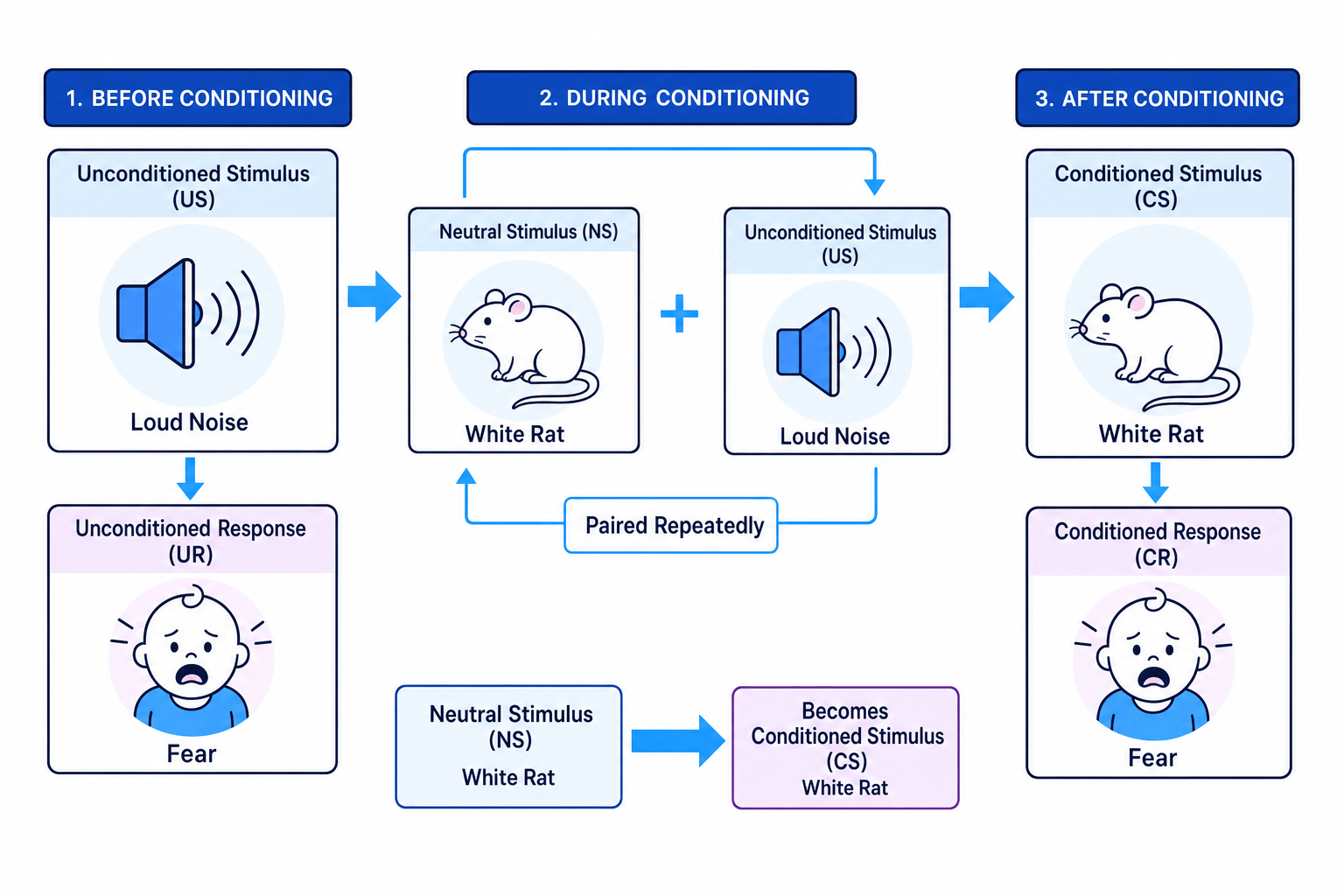
Classical conditioning is learning by association. A person learns to link two stimuli together, so that a stimulus that was once neutral begins to trigger a response.
This is why the classic behaviourist study by Watson and Rayner (1920) matters. In the “Little Albert” study, a young child learned to fear a white rat after the rat was repeatedly paired with a loud noise. It supports the idea that emotional responses such as fear can be learned.
Ethically, Watson and Rayner’s study is heavily criticised: Albert could not give informed consent, he was exposed to distress, the right to withdraw was unclear, and the fear was not properly deconditioned. Modern research must follow the BPS Code of Ethics and Conduct, including consent, right to withdraw, protection from harm, confidentiality and debriefing.
Mapping a learned fear
- The loud noise is the unconditioned stimulus because it naturally produces fear without learning.
- Albert’s fear response to the loud noise is the unconditioned response because it happens automatically.
- The white rat starts as a neutral stimulus because it does not originally produce fear.
- After repeated pairings, the white rat becomes a conditioned stimulus, producing a conditioned response of fear.
Therapy changes the association
Behaviourist therapies do not usually focus on hidden meanings or childhood conflicts. They aim to change the learned link between a stimulus and a response.
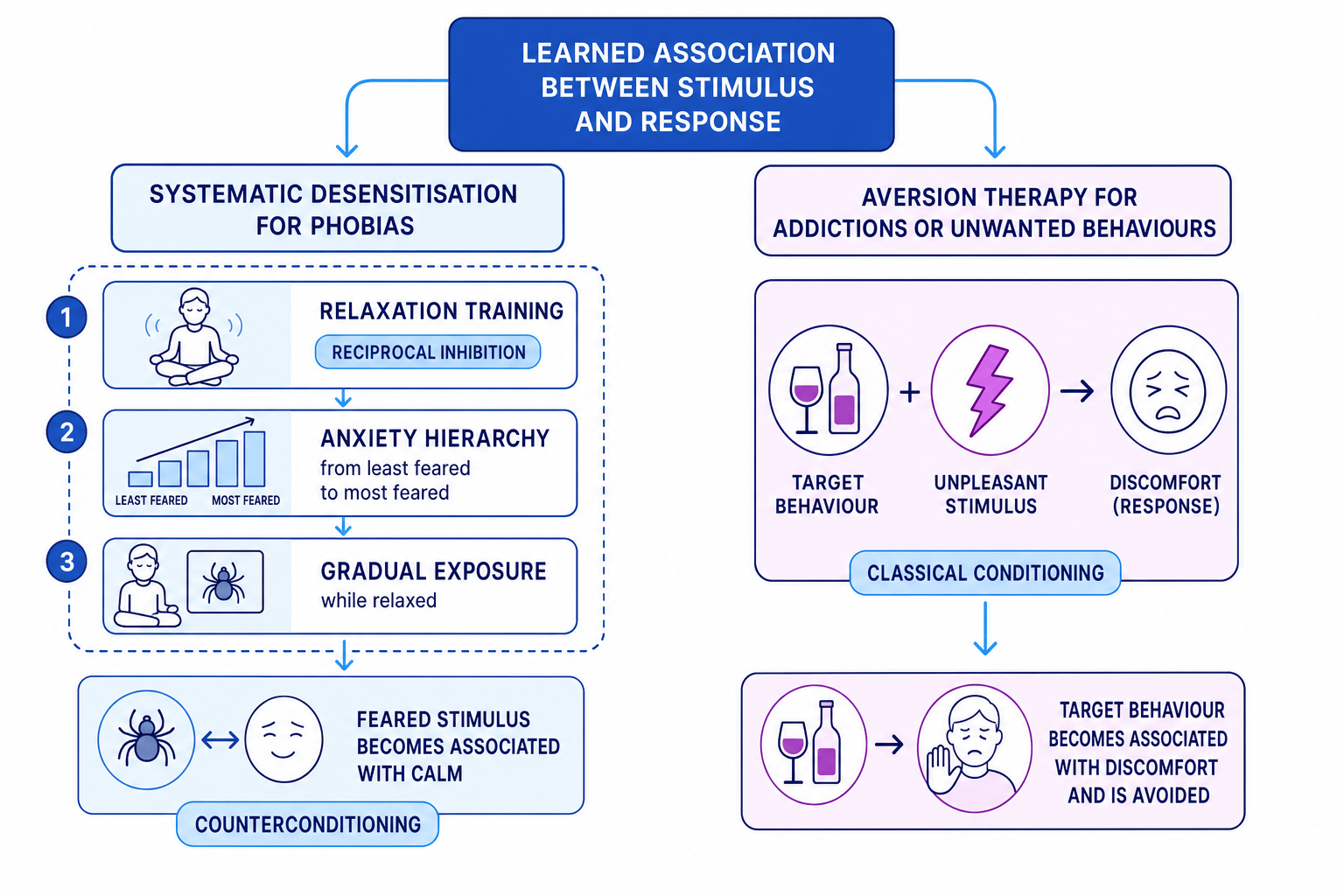
The same behaviourist logic can be used in two main therapy options: systematic desensitisation, usually for phobias, and aversion therapy, often for addictions or unwanted behaviours.
Eduqas choice
The Eduqas specification allows aversion therapy OR systematic desensitisation. Learn the therapy your class has chosen in depth. If a question asks for “one behaviourist therapy”, do not mix both as if they are the same treatment.
Systematic desensitisation
A phobia is an intense, persistent fear that leads to avoidance and distress. Systematic desensitisation is a behaviourist therapy for phobias, developed from the work of Joseph Wolpe (1958).
The therapy uses counterconditioning, which means replacing one learned response with a different learned response. In this case, the fear response is replaced with relaxation.
Reciprocal inhibition
Reciprocal inhibition is the idea that two opposite emotional states cannot be fully experienced at the same time. If you are deeply relaxed, it is harder to feel intense fear.
Stage 1: relaxation training
The therapist teaches the client relaxation techniques, such as controlled breathing or progressive muscle relaxation. This gives the client a calm response to use when facing feared stimuli.
Stage 2: anxiety hierarchy
An anxiety hierarchy is a ranked list of feared situations, from least frightening to most frightening. For a spider phobia, the hierarchy might begin with saying the word “spider” and end with holding a spider.
Stage 3: gradual exposure
The client is gradually exposed to each item on the hierarchy while practising relaxation. Exposure may be imaginal, meaning imagined, or in vivo, meaning in real life. The client only moves up the hierarchy when they can remain calm at the current level.
Creating an anxiety hierarchy
- A client with a dog phobia rates possible situations: looking at a cartoon dog as low anxiety, watching a dog through a window as moderate anxiety, and touching a dog as very high anxiety.
- The therapist orders these situations from least to most feared, so the client begins with a manageable stimulus rather than the most frightening one.
- The client practises relaxation while imagining or experiencing the first item until anxiety reduces.
- The therapist moves to the next item only when relaxation has become stronger than the fear response.
Systematic desensitisation is not flooding
Flooding exposes the client to the most feared situation immediately. Systematic desensitisation is gradual, controlled and paired with relaxation.
Aversion therapy
Aversion therapy aims to reduce an unwanted behaviour by pairing it with an unpleasant stimulus. It is often discussed in relation to addictions, such as alcohol dependence, or behaviours such as gambling.
An addiction is a pattern of compulsive behaviour that continues despite harm. In aversion therapy, the addictive substance or behaviour is repeatedly associated with discomfort, nausea, fear or disgust. The aim is for the person to develop an aversive response to the behaviour.
For example, alcohol may be paired with a drug that causes nausea. Over time, alcohol itself may trigger disgust or avoidance.
Pairing alcohol with nausea
- Before treatment, alcohol may be attractive or neutral to the client, while a nausea-producing drug naturally causes sickness.
- During treatment, alcohol is repeatedly paired with the nausea-producing drug, so the client experiences sickness in the presence of alcohol.
- After repeated pairings, alcohol becomes associated with nausea and disgust.
- The desired outcome is that the client avoids alcohol because it now triggers an unpleasant conditioned response.
Aversion therapy is not negative reinforcement
Do not say the unwanted behaviour increases because something unpleasant is removed. Aversion therapy is mainly about forming an unpleasant association so that the behaviour decreases.
AO3 evaluation: strengths and weaknesses
Strengths of systematic desensitisation
Systematic desensitisation has good practical value for phobias. Research such as Gilroy et al. (2003) found that people treated for spider phobia showed improvement compared with a relaxation-only control group, with benefits still seen at follow-up. This supports the therapy’s effectiveness and gives it real-world application.
It is also relatively ethical compared with more extreme exposure treatments because the client has control, moves gradually, and can stop. This helps meet BPS principles such as protection from harm and right to withdraw.
Weaknesses of systematic desensitisation
It may work best for specific phobias, such as fear of spiders or flying. It may be less effective for complex problems such as social anxiety, where thoughts, self-esteem and social experiences may also be important.
Some psychologists argue that not all fears are learned through simple association. Preparedness is the idea that humans may be biologically more ready to fear certain things, such as snakes or heights, because these were dangerous in evolutionary history.
Strengths of aversion therapy
Aversion therapy has a clear behavioural target and can be useful when a harmful behaviour needs to be reduced. Some research, such as Smith et al. (1991) on alcohol aversion therapy, suggests it can improve abstinence for some clients, especially when combined with wider support.
It also fits the behaviourist approach neatly because the method and outcome are observable: the therapist can measure whether the unwanted behaviour reduces.
Weaknesses of aversion therapy
Ethics are a major issue. Aversion therapy deliberately creates discomfort, so therapists must ensure informed consent, protection from harm, confidentiality, the right to withdraw and proper debriefing. It may be especially problematic with vulnerable clients or if the treatment is coercive.
The effects may also be temporary. A client might avoid the behaviour in therapy but relapse in a different environment. This is a problem of generalisation, where learning in one context does not fully transfer to other contexts.
Wider behaviourist evidence
The behaviourist approach is also supported by studies showing that behaviour can be shaped by the environment. For example, Becker et al. (2002) studied Fijian adolescent girls after the introduction of television and found changes in eating attitudes and behaviours, supporting the role of environmental models and learning.
This study is more relevant to social learning than therapy, but it still supports the wider behaviourist assumption that behaviour is influenced by external experience. Ethical issues include confidentiality, consent, and protection from harm because eating attitudes are a sensitive topic.
Some learning research has used non-human animals, such as Pavlov’s dogs or Skinner’s operant conditioning work. Modern animal research must be scientifically justified and follow welfare principles, including reducing the number of animals used, refining procedures to minimise suffering, and replacing animal use where possible.
AO2: applying this to scenarios and methods
If you are given a scenario, identify the behaviourist process clearly. For a phobia, look for a learned fear response and explain how systematic desensitisation would replace fear with relaxation. For an addiction, explain how aversion therapy would pair the target behaviour with an unpleasant response.
In Component 2, you might apply research methods to therapy evaluation. For example, a psychologist could measure anxiety scores before and after systematic desensitisation.
Choosing a test for therapy data
- If the same clients are measured before and after therapy, the design uses related data because each person provides two scores.
- If the anxiety scores are ordinal ratings, a Wilcoxon signed-ranks test would be suitable; if they are interval data and assumptions are met, a related t-test could be used.
- If two separate groups are compared, use Mann-Whitney U for ordinal data or an unrelated t-test for interval data.
- Use a default significance level of p≤0.05p \le 0.05p≤0.05, decide whether the hypothesis is one-tailed or two-tailed before analysing, and compare the observed value with the critical value using the correct table rule.
Other Eduqas tests include Spearman’s rho for correlations, chi-square for nominal frequency data, and the binomial sign test for related directional changes. For descriptive statistics, use medians and ranges for ordinal ratings, or means and standard deviations for interval scores. Bar charts, line graphs and scattergraphs may be useful depending on the data.
In the exam
- For AO1, describe the therapy as a sequence: learning principle, procedure, and intended behavioural change.
- For AO2, apply each stage directly to the scenario rather than writing a generic description.
- For AO3, balance effectiveness evidence with limitations such as ethics, relapse, generalisation, and whether the therapy fits the whole disorder.
Check yourself
- How does systematic desensitisation use counterconditioning and reciprocal inhibition?
- Why is aversion therapy ethically more controversial than systematic desensitisation?
- Which inferential test would you choose for before-and-after ordinal anxiety ratings?